


Best Practices
June 28, 2016
Two-thirds of concussions reported in Michigan high school football last fall occurred in games. Even though there are at least five times more hours of exposure during practices than games, there are half as many concussions during practice, according to the mandated concussion reporting requirement of the Michigan High School Athletic Association that is unmatched in the country in terms of its depth and breadth for a statewide requirement.
Michigan was among the handful of states to restrict contact in practice, in 2014, a full season prior to recommendations from the National Federation of State High School Associations and later action by most other statewide associations.
Some of those statewide organizations continue to operate without limitation on contact in football practices, while their counterpart organizations in other states have gone so far as to limit contact to a certain number of minutes in a day and/or week.
Entering mostly uncharted waters for high school football in early 2014, an MHSAA task force recommended that the number of practices be limited where collisions between players could occur – no more than one per day during preseason, no more than two per week after the first game.
This change was embraced by this state’s football coaches association and adopted by the MHSAA Representative Council. All parties liked the ease of administration of this policy, and all distrusted the idea of limiting the number of minutes of contact during practices.
If there is a 30-minute limit on contact in a day or a 90-minute limit on contact in a week, is it the same 30-minute or 90-minute period for all players, even if many are not involved in one or more of the contact drills? Or does the limit apply to each player individually; and if so, how is that tracked, and by whom?
These and other questions made coaches and administrators question how effective a limit on minutes might really be. Nevertheless, a 90-minute per week limit during regular season has been made an MHSAA recommendation for the 2016 season. This will provide an opportunity to address and possibly answer some of the questions that have been raised.
The MHSAA will survey schools this fall about their practice plans and the actual time spent in contact drills by players, assessing how that differs according to offense, defense, player position and grade in school, and determining best practices for how to track player contact minutes.
When Michigan acted in 2014 to limit contact in practice, it was one of the first states to do so. As Michigan takes additional steps to limit contact in practice, it will be one of the first states to do so after researching the best ways to actually do it.
Resilient Shelby Turning Struggles Into Strength During 1st Playoff Run in 12 years
By
Tom Kendra
Special for MHSAA.com
November 6, 2025
SHELBY – Not many football teams could sustain back-to-back heartbreaking losses to end the regular season – compounded with losing their senior starting quarterback to a broken hand during the first of those defeats – and still go on a playoff run.
 But not many football programs have endured half the adversity Shelby has over the past 10 years.
“Show me a place of struggle, and I’ll show you a place of strength,” said fifth-year Shelby coach Phil Fortier, who started as an assistant in 2009 at the Oceana County school, located near the towering Silver Lake Sand Dunes.
“We struggle with a lot of things here at Shelby, but there is a resilience. These kids don’t quit, and they are used to bouncing back.”
Shelby (6-4) shook off season-ending road losses at Mason County Central and Muskegon Orchard View with an impressive, 20-2 road victory at LeRoy Pine River in last weekend’s Division 7 District Semifinal – the school’s first playoff win in 12 years.
The Tigers will travel a little farther north this Friday to Harrison (8-2), seeking their first District championship since advancing to the Semifinals in 2012 and 2013.
What has transpired with Shelby football since that high-water mark is a case study in what can happen at a small, rural school when things start snowballing in the wrong direction. The Tigers have not won more than three games over the past 11 years, with five winless seasons.
 When Fortier stepped up to the head coaching job in 2021, he had his eyes on a dynamic group of middle schoolers who could turn things around.
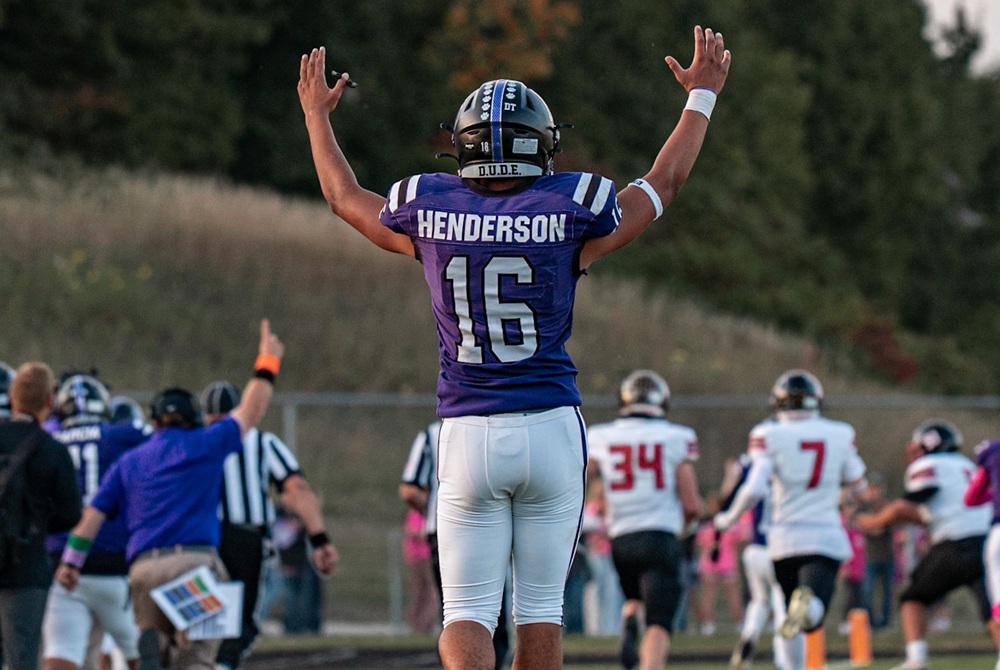
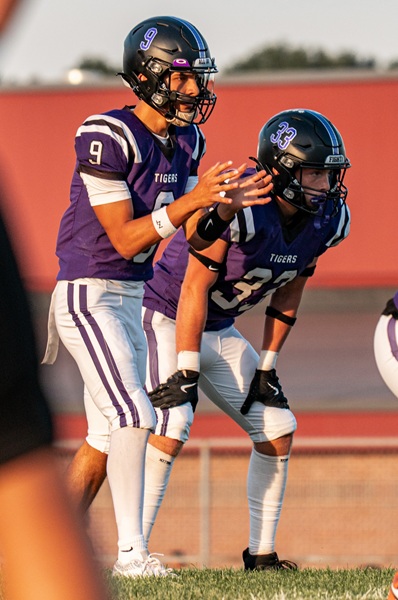
Among that special group are senior Isaac Garcia and junior Jaylin Henderson, who have led the Tigers’ turnaround season by sharing the crucial quarterback spot in the veer-option offense.
While a two-quarterback system is not unique, one that is split exactly 50-50 certainly is rare. Garcia and Henderson both have attempted 67 passes and completed 35 of them, with Henderson having a slight edge in passing yardage (624 to 620) and Garcia the edge in touchdown passes (6 to 4).
Garcia has leadership skills galore – he is the one his teammates look to in times of trouble, and he is also extremely accurate in the short-passing game.
Henderson, an MHSAA Individual Wrestling Finals qualifier last winter at 157 pounds, has athletic ability coming out of his ears, according to Fortier. He can throw a deadly deep ball on one play, then run over a linebacker on the next.
“I have been watching Tony Annese up at Ferris using all types of different quarterbacks in this offense,” said Fortier, who works closely with offensive coordinator Forrest Courtright. “Here we are with these two super-talented kids who bring different skills to the position, so why not use them both?”
In addition, Garcia was serving as a mentor for his talented, but younger, teammate.
“Isaac has really helped me a lot with my reads,” explained Henderson, who is second on the team with 95 carries for 617 yards and 10 touchdowns. “He gives me feedback and helps me to get better every week.”
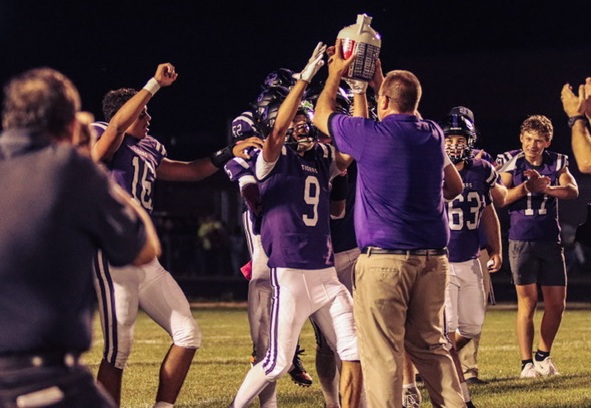
The system was working beautifully, as Shelby raced to a 5-2 start, highlighted by a 28-18 win over rival Hart and a 44-8 manhandling of Muskegon Catholic Central.
Then came the first half of the Week 8 game at Mason County Central, when Garcia’s right (throwing) hand got crunched against a helmet on a kickoff, resulting in a broken metacarpal bone.
Just like that, the training wheels were off for Henderson, who is now Shelby’s all-the-time QB and has responded with his legs against Orchard View (19 carries for 144 yards and two TDs) and his arm against Pine River (8-of-14 passing for 155 yards and one TD).
It helps that the Tigers have a pair of 6-3 wide receivers in Trevor Weiss and Evan Waller, dangerous slot receiver DayDay Garcia and the constant threat of junior fullback and leading rusher Brody Fessenden (140 carries for 786 yards and 11 TDs).
 “At this point in the season, our chemistry is really good,” said Henderson. “I trust all of our receivers. If I give them a chance, they will make the catch.”
Meanwhile, Garcia has been fitted with a club to protect his right hand and is back starting at safety, where he came up with a huge sack on third down and a pass deflection on fourth down to stop a late Pine River drive during last week’s playoff opener.
His return to the field has energized and motivated his teammates, who are watching their leader refuse to let even a broken throwing hand stop him in his senior year.
“At first, when the injury happened, I was very sad and depressed and didn’t want to leave my room,” said Garcia, a three-sport athlete who also competes in basketball and track.
“Then when they told me that I could play with a club, that brought my mood way up. It’s kind of like our team, we’re not gonna let anything stop us.”
 Tom Kendra worked 23 years at The Muskegon Chronicle, including five as assistant sports editor and the final six as sports editor through 2011. E-mail him at [email protected] with story ideas for Muskegon, Oceana, Mason, Lake, Oceola, Mecosta and Newaygo counties.
PHOTOS (Top) Jaylin Henderson celebrates a Shelby touchdown during the Tigers' 28-18 win over rival Hart in Week 3. (Middle) Isaac Garcia waits for the snap as running back Brody Fessenden stands ready. (Below) Garcia and coach Phil Fortier celebrate with the "Blood, Sweat & Tears" trophy after Shelby's win over Hart. (Photos courtesy of the Shelby football program.)