


Committees Fail Critical Issues
June 7, 2013
Typically, each sport committee meets once each year for three to five hours, during which time it considers proposals that come from schools, leagues and the state’s coaches association for the sport; and the proposals most often deal with allowing more regular-season events and more qualifiers to the MHSAA postseason tournament.
Occasionally there is a proposal that might improve sportsmanship. But much more often the proposals would increase conflicts between academics and athletics and/or strain overstressed local budgets. And almost never is there a proposal that would address the health and safety of participants (the Wrestling Committee has been an occasional exception and the Competitive Cheer Committee is a routine exception).
While coaches associations must shoulder some of the blame because they’ve brought MHSAA committees “trivial” topics, at least in comparison to the tougher health and safety topics, much of the cause of MHSAA committee ineffectiveness is that the committees don’t meet long enough or often enough to research serious problems and develop well-thought-out solutions. That is forgivable because it is difficult to get commitments from busy people all across Michigan to be absent from their regular jobs and travel dozens or even hundreds of miles, and to do so multiple times each year – which is what it takes to more fully understand complex problems and more carefully construct solutions. Meetings have to be few and they have to be efficient.
However, facing the worst publicity football has seen since the mid-1970s, we knew we had to supplement the football committee process. We did so by appointing a special Football Task Force of optimum size and experienced, representative makeup to meet on however many occasions are necessary during 2013 to accomplish three purposes:
- Review practice policies to improve acclimatization of players and reduce head trauma.
- Review competition rules to reduce head trauma and the frequency of the sport’s most injurious game situations.
- Develop promotions that extol the value of football to students, schools and communities and the safety record of school-based football.
The promotional efforts have begun to be rolled out; game rule modifications are being investigated; and four proposals for changing football practice policies have been prepared. They will be the topic of our next posting.
1st & Goal: Playoff Week 2 Preview
November 6, 2020
By Geoff Kimmerly
Second Half editor
The summery weather may make this weekend feel like mid-September in much of Michigan.
And this weekend certainly has the feeling of playoff football as we move to 256 teams in 11-player and 32 in 8, with matchups toughening and urgency rising.
Read on for a glance at 11-player District Semifinals and 8-player Regional Semifinals of particular note in each division. Spectator limits are again in effect (check with your local school for purchasing information), but there’s an opportunity to watch one or more of 53 games being broadcast on MHSAA.tv or FOX Sports Detroit.
Games below are Friday unless noted. Historical context is based in part on data at Michigan-football.com.
11-Player
Division 1
Grand Blanc (6-1) at Clarkston (7-0)
This will be the fourth playoff meeting of these teams over the last 11 seasons, and Grand Blanc is seeking its first win over the Wolves since 2010. The Bobcats’ offense is averaging nearly 40 points per game – and the key matchup will be how it contends with a Clarkston defense that hasn’t given up more than seven in a game in a month.
Keep an eye on these FRIDAY Hudsonville (5-2) at Rockford (5-0), Traverse City West (6-1) at Grandville (6-1), Howell (4-3) at White Lake Lakeland (6-0), Clinton Township Chippewa Valley (3-3) at Rochester Hills Stoney Creek (6-0).
Division 2
Grand Rapids Forest Hills Central (6-1) at Muskegon Mona Shores (7-0)
These two are meeting in the playoffs for the third time in four seasons – they didn’t see each other last year when Mona Shores made its run to the Division 2 championship. The Sailors haven’t slowed since, putting up nearly 48 points per game with their most impressive wins over Muskegon early and Detroit Martin Luther King two weeks ago. Forest Hills Central has allowed only one opponent to score more than 14 points – Byron Center, which handed the Rangers’ their lone defeat.
Keep an eye on these FRIDAY Battle Creek Lakeview (5-2) at Portage Northern (6-1), Midland Dow (5-2) at Midland (7-0), Birmingham Groves (4-3) at Birmingham Seaholm (5-2), Swartz Creek (5-2) at Traverse City Central (6-1).
Division 3
River Rouge (5-1) at Riverview (7-0)
The reigning champion Panthers are riding a four-shutout streak since an open date Week 6, but will get their strongest test since a Week 5 loss to East Lansing. The Riverview scoring machine over six games has put up just eight points fewer than it scored over 11 games in 2019. The Pirates are scoring 44.5 per game and have broken 40 in four straight.
Keep an eye on these FRIDAY Marysville (6-1) at Detroit Martin Luther King (4-3), Battle Creek Harper Creek (5-2) at St. Joseph (6-1). SATURDAY Cedar Springs (5-2) at Muskegon (6-1), Marquette (6-1) at Mount Pleasant (6-1).
Division 4
Croswell-Lexington (6-1) at North Branch (7-0)
These two decided the Blue Water Area Conference championship in Week 5, when the Broncos emerged with a 27-20 victory. Both won rematches by double digits last week, Croswell-Lexington over Imlay City and North Branch over Yale, and it’s fair to anticipate this rematch will be one of the headliners of this playoff round.
Keep an eye on these FRIDAY Paw Paw (5-2) at Hastings (6-1), Detroit Country Day (4-2) at Pontiac Notre Dame Prep (6-1), Goodrich (6-1) at Ortonville Brandon (6-1). SATURDAY Livonia Clarenceville (5-2) at Redford Union (6-1).
Division 5
Portland (6-1) at Grand Rapids West Catholic (6-1)
A strong playoff rivalry over the last decade will be renewed as these two meet in the postseason for the first time since 2017 and sixth time in 11 years. They’ve gotten here by similar roads this fall, both mostly dominating aside from lone losses to contenders in bigger divisions, Portland to Division 3 DeWitt and West Catholic to Division 4 Hudsonville Unity Christian.
Keep an eye on these FRIDAY Saginaw Swan Valley (4-3) at Essexville Garber (6-1), Belding (6-1) at Grand Rapids Catholic Central (6-0), Olivet (6-1) at Kalamazoo Hackett Catholic Prep (6-1), Almont (3-2) at Frankenmuth (7-0).
Division 6
Clare (7-0) at Montague (7-0), Saturday
Clare’s road has been one of the toughest from the start, even given last week’s score over another league champion. The Pioneers defeated Kent City 41-6 but now must travel to take on a Montague team that annually is in the title mix and missed out on Ford Field last year by a one-point Semifinal loss.
Keep an eye on these FRIDAY Boyne City (5-2) at Maple City Glen Lake (5-2), Adrian Madison (6-1) at Michigan Center (4-1), Erie Mason (7-0) at Clinton (6-1). SATURDAY Durand (5-2) at Detroit Edison (5-2).
Division 7
Sandusky (7-0) at Cass City (7-0)
These two have met the last two playoffs, Cass City winning by four points in 2018 and then 40 a year ago. This rematch should be much more like the first, in part because Sandusky’s defense is nearly matching its more impressive 2018 by giving up just under 14 points per game. Both also played Reese to nearly identical scores over the last two weeks (Cass City winning 36-26, Sandusky 36-28), perhaps a better indicator of how they might match up.
Keep an eye on these FRIDAY Oscoda (7-0) at Beaverton (6-1), Grass Lake (5-2) at Monroe St. Mary Catholic Central (5-2). SATURDAY Detroit Central (5-2) at Madison Heights Bishop Foley (6-1), Homer (5-2) at Lawton (6-1).
Division 8
Breckenridge (6-1) at Beal City (6-1)
Despite their proximity, these two haven’t met during the last five years of both being championship contenders. But they have taken similar paths to get here. The Huskies have gotten a good look at solid competition this fall, handing Carson City-Crystal its only loss and losing only to reigning Division 8 champion Reading. After losing to Reading in last year’s championship game, Beal City’s only defeat was by four this fall to still-undefeated McBain.
Keep an eye on these FRIDAY Unionville-Sebewaing (5-2) at Ubly (5-2), Mendon (6-1) at Reading (6-1), Royal Oak Shrine Catholic (5-2) at Auburn Hills Oakland Christian (6-1), Gwinn (4-3) at Iron Mountain (6-1).
8-Player
Division 1
Mayville (7-0) at Adrian Lenawee Christian (7-0)
Both are nearing relatively uncharted territory for their programs – in fact, Mayville has its most wins since 1987. This should be Lenawee Christian’s strongest challenge since handing Colon its only loss, 24-6 in Week 5. The Wildcats have been tested by tougher competition lately, but telling could be how both defeated International Academy of Flint by nearly identical scores over the last three weeks.
Keep an eye on these FRIDAY Indian River Inland Lakes (6-1) at Pellston (7-0), Whittemore-Prescott (5-2) at Suttons Bay (7-0), Mesick (5-2) at Gaylord St. Mary (6-1), Merrill (6-1) at Morrice (7-0).
Division 2
Rapid River (6-1) at Cedarville (6-1)
In Week 6, Cedarville broke a four-game losing streak against the Rockets with a 32-20 win. That was Rapid River’s only loss this season; Cedarville’s had come the week before to Division 1 contender (and last season’s Division 2 champion) Pickford. The key in this rematch could be the Trojans’ continuing defensive strength; they’ve kept four opponents to single digits and haven’t allowed more than 20 points this fall.
Keep an eye on these FRIDAY Bay City All Saints (4-2) at Mount Pleasant Sacred Heart (6-1). SATURDAY Brethren (5-2) at Hale (6-1), Peck (4-3) at Kinde North Huron (6-1), Lake Linden-Hubbell (4-3) at Powers North Central (7-0).
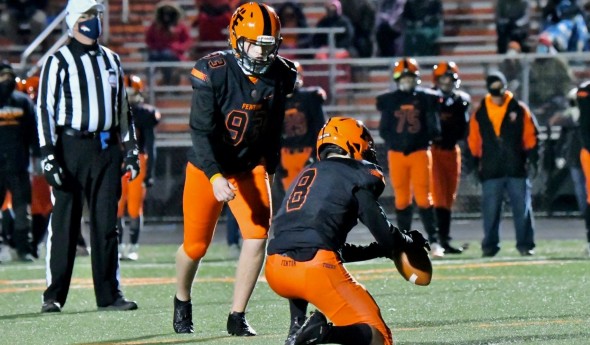
PHOTO: Fenton, here against Walled Lake Central last week, faces North Farmington tonight in a District Semifinal. (Photo by Terry Lyons.)