

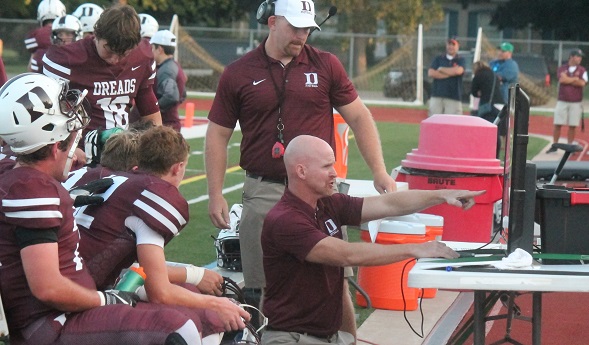
Dread Not: Jacobs Directing Dexter Rise
September 28, 2018
By Doug Donnelly
Special for Second Half
DEXTER – Dexter has long had outstanding football facilities, a large fan base and the support of school officials. What it hasn’t had in recent years is a winning football team.
 With each passing week, however, it looks like that is about the change.
The Dreadnaughts enter tonight’s game at Tecumseh with a 3-2 record and legitimate chance to make a run at the MHSAA football playoffs over the next few weeks. What’s remarkable is Dexter is seeking its first appearance in the tournament, which began in 1975.
“The previous coaches were good guys,” said superintendent Chris Timmis. “They tried hard to get things going. Sometimes it’s about timing.”
The timing right now has a lot to do with the arrival of head coach Phil Jacobs. The Adrian native spent nearly two decades on the Maples staff, including 11 seasons as head coach. He stepped down as the head coach after the 2014 season and spent two seasons as an assistant at Siena Heights University, before he was brought into the Dexter fold by Timmis, his former boss at Adrian.
“It took a lot of persuasion,” Timmis said.
Jacobs called it a “full-court press” to lure him back. Whatever it was, it looks like a successful move for Dexter.
“I was confident it would be,” Timmis said. “What I knew about Phil from when I was superintendent and principal at Adrian was he is a fantastic teacher. When we were working on a lot of academic improvement, Phil had a model classroom. I knew what he could bring to us was a lot more than just a football coach.”
Dexter was looking to hire a football coach a couple of years ago when Timmis made a short list of coaches from across the state that had rebuilt programs. Jacobs was on the list but wasn’t interested in coaching himself. Dexter made a hire, but it was short-lived. That coach left after only a short time on the job.
 Timmis called up Jacobs.
“I told him I wanted to talk to him again,” he said. “I think it was meant to be.”
Jacobs came on board in late April and started working with the Dreadnaughts players, getting them into the weight room in particular. Dexter went 0-9 in 2017, but as the season went on, Jacobs and others saw progress.
“He was putting the pieces together,” Timmis said.
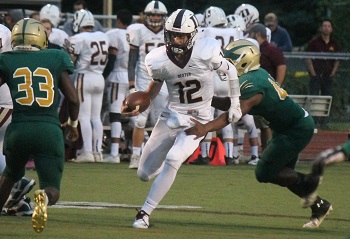
Dexter began this season with a 41-game losing streak and lost the season opener. In Week 2, however, Dexter pulled out a 36-22 win over Ypsilanti Community to break the streak. The next week the Dreadnaughts won again, this time a 37-14 win over Ann Arbor Huron. In Week 5, they topped Adrian, 42-30, as junior receiver Antwan Ficklen caught six passes for 177 yards and three touchdowns to lead Dexter to the win. Sophomore quarterback Colin Parachek threw for more than 300 yards and ran for a couple of touchdowns.
The Dreadnaughts aren’t just winning – they are exciting. Through five games, Dexter is averaging 30.8 points per game.
That Adrian win leaves Dexter with regular-season games against Tecumseh (2-3), Pinckney (1-4), Ypsilanti Lincoln (4-1) and Whitehall (3-2). Win three, and the team is automatically in the playoffs.
Jacobs points to three differences with this season’s Dexter team. For one, the players’ commitment to the weight room is paying off.
“We are stronger. With strength comes confidence,” Jacobs said. “We are nowhere near where we want to be or can be, but we are headed in the right direction.”
 Another difference is the players’ football knowledge is growing. With each week of practice, each week of repetition, Jacobs said the players are learning more about the game.
“Our football I.Q. is so much better than last year,” Jacobs said. “Last year, we were yelling things from the sidelines on every play, ‘get here,’ ‘get there.’ This year, we aren’t doing that as much. Our kids are learning. They speak our terms now.”
Lastly, Jacobs said having enough numbers so that his players are starting on only one side of the ball has paid huge dividends.
“In the third and fourth quarters, they are fresh,” he said. “They are learning one position. Plus, when you get your athletes playing on only one side of the ball, it frees them up to play special teams. You find creative ways to get your best kids on the field.”
Dexter’s most recent winning season was a 5-4 finish in 2010. The Dreadnaughts have had two winning seasons total during their players’ lifetimes.
“It’s great to see the kids believe in themselves,” Timmis said. “The whole community is feeling it right now.”
Dexter athletic director Mike Bavineau said the school and community are excited about the football team. There’s a buzz in the halls and at the Dexter field on Friday nights.
“The kids are excited, everyone is excited,” he said. “When you can win a little bit, it breeds confidence.”
 Doug Donnelly has served as a sports and news reporter and city editor over 25 years, writing for the Daily Chief-Union in Upper Sandusky, Ohio from 1992-1995, the Monroe Evening News from 1995-2012 and the Adrian Daily Telegram since 2013. He's also written a book on high school basketball in Monroe County and compiles record books for various schools in southeast Michigan. E-mail him at [email protected] with story ideas for Jackson, Washtenaw, Hillsdale, Lenawee and Monroe counties.
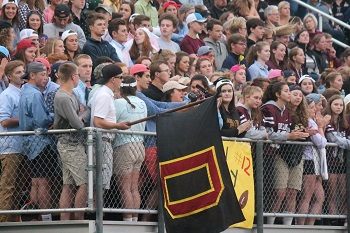
PHOTOS: (Top) Dexter coach Phil Jacobs gives his players some pointers on the sideline. (Middle) Quarterback Colin Parachek works to elude a pair of Ann Arbor Huron defenders. (Below) Students fill the stands to support the Dreadnaughts. (Photos by Terry Jacoby.)
Western's White Enjoys 'Special' Career
By
Tom Markowski
Special for Second Half
May 4, 2016
WALLED LAKE – Seeking a higher level of performance, many high school athletes have channeled their energy to one sport.
 Many refer to this concentration as specialization – and Cody White, for one, isn’t buying it.
White, a junior at Walled Lake Western, is a three-sport athlete and he loves every minute of it. He plays basketball during the winter, baseball in the spring and football in the fall. During the summer he competes in AAU basketball, travel baseball, 7-on-7 football games with his Western teammates, and he participates in a few summer football camps.
White has played these same sports all throughout high school. His freshman year he competed in track and field, along with baseball. White hasn’t ruled out returning to track and field, in addition to baseball, as a senior – but this season he’s sticking with just baseball.
It’s a hectic schedule but, again, White wouldn’t have it any other way.
“I couldn’t see myself not competing in those sports,” he said. “I love them so much. I want to finish my senior year playing all three.”
White estimates that he’ll have two days off, away from sports, in June. In July he’ll take a week off, between his summer baseball team schedule ending and the start of football practice.
There’s no question White is driven, but it’s more than that. In some high schools, and with some coaches, playing multiple sports can be a challenge. There are some coaches who would prefer the students to play one sport and only one sport.
According to Western football coach Mike Zdebski, that isn’t the case at his school.
“We encourage them to play more than one sport,” Zdebski said. “For one, we want them to get their money’s worth. We have a pay-to-play policy of $425. You play one sport and it costs $425. You play three sports and it costs the same. And, two, playing other sports helps them develop other skills. In basketball you create space. In baseball you chase fly balls, and that helps with depth perception. Besides you get to work with other coaches and other teams.
“We’re lifting weights during the summer. If a kid is playing summer baseball or AAU basketball, if they have time they can come by and lift weights. And what we always tell them, if you’re tired let us know. You can take a break.”
Zdebski – whose team finished 12-1 last fall – was quick to point out some excellent athletes in the past, like former Kansas City Royals outfielder/Oakland Raiders running back Bo Jackson, who were multiple-sport athletes. And, more recently, there’s Luke Glendenning of the Detroit Red Wings. Glendenning was an all-state running back at East Grand Rapids.
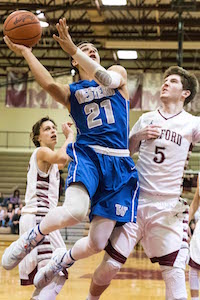 When his high school career is done, White will play football in college. Two months ago he committed to sign with Michigan State this winter. At 6-foot-3 and 200 pounds, White played receiver, defensive back and also returned kicks last fall. He played a big role in Western’s run to the Division 2 Semifinals.
During baseball season, White pitches and plays middle infield and right field. He plays the wing and shooting guard in basketball.
His interest in playing a variety of sports came at an early age and, as is the case with most children, a family member was the one who introduced White to athletics. Former NFL player and Detroit Lions executive Sheldon White is his father, but the first sport White played, at age 3, was baseball. Two years later he began playing football and basketball.
Sheldon White also played three sports at his high school in Dayton, Ohio, (Meadowdale High) and helps his son manage his busy schedule, particularly during the offseason.
“Growing up was a little different (for me) than the usual kid,” Cody White said. “Going to Lions games and just being around football all the time. I think I love the game more because I was around it so much.
“But I think playing three sports helped me, too. The twisting of your hips in baseball, when you swing the bat, you’re using different muscles. And all the jumping you do in basketball. You have to move in tight spaces.
“With football, you’re with the football guys. By doing all three you meet different people.”
Playing multiple sports has definitely been the right road for White to follow. And his busy schedule hasn’t hindered his work in the classroom.
White has a 3.54 grade-point average pending his grades for this semester.
 Tom Markowski is a columnist and directs website coverage for the State Champs! Sports Network. He previously covered primarily high school sports for the The Detroit News from 1984-2014, focusing on the Detroit area and contributing to statewide coverage of football and basketball. Contact him at [email protected] with story ideas for Oakland, Macomb and Wayne counties.
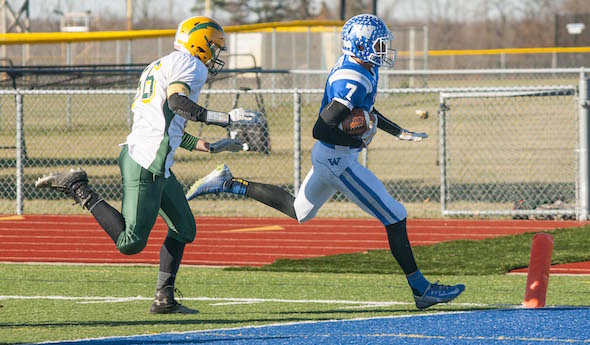
PHOTOS: (Top) Cody White (right) runs away from a Midland Dow defender during their Regional Final this fall. (Middle) White works for a shot against Milford. (Photos by Teresa Presty.)