

Drive for Detroit: 11-Player Finals Preview
November 20, 2018
By Geoff Kimmerly
Second Half editor
A very recognizable 27 football programs have combined to win the 56 MHSAA 11-Player championships contested so far this decade.
 Perhaps that’s the best way to illustrate the anticipation surrounding this weekend’s Finals, kicking off Friday morning and concluding Saturday evening at Ford Field.
Back will be reigning champions Clarkston in Division 1, Warren DeLaSalle in Division 2, Muskegon in Division 3 and Jackson Lumen Christi in Division 6. But we are guaranteed two first-time champions, and could finish with up to five.
Joining the final weekend march for the first time will be Hudsonville Unity Christian in Division 5, and both Division 8 finalists Breckenridge and Reading. Edwardsburg played at Ford Field last season for the first time, but will return seeking its first MHSAA title in this sport – as will other past runners-up Muskegon Mona Shores, Chelsea and Madison Heights Madison.
Clinton Township Chippewa Valley, Montague and New Lothrop are past champions but returning to the Finals for the first time in a decade or longer. Detroit Martin Luther King and Portland are only a few seasons removed from their last trips to Ford Field and back hoping to add to their title legacies.
See below for a look at all of the finalists taking the field, powered by MI Student Aid. Tickets cost $10 and are good for all four games on one day; only cash will be accepted at the door. Click for a full schedule. Also, for the first time, Ford Field will host a pair of Special Olympics Unified flag football games prior to the start of Saturday’s four 11-Player Finals. Teams from Brighton, Holt, Mason and Sparta will take the field at 9:40 and play 20-minute exhibitions. Unified Sports programs combine students with and without intellectual disabilities on competitive athletic teams.
The first two Friday and Saturday Finals will be broadcast live on FOX Sports Detroit’s primary and PLUS channels (check cable/satellite box listings for your specific channel) with the third and fourth games both days available live on FOX Sports Detroit PLUS only. All eight games also can be viewed live on FOXSportsDetroit.com and on the FOX Sports app. Games will be archived for on-demand viewing on MHSAA.tv, which also will live stream the first three postgame press conferences each day. Audio broadcasts will be available on the MHSAA Network website live both days.
Rankings below were voted on by The Associated Press’ media panel – teams that were ranked in different divisions for the regular season are noted. Statistics are current.
 Division 1
CLINTON TOWNSHIP CHIPPEWA VALLEY
Record: 13-0, No. 2
Coach: Scott Merchant, 10th season (68-38)
League finish: First in Macomb Area Conference Red
Championship history: Division 2 champion 2001.
Best wins: 28-16 over No. 3 Belleville in Semifinal, 42-7 over No. 6 Dearborn Fordson in Regional Final, 51-10 (District Final) and 24-17 over honorable mention Macomb Dakota, 31-26 over No. 5 Saline.
Players to watch: WR/DB David Ellis, 6-0/195 sr. (630 yards/9 TDs receiving, 3 TDs kick return, 1 TD punt return); RB/DB Andre Chenault, 5-7/195 sr. (1,030 yards/14 TDs rushing); QB Tommy Schuster, 6-0/185 sr. (1,653 yards/24 TDs passing); TE/LB Marcel Lewis, 6-1/220 sr. (4 TDs receiving).
Outlook: Chippewa Valley has been building toward this, with a 10-win season and District title a year ago followed by this fall’s perfect run through one of the most competitive leagues in the state. Lewis – committed to Michigan State – was an all-state linebacker last season and leads a defense that held powerful Belleville last week to its fewest points in two years. Schuster was an honorable mention all-state quarterback in 2017 and has led the offense to a program-record 515 points, spreading the ball to a number of playmakers. Ellis will sign with Indiana University and running back/defensive back Ja’Von Kimpson (11 rushing touchdowns) is committed to Miami (Ohio).
CLARKSTON
Record: 11-2, No. 8
Coach: Kurt Richardson, 32nd season (254-88)
League finish: First in Oakland Activities Association Red
Championship history: Three MHSAA titles (most recent 2017).
Best wins: 21-3 over No. 5 Saline in Semifinal, 13-0 over No. 7 Lapeer in Regional Final, 28-25 over No. 10 West Bloomfield.
Players to watch: QB Jake Jensen, 6-3/180 sr. (1,101 yards/9 TDs passing, 371 yards/9 TDs rushing); RB/LB Jacob Honstetter, 5-11/190 sr. (770 yards/10 TDs rushing; 67 tackles); WR/LB Max Nicklin, 6-2/190 sr. (92 tackles); OL/DL Rocco Spindler, 6-5/270 soph. (82 tackles).
Outlook: The Wolves are seeking their fourth Division 1 championship in seven years, bolstered by a defense giving up 11 points per game – and only four per game during the playoffs. Senior linebacker Brendan Baker and senior defensive backs Keagan King and Josh Luther are among other playmakers leading a veteran group on that side of the ball. Spindler, just a sophomore, is considered among the state’s best in his class (and is the son of former Detroit Lions lineman Marc Spindler). The offense doesn’t have anyone with extraordinary numbers but does its part. Senior running back Jake Billette is the leading rusher with 784 yards, plus five touchdowns on the ground. Clarkston’s two losses, to Oxford and Oak Park, were by a combined 10 points.
 Division 2
MUSKEGON MONA SHORES
Record: 12-1, No. 1
Coach: Matt Koziak, eighth season (60-26)
League finish: Second in Ottawa-Kent Conference Black
Championship history: Division 2 runner-up 2014
Best wins: 49-10 (District Final) and 49-42 over Jenison, 48-38 over Division 1 No. 4 East Kentwood, 33-14 over Rockford.
Players to watch: RB/LB Sincer’e Dent, 5-11/217 sr. (1,350 yards, 24 TDs rushing); QB Caden Broersma, 6-3/206 jr. (1,915 yards/19 TDs passing, 1,086 yards/18 TDs rushing); WR/DB James Gilbert, 6-2/179 sr. (1,466 yards/15 TDs receiving); TE/LB Jacob Wahlberg, 6-4/222 sr.
Outlook: Mona Shores has won its last three playoff games all by at least 21 points, and its only loss was to Division 3 finalist Muskegon in Week 8 in one of the Big Reds’ closest games this season. It’s all even more impressive considering the Sailors lost one of the state’s top playmakers in senior receiver Damari Roberson to an injury before the season started. But Gilbert has filled in to an elite degree as the main pass catcher, keeping some attention off Dent, two-way threat Broersma and junior Tre’shawn Hatcher, who has run for more than 700 yards and nine scores. Roberson and Wahlberg both have committed to Western Michigan.
WARREN DELASALLE
Record: 11-2, No. 4
Coach: Mike Giannone, third season (27-9)
League finish: Tied for first in Detroit Catholic League Central
Championship history: Division 2 champions 2014 and 2017, runners-up 2006 and 2008.
Best wins: 35-7 over No. 2 Oak Park in District Final, 21-3 over No. 7 Port Huron Northern in Regional Final, 28-0 over No. 9 Birmingham Groves in Semifinal, 26-10 over honorable mention Warren Mott in Pre-District, 24-6 over Division 1 honorable mention Detroit Catholic Central.
Players to watch: WR/DB Joshua DeBerry, 6-1/175 sr. (701 yards/9 TDs receiving; 43 tackles/5 interceptions); RB/DB Evan Vaillancourt, 5-10/205 sr. (646 yards/14 TDs rushing); RB/LB Jacob Dobbs, 6-1/215, sr. (85 tackles/4 forced fumbles); OL/DL Daniel Motowski, 6-4/270 sr.
Outlook: DeLaSalle is seeking its third championship in five seasons with a group that may not have any individuals who stick out statistically, but just keeps winning. The Pilots gave Muskegon a 15-point game in Week 1 and didn’t lose again until falling to Detroit Catholic Central by three in Week 8 – and they avenged that loss a week later in the Catholic League A-B championship game. DeBerry and Dobbs earned all-state honorable mentions last season; Dobbs is committed to Holy Cross and Motowski to Central Michigan University. Senior quarterback Nolan Schultz has completed an efficient 59 percent of his passes for 719 yards and six touchdowns and run for 10 scores.
Division 3
MUSKEGON
Record: 13-0, No. 1
Coach: Shane Fairfield, ninth season (100-18)
League finish: First in O-K Black
Championship history: Six MHSAA titles (most recent 2017), four runner-up finishes.
Best wins: 45-22 over No. 5 Zeeland East in Semifinal, 34-18 over No. 7 Cedar Springs in Regional Final, 55-35 over Division 2 No. 1 Muskegon Mona Shores, 24-21 over Detroit Martin Luther King (No. 3 Division 2 poll), 36-21 over Division 2 No. 4 Warren DeLaSalle.
Players to watch: RB/DB Jeremiah Lockhart, 5-10/200 sr. (1,157 yards/15 TDs); QB/DB Cameron Martinez, 5-11/190 jr. (2,316 yards/36 TDs, 632 yards/11 TDs passing); RB/LB Ali’vonta Wallace 6-0/230 sr.; OL/DL Anthony Bradford, 6-5/360 sr.
Outlook: If any team in the state has been a favorite from the first day of practice in August, it’s been Muskegon. Martinez has gone from great prospect as an underclassman to arguably the most intriguing standout in the state, while Bradford leads a starting offensive line that averages 6-foot-2 and 305 pounds. The Big Reds got a scare early from King and another in a seven-point Pre-District win over East Grand Rapids, but are the only team with wins over three other finalists playing this weekend. Bradford earned an all-state honorable mention last season and will continue his career at Louisiana State University. Senior back Demario Robinson also has run for more than 700 yards and eight touchdowns this fall; he was averaging 13.5 yards per carry entering the Semifinal as all four of the team’s top rushers were gaining 10 or more yards per carry.
DETROIT MARTIN LUTHER KING
Record: 11-2 (No. 3 in Division 2 poll)
Coach: Tyrone Spencer, third season (34-6)
League finish: First in Detroit Public School League Black
Championship history: Three MHSAA titles (most recent 2016), two runner-up finishes.
Best wins: 34-21 over No. 2 DeWitt in Semifinal, 7-6 over No. 3 River Rouge in Pre-District, 34-14 over No. 9 Warren Woods Tower in District Final, 52-38 over East St. Louis (Ill.).
Players to watch: QB Dequan Finn, 6-1/190 sr. (1,189 yards/20 TDs rushing, 1,936 yards/22 TDs passing); RB Peny Boone 6-1/215 jr. (826 yards/13 TDs rushing); LB Marvin Grant, 6-2/195 sr.; DB Ahmad Gardner, 6-2/160 sr.
Outlook: After winning Division 2 titles in 2015 and 2016, King fell just short of another Finals appearance last fall losing to eventual champion DeLaSalle by a point in a Semifinal. Moving into Division 3 for these playoffs, King navigated a loaded bracket with Finn growing his reputation as one of the state’s most dynamic quarterbacks. Grant – who has committed to Purdue – made the all-state team in Division 2 last season, and Finn earned an honorable mention. Finn will sign with CMU as will receiver Darrell Wyatt, while Gardner is committed to Cincinnati, flanker Jalen McGaughy to Northern Illinois, linebacker Rich Miller to Buffalo, senior safety Ray Williams to Youngstown State and senior offensive tackle DeShawn Ingram to Howard.
 Division 4
EDWARDSBURG
Record: 13-0, No. 1
Coach: Kevin Bartz, 24th season (172-74)
League finish: First in Wolverine Conference
Championship history: Division 4 runner-up 2017.
Best wins: 46-44 (OT) over No. 2 Grand Rapids Catholic Central in Semifinal, 38-15 over No. 5 Three Rivers, 56-21 over Holland Christian in Regional Final.
Players to watch: RB/DB Chase Goggins, 5-8/155 sr. (1,355 yards/23 TDs rushing, 344 yards/4 TDs receiving); RB/LB Chase Sager, 6-1/195 sr. (916 yards/17 TDs rushing; 56 tackles/11 tackles for loss); RB/LB Isaiah Mitchell, 5-10/205 sr. (771 yards/15 TDs rushing); QB/DB Tre’ Harvey, 6-1/190 sr. (624 yards/9 TDs passing, 534 yards/7 TDs rushing).
Outlook: Edwardsburg made its first trip to Ford Field last season, and after an 11-point loss to GRCC in the Final came back to avenge that defeat last weekend. A first championship this weekend would top a 58-6 run over the last five seasons where all but two of those defeats have come during the playoffs. Sager was one of the team’s leading rushers in last season’s Final, when Mitchell, Goggins and Harvey all also saw time. Sophomore Drew Bidwell (72 tackles) and senior Dylan McColley (68) team with Sager for a strong linebacker group that’s helped the team give up only 10 points per game.
CHELSEA
Record: 10-3, unranked
Coach: Josh Lucas, first season (10-3)
League finish: Third in Southeastern Conference White
Championship history: Division 3 runner-up 2015.
Best wins: 38-13 over No. 8 Williamston in Semifinal, 21-14 over Farmington Hills Harrison in Regional Final, 35-14 over honorable mention Milan in District Final, 28-21 over No. 3 Grosse Ile in Pre-District.
Players to watch: RB Aaron McDaniels, 5-9/175 sr. (992 yards/17 TDs rushing); WR/DB Hunter Neff, 6-4/210 sr. (1,097 yards/16 TDs receiving); QB Quinn Starkey, 6-3/180 sr. (2,268 yards/25 TDs passing); TE/DE Nick Christian, 6-5/210 sr. (477 yards/4 TDs receiving).
Outlook: Chelsea has made one of the most impressive climbs over the last month after finishing third in its league and then losing at 3-6 Alpena in Week 9. The Bulldogs have cut a touchdown off their defensive points-allowed average during the playoffs, giving up 15.5 over the last four games. The offense has remained steady, meanwhile, even as Chelsea has faced and eliminated two league champions during this postseason. Lucas formerly led the varsity for three seasons at Allegan after five as an assistant at Zeeland East.
 Division 5
PORTLAND
Record: 13-0, No. 2
Coach: John Novara, 20th season (145-63)
League finish: First in Capital Area Activities Conference White
Championship history: Division 5 champion 2012.
Best wins: 17-13 (District Final) and 16-8 over No. 5 Lansing Catholic, 40-6 over Frankenmuth in Regional Final, 35-14 over Marine City in Semifinal, 27-20 over No. 9 Montague (moved to Division 6 for playoffs).
Players to watch: RB/DB Jacob Veale, 5-10/165 sr. (1,662 yards/26 TDs rushing); QB/DE Owen Russell, 6-4/195 jr. (559 yards/8 TDs passing); OL/DE Matthew Koster, 6-0/205, sr.; OL/DE Jacob Hickling, 6-3/215 sr.
Outlook: Despite its 2012 championship, Portland remains something of an under-the-radar power statewide. But the Raiders have won at least 10 games four straight seasons and had only four single-digit victories this fall, with the rest by at least 14 points. What’s not a secret is how Portland succeeds – the Raiders went over 3,000 rushing yards for the season last week, and defensively they’re giving up an average of 165 yards and eight points per game. Senior tackle Hunter Klein (6-7, 315 pounds) is among those leading the way for Veale.
HUDSONVILLE UNITY CHRISTIAN
Record: 11-2 (No. 10 in Division 4 poll)
Coach: Craig Tibbe, 16th season (84-79)
League finish: Third in O-K Green
Championship history: Has never played in an MHSAA Final.
Best wins: 14-7 over No. 1 Saginaw Swan Valley in Semifinal, 39-14 over No. 4 Kalamazoo United in Regional Final, 40-37 over No. 6 Muskegon Oakridge in District Final, 41-22 over Grand Rapids West Catholic in Pre-District.
Players to watch: RB/LB Hayden Large, 6-2/185, jr. (1,205 yards/12 TDs); RB/DB Malekhi Obande, 5-8/155, soph. (866 yards/7 TDs); QB/DB Isaac TeSlaa, 6-3/180 jr. (490 yards/11 TDs rushing, 468 yards/3 TDs passing); RB/DL Max Buikema, 5-10/190 sr. (781 yards/13 TDs rushing).
Outlook: Unity Christian will play in its first football championship game to conclude one of the most impressive playoff runs in any division this fall. The Crusaders opened by eliminating five-time reigning champion West Catholic before taking down three ranked teams – last week setting a program record for wins in the process of eliminating last season’s runner-up Swan Valley. And that was after navigating a league that saw four of seven teams make the playoffs, three win District titles and Zeeland East also advance to the Semifinals. Unity has run for 3,942 yards – or 87 percent of its offense this season – and Obande and Buikema have combined for 30 2-point conversions.
 Division 6
JACKSON LUMEN CHRISTI
Record: 12-0, No. 1
Coach: Herb Brogan, 39th season (366-83)
League finish: First in Interstate 8 Athletic Conference
Championship history: 10 MHSAA titles (most recent 2017), two runner-up finishes.
Best wins: 42-20 over Montrose in Semifinal, 41-14 over Michigan Center in District Final, 34-12 over Grand Rapids West Catholic, 34-7 over Division 3 honorable mention Parma Western.
Players to watch: RB/LB Nick Thomas, 6-0/205 sr. (1,690 yards/30 TDs rushing); QB Joe Barrett, 6-2/195 sr. (1,180 yards/11 TDs passing); TE/DE Dayton Keller, 6-4/240 sr. (591 yards/2 TDs receiving); OL/DL Keegan Smith 6-3/285 jr.
Outlook: Lumen Christi has yet to have a game closer than 15 points as it marches for a third straight Division 6 title. The Titans have won all four of their playoff games by at least 22 points and are giving up nine per game for the season, with only two of 12 opponents scoring more than 14 (Lumen played 12 games, with an open date Week 9). Senior Cy’Aire Johnson is another exciting player to watch; he starts at defensive back but also is second on the team with nine touchdowns – five receiving and four rushing. Keller earned an all-state honorable mention in 2017.
MONTAGUE
Record: 11-2 (No. 9 in Division 5 poll)
Coach: Pat Collins, 15th season (137-41)
League finish: First in West Michigan Conference
Championship history: Division 6 champion 2009 and 2008, Class CC runner-up 1992.
Best wins: 14-7 over No. 2 Traverse City St. Francis in Semifinal, 30-14 over No. 9 Schoolcraft in Regional Final, 25-24 over Division 5 No. 6 Muskegon Oakridge.
Players to watch: RB/SS Bryce Stark, 5-10/191 sr. (1,579 yards/25 TDs rushing; 61 tackles); QB/SS Drew Collins, 6-2/190 soph. (1,805 yards/16 TDs passing, 417 yards/7 TDs rushing); WR/CB Kenyan Johnston, 5-11/165 sr. (808 yards/8 TDs receiving, 3 TDs rushing; 4 interceptions); OT/DL Luke Marsh, 6-5/290 sr. (77 tackles)
Outlook: Montague made its first Final since the 2009 championship run and has seen its share of tough competition. In addition to the wins above, the Wildcats also took losses to Division 5 finalist Portland and another Division 5 District winner, Reed City. Stark and Marsh made the all-state team last season as juniors, when Montague’s only defeat came in the Regional Final. Two juniors play big defensive roles this time; defensive back Brennan Schwarz leads with 121 tackles plus three interceptions, and linebacker Mark Vanderleest is second on the team with 86 tackles.
 Division 7
MADISON HEIGHTS MADISON
Record: 13-0, Tied for No. 3
Coach: James Rogers, third season (31-5)
League finish: First in MAC Silver
Championship history: Division 5 runner-up 2006.
Best wins: 37-34 over No. 7 Cassopolis in Semifinal, 38-0 over No. 10 Detroit Loyola in District Final, 20-7 over Division 4 No. 9 St. Clair, 28-6 over Farmington.
Players to watch: QB/DB Austin Brown, 6-1/190 sr. (2,060 yards/22 TDs passing, 1,831 yards/33 TDs rushing); RB/LB Khyron Franklin, 5-9/185 sr. (1,121 yards/8 TDs rushing); WR/DB Troye Williams, 5-11/185 soph. (689 yards/7 TDs receiving); OL/LB Adam Long, 5-10/190 jr. (181 tackles, 2 forced fumbles)
Outlook: Madison had made its share of playoff runs since it’s last trip to the Finals, missing last year’s championship game with a 14-7 loss to Saugatuck in the Semifinals. They’ve taken the next step with elite play on both sides of the ball, and with most of its regular-season schedule against much larger opponents. The defense is giving up 11 points per game and has an incredible 81 sacks, with seniors Chauncey Earnest (18 sacks), Caelon Eason and Kaylen Jackson (both 14) and junior Aaron McClure (6) bringing the heat up front. Brown has thrown for a combined 4,732 yards and 54 touchdowns and run for a combined 2,225 yards and 41 scores over the last two seasons. He has a big target in 6-4 junior Isaiah Pollard, who has 11 touchdowns on 21 catches.
NEW LOTHROP
Record: 12-1, No. 2
Coach: Clint Galvas, 10th season (105-14)
League finish: First in Mid-Michigan Activities Conference
Championship history: Division 8 champion 2006.
Best wins: 51-22 over Lake City in Semifinal (No. 4 Division 6 poll), 26-14 over No. 1 Pewamo-Westphalia in Regional Final, 51-12 over Montrose.
Players to watch: QB/DB Avery Moore, 6-2/210 jr. (1,533 yards/22 TDs rushing, 1,578 yards/20 TDs passing); RB/LB Will Muron, 5-9/180 soph. (669 yards/10 TDs rushing, 1 TD punt return); WR/DB Aidan Harrison, 6-3/190 sr. (673 yards/14 TDs rushing, 20 TDs receiving, 1 TD kickoff return); OL/DL Garrett Birchmeier, 6-3/250 sr.
Outlook: Perhaps no team statewide has been on the verge of getting back to the Finals more than New Lothrop, which improved last week to 98-10 over the last nine seasons but had three Semifinal losses during that run before downing previously-unbeaten Lake City this time. Moore generates plenty of excitement from his quarterback spot, but Harrison will get plenty of defensive attention – he’s qualified for the record book for single-season touchdowns and will sign with Missouri. The only loss came in Week 9 to Traverse City St. Francis, a Division 6 semifinalist.
 Division 8
READING
Record: 13-0, (No. 6 Division 7 poll)
Coach: Rick Bailey, 31st season (209-105)
League finish: First in Big 8 Conference
Championship history: Has never played in an MHSAA Final.
Best wins: 28-6 over Ottawa Lake Whiteford (T-No. 3 Division 7 poll) in District Final, 65-48 over No. 8 Pittsford in Pre-District, 55-7 over Grass Lake.
Players to watch: RB Ethan LoPresto, 5-8/165 sr. (2,422 yards/27 TDs rushing; 57 tackles/15 tackles for loss); QB/DB Alex Price, 6-2/190 sr. (627 yards/10 TDs rushing, 844 yards/9 TDs passing); RB/LB Anthony Willoughby, 5-9/180 sr. (559 yards/13 TDs rushing; 54 tackles); FB/LB Ben Affholter, 6-2/275 jr. (269 yards/4 TDs receiving; 119 tackles/5 forced fumbles).
Outlook: Reading’s season so far has included its first Semifinal run since 2008, a program record for wins and earning a trip to the Finals for the first time ever. LoPresto has led an offense that’s chewed up 5,505 yards on the ground; in addition to those mentioned above, junior Elijah Strine has run for 623 yards and 11 scores. But just as much credit should be paid a defense that earned its seventh shutout of the fall last week against Holton and is giving up 7.2 points per game. Junior Nick Affholter (6-3/302) and senior Caleb Miller both have more than 20 tackles for loss.
BRECKENRIDGE
Record: 13-0, tied for No. 1
Coach: Kris Robinson, sixth season (39-23)
League finish: First in Mid-State Activities Conference
Championship history: Has never played in an MHSAA Final.
Best wins: 12-0 over No. 3 Harbor Beach in Semifinal, 12-6 over Ishpeming (No. 5 Division 7 poll) in Regional Final, 37-12 over No. 4 Johannesburg-Lewiston in District Final, 30-12 over Carson City-Crystal.
Players to watch: RB Hunter Collins, 5-10/185, sr. (1,022 yards/15 TDs rushing, 3 TDs receiving); QB Carter Staley, 6-2/215, sr. (947 yards/13 TDs rushing, 949 yards/10 TDs passing); RB/DB Lukas Ebright, 5-6/160 sr. (300 yards/8 TDs rushing, 460 yards/3 TDs receiving, 1 TD punt return); OG/LB Hunter Smith, 6-2/255 sr.
Outlook: Breckenridge is another that has made an incredible climb; the Huskies were 0-9 just three seasons ago. Robinson has turned the Huskies into a
Drive for Detroit: Playoff Week 1 Review
October 30, 2017
By Geoff Kimmerly
Second Half editor
A couple massive upsets and an MHSAA record. Not a bad way to kick off the 2017 Football Playoffs.
Those are just a few of the many highlights from this weekend’s first rounds – Pre-District in 11-player and Pre-Regional in 8-player – and we’ve mentioned many more in our “Drive for Detroit” report below powered by MI Student Aid.
Read on for some from each division that especially stuck out from the first of our five-week run.
11-Player Division 1
Holland West Ottawa 33, Grandville 29
On a night that saw three teams lose Week 9 rematches they won the first time, West Ottawa (9-1) held on to down the Bulldogs (6-4) for the second straight week by scoring the winning points with less than a minute to play. West Ottawa had beaten Grandville 34-18 two weeks ago to claim the Ottawa-Kent Conference Red title outright; now the Panthers take on another league foe in Rockford. Click for more from the Holland Sentinel.
Also noted:
Rockford 36, Grand Ledge 0 – The Rams (7-3) hit the road and won their playoff opener for the 15th straight season, this time over the Capital Area Activities Conference Blue champion Comets (8-2).
Detroit Catholic Central 24, Livonia Stevenson 7 – The Shamrocks (6-4) made the playoffs as an at-large qualifier, but get a chance to win a third straight District title after downing another at-large team in Stevenson (5-5).
Canton 42, Saline 14 – The Chiefs (9-1) avenged last year’s District Final loss to the Hornets (7-2) as these two met in the postseason for the fourth straight.
West Bloomfield 31, Bloomfield Hills 6 – The Lakers’ most recent loss was by four points Week 2 to Bloomfield Hills (6-4), now avenged as West Bloomfield moved to 8-2 on the season.
11-Player Division 2
Flushing 20, Lowell 14
This season got even sweeter for the Raiders as they moved on to the District Final by handing Lowell (6-4) its earliest playoff exit since 1999. Flushing (8-2) now has as many wins as the last two seasons combined; the Raiders finished 4-5 in both 2015 and 2016. They scored with just more than three minutes to play Friday to break a 14-14 tie. Click for more from the Flint Journal.
Also noted:
Traverse City Central 21, Midland 13 – The Trojans (7-3) drove south and came back with a win over the Saginaw Valley League Blue champ Chemics (8-2), earning the opportunity to see rival Traverse City West again this week.
Ypsilanti Lincoln 14, Brownstown Woodhaven 7 – In its fourth playoff game ever, Lincoln (8-2) earned its first playoff victory by ending a seven-game winning streak for the Warriors (7-3).
Birmingham Brother Rice 24, Birmingham Groves 21 (3OT) – This thriller included a blocked field goal attempt to stay alive and made field goal to win, both by the Warriors (7-3), to avenge last year’s playoff loss to Groves (7-3).
Livonia Franklin 35, Walled Lake Western 28 (OT) – The Patriots (8-2) ran their winning streak to six straight by outlasting the reigning Division 2 runner-up Warriors (8-2).
11-Player Division 3
Cedar Springs 41, East Grand Rapids 40
On a night of upsets, this one sent the loudest boom across the state. The Pioneers (9-1), coming off their first perfect regular season since their Division 3 championship year of 2010, trailed throughout the first half before taking a lead early in the second. Cedar Springs (7-3) went ahead again and stopped a two-point conversion attempt after East Grand Rapids’ last score to secure the win. Click for more from WOODTV8.
??EARLY UPSET ALERT??
Cedar Springs leads undefeated East Grand Rapids 14-0, 6:40 1st Q. #frenzy8 @woodtv pic.twitter.com/O29Hl9sYAK— Luke Stier (@LukeStier) October 27, 2017
Also noted:
Zeeland West 42, Zeeland East 27 – For the second time in six years, West (7-3) took a loss from East (9-0) during the regular season (in this case Week 9) but came back to end the previously-undefeated Chix’ playoff run in the first round.
DeWitt 42, Grand Rapids Christian 10 – The Panthers (9-1) also got a revenge win after suffering their only loss this season on opening night to the Eagles (7-3).
Haslett 31, Parma Western 29 – The Vikings (8-2) continued their best season since 2006 thanks to a last-minute field goal by Nate Magnusson; at 6-4, Parma Western did tie its best record since 1986.
Redford Thurston 26, Romulus 0 – A loss in Week 6 to eventual champion Romulus (6-4) cost Thurston the Western Wayne Athletic Conference Blue title, but the Eagles (7-3) will get to play for a District championship instead.
11-Player Division 4
Three Rivers 20, Vicksburg 10
In another case of sudden revenge, Three Rivers bounced back from a Week 9 loss to the Bulldogs (7-3) that cost the Wildcats a share of the Wolverine B Conference title. The 20-point swing Friday kept Three Rivers (8-2) alive with its most wins since 2012 and earned it a rematch with Wolverine champ Edwardsburg; the Wildcats beat the Eddies in Week 7. Click for more from JoeInsider.com.
Also noted:
Williamston 34, Lake Fenton 14 – The Hornets (6-4) came back from a seven-point Week 9 loss to the Blue Devils (8-2) with their first playoff wins since 2012.
Wyoming Kelloggsville 49, Wyoming Godwin Heights 7 – After downing their rivals by only one in Week 6, the Rockets (10-0) broke away; Godwin (7-3) should still celebrate its best finish since 1989.
Grand Rapids Catholic Central 32, Hudsonville Unity Christian 26 – The reigning champion Cougars (10-0) survived one of their few scares of the season to eliminate Unity Christian (6-4) in a rematch of last year’s Semifinal.
Plainwell 24, Grand Rapids South Christian 13 – The Trojans (8-2) reached eight wins for the third time in five years but after going only 4-5 a year ago, ending the season for a South Christian team that improved two wins to 7-3 this fall.
11-Player Division 5
Frankenmuth 31, Almont 28
A seemingly high number of games enjoyed dramatic finishes to start the playoffs – but this one might have taken the prize. After trailing by 18 heading into the fourth quarter, Almont (7-3) took a 28-24 lead with 16 seconds to play. But Hunter Schluckebier brought back his second kickoff return for a touchdown on the night, this one 84 yards to give the Eagles (10-0) the lead again with two seconds left. Click for more from the Saginaw News.
Also noted:
Grant 28, Newaygo 14 – The Tigers (7-3) equaled their most wins since 2010 by avenging a Week 8 loss to the Lions (7-3), who won the first meeting by 14.
Carrollton 25, Freeland 6 – The best season for Carrollton (7-3) since 2012 got even better with this avenging of a Week 8 loss to the Falcons (6-4), who won the first meeting by 17.
Ida 22, Detroit Denby 20 – The Bluestreaks (8-2) have bounced back from seeing their league title hopes dashed and downed one of the best from the Detroit Public School League in Denby (6-3).
Algonac 20, Ann Arbor Gabriel Richard 3 – The Blue Water Area Conference champ Muskrats (9-1) moved to 6-2 in the playoffs over the last three years by ending the best season for the Fighting Irish (7-3) since 2014.
11-Player Division 6
Maple City Glen Lake 28, Boyne City 7
It was easy to glance at this Division 6 District and anticipate a rematch between Boyne City (9-1) and Traverse City St. Francis, who decided the Northern Michigan Football League Legends championship in Week 9. But reigning Division 6 runner-up Glen Lake (7-2) won the Leaders division this fall after a rough nonleague start and now gets a chance to avenge a Week 2 loss to the Gladiators. Click for more from the Traverse City Record-Eagle.
Also noted:
Houghton Lake 20, Harrison 16 – After falling to Harrison (6-4) by two in Week 7, the Bobcats (7-3) came back to ensure their best record since 2005.
Laingsburg 7, Montrose 0 – The Wolfpack (8-2) got to eight wins for the third straight season with the game’s lone points against the Rams (7-3).
Blissfield 13, Napoleon 7 – The Royals (6-4) emerged from third place in the Lenawee County Athletic Association to hand a season-ending loss to Cascades Conference co-champion Napoleon (7-3).
Detroit Central 41, Clinton Township Clintondale 12 – The Trail Blazers (8-2) have their most wins since 2010 and will play for a second straight District title after ending a nice bounce-back season for the Dragons, who went from 4-5 in 2016 to 7-3.
11-Player Division 7
St. Louis 13, Beaverton 12
First St. Louis made the playoffs this month for the first time, and now this: The Sharks (6-4) also have their first playoff win and their most victories total in one season since 1995, thanks to a late touchdown that secured this opener. Beaverton (8-2) also enjoyed a historic season, its winningest since 1970. Click for more from the Mount Pleasant Morning Sun.
Also noted:
Ishpeming Westwood 30, Elk Rapids 0 – Westwood (9-1) extended its record for wins in a season with this one over Elk Rapids (7-3) its first in the playoffs since 2009; the Elks can celebrate a great run after going a combined 2-15 over 2015-16.
Reading 21, Union City 20 – Reading (8-2) hung on in a rematch after first defeating Union City (7-3) by 24 in Week 6.
Monroe St. Mary Catholic Central 45, Addison 28 – St. Mary’s first playoff win since 2014 pushed the Falcons to 6-4 after a 1-3 start; Cascade Conference co-champ Addison (7-3) finished its most successful season since 2007.
Riverview Gabriel Richard 22, Rochester Hills Lutheran Northwest 21 – The Pioneers (9-1) also set a program record for wins while ending a perfect run for Lutheran Northwest (9-1).
11-Player Division 8
Climax-Scotts 84, Fulton 62
Part of the fun of this record-setting result was watching the score climb. The Pirates (7-3) led 35-34 at halftime, but Climax-Scotts (8-2) took a 62-49 advantage into the fourth quarter. Total, the 146 points set an MHSAA record for a game in which the losing team scored at least 40. Click for more from the Battle Creek Enquirer.
Halftime: Fulton 35, Climax-Scotts 34 pic.twitter.com/18m0PwS4l1
— Nick Buckley (@NickJBuckley) October 28, 2017
Also noted:
Hillman 15, AuGres-Sims 6 – The Tigers (6-4) opened 0-3 but now have avenged one of those defeats, in the process handing AuGres-Sims (8-1) its only loss.
Harbor Beach 30, Ubly 22 – The Pirates defeated the rival Bearcats (7-3) for the second time in three weeks, moving to 9-1 with an eighth straight victory.
Petersburg-Summerfield 14, Morenci 6 – The Bulldogs (7-3) swung the score 20 points after falling 40-28 to Morenci (6-4) in Week 9.
Clarkston Everest Collegiate 26, Waterford Our Lady 21 – The Mountaineers (8-2) ran their streak against rival Our Lady to four straight after also downing the Lakers (6-3) in Week 7 to clinch the first share of the Detroit Catholic League Intersectional 2 title.
8-Player Division 1
Lawrence 24, Camden-Frontier 20
The Cedar Springs win is tough to beat, but this was a massive upset as well. Camden-Frontier (9-1) entered with the second-highest playoff point average in Division 1, and only one opponent had come closer than 26 of catching the Redskins this fall. Lawrence (5-5) was the only team to make the playoffs with a sub-.500 record – but the 2014 champion is moving on. Click for more from the Hillsdale Daily News.
Also noted:
Cedarville 20, Rudyard 0 – Ten weeks later the result was more or less the same, as Cedarville (8-2) handed Rudyard (7-3) a second loss after they first met opening night.
Suttons Bay 38, Wyoming Tri-unity Christian 24 – After not being able to finish last season’s schedule in 11-player, Suttons Bay (7-3) has found a home and downed Tri-unity (6-4) after it made the Semifinals in 2016.
Morrice 58, Kingston 28 – A month ago, Kingston (7-3) stunned the Orioles (9-1) the week after they handed Deckerville its lone loss; now Morrice gets to see Deckerville again after the two ended up splitting the North Central Thumb League Stars title.
8-Player Division 2
Engadine 38, Rapid River 28
Chalk up a major win for the eastern Upper Peninsula. Engadine (8-2) was surrounded in this Regional by three strong teams from the powerful Western Eight Conference, but now has a chance to come out as the winner after eliminating the WEC champion Rockets (7-3). Click for more from the Escanaba Daily Press.
Also noted:
Crystal Falls Forest Park 20, Powers North Central 6 – The Trojans (8-2) handed North Central a loss for the second time this season, eliminating the two-time reigning champion after the Jets (6-3) had won five straight.
Bay City All Saints 44, Marion 42 – The Cougars (7-3) bounced back from two straight losses to end the regular season to take down the West Michigan D League champ Eagles (7-2).
Flint International Academy 36, Battle Creek St. Philip 24 – The Phoenix (8-2) earned its first playoff win and sit 14-5 in two seasons as a program; St. Philip finished 5-5, returning to the playoffs after missing a year ago.
Second Half’s weekly “Drive for Detroit” previews and reviews are powered by MI Student Aid, a part of the Student Financial Services Bureau located within the Michigan Department of Treasury. MI Student Aid encourages students to pursue postsecondary education by providing access to student financial resources and information, including various student financial assistance programs to help make college more affordable for Michigan students. MI Student Aid administers the state’s 529 savings programs (MET/MESP) and eight additional aid programs within its Student Scholarships and Grants division. Click for more information and connect with MI Student Aid on Facebook and Twitter @mistudentaid.
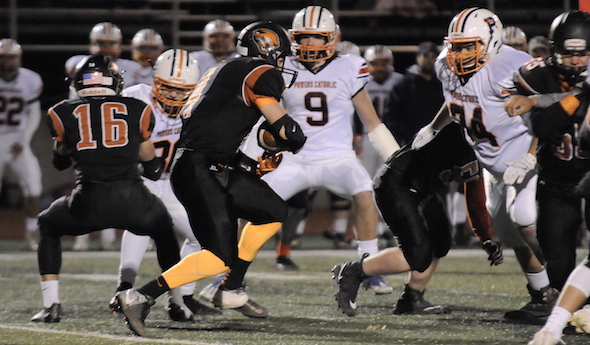
PHOTO: Alma and Flint Powers Catholic played into overtime Friday before the Panthers emerged with a 20-14 win in Division 4. (Click to see more from HighSchoolSportsScene.com.)