

Drive for Detroit: Playoffs R1 in Review
November 2, 2015
By Geoff Kimmerly
Second Half editor
Three reigning champions were eliminated this weekend, six undefeated teams fell, and October came to and end with the MHSAA football playoff field halved to 136 teams still alive for nine titles.
Divisions 1, 2 and 6 will have new winners this month. And a few teams that looked like contenders also are done after the first round and a series of upsets that made headlines across the state.
See below for some of the most unexpected and heaviest-hitting results from the first week in all eight 11-player divisions and the 8-player bracket.
Division 1
Novi 31, West Bloomfield 28
After four straight losing seasons and an 0-3 start this fall, Novi (6-4) made the playoffs for the first time since 2008 with an at-large bid – and then dealt undefeated West Bloomfield (9-1) its only loss in arguably the biggest upset in the state this weekend. The teams combined for five touchdowns during the fourth quarter, but West Bloomfield never could completely catch up to the Wildcats. Click for more from the Oakland Press.
Also noted:
Rockford 24, Grandville 6 – The Rams (7-3) won the rematch of Ottawa-Kent Conference Red co-champions after also beating Grandville (6-4) in Week 4.
Romeo 28, Clarkston 14 – The Bulldogs (9-1) bounced back from a tough three-point loss to Utica Eisenhower in Week 9 to eliminate the reigning champion Wolves (7-3).
Ann Arbor Pioneer 22, Belleville 7 – Pioneer (7-3) ended a two-game losing streak by handing Belleville (8-2) its first loss since opening night.
Utica Eisenhower 23, Clinton Township Chippewa Valley 20 (2 OT) – Eisenhower (7-3) kept surging with its fourth straight win, first in the playoffs since 2012 and second in four weeks over Chippewa Valley (7-3).
Division 2
Detroit East English 25, Warren DeLaSalle 21
East English (8-2) has made the playoffs all four seasons as a program after emerging from the former Detroit Crockett, which made the playoffs its final 12 seasons and the MHSAA Semifinals twice. So the Bulldogs have had their share of success – but this might be the best win of the new program’s history, as they eliminated the reigning Division 2 champion and after falling to DeLaSalle (6-4) by only seven in last year’s District Final. Click for more from MLive-Detroit.
Also noted:
Muskegon 40, Traverse City Central 14 – The Big Reds (8-2) took the long trip up north and handed Traverse City Central (9-1) its first and only loss, earning a rematch with rival Mona Shores this week.
Byron Center 34, Portage Central 21 – The Bulldogs (8-2) have made three straight playoffs and won two playoff games only two years ago, but it’s still fair to say they were underdogs on the road at Portage Central (8-2).
Birmingham Groves 10, Farmington Hills Harrison 0 – Groves (10-0) reached 10 wins for the first time in program history with its sixth shutout this season, ending Harrison’s at 7-3.
Jackson 42, Livonia Churchill 35 – After making the playoffs for the first time since 2009, Jackson (8-2) won its first playoff game since 1999 in ending Churchill’s season at 5-5.
Division 3
East Grand Rapids 27, Grand Rapids Christian 14
After watching a 26-0 lead on Grand Rapids Christian fade in their first matchup this season, in Week 6, the Pioneers (7-3) finished this time against their O-K White rival. East Grand Rapids will play in a District Final for the first time since 2011. Grand Rapids Christian, which beat EGR 39-33 in that first game, ended at 5-5. Click for more from the Grand Rapids Press.
Also noted:
Vicksburg 16, Marshall 8 – The Bulldogs (8-2) quietly have built a five-game winning streak, adding to it with a road win at Marshall (7-3).
Trenton 34, New Boston Huron 21 – The Trojans (9-1) equaled their best record since 2003 by avenging last season’s District Final loss to Huron (5-5).
Coldwater 31, Parma Western 7 – Coldwater (10-0), which made the playoffs for the first time three seasons ago, earned its first playoff win by downing Western (6-4), which was playing in its first playoff game.
Redford Thurston 48, Warren Fitzgerald 14 – One of the rare at-large qualifiers with a home game, Thurston (6-4) justified it with a first-round win for the second straight season; Fitzgerald finished its second straight at 6-4.
Division 4
Benton Harbor 28, Dowagiac 7
We’ve nearly run out of neat ways to crunch the numbers for the Tigers (6-4), who are enjoying their best season and whose six wins this fall are more than they won over the previous eight combined. Benton Harbor’s first playoff game resulted in its first victory – and the chance to next take on annual championship contender Zeeland West. Dowagiac isn’t to be forgotten, however; the Chieftains (6-4) bounced back from finishing 3-6 in 2014. Click for more from the Kalamazoo Gazette.
Also noted:
Bloomfield Hills Cranbrook Kingswood 35, St. Clair Shores South Lake 14 – The Cranes (9-1) equaled their best record since 2004 and ended the best season for South Lake (8-2) since 2011; the Cavaliers improved from 2-7 a year ago.
Comstock Park 38, Saginaw Swan Valley 35 – Quarterback Pat Naughton threw four touchdown passes and Monterio Smith caught two and ran for a third score as Comstock Park (8-2) came back early and then held off the Vikings (6-4).
Detroit Denby 36, Detroit Collegiate Prep 6 – Denby (6-4) claimed its first playoff win since 2007 by handing the first loss this season to Collegiate Prep (9-1), the Detroit Public School League Division II champion.
Lake Fenton 29, Corunna 27 – Lake Fenton’s most recent loss was by seven to Corunna in Week 8, but the Blue Devils (6-4) went on the road to take the rematch from the Cavaliers (8-2).
Division 5
Ida 35, Ann Arbor Gabriel Richard 23
The Bluestreaks built on their first undefeated regular season since 1971 with a second straight playoff win over Ann Arbor Gabriel Richard (5-5). Ida (10-0) also set a program record for wins despite giving up the most points in a game this season; the Bluestreaks gave up only 64 total during the first nine weeks. They scored three times during the third quarter to pull away. Click for more from the Monroe Evening News.
Also noted:
Buchanan 34, Hillsdale 31 – The Bucks' first perfect regular season since 1988 has turned into its first 10-0 start ever after its third win in a month decided by three points or fewer, this time against a Hillsdale team (6-4) in its 15th straight playoffs.
Almont 10, Marine City 3 – The Raiders (8-2) have bounced back nicely from back-to-back losses in Weeks 7 and 8, this time downing Marine City (6-4) in the playoffs for the second straight season.
Dearborn Heights Robichaud 50, Brooklyn Columbia Central 37 – Robichaud (8-2) reached 50 points for the second time this season to get its first playoff win since 2012, while Columbia Central ended at 8-2 after three straight losing seasons.
Kingsford 25, Harrison 0 – The Flivvers bounced back from a sub-.500 record last season and then a loss in Week 9 to claim a playoff win for the first time since 2012 and with their first shutout of this fall – which also was the first time Harrison (7-3) was shut out since Week 1 of 2013.
Division 6
Clinton 14, Monroe St. Mary Catholic Central 10
Clinton (10-0) was one of two undefeated teams that had road games this weekend, and the Redskins responded by eliminating the reigning champion. Monroe St. Mary (8-2) had dominated most of its competition this fall, aside from a Week 9 loss to Division 5 contender Lansing Catholic. But Clinton drove 93 yards for the go-ahead score on the legs of Matt Sexton, who gained 100 yards total on the winning possession. Click for more from the Monroe Evening News.
Also noted:
Calumet 24, Negaunee 14 – The Copper Kings (8-2) earned their first win over Negaunee since 1955 and after five losses over the last four seasons to the Miners (7-3).
Sanford Meridian 44, Millington 38 – The Mustangs (10-0) also set a program record for wins and earned the opportunity to face another undefeated team, Ithaca, this week while ending Millington’s 12th straight playoff season at 8-2.
Laingsburg 23, Burton Bendle 15 – The Wolfpack (7-3) moved past six wins for the first time since 2009 by edging a Bendle team that went from 3-6 a year ago to 8-2 this fall.
Constantine 31, Schoolcraft 28 (OT) – In arguably the other biggest stunner of the first week of the playoffs, at-large qualifier Constantine (6-4) went on the road and downed rival Schoolcraft (9-1), handing the Eagles their first loss after falling to them 42-24 only two weeks ago.
Division 7
Saugatuck 42, Hesperia 7
These two played the only playoff game between undefeated teams during the first week, with the Indians (10-0) earning their first postseason victory since the 2010 run to the Division 8 Final. Hesperia made one of the most impressive turnarounds in MHSAA football history this fall, going from 1-8 last season to 9-1 before falling Friday. Click for more from the Holland Sentinel.
Also noted:
McBain 34, Whittemore-Prescott 22 – Highland Conference co-champ McBain (7-3) won this battle of league winners, edging the first-place Cardinals (5-5) from the North Star League Big Dipper.
Cass City 34, Ubly 6 – The Red Hawks (8-2) have their most wins in a decade after ending the best season for Ubly (7-3) since 2011.
Flint Beecher 30, Flint Hamady 28 – The Buccaneers (7-2) took the lead for good in the fourth quarter in their first matchup with Hamady (7-3) since a District Final in 2012.
Riverview Gabriel Richard 30, Grosse Pointe Woods University Liggett 27 – A 42-yard field goal by Zach Loewengruber on the game’s final play gave Gabriel Richard (7-3) its first playoff win and ended Liggett’s season at 6-4.
Division 8
Climax-Scotts 8, Mendon 6
Climax Scotts (10-0) held on for its first win over Mendon (5-5) since 1977, after 30 straight losses. Climax-Scotts scored on the first possession of the game and made a two-point conversion, and stopped Mendon’s conversion attempt after its lone score. The Panthers have made the playoffs 13 straight seasons, and now will try for a second Regional Final in eight tries; Mendon had eliminated them from the playoffs the past four seasons. Click for more from the Battle Creek Enquirer.
Also noted:
Crystal Falls Forest Park 24, Lake Linden-Hubbell 0 – The Trojans (6-3) must have figured out a few things between falling to Lake Linden-Hubbell 34-28 only a week earlier and then handing the Lakes (9-1) their first and only loss.
Bark River-Harris 22, Munising 6 – Three weeks after falling to Munising by seven, Bark River-Harris (8-2) advanced to a District Final for the second straight season by downing the reigning Division 8 runner-up Mustangs (7-3).
Johannesburg-Lewiston 35, Hillman 8 – The Cardinals (9-1) won their ninth game for the third time in four seasons by downing North Star League Little Dipper champion Tigers (6-4), and now get another shot at Ski Valley Conference winner St. Ignace after finishing a win behind the Saints in the league standings.
Ottawa Lake Whiteford 20, Petersburg-Summerfield 14 – Revenge surely was sweet for Whiteford (8-2), which fell to Petersburg-Summerfield (7-3) by 20 in their Week 4 Tri-County Conference matchup.
8-Player
Rapid River 36, Engadine 29
A Week 5 loss to Engadine started a string of three losses in four games for Rapid River (7-3), but the Rockets have avenged the first defeat and earned the opportunity to avenge a second against Powers North Central. Engadine (7-3) was held to fewer than 40 points for the first time since Week 3. Click for more from RRN Sports.
Also noted:
Cedarville 48, Owendale-Gagetown 28 – The reigning 8-player runner-up Trojans (8-2) have won four straight and delivered O-G (9-1) its first and only loss.
Lawrence 54, Waldron 52 – The Spartans (8-2) played the reigning champion impressively close, but Lawrence (8-2) emerged with another opportunity against rival Battle Creek St. Philip this week after falling to St. Philip two weeks ago.
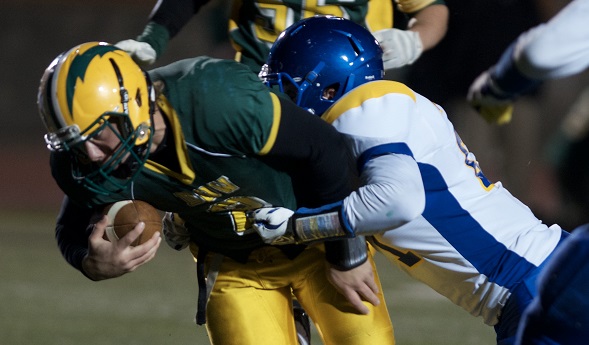
PHOTO: Midland Dow, in green, faced rival Midland for the second straight week and won for the second straight as well, 42-7. (Click for more from HighSchoolSportsScene.com.)
1st & Goal: Week 7 in Review
October 12, 2020
By Geoff Kimmerly
Second Half editor
Yes, it’s true. We’re days from mid-October, with only two regular-season football games remaining, celebrating league champions and starting to look forward to the MHSAA Playoffs.
All of that has seemed to come on quickly this fall, but Week 7 provided us even more of what we’re used to enjoying every year.
In front of larger crowds at many stadiums, we watched the most unusual fall in a century continue to take shape – starting with a major southwestern matchup Thursday night and concluding Saturday with a few more indicators of what might be on the way as this season’s best contenders continue to rise.
Bay & Thumb
HEADLINER Port Huron 20, Port Huron Northern 7 The Big Reds (4-0) added on to last year’s playoff-opener win over Northern by breaking a three-game regular-season losing streak versus the Huskies (2-1). In doing so, Port Huron clinched a share of the Macomb Area Conference Blue championship and can finish an outright run this week against winless Sterling Heights. Click for more from the Port Huron Times Herald.
Watch list North Branch 56, Richmond 7 This is two weeks straight for the Broncos (4-0), who have avenged both of their regular-season losses from last year and sit alone atop the Blue Water Area Conference standings.
Remember this one Freeland 21, Saginaw Swan Valley 14 The Falcons (3-1) broke a four-game losing streak against the Vikings (2-2) and in doing so clinched a share of the Tri-Valley Conference Central title.
More shoutouts Reese 23, Elkton-Pigeon-Bay Port 20 The Rockets (1-3) made their first win count, upsetting Laker (3-1) and toppling it from a first-place tie in the Greater Thumb Conference West. Cass City 28, Unionville-Sebewaing 24 The Red Hawks, who don’t play Laker during this abbreviated season, were beneficiaries of that Reese upset and now sit atop the West together with only Bad Axe thanks also to this close win over USA (2-2).
Greater Detroit
HEADLINER Grosse Pointe South 21, Clinton Township Chippewa Valley 17 Joining one of the toughest leagues in the state hasn’t fazed newcomer Grosse Pointe South (3-1) this fall, as it showed against reigning champ Chippewa Valley (2-2). The Blue Devils find themselves tied with Macomb Dakota and Sterling Heights Stevenson for first place, and with Stevenson up next. Click for more from MLive-Detroit and see highlights below from State Champs Sports Network.
VIDEO: Check out the highlights of the Grosse Pointe South (@gpsouthfb) vs. Chippewa Valley football game from tonight. @SOUTHBLUEDEVILS @MHSAA pic.twitter.com/7b9wqEckvp
— STATE CHAMPS! Michigan (@statechampsmich) October 10, 2020
Watch list Clarkston 31, Lake Orion 7 The Wolves (4-0) continued their bounce back this fall by clinching a share of the Oakland Activities Association Red title while dealing the Dragons (2-1) their first defeat.
Remember this one Birmingham Seaholm 35, Birmingham Groves 28 Make that two in a row in this rivalry for Seaholm (3-1) after breaking a former seven-game losing streak to Groves (2-2) during last season’s playoffs.
More shoutouts Detroit Catholic Central 27, Orchard Lake St. Mary's 10 The Shamrocks (4-0) capped a perfect run through the Detroit Catholic League Central, holding their three league opponents to a combined 32 points. Rochester Hills Stoney Creek 23, Rochester Adams 10 The Cougars (4-0) defeated Adams (1-3) for the first time since 2014 and in doing so clinched a share of the OAA White championship.
Mid-Michigan
HEADLINER Mason 42, Fowlerville 14 The Bulldogs (4-0) ran their regular-season winning streak to 15 and set up a Week 9 winner-takes-all with also-undefeated Williamston for the Capital Area Activities Conference Red championship. Mason put up its most points in a game this season and has now held its four opponents to a combined 43. Click for more from the Lansing State Journal.
Watch list Olivet 30, Lake Odessa Lakewood 6 The Eagles (4-0) extended their Greater Lansing Activities Conference winning streak to 18 while clinching a share of the league title – and with unbeaten Williamston up next for an intriguing nonleague matchup.
Remember this one DeWitt 43, Warren De La Salle Collegiate 3 The Panthers (4-0) already were off to another strong local start, but defeating the Pilots (1-3) on the road no doubt drew plenty of statewide eyes.
More shoutouts Breckenridge 29, Carson City-Crystal 7 The Huskies (3-1) are 5-for-5 in the Mid-State Activities Conference, this win clinching their fifth title in five seasons playing in the league. Durand 20, Chesaning 14 The Railroaders (4-0) not only are off to their best start since 2016, but this was their first margin of victory smaller than 21 this fall.
Northern Lower Peninsula
HEADLINER Traverse City Central 57, Alpena 0 The Trojans (4-0) earned a share of a repeat championship in the Big North Conference, and how they’ve rumbled through league competition the last few years has been exceptional. Central has won 13 straight league games, going back nearly three full league seasons, and with the last 11 consecutive wins all by at least 24 points. Click for more from MI Sports Now.
Watch list Evart 34, Lake City 21 After opening 0-2, Evart (2-2) has won two weeks over opponents that last season outscored the Wildcats by a combined 64-12.
Remember this one Harbor Springs 57, Frankfort 22 The Rams (3-1) set themselves up to play Johannesburg-Lewiston in Week 9 for the Northern Michigan Football Conference Legacy title.
More shoutouts Oscoda 58, Blanchard Montabella 0 That the Owls are 4-0 isn’t super stunning coming off last year’s league title, but that they’ve yet to give up a point is impressive no matter the circumstances. East Jordan 48, Alcona 22 The Red Devils (3-1), counting the end of 2019, have won six of their last eight games.
Southeast & Border
HEADLINER Milan 24, New Boston Huron 7 A Week 5 loss to current leader Riverview has Milan (3-1) still trailing in the Huron League by a game with one to play. But the Big Reds hung on to a shared title hope by handing New Boston Huron (3-1) its first defeat. Click for more from the Monroe News.
VIDEO: Check out the highlights of the Milan (@MilanBRFootball) at New Boston Huron football game from tonight. @MilanBigRedsAD @ColeMcelvany
Presented by @LawrenceTechU. For more information go to https://t.co/Uq6Fmk66eG pic.twitter.com/MSI75OtuSQ— STATE CHAMPS! Michigan (@statechampsmich) October 10, 2020
Watch list Hillsdale 22, Brooklyn Columbia Central 21 Blissfield leads the Lenawee County Athletic Association, but Hillsdale (3-1) is tied with Week 9 opponent Clinton for second place as both hope for a Royals stumble.
Remember this one Michigan Center 36, Grass Lake 28 After two weeks off, Michigan Center (1-1) shook up the Cascades Conference standings, pulling Grass Lake (3-1) out of a tie for first place.
More shoutouts Adrian Madison 39, Morenci 22 The Trojans’ next two opponents are a combined 1-7, and if Madison gets to 5-1 it would guarantee its winningest season since 2009. Erie Mason 52, Britton Deerfield 12 The Eagles (4-0) won to set up a Tri-County Conference title match for this week with also-undefeated Sand Creek.
Southwest Corridor
HEADLINER Centreville 36, Mendon 0 The Bulldogs are well into a third season of impressive football after struggles through most of the last decade, and this might be one of the biggest wins in recent memory. Centreville traveled to Mendon and emerged in the matchup of unbeatens with a share of the Southwest 10 Conference championship and a second shutout in four games this fall. Click for more from the Sturgis Journal.
VIDEO: Check out the highlights of the Centreville at Mendon football game from Thursday night. Courtesy: WXMI-TV
Brought to you by @hungryhowies pic.twitter.com/9R4bUHctWS— STATE CHAMPS! Michigan (@statechampsmich) October 9, 2020
Watch list Battle Creek Harper Creek 28, Coldwater 7 This puts Harper Creek at only 1-2 in the Interstate 8 Athletic Conference, but dropped Coldwater into a mix of six teams that has one or two league defeats.
Remember this one Marshall 41, Parma Western 27 Having lost to two other league contenders close, Marshall (2-2) caused some I8AC juggling as well with this win over former lone league leader Western (3-1).
More shoutouts Buchanan 42, Comstock 7 The Bucks (4-0) inched closer to a possible Berrien-Cass-St. Joseph Conference title, now needing to win one of their final two regular-season games to clinch a share. Battle Creek Pennfield 28, Jackson Lumen Christi 20 The Panthers (2-2) hadn’t gotten within 15 points of Lumen Christi (2-2) during their first six meetings as part of the I8AC together.
Upper Peninsula
HEADLINER Kingsford 30, Gladstone 28 Getting a read on the Upper Peninsula pecking order is getting pretty difficult this fall, as Marquette, Sault Ste. Marie and Gladstone all have taken turns as the possible leader. Kingsford (3-1) is at least in the growing mix now coming off this close win – which also gave the Braves (2-1) three two-point games in three tries this season. Click for more from RRN Sports.
Watch list Sault Ste. Marie 34, Benzie Central 13 The Blue Devils (3-1) bounced back from their two-point Week 6 loss to Gladstone by sending Benzie Central to 2-2.
Remember this one Marquette 44, Menominee 26 That’s two Marquette wins over the rival Maroons (2-2) over four weeks, this one giving Marquette (3-1) a share of the Great Northern Conference title.
More shoutouts Gwinn 14, Norway 12 The Modeltowners (2-2) avenged a 28-20 loss from a year ago. Ishpeming Westwood 55, L'Anse 15 The Patriots (3-1) gave up a forfeit to open the season but haven’t lost since.
West Michigan
HEADLINER Byron Center 36, Lowell 22 The Bulldogs (4-0) became the lone leaders atop a strong Ottawa-Kent Conference White, adding a pair of fourth-quarter touchdowns to hold off the Red Arrows in another matchup of previously-undefeated teams. Lowell (3-1) pulled within seven late before Byron Center added one more score. See highlights below from WZZM.
13 On Your Sidelines: Lowell vs. Byron Center https://t.co/cjxExC0yIb
— 13 On Your Side (@wzzm13) October 11, 2020
Watch list Muskegon Catholic Central 40, Manistee 0 The Crusaders (4-0) clinched a share of the Lakes 8 Athletic Conference championship in dominating fashion, shutting out Manistee (3-1) for the second-straight season.
Remember this one Reed City 70, Newaygo 40 This one will reach the record book as offense reigned and Reed City (4-0) held on to its lead in the Central State Activities Association Gold.
More shoutouts Grand Rapids South Christian 32, Cedar Springs 14 The Sailors (4-0) join Week 9 opponent Grand Rapids Catholic Central alone atop the O-K Gold as both have claimed wins over Cedar Springs (2-2). Hopkins 34, Belding 28 The Vikings (4-0) are leaders alone in the O-K White after handing Belding (3-1) its lone defeat.
8-Player
HEADLINER Mayville 58, Deckerville 54 As noted in Friday’s preview, Mayville has seemed like a program on the verge of this level of win. The Wildcats (4-0) not only avenged last season’s 44-12 loss to the Eagles (3-1) but they ended Deckerville’s 18-game regular-season winning streak while staying tied for first in the North Central Thumb League Stars. Click for more from the Huron Daily Tribune.
Watch list Pellston 34, Gaylord St. Mary 28 While the Ski Valley Conference standings will be unbalanced because of the abbreviated schedule, Pellston (4-0) absolutely has earned its status as at least a co-champion by finishing its league slate with an impressive win over the Snowbirds (3-1).
Remember this one Bridgman 34, New Buffalo 20 Five teams in the Southwestern Michigan 8-man Football League have one conference loss, with Bridgman (3-1) handing New Buffalo (3-1) its first.
More shoutouts Morrice 56, Genesee 14 As the NCTL Stars reshuffled in part because of Mayville/Deckerville over the weekend, the Orioles (4-0) joined Mayville among undefeated teams in the league by handing Genesee (3-1) its first defeat. Munising 28, Stephenson 14 The Eagles (3-1) don’t lose a step in their Great Lakes Eight West race, but Munising (4-0) impressed again in remaining undefeated.
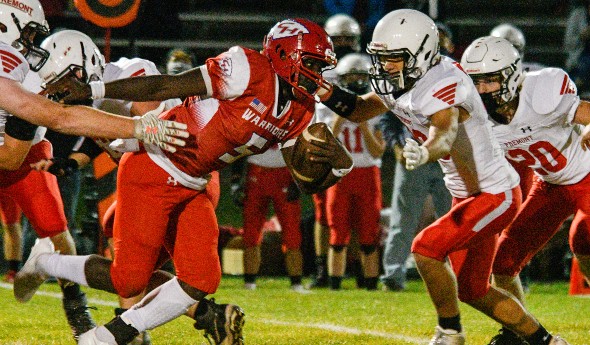
PHOTO: Fremont earned its first win this season in Week 6, defeating Remus Chippewa Hills 42-26. (Click to see more from HighSchoolSportsScene.com.)