

Drive for Detroit: Week 8 in Review
October 15, 2012
By Geoff Kimmerly
Second Half editor
As the old cliché goes, Week 8 was why they play the games.
Sure, some of the weekend’s results could be anticipated. But others – think Detroit Martin Luther King over Cass Tech, Oxford over Oak Park and Bessemer over Crystal Falls Forest Park to mention a few – no doubt caught some high school football fans by surprise.
Following are the most significant results from all corners of Michigan during the second-to-last weekend of the regular season. The final games finish off this week, with playoff brackets to be announced during the Selection Sunday Show at 6 p.m. on Fox Sports Detroit.
Greater Detroit
Clarkston 21, Lake Orion 14
In a game pitting the two top-ranked teams in Division 1 according to The Associated Press, No. 1 Clarkston scored with 14.3 seconds to play to move to 8-0 and win the Oakland Activities Association Red championship. Lake Orion fell to 7-1. Click to read more from The Oakland Press.
Also noted:
Detroit Catholic Central 35, Orchard Lake St. Mary 13 – DCC’s win created a three-way tie atop the Detroit Catholic League Central standings, and set up these two to meet again in this week’s Prep Bowl. St. Mary (6-2) is in the playoffs for sure, while DCC (5-3) can earn an automatic berth.
Detroit Martin Luther King 44, Detroit Cass Tech 13 – King might be the best 5-3 team in Michigan, but it’s fair to call this an upset with Cass Tech (6-2) considered among the state’s elite all season. King now will face Detroit East English in Friday’s Public School League championship game.
Walled Lake Northern 55, Hartland 52 – Northern (6-2) not only handed Hartland (7-1) its first loss, but most importantly earned its first playoff berth ever.
Oxford 14, Oak Park 12 – Oak Park (7-1) still won the Oakland Activities Association White title, but Oxford (5-3) kept the Knights from doing so perfectly while keeping its automatic playoff berth chances alive.
Bay and Thumb
Midland 42, Bay City Western 15
Midland had fallen just shy of a league title over the last four seasons, with a combined five league losses during that stretch. But the Chemics (8-0) made it seven wins over Western in their last nine meetings, and earned a share of the Saginaw Valley Association North championship with Midland Dow coming up this week. The Warriors (7-1) must hope for a Midland loss and beat rival Bay City Central to also earn a share. Click to read more from the Bay City Times.
Also noted:
Fenton 55, Swartz Creek 28 – By beating Swartz Creek (7-1), Fenton (7-1) created a four-way tie atop the Flint Metro League standings with a league game to play.
Marine City 35, St. Clair 34 – After opening this season with a nonleague loss, Marine City (7-1) has won seven straight and clinched the Macomb Area Conference Gold title with this nail-biter over second-place St. Clair (7-1)
Merrill 35, Saginaw Valley Lutheran 27 – The Vandals (5-3) kept their automatic playoff berth hopes alive, while dealing a blow to Valley Lutheran (5-3) as it goes for its first berth ever.
Burton Bendle 20, Genesee 16 – Bendle (7-1) has earned a third-straight playoff berth, and remains a win behind New Lothrop in the Genesee Area Conference Blue standings. Genesee (5-3) can still earn an automatic berth, but needs to beat New Lothrop to do so.
Southwest and Border
Stevensville Lakeshore 28, Mattawan 16
It’s something that both of these teams were undefeated heading into this game, given the competitiveness of the Southwestern Michigan Athletic Conference West this fall. But Mattawan (7-1) couldn’t make it two in a row over Lakeshore (8-0), which earned a share of the league title. Click to read more from the Kalamazoo Gazette.
Also noted:
Dowagiac 28, Edwardsburg 8 – The Wolverine Conference West came down to the final league game of the season, with Dowagiac (8-0) edging runner-up Edwardsburg (6-2).
Watervliet 26, Decatur 19 – Four of six teams in the Southwestern Athletic Conference South have made the playoffs, and a fifth can this week; Watervliet (8-0) leads them all and earned a share of the title, while knocking Decatur (6-2) into a tie for third.
Paw Paw 46, Otsego 23 – Paw Paw (8-0) avoided being part of a three-way championship in the Wolverine Conference East by knocking off formerly second-place Otsego (6-2).
Mendon 33, Buchanan 28 – Mendon (8-0) got its biggest scare with its first win by fewer than 20 points, but also big playoff points because Buchanan (6-2) is a Class B school.
West Michigan
Lowell 14, Caledonia 7
Caledonia (6-2) nearly crashed Lowell’s run at the O-K White title. But the Red Arrows (7-1) – despite five turnovers – held on to earn the right to play Grand Rapids Christian this weekend for the league championship. Click to read more from the Grand Rapids Press.
Also noted:
Grand Rapids West Catholic 25, Cedar Springs 20 – This close call earned West Catholic (7-1) the opportunity to play Grand Rapids Northview this week for the O-K Bronze title, and might’ve dropped Cedar Springs (4-4) out of playoff contention.
Hamilton 42, Zeeland West 38 – The Hawkeyes (5-3) edged a win closer to their first playoff berth since 2009, while knocking Zeeland West (5-3) into a three-way tie atop the O-K Green with a league game to play.
Grand Rapids Catholic Central 28, Hastings 14 – The Cougars (8-0) clinched a share of the O-K Gold championship, although Hastings (6-2) can still earn another share in the unlikely scenario that GRCC falls this week to winless Wayland.
Fruitport 24, Muskegon Catholic Central 21 (OT) – The Trojans (8-0) hadn’t faced MCC (5-3) since 1976, but are now one win away from a 9-0 season for the first time since 2006.
Mid-Michigan
Lansing Waverly 38, Mason 16
The Warriors (5-3) need another win Friday over Fowlerville to earn an automatic playoff berth. But it’s fair to say this was their best win since 2002, the last time Waverly made the postseason. Mason (5-3) has beaten the Warriors by an average of 21 points per game over the last four seasons. Click to read more from Mlive Lansing.
Also noted:
Clare 27, Sanford Meridian 7 – After opening 0-2, Clare (6-2) has stormed back to win a share of the Jack Pine Conference title while putting Sanford Meridian (5-3) in a must-win situation to earn an automatic playoff berth.
Grand Ledge 40, East Lansing 0 – This was expected to be much closer with both 5-2 coming in; the Comets (6-2) are no doubt relieved to have a playoff berth in hand with a tough game against Holt coming up, while the Trojans (5-3) should still get in with two-win Okemos next on the schedule.
Williamston 25, Haslett 22 – A late score kept playoff hopes alive for Williamston (5-3), while potentially derailing those of Haslett (4-4).
Portland 37, DeWitt 7 – When these teams were in the same league a decade ago, few would have believed Portland (7-1) could beat DeWitt (6-2) twice in row; this made it so.
Lower Up North
Maple City Glen Lake 26, Traverse City St. Francis 20
Glen Lake (8-0) hadn’t won more than five games in a season since 2001, but lined itself up for its first perfect regular season since that season with a late score to claim this nonleague game. In doing so, the Lakers also might’ve finished St. Francis’ MHSAA-best 22-season playoff streak – the Gladiators fell to 4-4. Click to read more from the Traverse City Record-Eagle.
Also noted:
Boyne City 44, Elk Rapids 30 – Boyne City (8-0) remained tied for first in the Lake Michigan Conference with a league game to play, while dropping Elk Rapids (4-4) into a tough spot for playoff qualification.
Grayling 63, East Jordan 29 – Grayling (8-0) didn’t have as much to stress with East Jordan (0-8), but will face Boyne City this week for the Lake Michigan Conference title.
West Branch Ogemaw Heights 56, Traverse City West 39 – Ogemaw Heights kept automatic playoff berth hopes alive by moving to 5-3, and made life a little less comfortable for Traverse City West, also 5-3.
Lake City 49, Manton 12 – Lake City (7-1) can only hope for a Beal City loss this week that would split the Highland Conference title. Manton (4-4) hopes to get into the playoffs if it can finish with a victory.
Upper Peninsula
Bessemer 46, Crystal Falls Forest Park 15
Bessemer (5-2) hadn’t celebrated a winning season since 2006. Now the Speedboys also can celebrate a league title, with this win giving it a shared championship in the Great Western Conference with Hurley (Wis.). Bessmer (also referred to as Gogebic because it is a co-op with Wakefield) also qualified for the playoffs, something Forest Park (6-2) had already secured. Click to read more from the Iron Mountain Daily News.
Also noted:
Kingsford 49, Gladstone 28 – Kingsford (7-1) finished a perfect 4-0 in the Great Northern UP Conference by knocking off fifth-place Gladstone (2-6)
Eagle River Northland Pines (Wis.) 68, L'Anse 24 – Northland Pines (8-0) avoided a three-way tie in the Western Peninsula Athletic Conference, while dropping L’Anse (6-2) to third in the final league standings.
Marquette 34, Negaunee 26 – Marquette (4-4), playing eight games this regular season, kept a slim hope of playoffs alive by beating Mid-Peninsula Athletic Conference champion Negaunee (7-1, with a share of the title so far). Marquette also claimed the Diamond Jubilee Trophy, which originated in 1969.
Menominee 48, Marinette (Wis.) 26 – This was the 106th meeting between the two, dating back to 1894.
Trophy Games
Every week, the MHSAA highlights trophy games played throughout the state. Here are a few more from Week 8:
- Brown Jug – This trophy contended by Center Line and Warren Lincoln dates back to 1947. Final: Warren Lincoln 52, Center Line 13.
- Oak Chest – Lansing Everett beat the Big Reds for the first time since 2008, and after losing by 32 to Sexton in 2011. Final: Everett 32, Sexton 0.
- Sugar Bowl – Reese made it seven straight wins in this series against Unionville-Sebewaing for a trophy that originated in 1994. Final: Reese 55, USA 42.
- Spirit Bell – Ithaca at St. Louis - Originated in 1972, this is an all-sports traveling trophy. The Bell goes on the line again next week when the two schools meet in volleyball. Final: Ithaca 70, St. Louis 0.
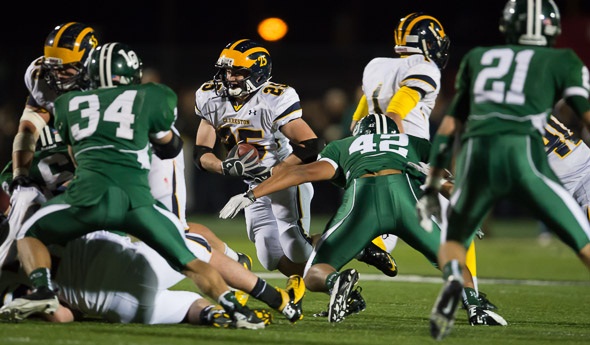
PHOTO: Clarkston junior running back Ian Eriksen (25) searches for an opening during Friday's win against Lake Orion. (Click to see more at Terry McNamara Photography.)
Drive for Detroit: 11-Player Finals Preview
November 22, 2016
By Geoff Kimmerly
Second Half editor
Each day of this weekend's MHSAA 11-Player Football Finals at Ford Field will have its own distinct theme.
 Friday features the only first-time football finalist this season, Ottawa Lake Whiteford in Division 8, plus three teams seeking their first championships since the 1990s: Walled Lake Western in Division 2, Detroit Country Day in Division 4 and Maple City Glen Lake in Division 6.
Saturday, meanwhile, will be rematch day. The Division 1, 3 and 5 Finals are rematches of championship games from earlier this decade, and Division 7 finalists Detroit Loyola and Pewamo-Westphalia met in a Semifinal a year ago.
See below for a look at all of the finalists taking the field this weekend, powered by MI Student Aid. Tickets cost $10 and are good for all four games on one day. Click for a full schedule.
The first three Friday games will be broadcast live on Fox Sports Detroit’s primary channel (check cable/satellite box listings for your specific channel) with the Division 4 game available live on FoxSportsDetroit.com and on FOX Sports GO! for tablet and handheld users. Saturday's first two games will air live on Fox Sports Detroit, with the third on Fox Sports Detroit-PLUS. As with the Division 4 game, the Division 3 game will be available live online only, but both will be aired on Fox Sports Detroit on Sunday; the Division 4 game will air at 6:30 p.m., followed by the Division 3 game at 9 p.m. Audio broadcasts will be available on the MHSAA Network website.
Rankings below were voted upon by The Associated Press’ media panel. Statistics are current unless noted; those with a "*" are only through Regional Finals.
 Division 1
DETROIT CASS TECH
Record/rank: 13-0, No. 1
Coach: Thomas Wilcher, 19th season (197-51)
League finish: First in Detroit Public School League East Division 1.
Finals history: Division 1 champion 2012, 2011; runner-up 2015.
Best wins: 32-28 over No. 3 Utica Eisenhower in the Semifinal, 43-42 over No. 4 Saline in the Regional Final, 24-7 over No. 7 Dearborn in the District Final, 35-7 over No. 8 Dearborn Fordson in the Pre-District, 31-18 and 41-20 over Division 2 No. 3 Detroit Martin Luther King.
Players to watch: RB/DB Donovan Johnson, 5-8/175 sr. (1,007 yards/16 TDs rushing); QB Rodney Hall, 6-2/210 sr. (2,315 yards/23 TDs passing); WR/FS Donovan Peoples-Jones, 6-2/190, sr. (982 yards/16 TDs receiving); OT/DT Jordan Reid, 6-5/295 jr.; DB/RB Jaylen Kelly-Powell, 6-0/200 sr.
Outlook: Not that anyone was doubting it before, but it’s tough to argue with Cass Tech’s ranking after its body of work in the playoffs – with Saturday’s comeback win over Eisenhower just the latest of an impressive run. Hall, Peoples-Jones and Kelly-Powell were stars on last year’s team too and Johnson and senior Tim Cheatem are back as the top runners after the Technicians – without Hall because of an injury – fell to Romeo in last season’s Division 1 Final. Kelly-Powell is committed to sign with Michigan, Hall with Northern Illinois and Reid with Michigan State, and both Peoples-Jones and Johnson are making decisions with a number of offers from elite college programs.
DETROIT CATHOLIC CENTRAL
Record/rank: 13-0, No. 2
Coach: Tom Mach, 41st season (373-96)
League finish: First in Detroit Catholic League Central.
Finals history: Ten MHSAA titles (most recent 2009), six runner-up finishes.
Best wins: 28-14 over No. 6 Grandville in the Regional Final, 28-21 over Division 2 No. 10 Birmingham Brother Rice, 28-7 and 17-14 over Division 3 No. 10 Orchard Lake St. Mary’s.
Players to watch: RB/DB Nicholas Capatina, 5-9/180, sr. (1,035 yards/13 TDs); QB/DB Austin Brown, 6-0/180, soph. (1,314 yards/14 TDs); FB/LB Cameron Ryan, 6-0/220, jr. (833 yards/15 TDs rushing); FB/LB Isaac Darkangelo, 6-1/230, jr.; RB/LB Matt Young, 6-1/220, jr.
Outlook: The Shamrocks get to renew their postseason rivalry with Cass Tech after going 1-2 against the Technicians during two championship game and one Semifinal meeting from 2011-13. DCC can control the tempo by controlling the ground game – see last week’s 17-0 win over reigning Division 1 champion Romeo – but additionally hasn’t given up more than 21 points in a game this season while also defeating some strong out-of-state competition including Toledo Whitmer (29-7) and Cleveland St. Ignatius (28-21). The Shamrocks run behind a line averaging 6-foot-2 and 260 pounds and can deploy some skilled receiving threats in seniors Chris Jakubik and Jack Morris.
Division 2
 DETROIT MARTIN LUTHER KING
Record/rank: 11-2, No. 3
Coach: Ty Spencer, first season (11-2)
League finish: Second in Detroit Public School League East Division 1.
Finals history: Division 2 champion 2015 and 2007, two runner-up finishes.
Best wins: 14-7 over No. 5 Birmingham Groves in the Semifinal, 21-7 over No. 7 Temperance Bedford in the Regional Final, 39-0 over No. 10 Southfield Arts & Technology.
Players to watch: RB Kevin Willis, 5-8/165 sr. (1,003 yards/13 TDs rushing*); WR/DB Ambry Thomas, 5-11/175, sr.; (885 yards/13 TDs); QB Dequan Finn, 6-0/165, soph. (2,175 yards/34 TDs); DB/FL Jae’Veyon Morton, 5-9/165, jr. (592 yards/13 TDs receiving*).
Outlook: Last season’s champion is back in the Final with a few different players in key positions, but also returning standouts Willis and Thomas. King’s only losses this fall were twice to Division 1 finalist Detroit Cass Tech; Cass Tech and also-PSL rival Detroit East English were the only teams to put up more than 14 points on the Crusaders this season. Thomas is one of the most highly-recruited players in the state and also has scored on interception, kick and punt returns this season. Former defensive coordinator Spencer has led the return effort, taking over after the tragic death of coach Dale Harvel in July.
WALLED LAKE WESTERN
Record/rank: 12-1, No. 2
Coach: Mike Zdebski, 19th season (153-56)
League finish: First in Kensington Lakes Activities Association North and Lakes.
Finals history: Two MHSAA titles (most recent 1999), one runner-up finish.
Best wins: 37-34 over No. 1 Lowell in the Semifinal, 61-21 over Fenton in the Regional Final, 37-7 over Brighton.
Players to watch: WR/DB Cody White, 6-3/205 sr. (547 yards/8 TDs rushing, 694 yards/9 TDs receiving, 638 yards/9 TDs passing); WR/DB Kameron Ford, 5-10/165, sr. (1,097 yards/13 TDs receiving); TB/LB Jalen Marshall, 5-10/225 sr. (881 yards/17 TDs rushing); QB Johnny Tracy, 6-3/205 sr. (2,125 yards/23 TDs passing).
Outlook: Zdebski brings Walled Lake Western back to the Finals after leading the Warriors to a championship back in his second season and also a 12-1 record a year ago. White – a rushing/receiving/passing threat headed to Michigan State – is the player most know, but he’s hardly the only offensive threat. Senior defensive back Jack Dodge paces the defense with 120 tackles and seven interceptions; total, Western has taken advantage of 30 turnovers this fall.
Division 3
 ORCHARD LAKE ST. MARY’S
Record/rank: 9-4, No. 10
Coach: George Porritt, 28th season (254-71)
League finish: Second in Detroit Catholic League Central.
Finals history: Seven MHSAA titles (most recent 2015), six runner-up finishes.
Best wins: 35-28 over No. 6 DeWitt in the Regional Final, 21-0 over Division 2 No. 10 Birmingham Brother Rice, 35-14 over Division 7 No. 5 Detroit Loyola.
Players to watch: RB/DE Kyren Cunningham, 6-1/220, jr. (1,967 yards/22 TDs rushing); RB/LB RaShawn Allen, 5-9/200, jr. (943 yards/16 TDs); LB/RB Josh Ross, 6-1/225, sr.; DB/WR Richard Bowens, 6-1/190, sr.
Outlook: St. Mary’s is playing for its third straight Division 3 title and the second time against Muskegon during this run after downing the Big Reds 7-0 in the 2014 Final. The Eaglets’ offensive playmakers are mostly juniors; joining Cunningham and Allen in the backfield, junior quarterback Caden Prieskorn (6-6/215) has thrown for more than 1,000 yards. The defense is stacked with talented seniors; Ross will sign with Michigan, Bowens has committed to play at Iowa State, defensive back Shermond Dabney is headed to Bowling Green and nose guard Ralph Holley and linebacker Dwayne Chapman to Western Michigan. The Eaglets have given up more than 17 points only three times.
MUSKEGON
Record/rank: 12-1, No. 1
Coach: Shane Fairfield, 12th season (73-17)
League finish: First in Ottawa-Kent Conference Black.
Finals history: Five MHSAA titles (most recent 2008), three runner-up finishes.
Best wins: 49-14 and 62-7 (Regional Final) over No. 5 Byron Center, 19-8 over No. 2 Edwardsburg in the Semifinal, 28-10 over East Grand Rapids in the District Final.
Players to watch: QB Kalil Pimpleton, 5-7/160 sr. (1,456 yards/21 TDs rushing, 714 yards/14 TDs passing, 229 yards/2 TDs receiving); QB La’Darius Jefferson, 6-2/210, jr. (865 yards/17 TDs rushing, 863 yards/9 TDs passing); WR/FS Jacorey Sullivan, 6-3/205, sr. (553 yards/7 TDs receiving); LB/RB Andrew Ward, 6-1/210, sr.
Outlook: As noted above, this is a rematch of the 2014 Final, and a little bit of a rebound for the Big Reds after they fell to Lowell in a Division 2 Regional Final a year ago. The quarterback tandem of Pimpleton and Jefferson should be one of the most entertaining offensive duos of the weekend; Pimpleton will play next at Virginia Tech. Ward also has major conference Division I offers and leads a defense that has given up 39 points over four playoff games and more than 15 only once, in a three-point Week 2 loss to Lincolnshire Stevenson of Illinois.
Division 4
 DETROIT COUNTRY DAY
Record/rank: 13-0, No. 1
Coach: Dan MacLean, 19th season (148-68)
League finish: Does not play in a conference.
Finals history: Three MHSAA titles (most recent 1999), five runner-up finishes.
Best wins: 20-14 over No. 2 River Rouge in the Semifinal, 45-7 over No. 4 Marysville in the District Final, 21-20 over Division 2 No. 7 Temperance Bedford.
Players to watch: RB/DB Chris Bergin, 5-11/200 sr. (626 yards/11 TDs rushing); QB/WR/DB Steve Mann, 6-0/195, sr. (713 yards/6 TDs passing, 281 yards/4 TDs receiving); QB/DB Jalen Graham, 6-2/185, soph. (407 yards/7 TDs passing); LB Kolin Demens, 6-2/200 jr.
Outlook: Country Day has played in three Finals over the last decade, in 2007, 2008 and 2012, and is back after falling in Semifinals the last two seasons. The Yellowjackets set a school record with 470 points with some incredible balance; although no player’s stats jump off the page, both Mann and Graham have had success at quarterback, while Bergin leads five with at least 200 yards rushing and four players have caught 10 or more passes. The defense gets more attention; aside from giving up 21 and 20 to Division 2 Detroit U-D Jesuit and Temperance Bedford, respectively, Country Day has held the rest to 14 or fewer points. Senior linebacker Adam Fakih leads with 98 tackles.
GRAND RAPIDS CATHOLIC CENTRAL
Record/rank: 12-1, No. 5
Coach: Todd Kolster, fifth season (49-10)
League finish: Tied for first in O-K Blue
Finals history: Two MHSAA titles (most recent 2010), two runner-up finishes.
Best wins: 31-3 over No. 8 Hudsonville Unity Christian in the Semifinal, 34-0 over Escanaba in the Regional Final, 27-6 over East Grand Rapids, 35-20 and 38-7 (District Final) over Allendale.
Players to watch: QB Jack Bowen, 5-10/165 jr. (2,329 yards/24 TDs passing*); TB Nolan Fugate, 6-0/200 jr. (1,637/14 TDs rushing); WR/DB Michael Brown, 6-0/200, sr. (1,090 yards/11 TDs receiving*); WR/DB Antonio Strong, 6-0/180, sr. (1,050 yards/11 TDs receiving*).
Outlook: GRCC advanced past the District round for the first time since 2010 with its highest-scoring offense since that season and a defense that has given up a combined 10 points over the last five weeks. The lone loss was to Division 5 finalist Grand Rapids West Catholic in Week 8, and in that game the Cougars allowed only 20 points. A key has been forcing turnovers; GRCC had 24 interceptions and seven fumble recoveries head into the Semifinal.
Division 5
 GRAND RAPIDS WEST CATHOLIC
Record/rank: 11-2, No. 6
Coach: Joe Hyland, first season (11-2)
League finish: Tied for first in O-K Blue.
Finals history: Four MHSAA titles (most recent 2015), two runner-up finishes.
Best wins: 10-7 over No. 1 Portland in the District Final, 28-7 over No. 4 Lansing Catholic in the Pre-District, 30-13 over Division 6 No. 5 Jackson Lumen Christi, 20-3 over Division 4 No. 5 Grand Rapids Catholic Central.
Players to watch: RB/QB/DB David Fox, 6-2/215 sr. (689 yards/8 TDs rushing, 1,286 yards/17 TDs passing*); QB Gaetano Vallone, 5-10/170, jr. (889 yards/7 TDs passing*); WR/DB Sam Neville, 6-3/205, sr. (854 yards/13 TDs receiving*); WR/DB Alex Fortier, 5-8/150 jr. (574 yards/9 TDs rushing*)
Outlook: The Falcons have a new coach but the same result as they’ll play in their fifth straight Final while seeking their fourth straight Division 5 championship. Hyland brought a successful past that included leading a playoff program in South Carolina, and he has guided West Catholic through all road games (including a neutral-field Semifinal) on the way to Detroit. Fox and Vallone were the stars of last year’s victory over River Rouge, and Fox at defensive back also helps linebackers Nathaniel Mitchell and Chris Markules pace a defense that has given up 20 points total during the playoffs.
MENOMINEE
Record/rank: 12-1, No. 5
Coach: Joe Noha, fifth season (59-6)
League finish: First in Great Northern U.P. Conference
Finals history: Three MHSAA titles (most recent 2007), one runner-up finish.
Best wins: 23-20 over No. 7 Frankenmuth in the Semifinal, 40-14 over No. 8 Reed City in the Regional Final, 28-14 over Escanaba.
Players to watch: WB/DB Ethan Mileski, 6-2/180, jr. (658 yards/5 TDs rushing, 1,250 yards/15 TDs passing); FB/LB Sam Larson, 5-11/185, sr. (766 yards/17 TDs rushing); WB/DB Marcus McKenney, 6-0/170 sr. (385 yards/4 TDs rushing, 499 yards/4 TDs receiving); TB/DB Keifer Rasner, 5-10/190, sr. (1,372 yards/20 TDs rushing, 410 yards/3 TDs passing).
Outlook: Menominee is back at Ford Field for the first time since 2013, earning a rematch of that Division 5 Final loss to West Catholic. The run has been impressive, including a late comeback win last week over Frankenmuth, and especially because all-state running back Rasner has missed the last few games with an injury. Larson and Mileski have picked up the slack, Larson with more than 300 yards rushing over the last two games and Mileski with more than 500 yards of total offense as the team downed the Eagles and Reed City.
Division 6
 JACKSON LUMEN CHRISTI
Record/rank: 11-2, No. 5
Coach: Herb Brogan, 37th season (336-83)
League finish: Tied for first in Interstate 8 Athletic Conference.
Finals history: Eight MHSAA titles (most recent 2009), two runner-up finishes.
Best wins: 27-7 over No. 3 Millington in the Semifinal, 37-34 OT over No. 2 Schoolcraft in the District Final, 21-20 OT over Coldwater.
Players to watch: RB Bo Bell, 5-9/170 sr. (2,428 yards/32 TDs rushing); WR/FS Jake Lathers, 5-11/175, sr. (593 yards/4 TDs receiving*); QB Troy Kutcha, 6-1/170 jr. (1,374 yards/10 TDs passing); FB/LB Kyle Minder, 5-11/200 jr. (457 yards/8 TDs rushing*).
Outlook: Lumen Christi will make its first trip to the Finals since that last championship run after eliminating two of the favorites along the way. Bell has carried a heavy load especially during the playoffs, and carried it well, while Kutcha adds a threat in the air to keep defenses honest. Minder is joined on defense by talented linebackers Alex Lasky and Luke Stanton, while end Karim Harris and tackle Grant Smith provide further power up front.
MAPLE CITY GLEN LAKE
Record/rank: 11-2, No. 6
Coach: Jerry Angers, eighth season (50-32)
League finish: Second in Northern Michigan Football Conference Leaders.
Finals history: Class DD champion 1994, Class DD runner-up 1996.
Best wins: 14-0 over No. 4 Calumet in the Regional Final, 36-12 over No. 8 Roscommon in the District Final, 34-20 over Leroy Pine River in the Semifinal.
Players to watch: RB/LB Nick Apsey, 6-1/200 jr. (791 yards/13 TDs rushing, 610 yards/10 TDs receiving); QB Cade Peterson, 6-4/190, jr. (1,953 yards/20 TDs passing, 664 yards/7 TDs rushing); WR/DB Jared Jackson, 5-11/160, sr. (455 yards/3 TDs receiving); RB/LB Duke Angers, 6-1/230, sr. (255 yards/3 TDs rushing).
Outlook: Glen Lake has broken the 10-win plateau for the first time since 2001 and won their most games since that last Finals run. Fewer teams at this stage have better losses; Glen Lake fell to Frankfort and Traverse City St. Francis, which both finished with only one loss this fall. Only those two and Pine River last week have scored more than 14 points against a defense keyed by Angers in the middle.
Division 7
 DETROIT LOYOLA
Record/rank: 11-2, No. 5
Coach: John Callahan, seventh season (77-14)
League finish: First in Detroit Catholic League AA
Finals history: Division 7 champion 2014, runner-up 2013 and 2012.
Best wins: 36-13 over No. 6 Hudson in the Regional Final, 46-7 over No. 8 Grosse Pointe Woods University Liggett in the District Final, 34-24 over Dearborn Divine Child.
Players to watch: QB/DB Price Watkins, 6-0/175, sr. (1,060 yards/9 TDs rushing, 817 yards/9 TDs passing); RB/LB Malcolm Mayes, 6-1/207, sr. (1,240 yards/14 TDs rushing); RB/LB D’Anthony Robinson, 5-10/210 soph. (1,298 yards/19 TDs rushing); LB/OL Kailen Abrams, 6-2/220 sr.
Outlook: Loyola no doubt has been looking forward to this rematch after falling to P-W 30-0 in a Semifinal last season. And the Bulldogs have beaten four league champions during this playoff run. But they are in a bit of a tough spot; Loyola's success this decade mostly has come as a result of a highly-productive running game, and three players have gone over 1,000 yards rushing this season. But the Detroit News has reported that Mayes and Robinson will be out with injuries Saturday. The good news is this team also can throw; Watkins has an all-state receiver in 6-foot-4 senior Hunter Harris (618 yards/7 TDs receiving).
PEWAMO-WESTPHALIA
Record/rank: 13-0, No. 2
Coach: Jeremy Miller, fourth season (46-6)
League finish: First in Central Michigan Athletic Conference.
Finals history: Division 7 runner-up 2015 and 2011.
Best wins: 17-14 over No. 1 Traverse City St. Francis in the Regional Final, 25-19 over No. 3 Saugatuck in the District Final, 34-16 over No. 4 Ubly in the Semifinal, 40-7 over Division 6 No. 10 Laingsburg.
Players to watch: RB/LB Jared Smith, 6-0/205, sr. (2,528 yards/38 TDs rushing); WR/DB Mason Schneider, 5-11/160, sr.; OT/DT Dominic Spitzley, 6-3/260, sr.; OL/LB Devon Pung, 5-11/200, sr.
Outlook: P-W was 3 minutes and 53 seconds from its first MHSAA title last season before falling to Ishpeming 22-16, and many of 2015's top contributors are back for another shot – including the second-leading rusher in MHSAA history. Smith has run for 8,140 yards over a four-season varsity career and is only 291 shy of the career record set by East Grand Rapids’ Kevin Grady from 2001-04. Defenses will focus on Smith – but he has a veteran line in front of him and a pair of quarterbacks in senior Ryan Smith and junior Jimmy Lehman who bring different looks on that side of the ball. Senior Nathan Smith joins Pung and Schneider as all-state honorees leading a defense that hasn’t given up more than 20 points in a game and 103 overall.
Division 8

OTTAWA LAKE WHITEFORD
Record/rank: 13-0, No. 5
Coach: Jason Mensing, fifth season (47-12)
League finish: First in Tri-County Conference.
Finals history: Has never played in an MHSAA Final.
Best wins: 40-21 over Saginaw Michigan Lutheran Seminary in the Semifinal, 38-18 over No. 2 Climax-Scotts in the Regional Final, 30-26 and 44-21 (District Final) over Morenci.
Players to watch: QB/FS Thomas Eitniear, 5-10/160, jr. (920 yards/9 TDs passing, 796 yards/7 TDs rushing); RB/LB Jesse Kiefer, 5-9/165, sr. (1,240 yards/30 TDs rushing rushing, 287 yards/5 TDs receiving); WB/LB Conner Hoogendoorn, 5-11/175 sr. (953 yards/16 TDs rushing); OT/DT Lucas Tesznar, 6-5/250, jr.
Outlook: This is Whiteford’s first trip to the Finals after its second straight – and second-ever – Semifinal appearance. Kiefer, an all-state honorable mention, is the school’s career record-holder for rushing yards, points and total offense, while Eitniear has started every game of the two Semifinal runs at quarterback. He also was an all-state honorable mention and Tesznar made the first team as Whiteford has scored nearly 100 points more than last season’s record total. The Bobcats have had only two single-digit games this fall, winning their four playoff games by an average of 21 points.
MUSKEGON CATHOLIC CENTRAL
Record/rank: 13-0, No. 1
Coach: Steve Czerwon, fourth season (50-4)
League finish: First in Lakes 8 Conference.
Finals history: Eleven MHSAA titles (most recent 2015), three runner-up finishes.
Best wins: 21-6 and 35-0 (Semifinal) over No. 3 St. Ignace, 35-0 over No. 6 Frankfort in the Regional Final, 30-6 over Division 5 No. 9 Muskegon Oakridge.
Players to watch: RB/LB LaTommy Scott, 5-10/175, sr. (873 yards/8 TDs rushing); LB Andrew Schulte, 5-10/185, sr.; RB/DB Logan Helton, 5-9/175 sr. (817 yards/13 TDs rushing); RB/DB Walker Christoffersen, 5-9/180 sr. (656 yards/11 TDs rushing).
Outlook: MCC has won the last three Division 8 titles and brings back a number of veterans including all three top running backs from last season, when the Crusaders beat Waterford Our Lady 7-0. They did suffer a setback when all-state lineman Adam Benoit was ruled out for the rest of the season with an injury a few weeks ago – but it’s been tough to tell by MCC’s combined 70-0 score over the last two games. Senior quarterback Trenton Bordeaux adds another dimension offensively (589 yards/7 TDs passing) and also is an all-state punter, while all-stater Schulte leads a defense that hasn’t given up a point in three weeks and only 71 overall this fall.
Second Half’s weekly “Drive for Detroit” previews are powered by MI Student Aid, a part of the Student Financial Services Bureau located within the Michigan Department of Treasury. MI Student Aid encourages students to pursue postsecondary education by providing access to student financial resources and information, including various student financial assistance programs to help make college more affordable for Michigan students. MI Student Aid administers the state’s 529 savings programs (MET/MESP) and eight additional aid programs within its Student Scholarships and Grants division. Click for more information and connect with MI Student Aid on Facebook and Twitter @mistudentaid.
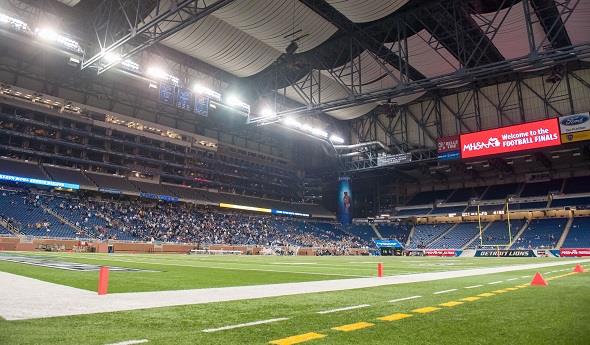
PHOTO: Ford Field is again the home of the MHSAA 11-Player Football Finals.