

Eriksen, Clarkston Finish 'Dream' Run
November 30, 2013
By Bill Khan
Special to Second Half
DETROIT — Ian Eriksen's senior season was slipping away.
And so was his lifelong dream.
Eriksen and his football-playing buddies in Clarkston talked about earning an MHSAA championship back when they were in elementary school and winning the Super Bowl of the Northern Youth Football League in Oakland County.
But after rushing for 2,167 yards and 33 touchdowns as a junior, Eriksen came into his senior year with Achilles and ankle injuries, then underwent arthroscopic surgery for a partially torn meniscus in his right knee on Sept. 19.
Four Friday nights passed with Eriksen in street clothes, unsure of when — or if — he'd ever rejoin his teammates in pursuit of their shared dream.
"That was really tough, because I've never been injured that seriously," Eriksen said. "It could've been a lot worse. I tried to be positive. All you can do is be positive rather than mope over it."
One positive out of the situation may be that Eriksen was fresh enough by the end of the playoffs to take on a heavy workload and help carry the Wolves to their first MHSAA football title.
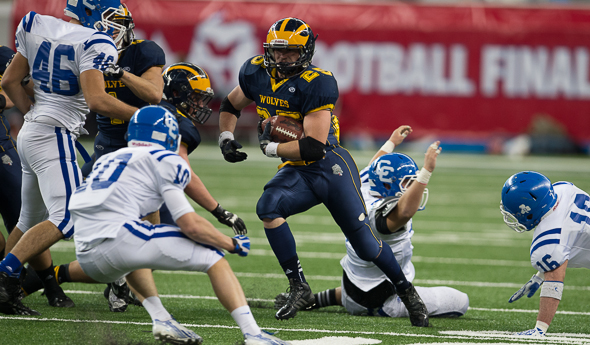
Eriksen ran 32 times for 237 yards and three touchdowns in Clarkston's 32-14 victory over perennial power Detroit Catholic Central in the MHSAA Division 1 championship game Saturday at Ford Field.
He also had a 30-yard catch to extend Clarkston's first touchdown drive, and a sack. In Clarkston's last two games, Eriksen ran 76 times for 592 yards and nine touchdowns.
"He gave us a lot of problems," said veteran Catholic Central coach Tom Mach, who has built a dynasty with the power-running game. "He was a very good running back. He would be a good running back in our program. We would've loved to have him. We had a lot of trouble tackling him. He got the extra yard and put in the extra effort.
“They kept the ball away from us, getting those first downs, getting those first downs, getting those first downs. That's frustrating on a team, especially when you do get the ball when you're a ball-control offense like us."
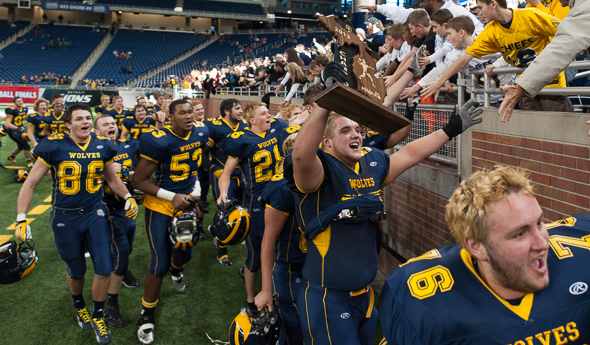
 Bringing Clarkston its first MHSAA championship was the fulfillment of a dream for Eriksen and his teammates after the program reached three Semifinals and made the postseason 16 times under 27-year coach Kurt Richardson.
"In Little League, there's a Super Bowl," Eriksen said. "We won the Super Bowl together in 2006 when we were in fourth and fifth grade. The next thing we started talking about was winning a high school championship if we could do it. We knew we could."
Eriksen and some of the players who delivered that championship were in the stands at Troy Athens four years ago when Clarkston lost by two points in a Semifinal to Sterling Heights Stevenson.
"I remember when that happened," Eriksen said. "Everyone in the community was just so upset about that. Me and the other guys were like, 'That's not going to happen to us when we get there.'"
Clarkston made Catholic Central settle for a third straight runner-up finish by stealing a page from the Shamrocks' script.
Led by Eriksen and an outstanding offensive line, the Wolves ground out 288 yards on 45 carries. They had a 27:58 to 20:02 advantage in time of possession.
"The offensive line doesn't get enough credit," Richardson said. "They deserve it for this one."
After a punt and interception ended Clarkston's first two drives, the Wolves scored touchdowns on their next five possessions.
Both teams had promising drives end with interceptions deep in the opponent's territory before Clarkston broke through for the game's first score with 13 seconds left in the first half.
Converting three times on third down and once on fourth, Clarkston moved 91 yards in 17 plays, taking 6:36 off the clock, before D.J. Zezula hit Shane Holler with a 15-yard touchdown pass on a post route. The extra point failed.
The key play on the drive was a 30-yard pass to Eriksen on third-and-12 from Clarkston's 15-yard line.
"We knew we had to score, because we got the ball to start the second half," Zezula said. "It was 0-0 and we knew we had to get up on CC. They brought in an extra (defensive back). The play-action with Ian helps me out a lot with time and the O-line helps me a lot with time. We knew the play-action would work."
Catholic Central's best drive of the first half came following the opening kickoff. The Shamrocks marched to the Clarkston 24 before Tim Cason intercepted a pass, only the second pick thrown by Catholic Central all season.
Jack Van Acker made two big plays to keep Clarkston out of the end zone on the Wolves' second possession. First, he made a touchdown-saving tackle on a 35-yard run by Eriksen to the Shamrocks' 10-yard line. Then, two plays later, he picked off a pass in the end zone after Clarkston moved to the 6.
A 63-yard punt by Zach Bock pinned Clarkston at its own 9-yard line with 6:49 left in the second quarter before the Wolves drove for the only touchdown of the first half. Clarkston's average starting field position on three first-half possessions was its own 10.
Armed with a lead and momentum, Clarkston took the opening kickoff of the second half and marched 80 yards in eight plays, taking a 12-0 lead on a 37-yard run by Eriksen with 8:18 left in the third quarter.
The lead reached 18-0 on a 1-yard run by Eriksen with 3:59 left in the third.
Catholic Central got on the board when Dylan Roney scored on a 2-yard run with 45 seconds left in the third quarter, cutting Clarkston's lead to 18-7.
The Wolves responded with a seven-play, 71-yard drive that ended on a 47-yard pass from Zezula to Caine Watlington with 8:35 left in the game.
The Shamrocks scored again on a 48-yard pass from Sean Birney to Alexander Bock with 5:46 left, but Clarkston again had an answer, with Eriksen scoring on a 12-yard run to cap the scoring with 4:06 left.
Zezula was 10 for 15 for 154 yards, two touchdowns and one interception. Birney was 13 for 23 for 166 yards, one touchdown and one interception.
Clarkston won its final 13 games after a season-opening loss to Rochester Adams, a loss the Wolves avenged in the playoffs.
"A lot of these kids have been playing together since fifth grade," Richardson said. "They've played Chiefs together, so they've come up through the junior ranks. We all felt this could be a special season. We had some issues at the start. We talked to the kids at the time about turning a negative into a positive. You're going to get slapped in the face in life. We got slapped in the face in the first game. They learned from it. It was a huge coming-together point for us as a team."
Catholic Central (11-3) became the third team to finish runner-up three straight years. Utica Eisenhower was the Division 1 runner-up from 1999-2001 and Crystal Falls Forest Park was the Division 8 runner-up from 2004-06.
The Shamrocks' 2012 runner-up team was led defensively by sophomore middle linebacker David Widzinski, who had a game-high 15 tackles. Less than two weeks later, he died in his sleep.
Tributes to Widzinski were visible at Ford Field. Catholic Central's uniforms had a patch with his No. 33 inside a shamrock. In the student section, some students wore white and formed a 33 within a field of blue shirts worn by the others. Widzinski's jersey hung on the wall on the Catholic Central sideline.
"We brought up David a lot," Mach said. "He was a force behind our team all year long. Every day after practice, we would say a prayer for him and the people in our community who are suffering. It was a real learning experience for our kids to put something bigger than themselves in place of winning and losing."
PHOTOS: (Top) Clarkston players trade high fives with fans as they march off the Ford Field turf with their first MHSAA championship trophy. (Middle) Clarkston running back Ian Eriksen runs through the reaching arms of Detroit Catholic Central defenders Saturday. (Click to see more from Terry McNamara Photography.)
Performance: Cass Tech's Rodney Hall
December 1, 2016
 Rodney Hall
Detroit Cass Tech senior – Football
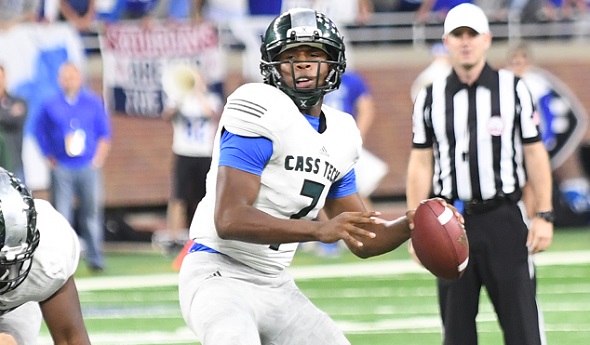
A year ago, Hall’s junior season ended on the Ford Field sideline, watching Cass Tech fall 41-27 to Romeo in the Division 1 Final after he suffered a lower leg injury two weeks before. But he came back this season fueled by championship motivation, and made it pay off. Hall threw for 220 yards and an MHSAA Finals record-tying five touchdown passes to lead the Technicians to a 49-20 win over Detroit Catholic Central in the Division 1 Final on Saturday and earn the Michigan National Guard “Performance of the Week.”
Hall started a pair of playoff games as a freshman before taking over the varsity fulltime in 2014 and leading Cass Tech to a 12-1 record. The Technicians were a combined 36-3 under him the last three seasons and scored a program-record 619 points (44.2 per game) this fall. The 6-foot-2, 210-pound signal-caller completed 10 of 18 passes in the Final and also ran for 58 yards on only seven carries. He finished this season 142 of 238 passing for 2,535 yards and 28 touchdowns, after a junior season when he threw for 2,232 yards and 20 touchdowns and ran for 1,053 yards and 14 scores.
 After admitting Saturday to being a little timid to run at the start of the fall, and with a steel plate still in his ankle, Hall ran for a combined 253 yards and three touchdowns over his final three playoff games. He has committed to sign to play football at Northern Illinois University but said he’s unsure which course of study he’ll pursue. MLive-Detroit reported Hall carries a 3.4 grade-point average in its feature on the Technicians standout as one of 10 finalists for MLive’s High School Football Player of the Year award.
Coach Thomas Wilcher said: Let's say it like this: He lost one game his first year, two games his second year, zero games his third year. That's enough said. ... I think the most important thing about Rodney Hall is you have to look at his stats. He has phenomenal stats. He has a phenomenal win-loss record. I haven't been around anything like that before. I just look at his game – (he's) the gamer. He's always bringing back a victory. We went down to the wire several times, and it was all about him. And I just told him this week, 'Look, I don't need you to run the ball. All I want you to do is throw the ball. You should throw the ball for over 300 yards.’ That’s it. And I told him, just stick with the game plan; no running. And I just kept telling the offensive coordinator, don't let him run. Let him throw it. That's it."
Performance Point: “Just to be able to make it back to this point and play in this game, I was just excited to come play, and glad we won,” Hall said. “The offense was clicking, and guys were open. They did the rest. I just put it to them. … (At last season’s Final) I was crying. I was hurt that I couldn't be out there to help my teammates. I wanted (this year) bad. We made history at Cass because I think we’re the first team to go 14-0 and win the state championship. We just wanted to win this game because we’ve been losing ever since we came into high school. We have a lot of wins, but we’ve been coming up short for the last three years – and it’s great to come out with the championship this year.”
Learning to run again: “I came in (to this season), I was a little timid to run, actually. I didn't want to get hurt again and miss this opportunity. Coach, he's been pressing me to run all year, and when I finally do, I get positive yards.”
 Star among the stars: “Quarterback is simple. You just have to keep everybody on the right track and make sure teammates don’t get down when we get behind. The last two weeks we’ve been losing, and I just remind my guys, ‘Come on, we can win this. We’re going to go back and score.’ Just remind them to keep scoring, remind the defense we’re going to keep getting stops, and just keep everybody’s heads up.”
Pass is present: “This year, I’ve been a way better passer. Because all offseason, I haven’t been able to run. I’ve just been working the pocket, making sure I’m looking at everything, making sure I’m reading the defense better. And I’ve had a better passing year this year, I believe.”
Leaving a legacy: “I just can’t believe it’s over with. I just want people to know I was a guy to go out there and give it all I’ve got. Just sell out for the team, and that’s what you should do – and you’ll end up a champion.”
- Geoff Kimmerly, Second Half editor
Every week during the 2016-17 school year, Second Half and the Michigan National Guard will recognize a “Performance of the Week" from among the MHSAA's 750 member high schools.
The Michigan Army National Guard provides trained and ready forces in support of the National Military Strategy, and responds as needed to state, local, and regional emergencies to ensure peace, order, and public safety. The Guard adds value to our communities through continuous interaction. National Guard soldiers are part of the local community. Guardsmen typically train one weekend per month and two weeks in the summer. This training maintains readiness when needed, be it either to defend our nation's freedom or protect lives and property of Michigan citizens during a local natural disaster.
Previous 2016-17 honorees:
Nov. 24: Ally Cummings, Novi volleyball – Read
Nov. 17: Chloe Idoni, Fenton volleyball – Read
Nov. 10: Adelyn Ackley, Hart cross country – Read
Nov. 3: Casey Kirkbride, Mattawan soccer – Read
Oct. 27: Colton Yesney, Negaunee cross country – Read
Oct. 20: Varun Shanker, Midland Dow tennis – Read
Oct. 13: Anne Forsyth, Ann Arbor Pioneer cross country – Read
Oct. 6: Shuaib Aljabaly, Coldwater cross country – Read
Sept. 29: Taylor Seaman, Brighton swimming & diving – Read
Sept. 22: Maggie Farrell, Battle Creek Lakeview cross country – Read
Sept. 15: Franki Strefling, Buchanan volleyball – Read
Sept. 8: Noah Jacobs, Corunna cross country – Read
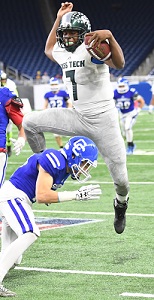
PHOTOS: (Top) Detroit Cass Tech's Rodney Hall prepares to unload a pass during Saturday's Division 1 Final at Ford Field. (Middle) Hall hurdles a would-be Detroit Catholic Central tackler.