

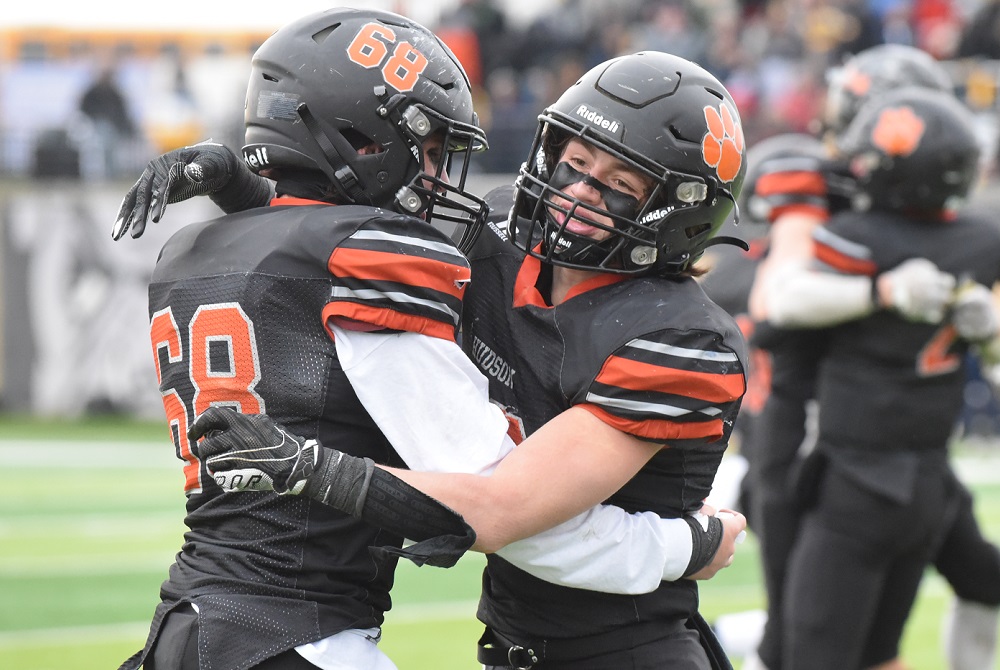
Father-Son Bond Helps Set Foundation for Hudson's Dominating Defense
By
Doug Donnelly
Special for MHSAA.com
November 23, 2021
HUDSON – Payton Rogers doesn’t remember the first time he went to a Hudson Tigers football game.
 That because he was about 6 months old.
“He was in a stroller,” said his father, Hudson head football coach Dan Rogers. “When he says he grew up around Hudson football, he means it literally. He was always on the sidelines with me. He was a ball boy by the time he was 5.”
Payton has a much different role these days. The 17-year-old senior is a starting linebacker, top tackler and emotional leader for Hudson’s powerful defense that will play for the Division 8 championship Friday at Ford Field against Beal City. Hudson is 13-0 and one of nine remaining undefeated 11-player teams in the state.
It’s little surprise that Payton grew up to be a great defensive player. His father had coached the Hudson defense for nearly two decades before becoming the head coach at the start of the 2020 season. The Tigers were coming off a 2-7 season during which several sophomores – including Payton – were pressed into starting roles because the team was so young.
Those five are still playing and now have starring roles.
“They all had a big part of our Semifinal win,” Coach Rogers said. “That was nice to see. They all started that sophomore season, and there were some rough times. That hard work is paying off.”
Payton was among those starters, although he was the starting nose tackle, despite being somewhat undersized.
“He got in there and got beat up a little bit,” Coach Rogers said. “That was his role. He was quick, and he always battled hard.”
After last season, when Hudson went 4-4, Payton told his dad he wanted to play linebacker this year. He worked the entire offseason on getting bigger, stronger, and faster so he would be ready for his new role.
The work was more than worth it.
Payton leads the team in tackles with 95 and solo tackles with 38. The 5-foot-6, 150-pounder is tied for the team lead in interceptions and second with six tackles for loss.
 “He will watch film with me and pick things out, what works, what he wants to do, what doesn’t work,” Rogers said. “If I don’t agree with something, I’ll tell him, but he’s the coach on the field. He makes our calls and gets kids into the right spots. He’s become really good at watching film and breaking things down.”
Studying – not just watching – game film has been a passion for father and son. Coach Rogers said he took some advice from other coaches he knew who had coached their sons, and he sets some restrictions on watching film with Payton.
“You have to pick a time where you are watching as a father and son and when you are watching as a coach-player,” he said. “We just put it out there. Before we start watching, it’s ‘okay, this is coach-player,’ and we watch. You have to do it that way.”
Payton said the two of them know when to talk football as coach-player and when to be father-son.
“I’d say we mix it up,” he said. “Tuesdays at Hudson has always been defensive film day. That goes way back, so I’ve always watched film with my dad. This year it became a little more important because I needed to know more about the keys and the other team. My dad always taught me little things about football, but this year, with watching film, he’s taught me so much.”
The Hudson defense has been outstanding from the start, posting seven shutouts in 13 games. From Week 4 through the Regional Final, Hudson gave up just two touchdowns total.
Five Tigers defenders have at least 50 tackles on the season – Cameron Kimble has 85, Austin Marry 65, Ethan Harris 53 and Bronson Marry 53. In the Semifinal game against Ottawa Lake Whiteford on Saturday, the Tigers gave up 22 points over the first 14 minutes, made some adjustments, then shut out the high-scoring Bobcats the rest of the game. They forced three turnovers along the way.
On Whiteford’s final drive, the Bobcats got inside the Hudson 5-yard line with 1.9 seconds to play, but the quarterback came up a yard short on a 4th-and-6 play. Harris and Nick Kopin made the stop, ending the Whiteford scoring threat and turning the ball over to Hudson for the final play of the game.
“Harris and Kopin were part of that group of sophomores,” Rogers said. “They made a great tackle on their quarterback.”
Beal City will bring an offense averaging 35.5 points a game into the championship against Hudson.
“It’s certainly going to be a challenge,” Rogers said. “They are big and physical.”
Hudson made back-to-back Finals appearances in 2009 and 2010. Payton had a front row look for both games, serving as the ball boy for the Tigers.
 “On 2009 and 2010 I was on the sidelines with my dad,” he said. “It’s such an honor to go back. I haven’t been there since then. I just want to enjoy it with my father and my team. It’s fun to be a part of.”
Payton wasn’t just handed the role of ball boy. He had to learn from older ball boys and move up into the ranks.
“I wanted to be on the sidelines with my dad,” he said. “I was ball boy all the way up until 2016.”
Hudson has a storied football history, most famous for the 72-game win streak during the 1960s and 1970s that drew national attention. One of the players on the 1975 team was Chris Luma. Luma would go on to coach Hudson, stepping down after the 2019 season. He was the coach who brought Rogers onto the staff. This season, Luma has a seat in the Hudson coaches box, talking in the ear of Rogers and other coaches about what he sees on the field.
It's a continuation of the Hudson football community and family. Roots run deep in Hudson, and the football team is usually top of mind.
Rogers is part of that family. The 1992 Hudson graduate – yes, he played for the Tigers – will not only have his son Payton on the field, but his younger son, Harper, 8, will be the ball boy for the game. His wife, Lindsey, and daughter Mia, 13, will be in the crowd.
“Everything is family around Hudson,” Payton said. “Our team has grown up together, and this year there have been so many people at our games, past players and guys we used to look up to. It’s been great seeing them come back for games.”
While a trip to the Finals is nothing new for the Tigers – Friday will be their fifth all-time appearance – it’s always a big deal in Hudson.
“I’m so happy for these kids and this community,” Coach Rogers said. “It’s a special thing to be a Hudson football player and live in Hudson and coach. The players are rewarded, and the whole community really supports the team. I’m just so happy for everyone right now.”
 Doug Donnelly has served as a sports and news reporter and city editor over 25 years, writing for the Daily Chief-Union in Upper Sandusky, Ohio from 1992-1995, the Monroe Evening News from 1995-2012 and the Adrian Daily Telegram since 2013. He's also written a book on high school basketball in Monroe County and compiles record books for various schools in southeast Michigan. E-mail him at [email protected] with story ideas for Jackson, Washtenaw, Hillsdale, Lenawee and Monroe counties.
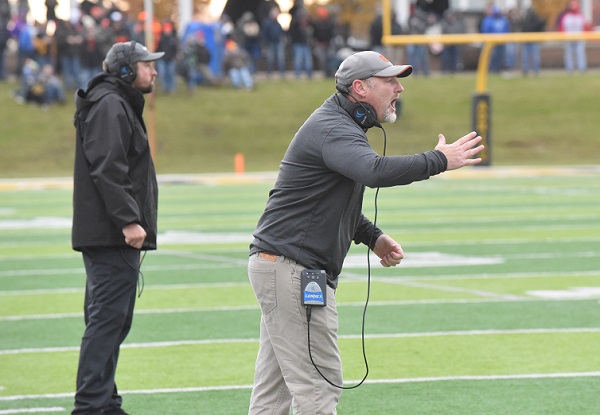
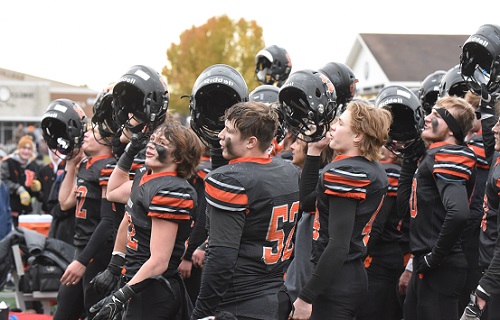
PHOTOS (Top) Hudson senior Payton Rogers (22) hugs junior Calix Campbell after Saturday’s Semifinal win over Ottawa Lake Whiteford. (Middle) Hudson coach Dan Rogers (right, with assistant Jacob Bovee) provides instruction from the sideline. (Below) The Tigers celebrate their Semifinal win. (Photos by Deloris Clark-Osborne.)
A Game for Every Fan: Week 5
September 24, 2015
By Geoff Kimmerly
Second Half editor
Halftime of this weekend’s games will mark the midway point of the 2015 football regular season.
And the final results this Friday and Saturday could prove to be turning points for a number of teams playing for league titles all over the state.
The Week 5 slate is filled with matchups of teams tied for first place in their respective leagues, plus others pitting leaders against those in second and hoping to move up. The report below touches on many, but not all of these – tune in to the Score Center this weekend for scores and updated standings as those games are decided.
Bay & Thumb
Frankenmuth (4-0) at Millington (4-0)
The latest chapter in this Tri-Valley Conference East rivalry should again decide the champion. Millington handed the Eagles their only loss of the 2014 regular season – although these two then shared the title with Birch Run after the Panthers beat the Cardinals. Millington has won nine of the last 15 meetings, but Frankenmuth holds a slim 22-20 edge going back to their first reported meeting in 1956.
Others that caught my eye: Almont (4-0) at Richmond (4-0), Mount Pleasant (3-1) at Lapeer (4-0), Flint Powers Catholic (3-1) at Midland Dow (3-1), St. Clair Shores South Lake (4-0) at Marine City (3-1).
Greater Detroit
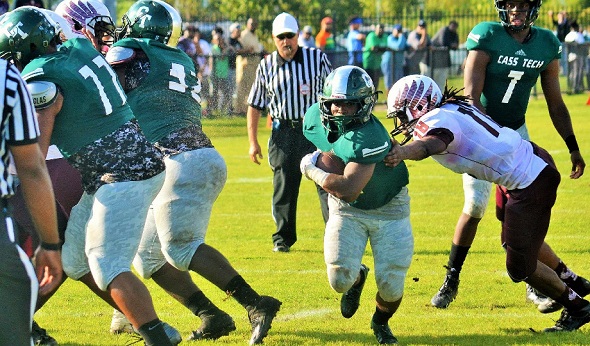
Detroit Cass Tech (4-0) at Detroit Martin Luther King (4-0)
This Detroit Public School League rivalry game always is anticipated, but this season more than most. King’s only regular-season loss last season was to Cass Tech, in the PSL championship game; the Crusaders then saw their season end in the first round of the playoffs the next week. However, they opened this fall by beating reigning Division 2 champion Warren DeLaSalle. Cass Tech hasn’t lost a regular-season game since Week 8 of 2012 – to King – but despite dominating four opponents that had winning records a year ago, might be behind the Crusaders in terms of generating statewide buzz.
Others that caught my eye: Warren Mott (4-0) at Clinton Township Chippewa Valley (3-1), Belleville (3-1) at Dearborn Heights Robichaud (4-0), Southfield (3-1) at Farmington Hills Harrison (3-1), Warren DeLaSalle (3-1) at Orchard Lake St. Mary's (4-0).
Mid-Michigan
Olivet (3-1) at Lake Odessa Lakewood (4-0)
Lakewood has plenty of history it would like to still make, but consider this from the Vikings’ start: they are 4-0 for the first time since 1974. Those four wins tie the total for all of last season and tie the team’s most for a season since 2005. Lakewood’s 176 points through four games is more than they scored during 14 of the last 20 seasons. But Olivet certainly can dampen the excitement by winning tonight’s Greater Lansing Activities Conference matchup, like the Eagles did last season 42-9 on the way to winning the league title.
Others that caught my eye: Jackson (3-1) at Grand Ledge (4-0), Flint Beecher (4-0) at Corunna (3-1), Haslett (3-1) at Mason (2-2), Holt (2-2) at East Lansing (2-2).
Northern Lower Peninsula
Boyne City (4-0) at Traverse City St. Francis (4-0)
By the smallest of margins, this game gets top billing over two others matching undefeated teams. For starters, Boyne City won the matchup last season 28-27 – and eventually, the Northern Michigan Football Conference Leaders division title. The Ramblers then made the Division 6 Semifinals, and then graduated a significant group of contributors – but has come back to shut out two of its first four opponents. Then again, St. Francis didn’t give up a point this season until last week and is sparking statewide chatter like its contending teams of a few years ago.
Others that caught my eye: Gaylord (4-0) at Traverse City Central (4-0), St. Ignace (4-0) at Johannesburg-Lewiston (4-0), Onekama (4-0) at Maple City Glen Lake (3-1), McBain (3-1) at Manton (2-2).
Southeast & Border
Clinton (4-0) at Morenci (4-0)
Morenci won 10 games last fall for the first time since 1996 – but the only blemish on an otherwise incredible regular-season run was a 28-26 loss to Clinton that ended up deciding the Tri-County Conference championship. All four of the Bulldogs’ wins this season are against teams .500 or better so far, lining this up as again a likely league title decider – Clinton has shut out two of its first four opponents and won 31 straight regular-season games.
Others that caught my eye: Brooklyn Columbia Central (4-0) at Ida (4-0), Monroe (3-1) at Ann Arbor Pioneer (4-0), Chelsea (4-0) at Tecumseh (2-2), New Boston Huron (2-2) at Milan (3-1).
Southwest Corridor
Berrien Springs (4-0) at Bridgman (4-0)
Both of these programs have enjoyed recent success; Bridgman has made the playoffs three straight seasons, and Berrien Springs made the postseason last year and two of the last four. But there’s a little more intrigue although these teams don’t play in the same division of the Berrien-Cass-St. Joseph Conference. Bridgman has never started 4-0 – and looks like the BCS Blue favorite. Berrien Springs likely will battle Buchanan in the BCS White and hasn’t allowed a point in two weeks, most recently shutting out BCS Red favorite Cassopolis.
Others that caught my eye: Saugatuck (4-0) at Decatur (3-1), Dowagiac (3-1) at Edwardsburg (4-0), Jackson Lumen Christi (4-0) at Marshall (3-1), Sturgis (3-1) at Vicksburg (3-1).
Upper Peninsula
Lake Linden-Hubbell (4-0) at L'Anse (3-1)
The Lakes are used to success and have made the playoffs nine of the last 11 seasons – but are 4-0 for the first time since winning 10 games in 2009 and on pace to score their most points since 1997. L’Anse has bounced back from 4-5 a year ago but has a tough schedule over the season’s second half – and would enjoy the momentum from playing a tough opponent well this weekend.
Others that caught my eye: Crystal Falls Forest Park (2-2) at Newberry (3-1), Detroit Country Day (3-1) at Escanaba (2-2), Ishpeming Westwood (2-2) at Iron Mountain (2-2), Felch North Dickinson (1-3) at Bark River-Harris (4-0).
West Michigan
Montague (4-0) at Whitehall (3-1)
The season’s first half has been one of resurgence for Montague, one of the state’s most successful programs during the first decade of the 2000s. The Wildcats are 4-0 for the first time since 2010 and after going only 2-7 a year ago. They’re giving up points, but scoring more including 70 on Ravenna and 55 against Shelby. Whitehall did fall by a score to undefeated Traverse City Central last week, but otherwise navigated well a solid nonleague slate – and beat Montague 48-20 a year ago.
Others that caught my eye: Hudsonville Unity Christian (3-1) at Byron Center (3-1), Grand Rapids Christian (3-1) at Hudsonville (3-1), Zeeland East (3-1) at Muskegon Mona Shores (4-0), Caledonia (2-2) at Rockford (2-2).
8-Player
Posen (4-0) at Pickford (3-1)
Pickford should be finding 8-player football to its liking so far. The Panthers, in their first season, have one more win than they earned all of 2014 and have lost this fall only to reigning MHSAA runner-up Cedarville. Posen has shown to be in a similar elite class so far, especially after last week’s 30-point win over always-tough Bellaire – and the Vikings have guaranteed tying their best finish since 2010.
Others that caught my eye: Webberville (4-0) at Waldron (4-0), Owendale-Gagetown (4-0) at Akron-Fairgrove (3-1).
PHOTO: A Detroit Cass Tech ball carrier breaks through during the Technicians’ win this season against Detroit Renaissance. (Photo courtesy of Detroit Public School League.)