

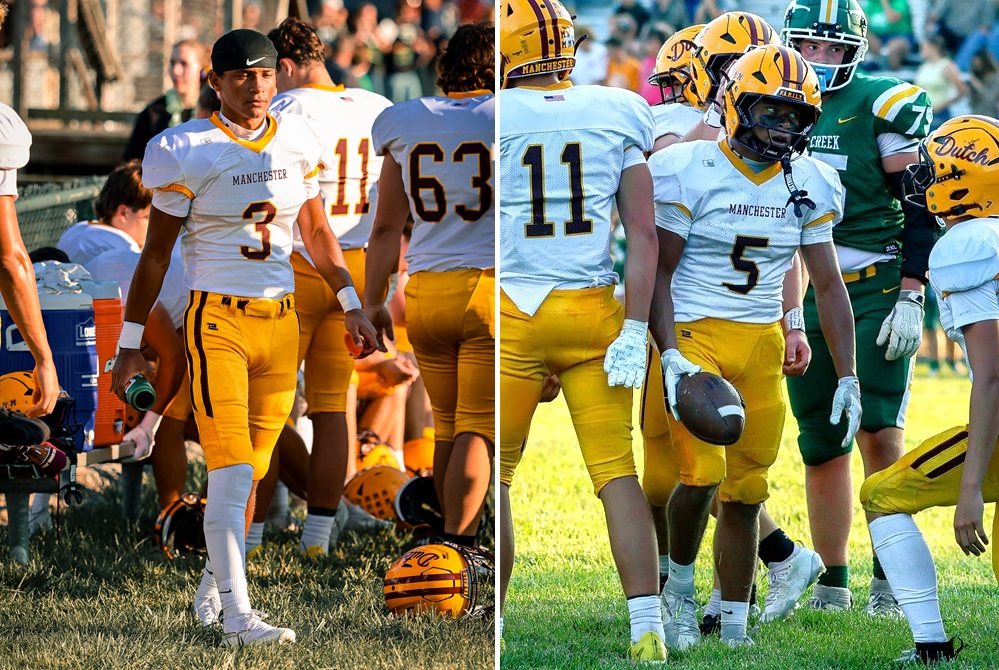
Finally on Field Together, Johnson Twins Form Prolific Pair in Manchester Backfield
By
Doug Donnelly
Special for MHSAA.com
November 11, 2026
When Donte Johnson was a freshman, he was called up to the Manchester varsity football team. At first, he was a fifth-quarter player, moving up from the junior varsity to also play one quarter in the varsity’s games. He eventually made the Flying Dutchman special teams lineup.
 Jayden Johnson, his twin brother, didn’t play varsity as a freshman, but stepped in as a sophomore when the projected Manchester starter at his position got hurt. Jayden responded with a great fall. Unfortunately, Donte missed that fall due to a knee injury suffered during basketball season.
As juniors, big things were expected from the duo, but injuries slowed Donte, and Jayden struggled as part of a very young Manchester team.
This season, seemingly out of nowhere, the two blossomed into the dynamic duo, both recording 1,000-yard rushing seasons for a 7-4 Manchester team that played in the Cascades Conference championship game and made the Division 8 playoffs. The trigger was a new offense installed in the offseason as the Flying Dutchmen went from the T formation to the single wing.
“I really liked the offense a lot more,” Jayden said. “I feel like it was meant for us. The T didn’t let our players use their full ability. With this team, this was perfect because we had a lot of speed.”
Donte agreed.
“I think it was interesting,” he said. “We knew we were going to run a different offense, but Coach really didn’t tell us until we went to the Olivet camp. I think it was the best change we could have done.”
Joshua Lindeman, who just completed his third season coaching the Flying Dutchmen, said seeing the Johnson twins together on the football field and playing at such a high level was great not only for the team, but for them as individuals as well.
“I think, because of some of the things they have gone through in the past, football and sports have become part of their identity,” Lindeman said. “To see them together, on the football field, finally, was a great thing to see. They couldn’t be more different, but they genuinely love each other and are great young men.”
The twins are from Manchester, where they have family, including grandparents. At a young age, they moved to northwest Tennessee. They returned to the Manchester area as fifth graders but had to reclassify as students and had different classmates from when they left.
“We had the choice of where we wanted to go to school, but we chose Manchester,” Jayden said. “It had always been home.”
Over the last 18 months, the two were adopted by their aunt, the sister of their mother.
“Sports has been their constant,” said Lindsey Beerens, their aunt. “It was a bad deal for them for a long time, but sports helped them. They moved around a lot when they were younger.
“This year, it was great to see them healthy and playing together. They are so supportive of one another.”
Lindeman said while the twins were both running backs, they couldn’t be more different off the field.
Donte, he said, is the one who talks more frequently, always with something on his mind.
“He is like the donkey from Shrek,” Lindeman said. “I’ve learned that is just who he is. He talks all of the time. It drives Jayden nuts.”
Jayden, on the other hand, is the more reserved of the two, but is also more open to talking about things he has gone through personally.
“If I had a dime for every time I had to tell those two to leave each other alone, I would be driving a much better car,” Lindeman said.
Ultimately, the two are great teammates – to each other and the rest of the team.
“One thing you will see, even though they can be bickering at each other at practice all week or in a game, when the other makes a play, the happiest guy on the field is the other one,” Lindeman said. “The celebration and joy they have over each other’s success is great. If you talk to them, like after Donte makes a good run, Jayden will say something like, ‘I’d (have) made it look better.’ But he has true joy in his heart and is happy for him.
“They are two competitive souls with each other.”
Jayden said Lindeman’s arrival helped spark a change in not only him but the team and community.
“There was a noticeable change,” he said. “I feel like he is pulling everyone together. We are one big family now. The community feels so much closer. Everyone is involved. We have so much support, dads from the community come out every Friday and help set up stuff.
“We have a motto – Family means Forget About Me, I Love You – and I think that pulls everyone together. It makes me want to work hard for everyone around me.”
Donte said he and his brother started playing tackle football at age 8 while they were in Tennessee. They play other sports – Jayden focuses on indoor track in the winter and outdoor track in the spring, and Donte is planning to play baseball this upcoming season – but football has been their main sport for as long as they can remember.
Lindeman said there was a time when he wasn’t sure Donte would play football again, which is one of the reasons this past season was so much fun.
“I watched film of him as a freshman and I thought, ‘There’s my starting quarterback for the next three years,’” Lindeman said. “Then, when I met him, he was hobbling around because of his knee. He sat on the couch in my office at one point and said he wasn’t going to play. When he came back and started playing, you could see his confidence. His whole personality started to shine.”
Together, the twins did more than just lead the Manchester football team to a great season. They lifted up everyone around them.
“They genuinely love each other,” Lindeman said. “It’s been special to watch how both of them were good for us this year because of what they’ve gone through. To watch both of them to do it together was very cool.”
 Doug Donnelly has served as a news and sports reporter at the Adrian Daily Telegram and the Monroe News for 30 years, including 10 years as city editor in Monroe. He's written a book on high school basketball in Monroe County and compiles record books for various schools in southeast Michigan. He is now publisher and editor of The Blissfield Advance, a weekly newspaper. E-mail him at [email protected] with story ideas for Jackson, Washtenaw, Hillsdale, Lenawee and Monroe counties.
PHOTOS (Top) At left, Jayden Johnson, and right, twin Donte Johnson, were both 1,000-yard rushers for Manchester this season. (Photos by Tyler George).
'22 Game' Lasts 2 Plays, Lives on
By
Ron Pesch
MHSAA historian
October 26, 2015
What would you do with 22 seconds to right a wrong?
In Michigan, the longest football game in high school sports history was played on September 23, 1977 when Detroit Southeastern defeated Detroit Northeastern 42-36 in nine overtimes.
But what is the shortest?
On the evening of Thursday, Nov. 5, 1953, Eaton County foes Bellevue and Vermontville squared off in a Tri-C Conference battle. It was a home contest for Vermontville, but without illumination at its field, the game was staged just west beneath the lights at Nashville High School in Barry County.
The dominant team in Tri-C play over the previous three years, Bellevue’s Broncos had posted three consecutive undefeated seasons from 1950 and 1952. However, graduation took its toll and with only five returning veterans in the fall of 1953, Bellevue lost its nonconference season opener to Homer. The Broncos had also dropped a pair of league contests, to Lake Odessa and Olivet, just prior to the Vermontville game, and entered with a 4-3 record.
Vermontville brought a 4-2 mark into the contest, and was in a four-way tie with Bellevue, Nashville and Lake Odessa for second in the conference.
The Broncos and Wildcats were evenly matched and played to a scoreless tie in the first half. Vermontville opened up a 6-0 lead on a 20-yard end sweep by the Wildcats’ quarterback Pete Benton in the third quarter, but entered the final minutes of the game trailing 12-6 thanks to a TD run by Bellevue’s Jim Smith and an early-fourth quarter scoring pass from Smith to Bob Babbitt.
Coach Dave McDowell’s Wildcats mounted a long final drive, and fans strapped in for a thrilling finish. Pushing deep into Bellevue territory, Vermontville faced a fourth down and eight from the 16-yard line with under a minute to play when Benton launched a desperation pass to the end zone.
The pass fell incomplete, but Bellevue was flagged for pass interference. Officials stepped off the penalty and awarded Vermontville the ball at the one-yard line, but the Wildcats’ plunge into the line fell an inch short on what was called a repeated fourth down play. Vermontville took possession and ran out the clock.
Following the game, Coach McDowell protested the ruling to officials, correctly stating that his team should have been awarded an automatic first down and goal from the 1-yard-line on the penalty, according to high school rules. Appealing the call, the situation was brought to the attention of the league, MHSAA executive director Charles Forsythe and the MHSAA athletic board.
On Wednesday, Nov. 11, the state athletic board agreed an error had been made, but did not order a replay. Instead, they noted three possible solutions:
- Result left as it was.
- Called a no contest.
- Replay it at the point of infraction.
The board moved a final decision back to the league. Because of the possible impact on the final conference standings, and eventually, the awarding of the league’s all-sports trophy, the Tri-C Conference opted to replay the contest from the point of infraction – the 1-yard line – with 22 seconds placed on the clock.
 The news of the league’s decision was blasted out by the news services nationwide, and immediately, the pending replay of a small town contest captured the imagination of reporters and sports fans across the United States.
“Shortest ‘Game’ in History?” read the headline in the Lexington, Kentucky Herald. From Biloxi, Mississippi, to Boston, Massachusetts, from Rockford, Illinois to Omaha, Nebraska and Seattle Washington, sports aficionados read the news about the error. Best of all, details flowed forth on the plan to replay critical seconds that might alter the result, fulfilling every fan’s dream.
So began the longest huddle in history.
“What would you do?” was the question on the lips of coaches and followers in barber shops and factories. Detroit Free Press writer George Puscas asked that very question to some of Michigan’s top coaches.
Detroit Lions coach Buddy Parker offered his advice to Vermontville’s coach McDowell.
“The other team will be expecting a run,” noted Parker, “so I would fake a run off tackle then throw a pass in the other direction – with three receivers downfield.”
Michigan State’s legendary Biggie Munn stated the obvious:
“Call a scoring play.”
University of Michigan head coach Bennie Oosterbaan was tied up preparing for the Wolverines’ upcoming contest with MSU, so instead U-M end coach Bill Orwig weighed in with a tongue-in-cheek recommendation:
“Take the time out.”
Earl “Dutch” Clark, in charge at the University of Detroit, suggested that McDowell diagram “two of the most unusual offensive formations … anything to confuse the defense. The first play should be a running play and if it didn’t work, take time out then try again.”
Wayne University’s coach Lou Zarza was the most specific of them all.
“On a goal line stand, the defense usually drifts toward the middle. So I would fake the ball to the right halfback on a slant, then send the fullback with the ball wide to the right, outflanking the defense. It’s a good goal line play on the T formation.”
Suggestions came from all over. A gentleman in Syracuse, New York, even penned a personal letter to McDowell with a sure-fire suggestion.
Three days after the 1953 prep season had officially ended, on the afternoon of Monday, Nov. 16, the same officiating crew and the Vermontville and Bellevue squads emerged and again travelled to Nashville to line up for what can arguably be called the shortest – or perhaps the longest – game in high school football history.
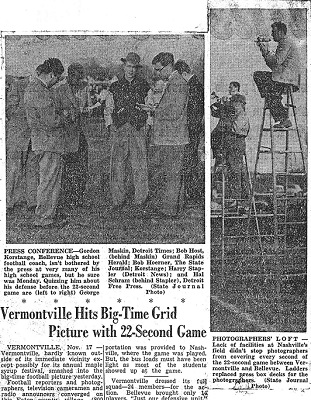
Reporters from Detroit, Grand Rapids, Lansing and Battle Creek converged on the city for 22 seconds of football. High school reporting legends Hal Schram of the Detroit Free Press, Bob Hoerner of the Lansing State Journal, George Maskin of the Detroit Times, Harry Stapler of the Detroit News and writers from the Associated Press and United Press International all descended upon mid-Michigan, “almost as if the Rose Bowl was to be played.”
“That game brought more publicity to coach Gordon Korstange’s 6-3 squad then his teams received for posting three consecutive unbeaten seasons in 1950, 1951 and 1952,” recalled 80-year old Burton H. Brooks, who was the only reporter who had covered the original contest, and one of many covering the replay. A graduate of Bellevue, he was a freshman at Michigan State at the time, earning money as a sports stringer for the Bellevue Gazette and Charlotte Republican Tribune.
Beneath sunny skies, “a crowd of over 500 fans and curiosity seekers, most of them attired in shirt sleeves, lined the field on both sides near the east end of the Nashville gridiron,” wrote Brooks, many years later. “At 5:00 the shrill blast of an official’s whistle split the air, announcing time for the game.”
Attendance was way up from the original contest, and in an unusual move for the time, Kalamazoo television station WKZO announced that they would send a crew to Nashville and then televise the game – (all 22 seconds of it!) – Tuesday evening. In addition, 10 newspaper photographers were on site to capture images from the game.
While the size of the crowd was up, turnout on the football squads had decreased. Vermontville dressed its full squad of 24 for the showdown, but kept out two regular tackles and his first-string quarterback, as all had been on the injured list at the end of the first clash.
Meanwhile, Bellevue brought only 14 players.
“Just our defensive unit and enough to run back the kickoff,” Korstange told the Lansing State Journal, prepared for a situation that could arise if Vermontville scored.
“Three of the defensive starters had decided to go deer hunting instead,” said Brooks discussing the shortened game, “so Bellevue needed to call up some kids for the game from the junior varsity squad.”
“Bellevue won its sixth game of the year, downing Vermontville in a sensational goal line stand in the famous ‘22’ Game” at Nashville last Monday,” wrote Brooks in the Bellevue Gazette. “Coach Dave McDowell’s Wildcats ran two plays against Bellevue, but couldn’t dent the solid Bronco defense. On the first play the Wildcats sent big Bob Steward up center, but he was driven back a yard by the entire center of the Bellevue line.”
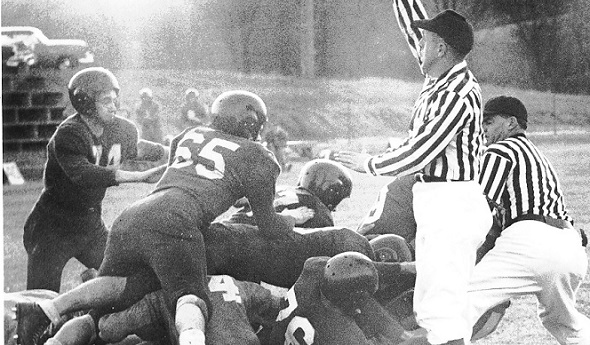
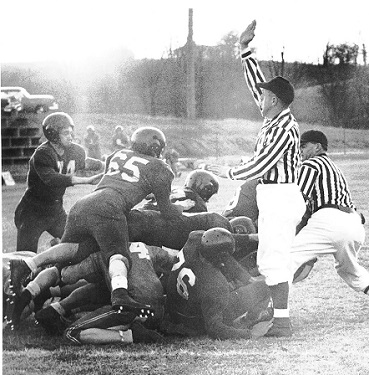 Following a timeout, the Green and White tried to sneak quarterback Pete Benton across the line to the left of center as the ball carrier on the second play, but the hole was quickly plugged by tackle Donald Rogers and guard Jerry Babbitt. Steward had been stopped by Bellevue guard Wayne Lesser. Dale Spotts, Bob Babbitt, Harold Messenger, Ralph Hales, Dick Moon, Jim Smith, Gordon Smith, and Ed Bessemer filled the other defensive spots and ensured the result of the first game went unchanged.
Once again, the wire services blasted their report from sea to shining sea.
“Officials Didn’t Rob Vermontville Team” screamed the headline in the Miami Daily News. Beneath an AP photo, residents of the Florida town were treated to a detailed account of the contest.
“Prep Grid Game Ends Same Way Following 11-Day Break” read the caption in the Dallas Morning News in football-crazed Texas.
“Replayed Grid Game Ends with the Same Result as Before,” read the headline in the Seattle, Washington, Daily Times.
As noted at the time, it certainly wasn’t the first, nor would it be the last, that a refereeing crew made a mistake in a game. Fans then, like now, were reminded officials are only human.
Bellevue ended the extended season in a tie for second with Lake Odessa, with 5-2 marks. For the first time in league history the Tri-C gridiron championship was awarded to Olivet, which, at 8-0, posted its first unbeaten season and, as it turned out, unseated Bellevue for the league’s 1953-54 all-sports trophy.
More than 60 years later, a forgotten showdown between high school football teams, played out before national attention in little Nashville, Michigan, still stands as one of the most entertaining and unusual sports moments in the history of America.
 Ron Pesch has taken an active role in researching the history of MHSAA events since 1985 and began writing for MHSAA Finals programs in 1986, adding additional features and "flashbacks" in 1992. He inherited the title of MHSAA historian from the late Dick Kishpaugh following the 1993-94 school year, and resides in Muskegon. Contact him at [email protected] with ideas for historical articles.
PHOTOS: (Top and below) What's believed to be a Battle Creek Enquirer photo shows one of the goal line stands by the Bellevue defense against Vermontville. (Middle) The Lansing State Journal reported on the nationwide reporting of the "22-second game."