

Football: 8 is More than Enough
By
Geoff Kimmerly
MHSAA.com senior editor
November 18, 2011
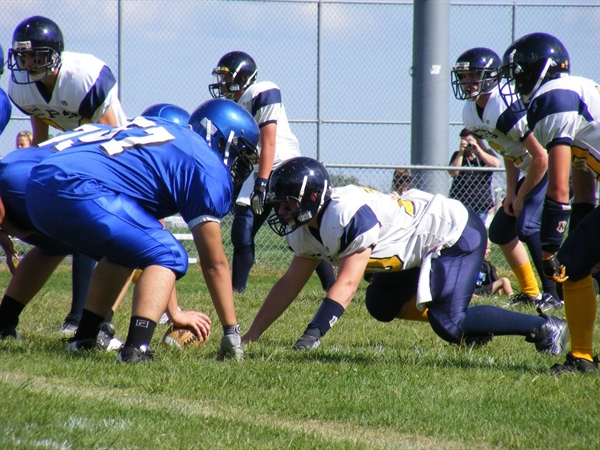
Carsonville-Port Sanilac has been all in since the beginning of 8-player football as an MHSAA sport three seasons ago.
Rapid River made the switch just this season.
But heading into tonight's first-ever MHSAA Final for the sport, both programs can claim similar rewards from embracing this adjusted version of the state's most popular high school sport.
Despite small enrollments, they can still play the game. And although they've struggled at times in recent years, both teams are winning -- and reaping all of the community support and good vibes that come with success.
Both 11-1, Carsonville-Port Sanilac and Rapid River kick off for the championship at 7 p.m. at Northern Michigan's Superior Dome.
"We can't be happier to have the opportunity to play (8-player) this year. The added success has really brought our team together, and I hope it ends on a good note," Rapid River coach Steve Ostrenga said. "It's great for the kids and great for the community. You always talk about hard work. But when we were 1-8 ... the kids who have been through those tough times, I think they appreciate it more."
Both teams can value that statement.
Rapid River won one game each of the last two seasons and hadn't reached the playoffs since 2002. The school has roughly 120 students now -- 40-50 fewer than when it was having its last run of success near the end of the 1990s.
Carsonville-Port Sanilac went 0-9 before leading the charge into 8-player football in 2009. Although the Tigers had made the playoffs as recently as 2005, winning seasons for the team had been few and far between. But Carsonville-Port Sanilac went undefeated a year ago and beat Bellaire in an unofficial state "championship" game that matched the Tigers -- winners of the Mid-Michigan 8-man Football League -- against the winners of the Bridge-Alliance 8-man Conference.
"It's changed the whole culture of the school," said C-PS coach Tim Brabant, who is in his second season running the program and graduated from the school in 2006. "At first, a lot of people didn't buy into it. But as we went undefeated last year, and with what we've done this year, we've gotten complete community support and a buy-in across the board."
Recently, that's included 240 people showing up at last week's pancake breakfast to raise money for this weekend's trip to Marquette. Tigers supports also filled two fan buses headed to NMU.
Both coaches also listed a similar adjustment teams that play 8-player football must make: Strong open-field tackling is a must.
Although the field is only 40 yards wide -- instead of the usual 53 -- having six fewer players on the field opens up the offense significantly. Rapid River has scored more than 60 points four times and Carsonville-Port Sanilac put up 70 and 91 in games this fall. Both average 51 points per contest. Ostrenga grew up in Menominee -- known for its single wing offense that doesn't use a quarterback -- but has embraced a spread passing attack that allows for opportunities all over the field.
Both teams suffered their only losses when their quarterbacks were injured briefly in September. Depth always is an issue when numbers are low.
That said, success in this version of the game has planted some roots for the future. C-PS had 50 players out for elementary teams this fall and hopes to have enough down the road for a full junior varsity. Rapid River thinks the move to 8-player will help it sustain the program despite enrollment losses of the last few years.
And the historical context of tonight's game is not lost on either team.
"They understand that. We were the first team in the state of Michigan to have a full 8-man roster," Brabant said. "A lot of people thought we were crazy. These kids understand what's at stake."
(Photo courtesy of Carsonville-Port Sanilac football program)
Drive for Detroit: Week 8 Preview
October 12, 2017
By Geoff Kimmerly
Second Half editor
This is the way it’s supposed to finish.
 With the random ordering or yearly rotating that spits out most league schedules, any week of the regular season might feature the game that ends up deciding those conferences’ championships. But this fall, we’re lucky.
At least 19 games among those listed in our Week 8 preview below have the opportunity to affect league title. Three of our nine featured matchups pit teams that haven’t lost yet with only two games left until the playoffs begin. And undefeated Pickford kicked off the week Thursday with a 47-8 title share-clinching win over Cedarville in the 8-player Bridge Alliance League.
Continue to follow all the results, league standings and real-time updating of playoff point averages with our MHSAA Score Center, and check out MHSAA.tv for nine live broadcasts tonight – click here for the schedule. Drive for Detroit is powered by MI Student Aid.
Bay & Thumb
Midland Dow (6-1) at Flint Carman-Ainsworth (5-2), Friday
At the end of the day, figuratively speaking, the one-time favorites in the Saginaw Valley League Red are playing for the championship after all and for the second straight season. Carman-Ainsworth opened this fall 1-2, but both losses were nonleague – and it will finish the weekend with a share of the title regardless of this outcome. But Dow, which dropped its league opener to Bay City Central by a point on Sept. 1, can also gain a share by avenging last year’s seven-point loss to the Cavaliers that also decided the Red winner.
Others that caught my eye: FRIDAY Algonac (6-1) at Richmond (7-0), Lapeer (5-2) at Midland (6-1), Alma (6-1) at Saginaw Swan Valley (6-1), Warren Woods Tower (6-1) at Port Huron Northern (6-1).
Greater Detroit
Detroit Cass Tech (5-1) vs. Detroit Martin Luther King (6-1) at Detroit Northwestern, Saturday
Although this is just a semifinal in the Detroit Public School League tournament, these two may be the best of the field – although undefeated East English and Detroit Renaissance, the other semifinalists, surely will put up an argument over the next two weeks as well. After two years in the same PSL division, King and Cass Tech were split up again this fall, and both won division titles and remain MHSAA title contenders as well after Cass Tech won Division 1 last year and King Division 2 in 2016 and 2015. Their only losses this season are to out-of-state teams, and together they’ve given up only 60 points over a combined nine games of league play.
Others that caught my eye: FRIDAY Detroit Catholic Central (5-2) at Warren DeLaSalle (5-2), Macomb Dakota (5-2) at Romeo (5-2), Redford Thurston (5-2) at Dearborn Fordson (6-1), SATURDAY Detroit Mumford (5-2) vs. Detroit Central (5-2) at Detroit Northwestern.
Mid-Michigan
Beaverton (7-0) at Harrison (5-2), Friday
Beaverton must dominate the best of Clare County over the next two weeks to do something no Beavers team has done this century. They sit tied with Week 9 opponent Clare for first place in the Jack Pine Conference while pursuing a first league title since 1989. Next week’s tilt with the Pioneers could be one of the state’s most intriguing regular-season finales – but will fall back to just one of many important games if Beaverton can’t get past third-place Harrison first. The Hornets’ only league loss was to Clare in Week 5.
Others that caught my eye: FRIDAY Berrien Springs (6-1) at Olivet (7-0), East Lansing (5-2) at Lansing Sexton (5-2), Morley Stanwood (6-1) at Beal City (4-3), Haslett (5-2) at Williamston (5-2).
Northern Lower Peninsula
Gaylord St. Mary (7-0) at Harbor Springs (4-3), Friday
The winner tonight claims a share of the Northern Michigan Football League Legacy championship, and host Harbor Springs shouldn’t be considered too much of an underdog despite the disparity in overall records. The Rams finished second in the Legacy last season and have made the playoffs in two straight, and earned that 2016 runner-up finish in part with a 38-24 win over the Snowbirds. That said, St. Mary turned back a good challenge from rival Johannesburg-Lewiston last week and has had only one opponent come within double digits – recently surging Newberry in Week 2.
Others that caught my eye: FRIDAY Lincoln Alcona (6-1) at Lake City (7-0), Boyne City (7-0) at Elk Rapids (6-1), Traverse City West (7-0) at Gaylord (4-3), Birmingham Brother Rice (4-3) at Traverse City Central (5-2).
Southeast & Border
Ottawa Lake Whiteford (7-0) at Clinton (5-2), Friday
With four league opponents still alive for playoff bids, Whiteford wasn’t going to get much of a break this season coming off last year’s Division 8 runner-up finish. But the Bobcats have handled every challenge with complete success, beating all seven opponents this season by at least 32 points. Clinton was the last team to hand Whiteford a league loss, in Week 9 of 2015, and the Redskins are tied for second in the TCC and riding a three-game winning streak. A win tonight will guarantee Whiteford a share of the league title, but a victory could eventually mean one for Clinton too with a winless opponent coming up in Week 9.
Others that caught my eye: FRIDAY Michigan Center (6-1) at Grass Lake (4-3), Ida (6-1) at Hillsdale (3-4), Detroit U-D Jesuit (3-4) at Ann Arbor Gabriel Richard (6-1), Ann Arbor Pioneer (3-4) at Adrian (3-4).
Southwest Corridor
Mendon (7-0) at Cassopolis (7-0), Friday
The first season of the Southwest 10 Conference has seen some parity, with five of 10 teams between 3-4 and 5-2. But these two are clearly at the top with a two-win edge on the rest and nearly identical numbers to tout that dominance. Cassopolis has given up 28 points; Mendon has given up 21. Cassopolis has scored 344; Mendon is right behind with 327. Both came from the Berrien-Cass-St. Joseph Red, won by Cassopolis last year as a result of a 33-14 Week 2 downing of the Hornets – the Rangers’ second straight in this emerging rivalry.
Others that caught my eye: FRIDAY Vicksburg (6-1) at Edwardsburg (6-1), Pittsford (6-1) at Climax-Scotts (6-1), Battle Creek Harper Creek (7-0) at Marshall (4-3), Watervliet (7-0) at Schoolcraft (5-2).
Upper Peninsula
Iron River West Iron County (6-1) at Hancock (6-1), Friday
The Wykons can clinch a share of their third Western Peninsula Athletic Conference title in five seasons and are just a two-point opening-night loss to Bark River-Harris from perfection this fall. Hancock is a little unfamiliar with this spot but also is a two-point loss from perfection in 2016. A win tonight would line the Bulldogs up to claim a shared league title next week and add another highlight to a rejuvenation that has seen a second straight winning season after a decade with only one, plus the clinching of their first playoff berth this fall since 2006.
Others that caught my eye: FRIDAY Kingsford (5-1) at Menominee (5-2), Lake Linden-Hubbell (3-3) at Norway (6-1), Marquette (3-4) at Negaunee (4-3), Bessemer Gogebic (3-4) at Calumet (4-3).
West Michigan
Muskegon (7-0) at Muskegon Mona Shores (7-0), Friday
The west side of the state is loaded with annually important rivalry games, and this Muskegon matchup has bulled its way into consideration among the best of them. Mona Shores won the Ottawa-Kent Conference in 2014 and 2015 with wins over the Big Reds, but Muskegon has taken the last three meetings starting with a rematch win in the District Final three weeks after that 2015 loss. Few teams in the state this season have dominated like Muskegon, which sits with a playoff average of 100.571 – ninth highest among all teams. Mona Shores, however, sits atop a projected Division 2 at 109.714 – second-highest in Michigan with a chance to jump even higher.
Others that caught my eye: FRIDAY Grand Rapids Catholic Central (7-0) at Grand Rapids West Catholic (6-1), Grand Rapids Forest Hills Central (7-0) at Cedar Springs (5-2), Belding (6-1) at Wyoming Kelloggsville (7-0), East Kentwood (5-2) at Rockford (4-3).
8-Player
Onekama (7-0) at Central Lake (7-0), Friday
The Midwest Central Michigan Conference is half filled with first-year 8-player teams and is putting forth at least two that could be MHSAA title contenders. If the season ended after last week, Onekama would be entering the 8-Player Division 2 playoffs with the highest playoff point average in the division and home games until the Final. Central Lake would be ranked third in 8-Player Division 1 by playoff point average – not too shabby, considering especially that Central Lake was 2-7 in 11-player in 2016 (while Onekama made the playoffs but as part of a co-operative program with Bear Lake). With both teams winning every game this season by at least 24 points, it’s deserved and lucky this league finale also will decide the league championship.
Others that caught my eye: FRIDAY Deckerville (6-1) at Peck (4-3), Mayville (4-3) at Bay City All Saints (6-1), Webberville (5-2) at Camden-Frontier (7-0), SATURDAY Marion (6-1) at Portland St. Patrick (6-1).
Second Half’s weekly “Drive for Detroit” previews and reviews are powered by MI Student Aid, a part of the Student Financial Services Bureau located within the Michigan Department of Treasury. MI Student Aid encourages students to pursue postsecondary education by providing access to student financial resources and information, including various student financial assistance programs to help make college more affordable for Michigan students. MI Student Aid administers the state’s 529 savings programs (MET/MESP) and eight additional aid programs within its Student Scholarships and Grants division. Click for more information and connect with MI Student Aid on Facebook and Twitter @mistudentaid.
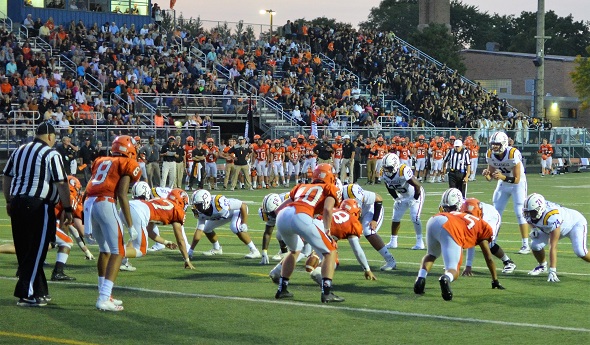
PHOTO: Warren DeLaSalle, on offense, faced Birmingham Brother Rice in Week 4 and won 36-14. The Pilots will play this week for the Detroit Catholic League Central title. (Click for more from HighSchoolSportsScene.com.)