

Football Kicks Off Again, 129 Years Later
By
Ron Pesch
MHSAA historian
August 25, 2017
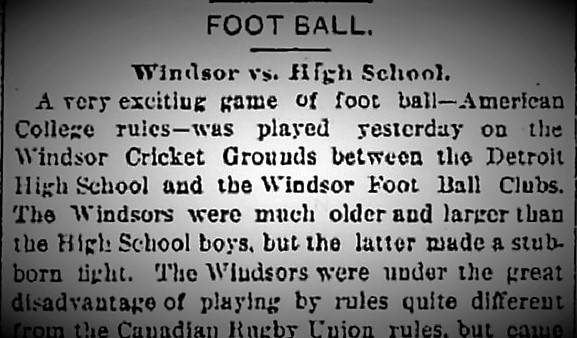
Buried in the text on the fourth page of the Saturday, October 27, 1888, Detroit Free Press is a single, concise sentence bearing a minimum amount of detail.
“The Windsor foot ball team will play the Detroit High School team this afternoon at 3.”
To date, this is the earliest account of a Michigan high school playing the game of “foot ball.”
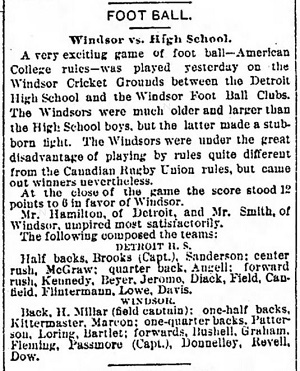
The following day’s paper provides only a few more details. The game was played on the Windsor Cricket Grounds. Despite the great disadvantage of playing under “American Football rules … quite different from the Canadian Rugby Union rules …” the “older and larger” Windsors won the contest, 12-6. Rosters for each squad were provided.
 Under American rules of the time, a touchdown was worth four points, with a conversion kick following a touchdown worth two additional points. At the time, a field goal counted for five points and a safety was worth two. The teams, however, may have agreed to a different scoring system before the contest.
Was this the first football game for a Michigan high school? That’s unlikely, but it is certainly among the earliest published accounts involving a prep game in the state.
It’s a fair assumption that foot ball, or some version of the game, was being played in neighborhoods before that time, at least based on the following statement found in the Jackson Citizen Patriot, dated June 18, 1867. Only days before, Dorrance & Goodwin’s, a store on Main Street in Jackson, had placed advertisements in the newspaper’s classifieds noting the pending arrival of this new product.
“Foot Ball – The pastime was inaugurated on our streets yesterday. Three or four balls were kept in motion all day on Main street alone. It affords no little amusement to the little boys, and is certainly a healthy exercise for the larger ones. It’s all right as long as no windows are broken or horses scared. Both calamities were barely escaped scores of times during the day.”
Rutgers and Princeton are credited with playing the first college football game in 1869. A decade later, in 1879, the University of Michigan established a football team.
Detroit High School played a number of games in 1888, besides the Windsor match, including a contest with the Tappen School from the Corktown area of Detroit. Played at the Detroit Athletic Club grounds on the afternoon of Thursday November 15, a final score was not mentioned in the following day’s Free Press.
For those unfamiliar with the sport, an account of the University of Michigan versus Detroit Athletic Club contest that appeared in the November 18 Free Press served as a fine introduction to the game, and the determination behind securing “possession of a leather-covered foot ball.”
“It was very interesting to see one speedy young man, after a desperate struggle in which the spectators fully expected to see him lose an arm or a leg, get away from his captors and start like a deer, with eight or ten of the opposite side in full pursuit. He is overtaken and the leader of the pursuing party springs upon the back of the man with the inflated trophy, bearing him to the ground with a dull thud … It is also an inspiring sight to see a fleet-footed player seize the ball and run at full speed in the direction of the goal of his opponents. Then a wing-footed opponent cuts across to intercept him, makes a flying leap, grasps the fugitive around the neck or waist and both go to grass with a suddenness and velocity that transforms them into human wheels …
 “While one unaccustomed to foot ball will naturally be startled by some of the acrobatic feats, still it is impossible to watch the game for any length of time without a tingling of the blood and holding of the breath. It is most intensely exciting, continuous in action and replete with fine points of play.
“It may be explained that the goals in a foot ball game are set at a distance of 330 feet from each other. The goal is made by placing two pieces of scantling twenty feet long upright in the ground, eighteen and one-half feet apart. Another piece runs midway horizontally between the uprights, and the ball must go over the horizontal piece and between the uprights to count a goal. There are eleven men on each side and the object is, of course, to get the ball through the goal of the other. The time of game is an hour and a half each side playing forty-five minutes from each goal, with an intermission of ten minutes between halves.”
A player who ran over an opponent’s goal line, “with the ball and touched it down” was then entitled to “bring the ball in front of the goal and attempt to kick it through”…
Among those playing for the Athletic Club squad that day was “little Hugh Brooks (captain) of the high school team.” Eligibility rules for players would evolve over time.
On Saturday, November 24, Detroit High School squared off for the first of two contests with Ann Arbor High School, this one at the Detroit Athletic Club grounds. Admission to the 2:45 p.m. contests was 25 cents. A crowd of around 300 watched “an exciting illustration of how Rugby foot ball is played. The exhibition by the Ann Arbor boys was considerably better than that of the Detroiters,” noted the Free Press, “the result of that being that Detroit’s banners have been kicked into the dust.”
Ann Arbor returned home with a 12-0 victory.
A second game with Ann Arbor was quickly scheduled.
In between, on Thursday, November 29, the Detroit High School squad played the Athletic Club before a crowd of about 200.
 “While the Athletics won by 12 to 0, still their playing was very loose, probably the result of over confidence. The Athletics will have to rid themselves of this by Saturday or the Albions will make short work of them.”
A large crowd gathered in the drizzling rain in Ann Arbor on Saturday, December 8, for what appears to be the final contest of the 1888 season for the high school teams of Detroit and Ann Arbor.
“It was a fine game. (Captain) Brooks, McGraw and Wisner, for Detroit, and Jewett, Diggert, Dupont, and Rathbone for Ann Arbor, made fine plays for their respective sides.” The result was an 8 to 2 win, and redemption, for the Detroit squad.
Today, 129 years later, “football” has seen wild expansion, numerous rule changes, and huge advancement in equipment worn when compared to those pioneer days of the sport. In 2017, more than 1 million individuals will suit up for high school teams across the United States. In Michigan alone, more than 36,000 participate in prep football.
And our state’s original programs live on. On Friday, Detroit Central opened its season with a win over Detroit Loyola. Ann Arbor High School, renamed Ann Arbor Pioneer in the late 1960s, fell in its Friday opener to Muskegon.
Welcome to another season of America’s favorite pastime.
 Ron Pesch has taken an active role in researching the history of MHSAA events since 1985 and began writing for MHSAA Finals programs in 1986, adding additional features and "flashbacks" in 1992. He inherited the title of MHSAA historian from the late Dick Kishpaugh following the 1993-94 school year, and resides in Muskegon. Contact him at [email protected] with ideas for historical articles.
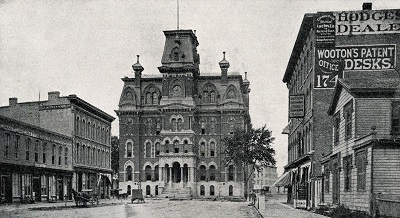
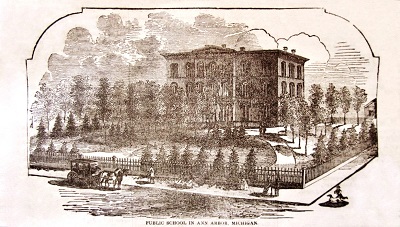
PHOTOS: (Top) The Detroit Free Press included brief coverage of the first "reported" game on Oct. 28, 1888. (Middle) When Michigan’s state government moved from Detroit to Lansing in 1847, the old Capitol building was re-opened as the Detroit’s first city high school in 1863. To better accommodate Detroit’s growing population, the old two-story structure was remodeled into a four-story building, unrecognizable to most. The school served the city well until January 1893, when it burned to the ground. (Below) Erected in 1856 at the cost of $27,000, Ann Arbor High School at State and Huron (now site of the North Quad of the University of Michigan) was destroyed by fire in 1904. (Photos courtesy of Ron Pesch.)
'Coaching Bug' Still Drives St Mary's Porritt
By
Tom Markowski
Special for Second Half
August 19, 2015
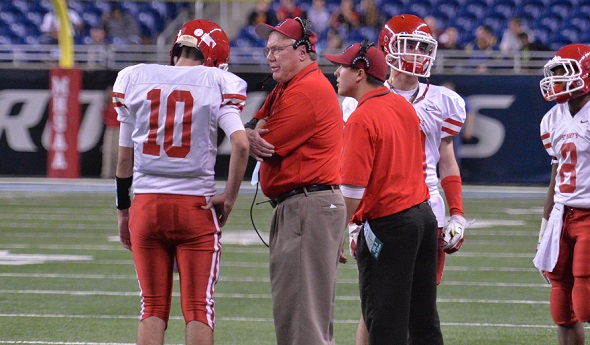
ORCHARD LAKE – George Porritt never seriously considered entering the coaching profession when he graduated from Hillsdale College in 1979 with a degree in both parks and recreation and physical education.
At age 14 he had worked part time in the parks and recreation department in Independence Township, a few miles south of Clarkston where he grew up. With that experience, Porritt thought he had found a career path.
 But a year after graduating from college, Porritt, like most in their early 20s, was looking for work – any kind of work. During the fall of 1980, Dan Fife, the head varsity boys basketball coach at Clarkston, hired Porritt as his freshmen coach. The next school year he became an assistant football coach, along with current head coach Kurt Richardson, under Walt Wyniemko at Clarkston.
“I got the coaching bug,” Porritt said.
And he’s been a coach ever since.
Competing in the Detroit Catholic League Central, considered by many the state’s best football conference, is a challenge every year. Butting heads with legendary coaches such as Al Fracassa (now retired) at Birmingham Brother Rice and Tom Mach at Detroit Catholic Central is a daunting task, but Porritt and St. Mary’s have proved worthy adversaries.
The Eaglets are coming off a 12-2 finish and Division 3 title, their fifth under his leadership.
Most who follow high school sports link the name Porritt with football. It’s understandable.
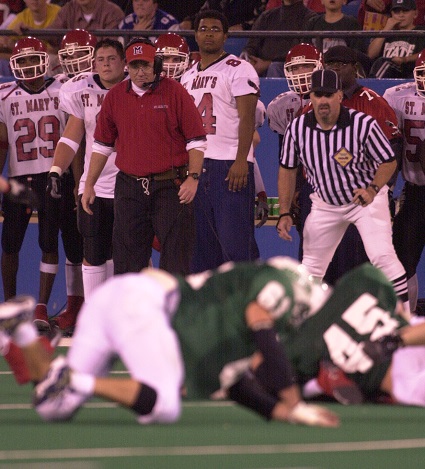 In 1986, St. Mary’s hired Porritt as a teacher, and that summer he became a varsity assistant football coach under Rob Haeger. Porritt replaced Haeger in 1989.
His record heading into this season is 234-66, which ranks 10th among active coaches. Since 2006, St. Mary’s has reached the MHSAA finals six times. He’s coached 15 players who have gone on to play in the NFL.
There’s more. His brother Rich is the offensive coordinator at Clarkston. His uncle, Bob Porritt, coached at Okemos and a cousin, Rob Porritt, coached at Haslett and Perry.
George Porritt loves coaching football, and it’s likely he’ll coach few more seasons.
But there’s something Porritt loves more than football, and that’s being a part of St. Mary’s.
He’s been the school’s athletic director since 1989, and the year before he was hired as the varsity basketball coach. He coached basketball for 22 seasons (he took six years in the mid-90s off to help his wife, Terry, raise their three children) before he retired from that position this past July.
Porritt’s success in football often overshadowed his success as a basketball coach. He coached the Eaglets to the Class B title in 2000, they reached the Class A Semifinals in 2006 and his teams won 10 Catholic League Central titles, six league championships, 12 district titles and six regional titles. His career record is 336-180.
When asked why he stepped away from basketball, Porritt said he pondered that move two years ago but continued on because of his relationships with the coaching staff and, of course, the players.
In the end he got out of coaching basketball to spend more time with his family. His son Kenny lives in Maryland and he and his wife are expecting their third child. His daughter, Marilyn, graduated from University of Oregon and recently moved to Nashville, Tenn., to begin working for Vanderbilt University. The Porritts’ third child, Mason, is a senior at Grand Valley State University.
 Terry Porritt travelled from Maryland and Tennessee earlier this month to visit her children, leaving her husband at home to coach football. Family time is precious, and the Porritts plan to spend more time with their family in the years to come.
But don’t expect George Porritt to leave St. Mary’s. Though he’s not coaching basketball, he’ll be at every home game because of his duties as athletic director. And aside from long road trips, he’ll be at the away games, too.
“I enjoyed my coaching at Clarkston,” he said. “And I wanted to get a teaching job there. But getting into education was tough then, as it is now.
“I love St. Mary’s. When you drive on this campus, it’s an awesome place to be. I want to work here as long as I can. I’ve met so many great people. Msgr. (Stanley) Milewski was awesome. (Headmaster) Larry Reeside has been tremendous. He inspired me and taught me so much. Then there’s the kids.”
Porritt mentioned one player, in particular, on the team this season as being a special person. His name is Josh Ross and his brother, James, plays for University of Michigan. Josh Ross is a 15-year-old junior but one of the team leaders, and he's already received scholarship offers from Michigan State, U-M and Notre Dame. Porritt said Ross is a no-nonsense type of player and one who helps maintain discipline, on the field and off.
Total, the Eaglets will return five starters on both offense and defense. Senior quarterback Brendan Tambone is back and joined by returning starting running backs Brandon Adams and Justin Myrick; Adams scored the lone touchdown in last season's MHSAA Final. Others of note include junior receiver/defensive back Kaylee Hamlee, who has offers from a handful of Big Ten programs, and 6-foot-5, 275-pound two-way lineman Cameron Kolwich, who will sign with Northwestern this fall.
 Tom Markowski is a columnist and directs website coverage for the State Champs! Sports Network. He previously covered primarily high school sports for the The Detroit News from 1984-2014, focusing on the Detroit area but also contributing to statewide coverage of football and basketball. Contact him at [email protected] with story ideas for Oakland, Macomb and Wayne counties.
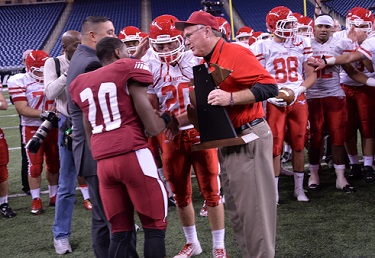
PHOTOS: (Top) Orchard Lake St. Mary's football coach George Porritt huddles with one of his players during last season's Division 3 Final. (Middle) Porritt watches a play unfold against Coopersville during his team's 2000 championship game win. (Below) Porritt receives last season's champion's trophy from Muskegon running back and MHSAA Student Advisory Council member Jared Pittman and the Representative Council's Orlando Medina, athletic director at Harrison Township L'Anse Creuse.