


Football Practice Proposals
June 11, 2013
During 2013, a Football Task Force has been working on revisions to practice policies that might simultaneously improve acclimatization of players and reduce head trauma. Over three meetings, the following four-part recommendation has been developed:
-
During the first week of practice of the season, only helmets are allowed the first two days, only shoulder pads may be added on the third and fourth days, and full pads may not be worn until the fifth day of team practice.
-
Before the first regular-season game, schools may not schedule more than one “collision” practice in a day.
• A “collision” practice is one in which there is live, game-speed, player-vs.-player contact in pads (not walk-throughs).
• During any additional practice sessions that day, players may wear helmets and other pads (neither is mandatory). Blocking and tackling technique may be taught and practiced. However, contact is limited to players vs. pads, shields, sleds or dummies.
-
After the first regular-season game, teams may conduct no more than two collision practice days in any week, Monday through Sunday. During other days of practice, players may wear helmets and other protective pads (neither is mandatory). Blocking and tackling technique may be taught and practiced. However, contact is limited to players vs. pads, shields, sleds or dummies.
-
No single practice may exceed three hours, and the total practice time for days with multiple practice sessions may not exceed five hours.
• Warm-up, stretching, speed and agility drills and cool down are all considered part of practice. Neither strength/weight training activities nor classroom sessions are considered practice for the purposes of the three- or five-hour limits.
MHSAA staff will be taking this recommendation on the road from now through October to obtain constituent understanding and feedback. It is the intent of the Task Force to finalize its consensus regarding these matters by late November so they may be reviewed by the Michigan High School Football Coaches Association, the MHSAA Football Committee and at the MHSAA League Leadership meeting prior to Representative Council action in March 2014.
1st & Goal: Week 6 Preview
October 1, 2020
By Geoff Kimmerly
Second Half editor
We may have only just begun this abbreviated Michigan high school football season, but this weekend we’ll reach the midway point – and the beginning of another October full of opportunities.
Every game matters even more with a six-game schedule, and early league leaders are meeting everywhere over the next two days – including in five leagues in the Grand Rapids/Muskegon areas alone.
Below is a quick look at some of the especially intriguing matchups. Check out the MHSAA Score Center beforehand for kickoff times and locations of all games, and come back Friday and Saturday for scores as they’re reported.
This week’s broadcast schedule includes 48 varsity football games on MHSAA.tv; click the link for listings.
Bay & Thumb
Mount Pleasant (2-0) at Midland (2-0)
Seven of the last 10 meetings between these Saginaw Valley League Blue foes have been decided by eight points or fewer, including Midland’s 22-21 win a year ago that helped the Chemics to a shared conference title. Along with matchups both still face with Midland Dow, tonight’s should significantly shape this season’s league race.
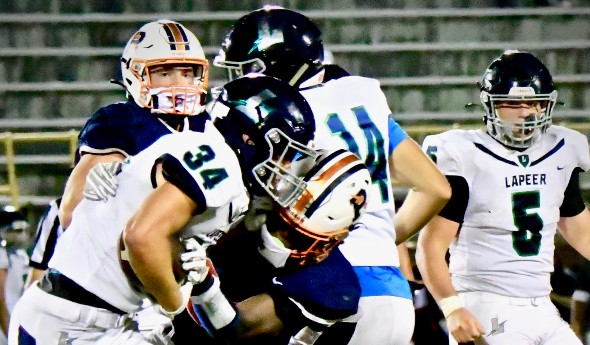
Keep an eye on these: FRIDAY New Lothrop (2-0) at Montrose (2-0), Grand Blanc (1-1) at Lapeer (2-0), Midland Bullock Creek (1-1) at Hemlock (2-0). SATURDAY Croswell-Lexington (2-0) at North Branch (2-0).
Greater Detroit
West Bloomfield (2-0) at Clarkston (2-0)
The Wolves quickly are making last season’s uncharacteristic 3-6 finish – their first below .500 since 2002 – a distant memory, but this matchup will allow them the opportunity to avenge a 2019 loss for the first time. West Bloomfield claimed last year’s matchup 24-0 on the way to finishing 10-2, and more interestingly hasn’t lost a game by more than seven points since 2016. With both programs surging again, we could be in for another close contest.
Keep an eye on these: FRIDAY Detroit Denby (2-0) at Detroit Martin Luther King (1-1), North Farmington (1-1) at Birmingham Groves (1-1), Clinton Township Chippewa Valley (1-1) at Sterling Heights Stevenson (2-0). SATURDAY Warren De La Salle Collegiate (1-1) at Detroit Catholic Central (2-0).
Mid-Michigan
Lansing Catholic (2-0) at Portland (1-1)
Lansing Catholic rode last year’s first win in this rivalry since 2015 all the way to the Division 5 championship, and the Cougars have tuned up on both sides of the ball outscoring their first two opponents by a combined 85-3. The Raiders will hope for a result similar to last year’s first meeting with Lansing Catholic, a 21-20 win, before they fell 21-0 in that District Final rematch. Portland last week bounced back with a shutout of Charlotte after falling big in its opener to DeWitt.
Keep an eye on these: FRIDAY Reed City (2-0) at Central Montcalm (2-0), Canton (2-0) at Brighton (1-1), Stockbridge (1-1) at Lake Odessa Lakewood (1-1), Ortonville Brandon (2-0) at Corunna (1-1).
Northern Lower Peninsula
Kingsley (2-0) at Traverse City St. Francis (1-1)
The Stags ended their six-game losing streak to St. Francis last season with a 26-7 victory that eventually decided the Northern Michigan Football League Legends title. Kingsley hasn’t slowed down, running its regular-season winning streak to 16 last week. But St. Francis’ 14-7 loss to new league member Sault Ste. Marie in the season opener is looking even better after the Sault’s win over Marquette, and the Gladiators still have reason to hope for at least a three-way tie for the Legends championship.
Keep an eye on these: FRIDAY Traverse City Central (2-0) at Cadillac (2-0), Harbor Springs (2-0) at Manistee (2-0), Frankfort (1-1) at Johannesburg-Lewiston (2-0), Charlevoix (2-0) at Boyne City (1-1).
Southeast & Border
Clinton (2-0) at Blissfield (2-0)
Reshuffling among southeastern Lower Peninsula leagues took these teams’ regular Week 2 nonconference meeting up a few levels. It already was a solid nonleague matchup – they’ve played regularly since 2012 and split the last four meetings with Clinton winning last season 45-13. Now they find themselves tied for the early lead in the Lenawee County Athletic Association, with Blissfield coming off a 31-14 win over reigning champion Hillsdale last week.
Keep an eye on these: FRIDAY Saline (2-0) at Monroe (2-0), Hillsdale (1-1) at Ida (1-1), Battle Creek Harper Creek (1-1) at Jackson Lumen Christi (1-1). SATURDAY Schoolcraft (2-0) at Chelsea (2-0).
Southwest Corridor
Cassopolis (2-0) at Centreville (2-0)
The Rangers are up to 26-1 in league play since the Southwest 10 Conference was formed in 2017, and that means even more considering five of the remaining six 11-player football members made the playoffs in 2019. Cassopolis’ closest league win last year was 15-0 over Centreville, which has continued its rejuvenation and could have its sights set on more after losing four games in 2019 by a combined 28 points. The Bulldogs avenged one of those defeats downing White Pigeon 14-8 last week.
Keep an eye on these: FRIDAY Sturgis (2-0) at Paw Paw (2-0), Portage Central (0-2) at St. Joseph (2-0), Constantine (1-1) at Watervliet (2-0), Stevensville Lakeshore (1-1) at Battle Creek Central (1-1).
Upper Peninsula
Gladstone (1-0) at Sault Ste. Marie (2-0)
Gladstone provided an uplifting story last weekend, coming off short prep time to edge Negaunee 22-20 and after also missing out on opening weekend. Next up is the team generating the most buzz in the Upper Peninsula. Sault Ste. Marie has wins over Traverse City St. Francis and Marquette – and will be looking to avenge last season’s 20-8 loss to the Braves.
Keep an eye on these: FRIDAY Marquette (1-1) at Kingsford (2-0), L'Anse (1-1) at Negaunee (1-1), Menominee (1-1) at Escanaba (0-0), Norway (0-2) at Bark River-Harris (0-2).
West Michigan
Zeeland East (2-0) at Zeeland West (2-0)
This next-door showdown always means a lot. It might mean even more now that Muskegon Mona Shores and Muskegon High have joined the Zeeland schools to make what was a strong Ottawa-Kent Conference Green now one of the most powerful football leagues in the state. West won both meetings last year, by 20 and then 31 points in a Division 3 playoff opener.
Keep an eye on these: FRIDAY Cedar Springs (2-0) at Grand Rapids Catholic Central (2-0), Grand Rapids Forest Hills Central (2-0) at Byron Center (2-0), Grandville (2-0) at Hudsonville (2-0), North Muskegon (2-0) at Whitehall (2-0).
8-Player
Whittemore-Prescott (2-0) at Gaylord St. Mary (2-0)
Whittemore-Prescott was a late addition to 8-player before the start of this fall. But it looks like the Cardinals made a sound decision. Their two wins in two weeks equal their total for the entire 2019 season. That said, St. Mary certainly will be W-P’s biggest challenge to date. The Snowbirds have put 111 points on the board over just two games and could be prepping for a serious run in their second season of this format.
Keep an eye on these: FRIDAY Adrian Lenawee Christian (2-0) at Climax-Scotts (2-0), Brethren (1-1) at Mesick (1-1), Indian River Inland Lakes (2-0) at Onekama (1-1). SATURDAY Hillman (1-1) at Portland St. Patrick (2-0).
PHOTO: Lapeer is looking to improve to 3-0 after downing Flint Powers Catholic 36-21 last week. (Photo by Terry Lyons.)