


Football Practice Proposals
June 11, 2013
During 2013, a Football Task Force has been working on revisions to practice policies that might simultaneously improve acclimatization of players and reduce head trauma. Over three meetings, the following four-part recommendation has been developed:
-
During the first week of practice of the season, only helmets are allowed the first two days, only shoulder pads may be added on the third and fourth days, and full pads may not be worn until the fifth day of team practice.
-
Before the first regular-season game, schools may not schedule more than one “collision” practice in a day.
• A “collision” practice is one in which there is live, game-speed, player-vs.-player contact in pads (not walk-throughs).
• During any additional practice sessions that day, players may wear helmets and other pads (neither is mandatory). Blocking and tackling technique may be taught and practiced. However, contact is limited to players vs. pads, shields, sleds or dummies.
-
After the first regular-season game, teams may conduct no more than two collision practice days in any week, Monday through Sunday. During other days of practice, players may wear helmets and other protective pads (neither is mandatory). Blocking and tackling technique may be taught and practiced. However, contact is limited to players vs. pads, shields, sleds or dummies.
-
No single practice may exceed three hours, and the total practice time for days with multiple practice sessions may not exceed five hours.
• Warm-up, stretching, speed and agility drills and cool down are all considered part of practice. Neither strength/weight training activities nor classroom sessions are considered practice for the purposes of the three- or five-hour limits.
MHSAA staff will be taking this recommendation on the road from now through October to obtain constituent understanding and feedback. It is the intent of the Task Force to finalize its consensus regarding these matters by late November so they may be reviewed by the Michigan High School Football Coaches Association, the MHSAA Football Committee and at the MHSAA League Leadership meeting prior to Representative Council action in March 2014.
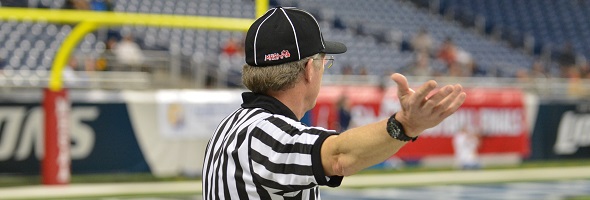
Be the Referee: You Make the OT Call
September 26, 2019
This week, MHSAA assistant director Brent Rice presents a "You Make the Call" regarding a penalty during football overtime.
Be The Referee is a series of short messages designed to help educate people on the rules of different sports, to help them better understand the art of officiating, and to recruit officials.
Below is this week's segment - You Make the Overtime Call - Listen
Let’s test your rules knowledge with this football You Make The Call.
A close game has gone to overtime, and Team A scores a touchdown on its first possession. During the extra point try, the kick is good, but Team B is called for roughing the kicker. What are Team A’s options?
You make the call.
In this case, the kicking team has two options – one is to accept the penalty and reattempt the point after from a yard and a half out, or accept the penalty on the succeeding spot, which would begin Team B’s overtime possession – 1st and Goal – that’s right – 1st and goal – at the 25-yard line.
Sept. 19: Swimming Finishing Touch - Listen
Sept. 12: Curbing Gamesmanship By Substitution - Listen
Sept. 5: Football Safety Rules Changes - Listen
Aug. 29: 40-Second Play Clock - Listen