


Football Scheduling
December 23, 2014
The major complaint about the MHSAA Football Playoffs is not that too few teams qualify or too many, or that a five-week playoff is too long or should become six weeks, or that some worthy teams miss out while some less worthy teams get in. No; most people find a five-week, 11-player tournament after a nine-game regular season is the best that our late start to fall classes and our early start to winter weather will allow us in Michigan.
Many people appreciate being able to complete our 14-week season in the warmth of Ford Field on the Friday and Saturday of Thanksgiving weekend. Most people think that nearly 45 percent of 11-player schools is a sufficient tournament field. Many people like the excitement that the six-win threshold creates for teams that had been eliminated earlier from league championships.
The most serious and legitimate complaint about the season-ending playoffs is the stress it has placed on conferences and the struggles many schools have in building nine-game regular-season schedules. Some critics want to mess with the Football Playoffs because of the mess they believe it makes for regular-season schedulers.
Having the MHSAA provide every school a nine-game regular season schedule of the most nearby teams of the most nearly equal enrollments would shift scheduling headaches from the local level to the MHSAA.
I’m not suggesting that this solution to local problems doesn’t create new, large headaches for the MHSAA. But in fact, that is the tradition of school sports: when an issue is large enough in scope and common enough among member schools, the state high school association is asked to be the problem-solver. That’s how we got transfer rules, defined sports seasons and competitive cheer tournaments, for example. Just about every policy and procedure and program of the MHSAA arises from a common local problem looking for a statewide solution.
The 2014 Update Meeting Opinion Poll indicates that 70 percent of responding administrators do not favor the solution of the MHSAA making all schools’ regular-season varsity football schedules. Maybe the question should be narrowed to having the MHSAA complete member schools’ non-conference scheduling.
Meanwhile, we will keep watching as high school associations in other states move to statewide scheduling. For if scheduling is the problem, then scheduling itself needs to be the focus of the solution.
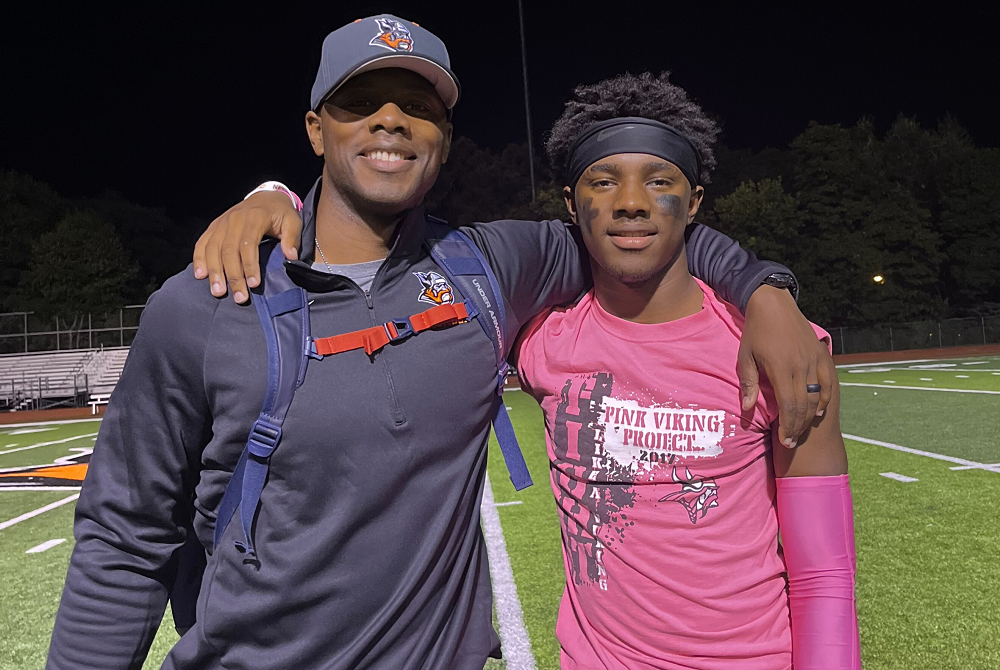
From MSP Post to Postgame: Lieutenants Return to the (Football) Field
September 27, 2023
While fans are settling into another season, Michigan State Police Lt. Tedric Gibbs has been fully immersed in football for months.
The Jackson Post’s assistant post commander serves as assistant coach for Jackson High School’s varsity football team and for the team at Parkside Middle School.
“I started coaching when my older son was in youth sports, as a way to do something together that we both love,” Gibbs said. “My younger son followed the same path, so I joined his team too. I grew up in Jackson and am grateful to be able to serve my hometown from the sidelines and at our post.”
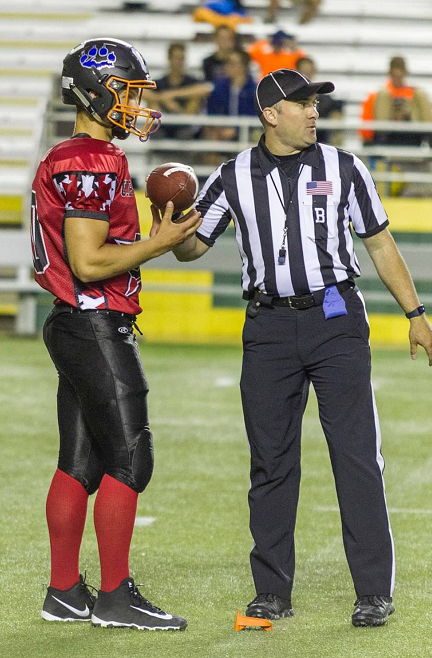 Some 400 miles north, Lt. Mark Giannunzio is also a familiar face in and on the field. The MSP Negaunee Post assistant post commander and Eighth District public information officer enforces the rules of the game as a high school and college football official, the latter for the Great Lakes Intercollegiate Athletic Conference.
“I started at the high school level to stay involved in athletics and make authentic connections in the community,” Giannunzio said. “It’s rewarding to help teach the game and share knowledge of the rules. I currently have a full 11-game schedule in the GLIAC Division II college conference, with high school games interspersed during the year.”
The correlation among coaching, officiating and policing translates.
“With my fellow troopers, I want to inspire, motivate and encourage to get the most out of them,” Gibbs said. “I take the same approach with my players to figure out what they need from me, as their designated leader, to be as successful as they can. In both capacities, I do the work alongside them. We do it together.”
This approach is especially important when tough times surface. Lieutenant Gibbs’ high school team experienced tragedy right before its first game when a player died in a car crash.
“We focused on adversity,” said Gibbs, who was in a unique position to talk from a police perspective too. “It’s a benefit to have that insight and background and share it with what they can control – make good decisions and wear your seatbelt.”
Lieutenant Gibbs incorporates his coworkers when he can, like during spring conditioning when fellow troopers join him and his players, helping all involved to make new connections and build strong bonds between the students and officers.
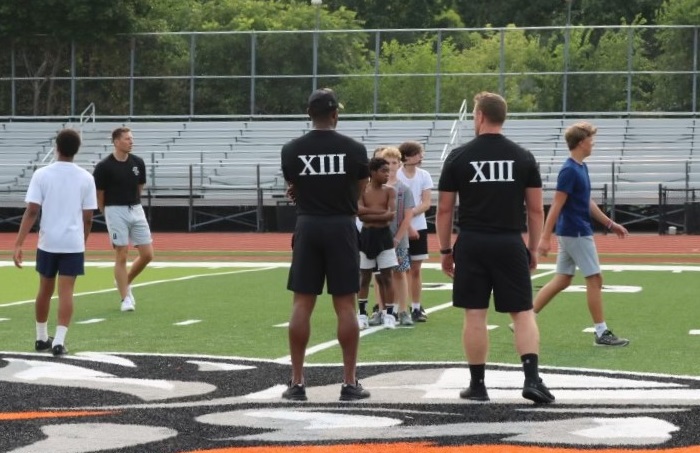 “One of the most important attributes in both careers is communication,” Giannunzio said. “Communication can make or break an official and a police officer. Much like selling a citation to a motorist, I need to be able to sell the penalty in a calm and professional manner. Demeanor and attitude go together on both the football field and when we are out patrolling in the Blue Goose.”
Treating everyone with dignity and respect is something Lieutenants Gibbs and Giannunzio commit to as members of a modern police agency and in their areas of expertise on the football field.
“Both roles afford so many opportunities to develop culture and cultivate teamwork,” Gibbs said. “The best part is watching others flourish and playing a part in their growth.”
PHOTOS (Top) Michigan State Police Lt. Tedric Gibbs, left, serves as an assistant football coach for the Jackson High varsity. (Middle) Lt. Mark Giannunzio officiates at the high school and college levels. (Below) Gibbs also coaches at Jackson Parkside Middle School. (Photos provided by the Michigan State Police.)