

Ford Swaps Frustration for Focus
October 24, 2017
By Tim Robinson
Special for Second Half
Midway through the 2016 season, Marcus Ford was frustrated.
 He was on the Pinckney football team, but not playing much.
A big part of that was due to his size — 6-foot-5 and over 400 pounds — but then-defensive coordinator Rod Beaton sensed there was more.
“We feel that we coach very hard,” said Beaton, now Pinckney’s head coach. “We’re very aggressive (on the varsity), and sometimes it’s an adjustment for juniors to understand that when they come out here, there’s expectations.
“There were a couple times where Marcus was questioning … whether football was for him.”
“I didn’t want to be there,” Ford said. “I thought, ‘This is stupid. Why am I here so late?’”
And then came a change.
“It came to a point where he went home and took a day off to re-gather himself,” Beaton said. “Marcus came back and he said to me, ‘Coach, I really want to be a part of things here.’”
And Ford did more than that.
He grew from a young man who bristled when his coaches pointed out mistakes to one who doesn’t react as if it were a personal attack, from an overweight kid who admits he was on his way to weighing 600 pounds to a big kid who is a key part of Livingston County’s most successful football team as a senior.
He rarely comes out of games, his coach says, and the quiet giant who rarely interacted with his teammates has transformed into a happy, smiling kid who dishes out and takes teasing from them.
It’s a story of transformation that only football could have done for Marcus Ford, who couldn’t play youth football because of his size and whose options for high school athletics seemed limited to football for the same reason.
“I may sound a little clichéd and corny,” Beaton said, “but I think this is why every single coach in America coaches football, to watch the development of a young man, from freshman to sophomore to junior and to see what football has done for him.”
How did Ford do it?
He turned his mental approach 180 degrees and made drastic changes to his diet and work ethic.
One clue came in looking at Pinckney’s roster from 2016 compared to 2017. Last year, Ford was listed at 380, which was about 40 pounds less than his actual weight.
This year, he’s listed at 405, which is a dozen pounds more than what he weighs now.
Last year, he played mostly in mop-up roles.
This year, he is a starter on defense, regularly occupying two blockers at a time, which in turn frees linebackers Cauy Hendee and Levi Collins to make tackles.
“I can play a lot longer,” he said. “I was tired when we were out there, but we don’t believe in the word ‘tired.’ We prefer ‘winded.’ We just need to catch our breath. So I get ‘winded’ a lot less.”
The first thing Marcus decided to change was his diet, and he got his cues by looking in the mirror.
“I didn’t like the muffin cap that was hanging down,” he said. “I didn’t like my stomach hanging over. ... I thought, ‘I don’t what to have a heart attack at age 25.’ I was doing ‘diets,’ per se, but eventually I thought, ‘This is stupid. Cut out pop and eat better,’ And I did.
“The only thing I would eat that was green was green beans, and they had to be made a certain way,” he said. “Now, I’m more like ‘this is somewhat appetizing. Let me try that.’ I don’t eat candy bars anymore. I don’t eat ice cream when my family does. I drink a lot less milk than I used to, and I drink more water.”
 Pinckney offensive coordinator Cody Patton noticed.
“His mom came to me about getting a weight plan, and he stuck with it,” Patton said. “They can only do so much in the weight room. When they leave, there’s not much you can control what they put into their bodies.”
But Ford also changed his mindset about football and being coached.
“His first real commitment was ninth-grade high school football, and it was a big adjustment for him,” Beaton said. “We knew there would be days where he might be a little confrontational, there may be some days where he goes through the motions.”
But after that midseason meeting last year, Ford redoubled his efforts in practice and in the offseason.
The first hint that he was a different player came in June, when Ford earned the team’s first bone helmet sticker of the season for effort in a drill.
“It was our first pursuit drill,” Beaton said. “We go four downs, and those kids have to sprint. There’s no exception. Marcus stepped to his gap, made his reads, flew to the football and didn’t say a word, every single time. He did it four times in a row. It really set the stage. I could tell he was wanting do to things right this year.
“When you see a 6-5, 400-pound kid moving with effort and tenacity, you sit there and go, ‘That young man can help us.’”
And so he has.
As a result, Marcus Ford is part of a Pinckney defense that has lifted the Pirates to an 8-1 regular-season record and shared Southeastern Conference White championship. He has transformed from a player who had little stamina to one who can go from opening kickoff to final horn.
“He can play a whole football game,” Beaton said. “He can go through a whole practice. One of the challenges we were talking about in the offseason is he has to put his body and mind in a position to not come off the field.”
That moment came on a warm night early in the season.
“We were in a huddle at Chelsea, and it was late,” Beaton recalled. “He’s drenched in sweat, and I said, ‘Marcus, you need a breather?’ And he said, ‘No, coach. I’m ready.’ That’s pretty cool.”
Asked his ideal weight, Ford said, “I would like to be at 250 if I could,” then laughs. His bone structure is such that at his height, he would be almost gaunt at 250. “I would settle for 340. That’s the dream within a dream goal.”
Next year, he plans to attend college.
“I want to go into bartending or being a head chef, or get a business degree,” he said. “One other choice is going to a police academy. As long as I can run a mile within 15 minutes, I should be good.”
There’s no reason, now, to think he couldn’t accomplish that.
He got his first sack against Dexter.
‘I grabbed him and rolled him over on top of me,” Marcus said. “I would have liked to have landed on him, but I got him down in the backfield. It’s good.”
And football now is fun.
“A lot more fun,” he said.
“Marcus made a concerted effort to our strength and agility program,” Beaton said. “It wasn’t two days at a time, then not be there five or six days. Marcus was there. He would stay after everyone had left and get some extra lifts in or do some extra work to make sure he was putting himself in a (good) position.
“He said, ‘Coach, I want to be your starting nose (tackle).’ The first day of June camp, he ran out to the nose tackle, and we haven’t looked back.”
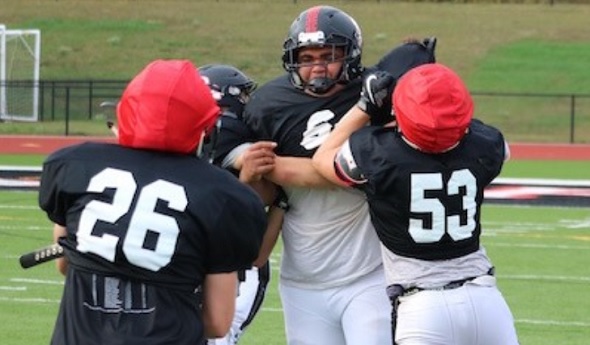
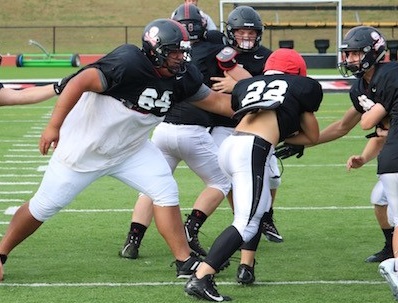
PHOTO: (Top) A pair of Pinckney blockers try to contain nose tackle Marcus Ford during a practice this season. (Middle) Ford breaks free to get an arm on a ball carrier. (Photos by Tim Robinson.)

Drive for Detroit: Playoffs R1 in Review
November 2, 2015
By Geoff Kimmerly
Second Half editor
Three reigning champions were eliminated this weekend, six undefeated teams fell, and October came to and end with the MHSAA football playoff field halved to 136 teams still alive for nine titles.
Divisions 1, 2 and 6 will have new winners this month. And a few teams that looked like contenders also are done after the first round and a series of upsets that made headlines across the state.
See below for some of the most unexpected and heaviest-hitting results from the first week in all eight 11-player divisions and the 8-player bracket.
Division 1
Novi 31, West Bloomfield 28
After four straight losing seasons and an 0-3 start this fall, Novi (6-4) made the playoffs for the first time since 2008 with an at-large bid – and then dealt undefeated West Bloomfield (9-1) its only loss in arguably the biggest upset in the state this weekend. The teams combined for five touchdowns during the fourth quarter, but West Bloomfield never could completely catch up to the Wildcats. Click for more from the Oakland Press.
Also noted:
Rockford 24, Grandville 6 – The Rams (7-3) won the rematch of Ottawa-Kent Conference Red co-champions after also beating Grandville (6-4) in Week 4.
Romeo 28, Clarkston 14 – The Bulldogs (9-1) bounced back from a tough three-point loss to Utica Eisenhower in Week 9 to eliminate the reigning champion Wolves (7-3).
Ann Arbor Pioneer 22, Belleville 7 – Pioneer (7-3) ended a two-game losing streak by handing Belleville (8-2) its first loss since opening night.
Utica Eisenhower 23, Clinton Township Chippewa Valley 20 (2 OT) – Eisenhower (7-3) kept surging with its fourth straight win, first in the playoffs since 2012 and second in four weeks over Chippewa Valley (7-3).
Division 2
Detroit East English 25, Warren DeLaSalle 21
East English (8-2) has made the playoffs all four seasons as a program after emerging from the former Detroit Crockett, which made the playoffs its final 12 seasons and the MHSAA Semifinals twice. So the Bulldogs have had their share of success – but this might be the best win of the new program’s history, as they eliminated the reigning Division 2 champion and after falling to DeLaSalle (6-4) by only seven in last year’s District Final. Click for more from MLive-Detroit.
Also noted:
Muskegon 40, Traverse City Central 14 – The Big Reds (8-2) took the long trip up north and handed Traverse City Central (9-1) its first and only loss, earning a rematch with rival Mona Shores this week.
Byron Center 34, Portage Central 21 – The Bulldogs (8-2) have made three straight playoffs and won two playoff games only two years ago, but it’s still fair to say they were underdogs on the road at Portage Central (8-2).
Birmingham Groves 10, Farmington Hills Harrison 0 – Groves (10-0) reached 10 wins for the first time in program history with its sixth shutout this season, ending Harrison’s at 7-3.
Jackson 42, Livonia Churchill 35 – After making the playoffs for the first time since 2009, Jackson (8-2) won its first playoff game since 1999 in ending Churchill’s season at 5-5.
Division 3
East Grand Rapids 27, Grand Rapids Christian 14
After watching a 26-0 lead on Grand Rapids Christian fade in their first matchup this season, in Week 6, the Pioneers (7-3) finished this time against their O-K White rival. East Grand Rapids will play in a District Final for the first time since 2011. Grand Rapids Christian, which beat EGR 39-33 in that first game, ended at 5-5. Click for more from the Grand Rapids Press.
Also noted:
Vicksburg 16, Marshall 8 – The Bulldogs (8-2) quietly have built a five-game winning streak, adding to it with a road win at Marshall (7-3).
Trenton 34, New Boston Huron 21 – The Trojans (9-1) equaled their best record since 2003 by avenging last season’s District Final loss to Huron (5-5).
Coldwater 31, Parma Western 7 – Coldwater (10-0), which made the playoffs for the first time three seasons ago, earned its first playoff win by downing Western (6-4), which was playing in its first playoff game.
Redford Thurston 48, Warren Fitzgerald 14 – One of the rare at-large qualifiers with a home game, Thurston (6-4) justified it with a first-round win for the second straight season; Fitzgerald finished its second straight at 6-4.
Division 4
Benton Harbor 28, Dowagiac 7
We’ve nearly run out of neat ways to crunch the numbers for the Tigers (6-4), who are enjoying their best season and whose six wins this fall are more than they won over the previous eight combined. Benton Harbor’s first playoff game resulted in its first victory – and the chance to next take on annual championship contender Zeeland West. Dowagiac isn’t to be forgotten, however; the Chieftains (6-4) bounced back from finishing 3-6 in 2014. Click for more from the Kalamazoo Gazette.
Also noted:
Bloomfield Hills Cranbrook Kingswood 35, St. Clair Shores South Lake 14 – The Cranes (9-1) equaled their best record since 2004 and ended the best season for South Lake (8-2) since 2011; the Cavaliers improved from 2-7 a year ago.
Comstock Park 38, Saginaw Swan Valley 35 – Quarterback Pat Naughton threw four touchdown passes and Monterio Smith caught two and ran for a third score as Comstock Park (8-2) came back early and then held off the Vikings (6-4).
Detroit Denby 36, Detroit Collegiate Prep 6 – Denby (6-4) claimed its first playoff win since 2007 by handing the first loss this season to Collegiate Prep (9-1), the Detroit Public School League Division II champion.
Lake Fenton 29, Corunna 27 – Lake Fenton’s most recent loss was by seven to Corunna in Week 8, but the Blue Devils (6-4) went on the road to take the rematch from the Cavaliers (8-2).
Division 5
Ida 35, Ann Arbor Gabriel Richard 23
The Bluestreaks built on their first undefeated regular season since 1971 with a second straight playoff win over Ann Arbor Gabriel Richard (5-5). Ida (10-0) also set a program record for wins despite giving up the most points in a game this season; the Bluestreaks gave up only 64 total during the first nine weeks. They scored three times during the third quarter to pull away. Click for more from the Monroe Evening News.
Also noted:
Buchanan 34, Hillsdale 31 – The Bucks' first perfect regular season since 1988 has turned into its first 10-0 start ever after its third win in a month decided by three points or fewer, this time against a Hillsdale team (6-4) in its 15th straight playoffs.
Almont 10, Marine City 3 – The Raiders (8-2) have bounced back nicely from back-to-back losses in Weeks 7 and 8, this time downing Marine City (6-4) in the playoffs for the second straight season.
Dearborn Heights Robichaud 50, Brooklyn Columbia Central 37 – Robichaud (8-2) reached 50 points for the second time this season to get its first playoff win since 2012, while Columbia Central ended at 8-2 after three straight losing seasons.
Kingsford 25, Harrison 0 – The Flivvers bounced back from a sub-.500 record last season and then a loss in Week 9 to claim a playoff win for the first time since 2012 and with their first shutout of this fall – which also was the first time Harrison (7-3) was shut out since Week 1 of 2013.
Division 6
Clinton 14, Monroe St. Mary Catholic Central 10
Clinton (10-0) was one of two undefeated teams that had road games this weekend, and the Redskins responded by eliminating the reigning champion. Monroe St. Mary (8-2) had dominated most of its competition this fall, aside from a Week 9 loss to Division 5 contender Lansing Catholic. But Clinton drove 93 yards for the go-ahead score on the legs of Matt Sexton, who gained 100 yards total on the winning possession. Click for more from the Monroe Evening News.
Also noted:
Calumet 24, Negaunee 14 – The Copper Kings (8-2) earned their first win over Negaunee since 1955 and after five losses over the last four seasons to the Miners (7-3).
Sanford Meridian 44, Millington 38 – The Mustangs (10-0) also set a program record for wins and earned the opportunity to face another undefeated team, Ithaca, this week while ending Millington’s 12th straight playoff season at 8-2.
Laingsburg 23, Burton Bendle 15 – The Wolfpack (7-3) moved past six wins for the first time since 2009 by edging a Bendle team that went from 3-6 a year ago to 8-2 this fall.
Constantine 31, Schoolcraft 28 (OT) – In arguably the other biggest stunner of the first week of the playoffs, at-large qualifier Constantine (6-4) went on the road and downed rival Schoolcraft (9-1), handing the Eagles their first loss after falling to them 42-24 only two weeks ago.
Division 7
Saugatuck 42, Hesperia 7
These two played the only playoff game between undefeated teams during the first week, with the Indians (10-0) earning their first postseason victory since the 2010 run to the Division 8 Final. Hesperia made one of the most impressive turnarounds in MHSAA football history this fall, going from 1-8 last season to 9-1 before falling Friday. Click for more from the Holland Sentinel.
Also noted:
McBain 34, Whittemore-Prescott 22 – Highland Conference co-champ McBain (7-3) won this battle of league winners, edging the first-place Cardinals (5-5) from the North Star League Big Dipper.
Cass City 34, Ubly 6 – The Red Hawks (8-2) have their most wins in a decade after ending the best season for Ubly (7-3) since 2011.
Flint Beecher 30, Flint Hamady 28 – The Buccaneers (7-2) took the lead for good in the fourth quarter in their first matchup with Hamady (7-3) since a District Final in 2012.
Riverview Gabriel Richard 30, Grosse Pointe Woods University Liggett 27 – A 42-yard field goal by Zach Loewengruber on the game’s final play gave Gabriel Richard (7-3) its first playoff win and ended Liggett’s season at 6-4.
Division 8
Climax-Scotts 8, Mendon 6
Climax Scotts (10-0) held on for its first win over Mendon (5-5) since 1977, after 30 straight losses. Climax-Scotts scored on the first possession of the game and made a two-point conversion, and stopped Mendon’s conversion attempt after its lone score. The Panthers have made the playoffs 13 straight seasons, and now will try for a second Regional Final in eight tries; Mendon had eliminated them from the playoffs the past four seasons. Click for more from the Battle Creek Enquirer.
Also noted:
Crystal Falls Forest Park 24, Lake Linden-Hubbell 0 – The Trojans (6-3) must have figured out a few things between falling to Lake Linden-Hubbell 34-28 only a week earlier and then handing the Lakes (9-1) their first and only loss.
Bark River-Harris 22, Munising 6 – Three weeks after falling to Munising by seven, Bark River-Harris (8-2) advanced to a District Final for the second straight season by downing the reigning Division 8 runner-up Mustangs (7-3).
Johannesburg-Lewiston 35, Hillman 8 – The Cardinals (9-1) won their ninth game for the third time in four seasons by downing North Star League Little Dipper champion Tigers (6-4), and now get another shot at Ski Valley Conference winner St. Ignace after finishing a win behind the Saints in the league standings.
Ottawa Lake Whiteford 20, Petersburg-Summerfield 14 – Revenge surely was sweet for Whiteford (8-2), which fell to Petersburg-Summerfield (7-3) by 20 in their Week 4 Tri-County Conference matchup.
8-Player
Rapid River 36, Engadine 29
A Week 5 loss to Engadine started a string of three losses in four games for Rapid River (7-3), but the Rockets have avenged the first defeat and earned the opportunity to avenge a second against Powers North Central. Engadine (7-3) was held to fewer than 40 points for the first time since Week 3. Click for more from RRN Sports.
Also noted:
Cedarville 48, Owendale-Gagetown 28 – The reigning 8-player runner-up Trojans (8-2) have won four straight and delivered O-G (9-1) its first and only loss.
Lawrence 54, Waldron 52 – The Spartans (8-2) played the reigning champion impressively close, but Lawrence (8-2) emerged with another opportunity against rival Battle Creek St. Philip this week after falling to St. Philip two weeks ago.
PHOTO: Midland Dow, in green, faced rival Midland for the second straight week and won for the second straight as well, 42-7. (Click for more from HighSchoolSportsScene.com.)