

Gooding & King Work to Fill SW Michigan's Officiating Ranks, Schedules
By
Pam Shebest
Special for MHSAA.com
December 12, 2023
KALAMAZOO – Cheer them or boo them, without officials, there are no games. That’s just a fact in the sports world.
 Two area men are tasked with supplying those officials for Southwest Michigan schools, and it is not always as easy as it seems.
Portage’s Todd Gooding is in charge of assigning football referees for 70 schools across eight leagues, with 500 officials on his staff.
Vicksburg’s Rob King assigns officials for girls and boys basketball in five leagues and has 290 men and women on his roster to work 1,100 games throughout the hoops season.
“We have six females on staff,” King said. “We’re looking to add more. I think the girls who are playing enjoy having a female ref on the court with them, plus it shows them they can do this, too.”
Although totals were dropping a few percentage points every year, the MHSAA still registered an average of 10,317 officials annually during the decade ending in 2019-20. But the beginning of the COVID-19 pandemic that spring played a large part in a decrease in registered officials by 12 percent for 2020-21, down to 8,090.
The last two school years saw a bounce-back of four percent, and recruiting and retaining efforts continue. But Gooding and King – also veteran officials themselves, Gooding for 25 years and King for 24 – and their assigning colleagues across the state have the closest look at the effects of fewer officials as they work to schedule at the local level and make sure everything is covered.
Doing so gets even harder with unforeseen roadblocks.
One of those challenges for Gooding came in August when extreme heat forced most schools to reschedule or delay their football games.
“Everyone was trying to get their games in,” he said. “We were moving start times back, then we were moving days. Football is a little different than basketball or baseball because you can only play within so many days, so we were really squeezed against the schedule.
 “I had a school or two reach out on Monday or Tuesday (before the Friday night game), so they looked ahead at the heat. Some of them waited, waited, waited, and then in some cases, it posed some big challenges because most of those crews had been spoken for.”
For a typical football Friday, Gooding staffs 30 or 35 games, “which is really difficult because everybody wants to play Friday night.”
Some referees in both football and basketball “double dip” by officiating games at freshman or junior varsity levels on nights other than Friday.
Gooding said at one time he hoped to go to seven officials for a football game, but with a shortage of officials, “Right now we’re just lucky to staff five in the games we have, and we’re still very short.
“Parents are a key component to a shortage of officials. A lot of it is more at the youth level, but everyone has to remember the sportsmanship aspect. Without officials there are no games, and sometimes we lose track of that, and that’s one reason there’s a shortage.”
Still, King noted that officiating provides more advantages than disadvantages.
“Everyone hears about the bad stuff, getting yelled at by fans and coaches, but those are so small,” he said.
“After a season of doing this, you learn to block out that stuff and realize it’s just part of the game. Fifty percent of people are mad at you every time you blow the whistle, so you get used to that.”
Pay raises in some leagues enticed many of those who “retired” to return, King said, but both he and Gooding agree the camaraderie developed while officiating is what makes it most special.
“It’s more about the time you spend on the floor with guys, in the locker room, driving to games, grabbing something to eat after the games, just talking about life, just building friendships,” King said. “That’s the part you remember.”
Gooding added some games stick in his memory more than others.
“My first varsity game (refereeing) was Lawton playing Saugatuck,” he said. “I show up and Channel 3 was there. I wondered what’s going on.
“Both schools were 0-8, both senior classes were 0-35. Somebody had to win, and it was my first varsity game. I think Saugatuck won, and it was close to 25 years ago.”
Another memory came as he officiated a basketball game.
 “A girl from Benton Harbor (Kysre Gondrezick in 2016) had 72 points,” he said. “It’s in the record books. and you’re just one small part of that and you remember them.”
Officiating is not only for adults. Even teenagers still in high school can become referees as part of the MHSAA Legacy Program.
King recently hosted an officiating summit at Paw Paw for high school athletes.
“There are nine schools in the Wolverine Conference and six of them brought 10 to 15 kids,” he said. “Myself and another official presented on basketball. They also did something on other sports.
“We got the kids up blowing the whistles and doing some of the signals. Three reached out wanting to get involved.”
King said officiating is a great way to earn money, especially while in college.
“You’ll work maybe two or three hours at the most and make $150 to $300 depending on the level,” he said. “Your friends will have to work six-, seven-, eight-hour days to make that much money.
“You can also block your schedule. We have a software with a calendar on it. If there are days you know you can’t work because you have classes or other things, you just block those days out, so you control your own schedule.”
With training, freshmen and sophomores can work junior high/middle school games, and juniors and seniors are able to officiate at the freshman and junior varsity levels.
“Usually what we do is get you a mentor,” King said, “and you work with that mentor and make some money.”
Those Legacy officials hopefully continue in the avocation, eventually becoming the next mentors.
Officiating, like school sports in general, is a cycle that’s constantly in motion – both when it comes to filling the ranks and filling the schedule to cover games ahead.
For example, although football season is over, “I don’t know if there really is an offseason,” Gooding said. “Leagues are going to start giving me their schedules. We’ll get those into an Arbiter system. Everything’s assigned by Arbiter, a computer system where officials get their assignments.
“I’ll start evaluating the crews, reach out to the crew chiefs. They’ll let me know any changes in their crew dynamics. I’ll evaluate the year gone by, how they performed and then start getting ready to work on getting those games staffed. That will start after the new year.”
For more information on officiating, including the Legacy Program, go to the Officials page of MHSAA.com.
 Pam Shebest served as a sportswriter at the Kalamazoo Gazette from 1985-2009 after 11 years part-time with the Gazette while teaching French and English at White Pigeon High School. She can be reached at [email protected] with story ideas for Calhoun, Kalamazoo and Van Buren counties.
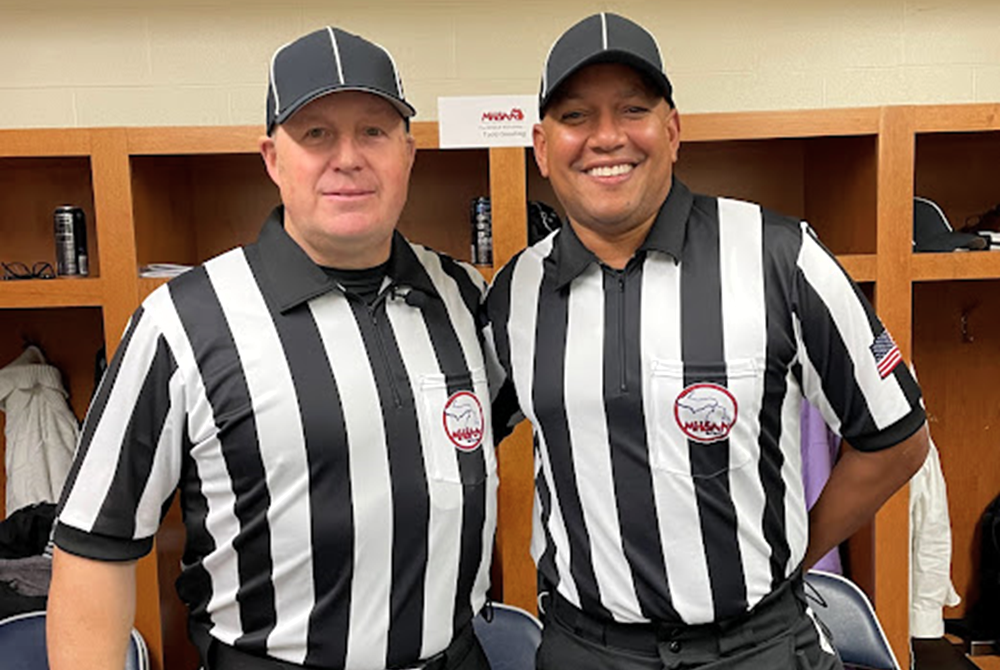
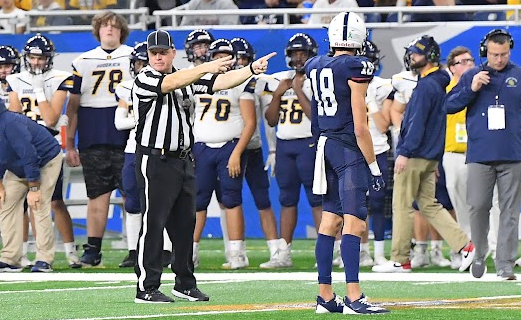
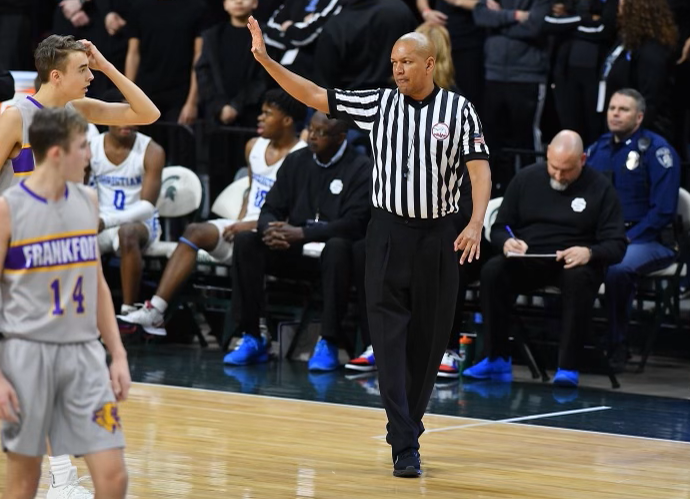
PHOTOS (Top) Todd Gooding, left and Rob King take a photo together while officiating the Division 4 Final at Ford Field in 2022. (Middle) Gooding signals during that contest between Goodrich and Grand Rapids South Christian. (Below) King officiates the 2019 Division 4 Boys Basketball Final at Breslin Center. (Photos courtesy of Gooding and King.)
Gaffney Returns to Basketball Court for Opening Night, Continuing Incredible Recovery
By
Tom Spencer
Special for MHSAA.com
December 5, 2025
Joe Gaffney was in a familiar spot Tuesday night when Charlevoix opened the basketball season at home against Ellsworth.
 The all-state guard was in the starting line-up.
But as the game was wrapping up, the four-year starter was in an unfamiliar spot.
“He was the loudest one on the bench cheering,” said Charlevoix coach Anthony Troshak. “He was coaching, giving out reminders and that's awesome for a kid that normally, in the last three years, he's out there in crunch time. Instead, he's still like, ‘Hey, I can make an impact,’ and that was a really awesome thing to see.”
The fact Gaffney was in the game at all is arguably a miracle. Gaffney nearly lost his life this spring. He was in a car crash along with the entire Charlevoix boys golf team and coach Doug Drenth.
The team was on its way to spend the night at Crystal Mountain, returning from the first day of a two-day tournament at Arcadia Bluffs. Emergency personnel transported Gaffney, his coach and the entire golf team to Munson Medical Center. Gaffney sustained a ruptured diaphragm and shattered pelvis.
Gaffney had emergency surgery to repair his diaphragm April 27 and underwent a nine-hour surgery the next day. Munson Orthopedic Institute surgeons Michael McDonald and Matthew Schuch placed 76 screws in his pelvis and femur.
“The trauma team and the general surgeons are the ones who repaired his diaphragm, and they're the ones that saved his life – that wasn’t me,” Dr. McDonald pointed out. “Joe’s done a lot of hard work. All credit to him, because it's tough to go through what he went through and come to where he has.”
Gaffney spent nine days in Munson’s Intensive Care Unit and then stayed in Munson’s Mary Free Bed rehab facility until May 9. He was non-weight bearing until July 9.
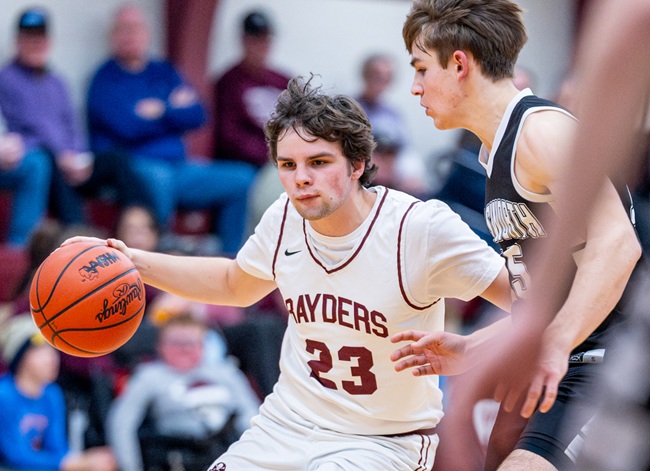
Many wondered if Gaffney would ever get back on the basketball court. Few thought it would be as early as the opening night win over Ellsworth. Gaffney played just more than two quarters and hit two of three shots from 3-point land. He also contributed two rebounds before sitting out the Rayders’ all-out press in the fourth quarter – but instead led the bench’s support.
“That’s the type of person he is,” Troshak said. “He's one of the most, if not the most determined individuals I've ever come across.”
 The crash and initial rehabilitation left Troshak thinking he’d likely have his star guard available only for something like a Senior Night appearance. But incredible community and medical support, and Gaffney’s hard work gradually changed Troshak’s hope.
“In the summer, I thought it might be maybe in January or February, and maybe a couple of minutes here and there,” Troshak said. “I never dreamed it would be game one – that's just how hard he's worked.”
Gaffney never lost sight of getting back on the court. He started physical therapy and occupational therapy in Traverse City three days a week until July and then transitioned closer to home for therapy in Charlevoix.
Gaffney was walking with a cane when he left Aug. 1 with his parents, Aaron and Karrie, for the Barwis Sports Performance Center in Deerfield Beach, Fla. He underwent therapy five days a week in Florida before returning to Charlevoix on Sept. 22.
His parents took turns flying back and forth to Florida every two weeks. They carried with them tremendous community support and prayers. When he left Florida Gaffney was able to jog about 100 yards. Therapy continued in Charlevoix, along with a home exercise program from Barwis.
“I had full confidence I would play again, and I didn't know exactly when,” Gaffney said. “As the season got closer, that date when I thought I could play got earlier and earlier until it was the first game. I really had confidence that this was going to happen very early on.”
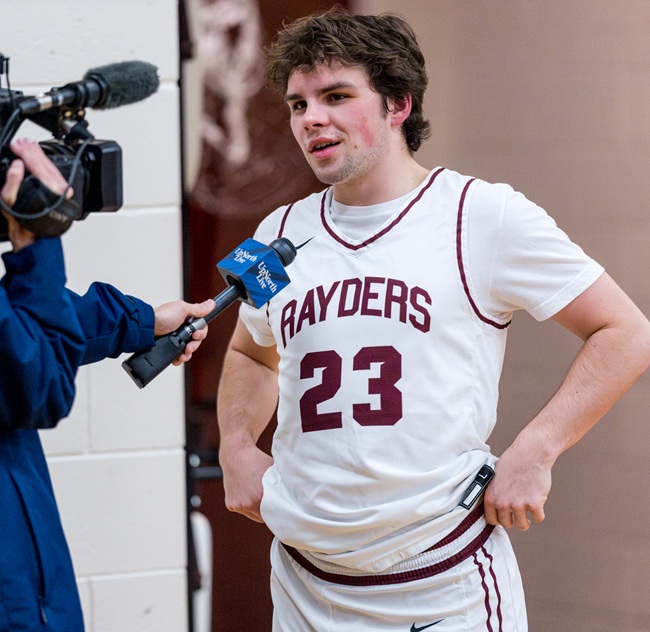
Gaffney was aware of the tremendous support the community was providing him and the entire golf team. But his awareness was heightened further when he realized starters would soon be introduced and the national anthem was playing Tuesday night.
“I've heard the hundreds if not thousands of prayers for the whole golf team and everything and all the letters,” Gaffney said. “I could really feel all the prayers and just everything people had done. And, I would say the moment, the game meant a lot more to everybody watching than it did to me.”
The Charlevoix gym was filled with supporters bearing signs for Gaffney. The team – except Gaffney – wore “Team Joe” warm-up T-shirts. Gaffney wore a “Team Doug” warm-up T-shirt in honor of his golf coach Doug Drenth, who spent months recovering in the hospital and also was in the crowd for the first basketball game.
At least one supporter was unable to attend the game. Logistic problems prevented Dr. McDonald from fulfilling his intent to make the trip from Traverse City. The surgeon is amazed, but not surprised Gaffney returned for opening night.
 “I think most probably would not have been able to do that,” McDonald said. “I think he put in the work, and he really had good community support that allowed him to do that. I think it's very, very impressive.”
Aaron Gaffney – who serves as superintendent for Ellsworth Community School – had thoughts on his mind from early conversations with McDonald as he watched his son get emotional before the contest. Seven months ago, Gaffney acknowledged, he didn’t think he’d see his son play basketball again. He also noted he never saw his son cry during those same seven months – until the tip-off neared.
“It was just great to see him back out there,” Aaron Gaffney said. “My wife asked the surgeon if he was ever going to walk again. He said, ‘Yeah, he's going to walk again.’ I asked him if he would ever play golf again, and the surgeon said, ‘Maybe.’ And then I asked him if he would ever run again, and he said, ‘Maybe.’”
The Gaffneys got answers Tuesday night as the Rayders started the season on a winning note. Talan Jacobs led Charlevoix with 12 points. Carter Greenacre added 11. Jason McNamara scored nine, and Peter Yanchulis chipped in seven.
Moments before the game, Gaffney returned a good luck charm his basketball coach had given him at a breakfast meeting as he was headed for Florida. It was bracelet bearing the words “Never Give Up.”
It was a gift Troshak’s brother had given him as he battled to recover from an eye injury he suffered while playing college basketball.
“I told Joe, ‘I want you to give this back to me when you check into a game, because in high school basketball you can’t wear bracelets,’” Troshak recalled.
Gaffney played Tuesday with empathy for the fans in attendance. The accident taught him more about the hard things going on in people's lives.
“The people there I could tell were there to support me, but there were probably people in that gym tonight that knew somebody or know somebody going through something themselves that was just as hard or harder than what I went through,” Gaffney said. “If people in the world can give them half the love or a quarter of the support that I got, I think that would just make this world a better place.”
Now that he is back on the court, the 1,000-point career milestone lies just ahead for Gaffney – he scored 952 heading into this weekend’s Will Lynch Invitational at Benzie Central. He’s happy about that but is more focused on his newer role. He is the only starter back from last year’s 16-8 team.
“That (1,000-point club) would definitely be a nice bonus, but I'm really just focused, trying to do my best to leave all the sophomores we have on the team with a little taste of what Charlevoix basketball is and what it feels like to win and what it feels like to be on the basketball team. I'm not the same player I was a year ago, but I can help mentor and lead these younger guys to be very successful when they become seniors.”
McDonald did watch a live stream of Tuesday night’s game. He’s making plans to attend another game this season.
Perhaps it will be the game Gaffney enters the 1,000-point club.
 Tom Spencer is a longtime MHSAA-registered basketball and soccer official, and former softball and baseball official, and he also has coached in the northern Lower Peninsula area. He previously has written for the Saginaw News, Bay County Sports Page and Midland Daily News. He can be reached at [email protected] with story ideas for Manistee, Wexford, Missaukee, Roscommon, Ogemaw, Iosco, Alcona, Oscoda, Crawford, Kalkaska, Grand Traverse, Benzie, Leelanau, Antrim, Otsego, Montmorency, Alpena, Presque Isle, Cheboygan, Charlevoix and Emmet counties.
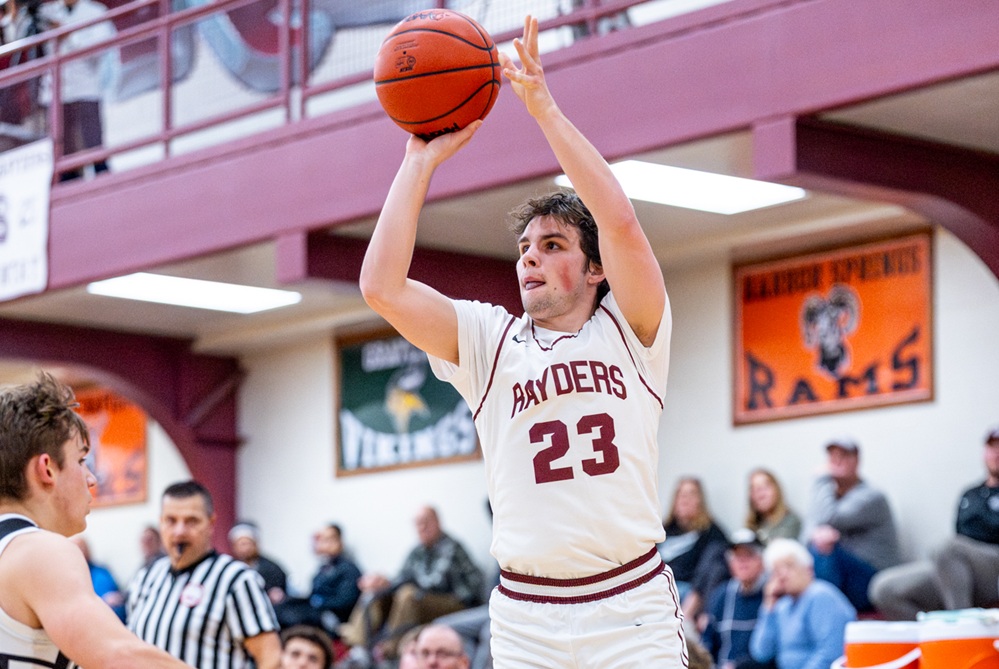
PHOTOS (Top) Charlevoix’s Joe Gaffney elevates on a jumpshot Tuesday in his team’s season opener against Ellsworth. (Middle) Gaffney works to get past an Ellsworth defender. (Below) Gaffney is interviewed by a local TV station after his return to the court. (Photos by In Motion Images.)