

Haslett Saving Big Hits for Game Time
August 16, 2016
By Geoff Kimmerly
Second Half editor
HASLETT – The sound of cleats on pavement. He and his teammates, hand in hand, walking toward the field together minutes before kickoff. Manowar’s “Heart of Steel” ringing in their ears from a few minutes before.
 Justin Kuchnicki gave himself goose bumps Monday describing Haslett’s weekly pregame ritual, which the senior lineman will take part in again beginning Aug. 26 when the Vikings open this season against Remus Chippewa Hills.
They’ll certainly be revved up – and especially to lay some big hits after saving them up during three weeks of non-collision practices.
Haslett has one of the most successful football programs in the Lansing area, with two trips to MHSAA championship games and 14 playoff appearances total over the last 18 seasons. The Vikings finished 6-4 a year ago against a schedule featuring four eventual playoff teams.
The program also might be the first in all of Michigan high school football to fully eliminate full-speed hitting at practice, something Haslett has moved toward over the last few seasons before longtime coach Charlie Otlewski decided to knock it out of his practice plans completely this fall in large part to keep his players healthier for when it matters most.
“It gives you the edge when it gets to game day. You practice all week and you’re not really hitting or doing anything like that, and you get to game day … and everyone’s ready to just go out there and fly around and make plays,” Kuchnicki said. “You’re not really worried about kinks and stuff in your body that you’d have from practices, so you just go out there and lay it on the line.”
Friday was the first day Michigan high school players were allowed to practice in full pads. Storms drenched mid-Michigan that afternoon, so Haslett’s first day in full gear was Monday. And from a distance, it sounded like any other full-contact practice with the normal hoots and hollers and smacking of pads.
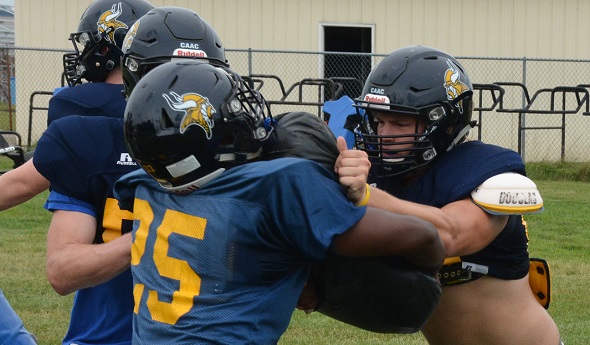
But on closer look, it was anything but. Lineman worked against blocking dummies on a sled or teammates holding hand pads. When the offense came together to run plays, linemen blocked against overturned plastic trash barrels. On the opposite end of the field, subvarsity players worked on defensive pursuit angles but again without hitting. Under a set of uprights laid an old gymnastics mat used to soften the fall during tackling drills, which players again did against standup dummies instead of their teammates.
Reducing collisions – that is, live, game-speed, player-vs.-player hitting – remains the focus of most conversations on health and safety in football. Much of the discussion is centered on reducing concussions, and MHSAA rules changes that took effect beginning with the 2014 season limit teams to one practice per day during the preseason (when teams frequently practice twice) where collisions can take place. During the regular season, teams can have collisions during practice only two days per week.
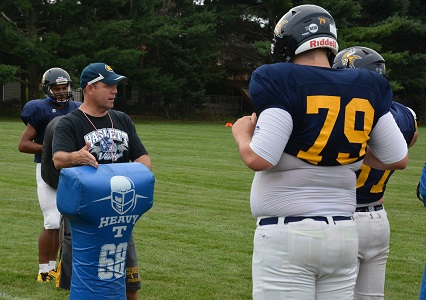 Otlewski – who formerly coached St. Ignace from 1990-93 before taking over at Haslett in 1994 – said his practices used to follow what could be considered a traditional after-school plan: individual position drills for an hour or more followed by 11-on-11 full contact team practice for 30-40 minutes, twice a week.
But a handful of reasons, chiefly the desire to avoid injuries, started his program on a different path five years ago.
“Nobody wants injuries, but you surely don’t want them in practice. Then the concussion thing started to happen. (But) we didn’t do it because of concussions; we did it because of general overall injuries,” Otlewski said.
“If we lose a guy in Thursday’s scrimmage, or next Thursday in a game, OK, that’s football. But what we don’t want to do is lose someone in practice, because that seems unnecessary.”
The initial changes Haslett began to make to practices that fall of 2011 became drastic two years later, when he and his staff went to a different practice model completely. The Vikings now break every practice into 10-minute sessions alternating between team time and position drills, so position coaches can work with players individually before and after seeing how they perform when all 11 are running plays together.
This new breakdown brought the amount of player-on-player contact at practice down significantly as much more time was dedicated to learning proper footwork, blocking and tackling techniques and other fundamentals. Players on Monday worked at 50-percent speed, at most, against teammates either in front of them and also not moving at game speed, or against others holding pads and dummies.
The last two seasons, the only full-contact session during practices came during preparation for goalline situations; Otlewski and his staff decided to eliminate those this fall as well.
“We’re OK with a certain level (of contact). But we never want to go on the ground; we always want to stay up,” he said. “We want to go fast enough so where we have to use the perfect technique to get there footwork-wise. But we’re trying to eliminate the physicality part.”
To be clear, eliminating all collisions/contact is not required by the MHSAA. And there are probably more than a few in the coaching fraternity who would think Haslett is making a massive mistake.
But the Vikings’ no-contact strategy follows a way of thinking made popular in part by coaches like Dartmouth College’s Buddy Teevens, whose team hasn’t tackled during practices in six years. The Ivy League as a whole adopted a policy of no tackling in practice for the regular season beginning this fall.
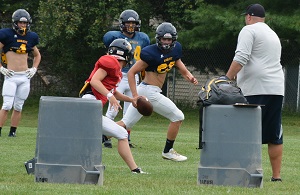 Otlewski said teaching to tackle without contact allows his players to practice the same technique-building drills during four-player offseason workouts, his team’s no-pads summer camp and then while wearing pads during the season. His defense doesn’t face a live offense during the week, but he doesn’t think his players lose out because they can gain just as much from watching film and working on pursuit angles and recognizing formations. Same goes for his offense, which can still practice skill work and the passing game full-speed while lineman go half-speed working on footwork and blocking technique.
And he sees 37 players on his varsity roster, with that total remaining consistent over the last many seasons – while three opponents on this year’s schedule don’t have junior varsities and a fourth won’t field a freshman team.
His players three seasons ago didn’t really like the idea of not hitting in practice at first. But they’ve since bought in. He hasn’t heard a ton from parents either way; but he taught a class on football for local moms over the winter, and they seemed to like the idea as well.
“On one hand, I’m a little apprehensive,” Otlewski said. “OK, we haven’t gone full go. Is there a difference all of a sudden when it’s live Thursday against (Grand Rapids) Christian? Are we going to be up to speed?
“I think I still worry about that a little bit. But once we get into it, it’s fine.”
Kuchnicki is just as confident. Contact doesn’t bother this guy. He’s 6-foot-6 and in the neighborhood of 320 pounds. Sure, he’d love to have one contact practice this year so he and his teammates can back up some of the trash-talking they do to each other on the field.
But he’s fine with saving his biggest hits for opponents – and especially those who might think Haslett won’t be prepared for a physical game.
“They’d probably think we’re soft,” Kuchnicki said. “But when it comes game day, they change their minds instantly. I’ll tell you that.”
 Geoff Kimmerly joined the MHSAA as its Media & Content Coordinator in Sept. 2011 after 12 years as Prep Sports Editor of the Lansing State Journal. He has served as Editor of Second Half since its creation in Jan. 2012. Contact him at [email protected] with story ideas for the Barry, Eaton, Ingham, Livingston, Ionia, Clinton, Shiawassee, Gratiot, Isabella, Clare and Montcalm counties.
PHOTOS: (Top) Haslett lineman work on blocking during Monday's practice. (Middle) Vikings coach Charlie Otlewski instructs his players on one of the team's blocking schemes. (Below) Backs work on the option with barrels serving as the defensive front.
Drive for Detroit: Week 3 Preview
September 12, 2019
By Geoff Kimmerly
Second Half editor
Every football regular season there’s one week when it’s tough to tell heading in which matchups might eventually have the greatest impact on the season as a whole. That tough-to-forecast week then tends to end up as one of the most exciting of the entire fall.
 This might be that week for 2019. There are some definite must-watch games across the state for Week 3 – but in a lot of places, we’re eager to see who emerges as leagues continue to get rolling and summer weather hangs on just a little bit longer.
Below are some pretty strong guesses at games you won’t want to miss from your part of Michigan. You’ll again be able to check out 20 games live on MHSAA.tv – including eight of the games listed below.
Games below are Friday unless noted. "Drive for Detroit" is sponsored by MI Student Aid.
Bay & Thumb
Flint Beecher (1-1) at Flint Hamady (2-0)
These neighbors have begun playing each other during the regular season again only recently, with Hamady winning both matchups as part of the Genesee Area Conference Blue schedule over the last two seasons. Hamady edged Beecher 24-18 in Week 3 last year on the way to winning the league title and both teams qualifying for the playoffs.
Keep an eye on these: FRIDAY Saginaw Michigan Lutheran Seminary (2-0) at Saginaw Nouvel (2-0), Kalamazoo Central (1-1) at Flint Powers Catholic (2-0), Sandusky (1-1) at Ubly (2-0), Chesaning (2-0) at Montrose (2-0).
Greater Detroit
Rochester Adams (2-0) at Lake Orion (2-0)
The Dragons are one of the stories of the season so far, coming off back-to-back 0-2 starts the last two years with wins over highly-touted Lapeer and Southfield Arts & Technology to open this one. Lake Orion won those games by a combined score of 54-14, but faces another team that hasn’t gotten much attention – yet. Adams has outscored its first two opponents by a combined 91-31, with a 31-7 win last week over 2018 playoff qualifier Oxford.
Keep an eye on these: FRIDAY Detroit U-D Jesuit (2-0) at Bloomfield Hills Brother Rice (2-0), Dearborn (1-1) at Belleville (2-0), Utica Eisenhower (1-1) at Clinton Township Chippewa Valley (2-0), Canton (1-1) at Plymouth (2-0).
Mid-Michigan
Clare (2-0) at Harrison (2-0)
The Jack Pine Conference title continues to go through Clare, which shared the championship with Roscommon last season after outright wins in 2016 and 2017 and four more during the first half of the decade. The Pioneers have lost only three league games this decade – including to Harrison in 2010 and 2015. The Hornets earned their first two wins this season by a combined 70 points, but Clare has to be happy too with a combined 62-point margin during its start that included an impressive 35-0 shutout of Alma in Week 1.
Keep an eye on these: FRIDAY Hartland (1-1) at Brighton (2-0), Fowlerville (2-0) at Williamston (2-0), Haslett (1-1) at Mason (2-0), Lake City (1-1) at Beal City (2-0).
Northern Lower Peninsula
Alcona (1-1) at Oscoda (2-0)
Alcona owns a 7-3 advantage since the teams began playing each other annually again in 2009, but Oscoda won 55-8 last season on the way to a North Star League title. The Owls offense found its stride last week against Coleman with a feat that is at least rare, if not unique – eight players combined to score 10 touchdowns, with Owen Franklin crossing the goal line three times and Andy Dault, Robert Host, Caleb Nagel, Gabe Kellstrom, Zach Ouillette, Gavin Lueck and Anthony Ward all scoring once (and quarterback Brayden Mallak making the MHSAA record book with five first-half TD passes).
Keep an eye on these: FRIDAY Ludington (2-0) at Manistee (2-0), Grayling (1-1) at Kingsley (2-0), Tawas (1-1) at Whittemore-Prescott (1-1). SATURDAY Holt (2-0) at Traverse City West (1-1).
Southeast & Border
Monroe St. Mary Catholic Central (2-0) at Milan (2-0)
This pair frequently of late has decided the Huron League title – although Milan last season followed up a 26-21 win over the Falcons with later losses to Riverview and eventual conference champion Grosse Ile. But these two look like the possible teams to beat again. Milan opened league play last week beating Grosse Ile 35-13, and St. Mary has nice wins over 2018 Division 7 runner-up Madison Heights Madison and Carleton Airport to start this fall.
Keep an eye on these: FRIDAY Coldwater (2-0) at Jackson Lumen Christi (2-0), Hillsdale (2-0) at Erie-Mason (2-0), Brooklyn Columbia Central (2-0) at Ida (1-1), Schoolcraft (2-0) at Ottawa Lake Whiteford (1-1).
Southwest Corridor
Portage Northern (2-0) at Portage Central (1-1)
These neighbors shared the Southwestern Michigan Athletic Conference West title last season, in part because of Central’s 21-20 win over Northern in Week 3. Northern earned a degree of revenge seven weeks later with a 35-7 win over Central in a Division 2 playoff opener and on the way to a District title. The Huskies got past a major league obstacle last week by edging Stevensville Lakeshore 14-6, but haven’t beaten Central during the regular season since 2012.
Keep an eye on these: FRIDAY Centreville (2-0) at Cassopolis (2-0), St. Joseph (2-0) at Mattawan (1-1), Paw Paw (2-0) at Plainwell (1-1), Kalamazoo United (0-2) at Berrien Springs (2-0).
Upper Peninsula
Calumet (2-0) at Ishpeming Westwood (1-1)
A number of contenders facing off immediately this season has put a focus on the Western Peninsula Athletic Conference Copper, and this week reigning champion Calumet will travel to take on 2018 runner-up Westwood. The Copper Kings won last year’s matchup 14-12 and then got past the Patriots 6-0 in a Division 6 playoff opener. But Westwood this time is trying to bounce back from last week’s 20-point loss to Iron Mountain, which has emerged as the possible Copper favorite this fall.
Keep an eye on these: FRIDAY Menominee (1-1) at Gladstone (2-0), Charlevoix (2-0) at St. Ignace (1-1), Ishpeming (2-0) at Norway (1-1), Marquette (0-2) at Sault Ste. Marie (2-0).
West Michigan
Grand Rapids Forest Hills Central (2-0) at Grandville (2-0)
This matchup features a pair of teams that have been impressive so far and have high hopes of moving up in tough conferences. Forest Hills Central was 5-5 a year ago and third in the Ottawa-Kent Conference White, but has beaten 2018 playoff teams Jenison and Holland West Ottawa to start and held both to seven points apiece. Grandville tied for fourth in the O-K Red last season and finished 4-5 overall despite a one-point Week 3 win over the Rangers. The Bulldogs have outscored their first two opponents by a combined 106-44, with a 39-point win over playoff regular East Lansing last week.
Keep an eye on these: FRIDAY East Grand Rapids (1-1) at Muskegon (2-0), Grand Rapids Catholic Central (1-1) at Zeeland East (2-0), Muskegon Reeths-Puffer (1-1) at Muskegon Mona Shores (2-0), Hamilton (2-0) at Byron Center (2-0).
8-Player
Pickford (2-0) at Powers North Central (2-0), Saturday
If nothing else, this matchup might feature the two best offenses in 8-player football this season – and might be pitting two teams that will be playing for MHSAA championships at the Superior Dome in two months. Reigning 8-player Division 1 runner-up Pickford has put up 106 points, against 34, over its two wins over playoff regulars Crystal Falls Forest Park and Engadine. North Central’s combined tally is 128-18 against two more annual powers, reigning 8-player Division 2 champion Rapid River and Cedarville.
Keep an eye on these: FRIDAY Pellston (2-0) at Au Gres-Sims (1-1), Bellevue (1-1) at Climax-Scotts (2-0), Battle Creek St. Philip (1-1) at Colon (2-0), Mount Pleasant Sacred Heart (1-1) at Deckerville (2-0).
Second Half’s weekly “Drive for Detroit” previews are powered by MI Student Aid, a part of the Office of Postsecondary Financial Planning located within the Michigan Department of Treasury. MI Student Aid encourages students to pursue postsecondary education by providing access to student financial resources and information. MI Student Aid administers the state’s 529 college savings programs (MET/MESP), as well as scholarship and grant programs that help make college Accessible, Affordable and Attainable for you. Connect with MI Student Aid at www.michigan.gov/mistudentaid and find more information on Facebook and Twitter @mistudentaid.
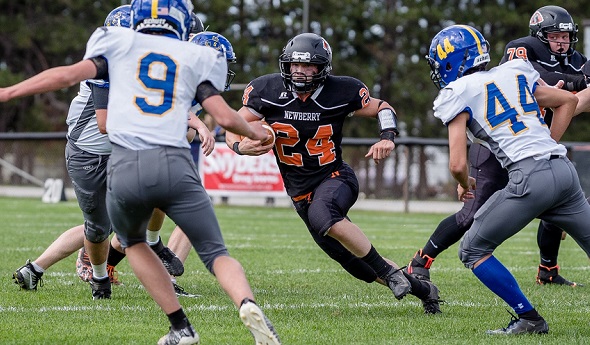
PHOTO: A Newberry ball-carrier looks for an opening during last week’s 8-player 32-8 win over Stephenson. (Photo by Jeff Rochefort.)