

Hudson Rides Dominating Defense to Lock Down Division 8 Title
By
Paul Costanzo
Special for MHSAA.com
November 26, 2021
DETROIT – For a team not used to giving up points – or yards, for that matter – it would have been easy Friday for Hudson to make some big changes at halftime to slow down a Beal City offense that had found success through the passing game.
But the Tigers – who entered the MHSAA Division 8 Final having allowed 107.7 yards and less than a touchdown per game through the Semifinals – didn’t stray from the gameplan.
“Honestly, (the adjustment was) just keep playing,” Hudson coach Dan Rogers said. “They did a great job, their line, we couldn’t get pressure on the quarterback. He could get out on the edge and we struggled getting to him. That made us cover a lot longer than we want to, so we were trying to get to the quarterback a little bit more, keep the receivers in front of us and make plays on the football.”
It worked, as Hudson smothered Beal City in the second half, allowing just 17 yards over the final 24 minutes of its 14-7 victory at Ford Field to claim its second Finals title.
“I can’t even describe it yet; it hasn’t really hit me yet,” said Hudson senior running back and safety Bronson Marry, who had a crucial late-game interception. “I’m just waiting to walk out of the locker room and find our families. It’s going to (hit like) a brick wall.”
While Hudson (14-0) never led by more than one score, Beal City never threatened to overcome it, spending the entirety of the second half offensively on its own side of the field. The Aggies’ five second-half possessions went for 4, -6, 13, 1 and 5 yards, and totaled 5 minutes and 29 seconds.
A fumble, an interception and downs ended the last three drives, with Nick Kopin breaking up the final Beal City pass attempt with 1:51 to play, sealing the game. It was a fitting end to Kopin’s big day, as he also had forced a fumble earlier in the fourth quarter and rushed for 131 yards and both of Hudson’s touchdowns.
“It’s amazing,” Kopin said. “Obviously, I’m going to credit all my runs to our offensive line and our play-calling by coach (Jeremy) Beal. It set up really good cutbacks, and they were blocking real well. Defensively, credit to (Coach Rogers), he’s very strict on us reading our keys and doing our jobs. I think all of us, including myself, just did that, and the game turned out in our favor.”
 Kopin’s second score, a 2-yard run, came with 6:58 to play and put the Tigers up 14-7. The two-point pass was no good, however, keeping Beal City within a touchdown. The Aggies received a further boost with the return of quarterback Hunter Miles, who had been injured midway through the third quarter, but Hudson’s defense didn’t allow for a storybook comeback.
“Hunter Miles is Hunter Miles; he’s a warrior,” Beal City coach Brad Gross said. “That’s Hunter Miles. Ankle, ribs, everything else (was hurt). We have a lot of guys dinged up. Cade Block’s had a (injured) shoulder that he’s been playing with for three weeks. Wade Wilson has a broken hand that he played the whole game with. We’re just banged up. We have a bunch of warriors. That’s why we’re here.”
Miles had more success in the first half, mostly on the strength of a pair of big pass plays to Carter Fussman. The first was a 53-yard touchdown pass late in the first quarter. Miles rolled to his right before finding Fussman open near the 10-yard line.
The second was a 56-yard throw and catch on the penultimate play of the first half, which came immediately after Hudson had taken an 8-7 lead on a 2-yard run from Kopin and a two-point conversion pass from Anthony Arredondo to Ambrose Horwath. The big pass play ended with Fussman being hauled down by Horwath at the Hudson 7-yard line with four seconds left in the half.
That tackle wound up being enormous, as an incomplete pass on the next play ended the half with Hudson still in the lead.
“It probably made the conversation at halftime better,” Rogers said. “It was a huge tackle. That’s what we talk about: You just have to keep playing. They’re going to make plays, things are going to happen, and it would have been just as easy to hang your head and he runs into the end zone. Our kids don’t do that, and Ambrose, he made a play, and that’s what we had to have.”
Hudson’s offense had success on the ground, rushing for 282 yards, but strong red zone defense from the Aggies kept them in the game. All five of Hudson’s second half drives – excluding the final one, which consisted of three kneel downs – ended at least within the Beal City 35, but just one led to a score.
“You have to give credit to Beal City, too,” Rogers said. “When we got down there, they stiffened up defensively and took all the inside runs away. Unfortunately, we weren’t able to score and it kept the game close.”
Payton Rogers added 62 yards on the ground for Hudson, while Horwath hauled in the lone completed pass for the Tigers, a 17-yard catch from Easten Strodtman that converted a 3rd-and-long on the Tigers’ fourth-quarter touchdown drive. Kopin led the Hudson defense with six tackles, while Strodtman and Ethan Harris each recorded a sack.
Fussman led the Beal City (12-2) offense with two catches for 109 yards, while Miles finished with 128 yards through the air – all in the first half. Josh Wilson recorded 13 tackles to lead the Beal City defense, while Miles had eight.
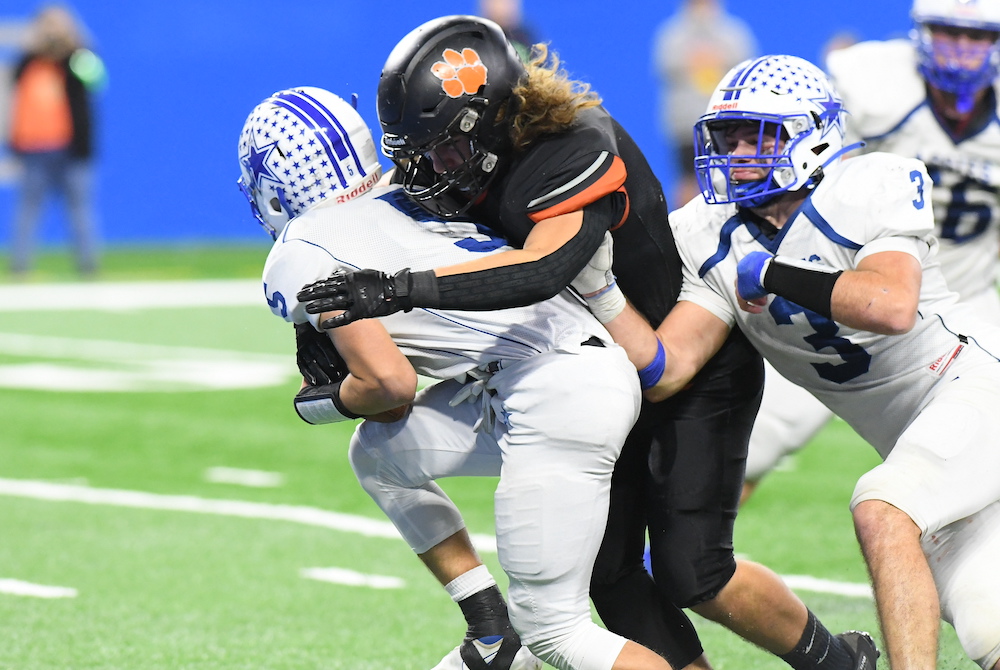
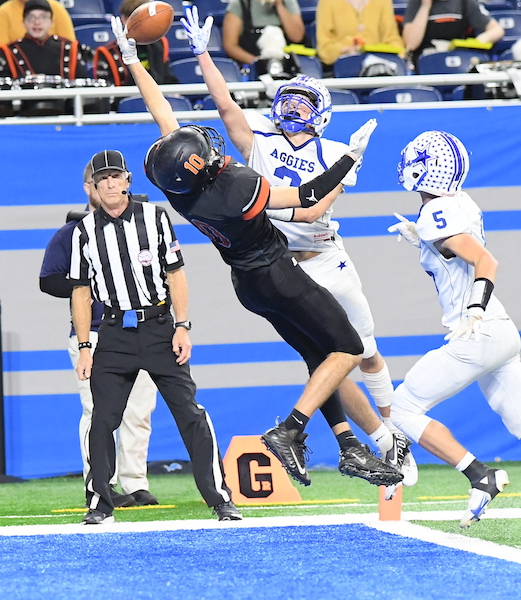
PHOTOS (Top) Hudson’s Easten Strodtman brings down Beal City quarterback Jack Fussman during Friday’s Division 8 Final. (Middle) The Tigers’ Ambrose Horwath (10) tries to get a hand on the ball with the Aggies’ Carter Fussman (2) and Jack Fussman defending. (Photos by Hockey Weekly Action Photos.)
1st & Goal: 2025 Week 8 Review
By
Geoff Kimmerly
MHSAA.com senior editor
October 20, 2025
The words “winner-take-all” appears in this week’s 1st & Goal Review 10 times referring to games played this weekend.
 As schedules tend to rotate annually or every few years, in just about every league across Michigan, to have that many winner-take-all conference championship matchups work out to fall during the same weekend is just incredible luck.
They certainly were the theme of Week 8, as we nearly finished up those races and turned even more of our attention to the playoff chase soon to begin.
Bay & Thumb
HEADLINER Grand Blanc 57, Davison 29 In one of two games statewide between undefeated teams, Grand Blanc (8-0) dominated in clinching the Saginaw Valley League South championship. Quarterback Jake Morrow was among headliners as the Bobcats scored a season high in handing Davison (7-1) its lone defeat. Click for more from the Flint Journal.
GRAND BLANC MAKING A STATEMENT! Senior QB Jake Morrow had himself a night in the Bobcats’ 57-29 win over Davison on Friday. 🔥 We had Grand Blanc #11 in our Top 20, but don’t be surprised if they’re cracking the Top 10 next week. 👀🏈@MHSAA | @Jakemorrow2026 | @GrandBlancFB pic.twitter.com/NxXUkgAFmR
— STATE CHAMPS! Michigan (@statechampsmich) October 18, 2025
Watch list Frankenmuth 27, Freeland 13 The Eagles (7-1) ran their winning streak over rival Freeland (6-2) to seven by locking up this winner-take-all matchup for the outright Tri-Valley Conference Red championship. Frankenmuth hasn’t lost a league game since 2014.
On the move Goodrich 21, Fenton 20 This concluded Sunday because of Saturday night storms, and the Martians (8-0) held on to claim a second-straight overall Flint Metro League title and after also facing Fenton (5-3) for the championship a year ago. Harbor Beach 20, Elkton-Pigeon-Bay Port Laker 6 The Pirates (8-0) need one more win – albeit against a tough Millington team this week – to lock up a second-straight perfect regular season after downing another solid opponent in Laker (6-2). Flint Elite 34, Burton Bendle 8 Elite, a cooperative of New Standard Academy and Burton Madison Academy, improved a 7-1 and clinched a share of the Genesee Area Conference championship with a solid win over Bendle (5-3), which also can clinch a share this week.
Greater Detroit
HEADLINER Detroit Cass Tech 35, Detroit Martin Luther King 19 The Technicians (8-0) finished a season sweep of King (6-3) and ran their winning streak over the Crusaders to three with a fourth-straight Public School League Blue city championship. One more win this weekend would will give Cass Tech its first perfect regular season (not including shortened 2020) since 2018. Click for more from the Detroit Free Press.
CASS TECH GOES DEEP IN THE PLAYBOOK 🎩 The Technicians pulled out the trickery Friday night vs. King — reverse to our Mr. Football candidate CJ Sadler, who drops it to Mylan Griggs for the touchdown! Cass Tech took the PSL Gold Division City Championship with a 35-19 win over… pic.twitter.com/8KcKSDfSW9
— STATE CHAMPS! Michigan (@statechampsmich) October 19, 2025
Watch list Warren Fitzgerald 36, Port Huron Northern 23 Fitzgerald (7-1) added to its perfect run through the Macomb Area Conference Gold with this notable victory over the MAC Blue champion Huskies (6-2). Although the Spartans did make the playoffs the last two seasons, this is guaranteed to be their first with a winning record since 2021.
On the move Detroit Denby 20, Detroit Pershing 6 After opening this season 0-2, Denby (6-2) began and finished PSL play with wins over Pershing (5-3), this one in the Gold city championship game. Detroit Edison 27, Ecorse 8 The Pioneers (7-1) finished an outright league title run in the Charter School Conference Gold, winning the tie-breaker over Romulus Summit Academy North because of a 26-14 victory in their Week 3 matchup. Utica 26, Macomb Dakota 17 After losing its league opener, Utica (6-2) still ended up with a share of the MAC White title and ran its winning streak to five games by avenging 35-0 and 31-0 losses to Dakota (6-2) from a year ago.
Mid-Michigan
HEADLINER Howell 37, Brighton 28 The Highlanders (7-1) had been chasing the lead in the Kensington Lakes Activities Association West since falling to Northville during the second week of the league schedule. They finally caught up and earned a share of the title by getting past co-champ Brighton (6-2), extending their winning streak over the Bulldogs to four. Click for more from the Livingston Daily Press & Argus.
Check out the moments of the STATE CHAMPS! Gametime Live football broadcast between Howell and Brighton from Friday, October 17th. Check out the full broadcast on the STATE CHAMPS! YouTube Page: https://t.co/xWJGUUEfUr
Delivered by @hungryhowies pic.twitter.com/vSij25F8BF— STATE CHAMPS! Michigan (@statechampsmich) October 20, 2025
Watch list Mount Pleasant 10, Midland 0 The Oilers (8-0) finished a perfect run through the SVL North with their closest win of the season, avenging last year’s 10-7 loss to the Chemics (4-4).
On the move Fowler 48, Ithaca 28 These two small-school powers most recently met in a 2023 playoff opener, won by Ithaca 28-27, but they won’t see each other again this fall with Fowler (6-2) in Division 8 and Ithaca (6-2) in Division 7. Beal City 49, LeRoy Pine River 6 The Aggies (8-0) finished their Highland Conference championship run with four shutouts in seven league games and giving up only 21 total in league play. Portland 49, Charlotte 7 The Raiders (8-0) capped another perfect run through the Capital Area Activities Association White, while Charlotte (4-4) will need to jump seven spots this week to make the Division 4 playoff bracket.
Northern Lower Peninsula
HEADLINER Charlevoix 13, Boyne City 12 With both teams already done with league competition, this played like a playoff game as Charlevoix (8-0) moved within one more win of achieving a first perfect regular season since 1977 (not counting shortened 2020). The Rayders also had lost three of their previous four against the Ramblers (5-3), including last year’s matchup 45-21. Click for more from the Petoskey News-Review.
Watch list Harbor Springs 34, Oscoda 22 After three straight winless seasons, Harbor Springs is 4-4 with a chance for its winningest since 2019.
On the move Ogemaw Heights 34, Sanford Meridian 0 The Falcons (7-1) posted their second-straight shutout in downing Meridian (5-3) in this matchup of Jack Pine Conference division champions. East Jordan 25, Frankfort 14 East Jordan (5-3) is No. 19 on the Division 8 playoff list and Frankfort (5-3) is No. 23 after the Red Devils’ fourth-straight win in the series. Kingsley 63, Kalkaska 8 The Stags (6-2) prepped to face Charlevoix this week by scoring their most points this season and holding Kalkaska (5-3) to its fewest.
Southeast & Border
HEADLINER Ann Arbor Father Gabriel Richad 44, Macomb Lutheran North 19 Matthew Hoban and James Milanovich both scored three touchdowns as FGR (8-0) finished a perfect run through the Catholic High School League Intersectional #1, ending Lutheran North’s two-year reign and also handing the Mustangs (7-1) their only loss. Click for more from the Ann Arbor News.
MATTHEW HOBAN WAS THAT DAWG. 🐾⛓️ The Ann Arbor Father Gabriel Richard senior and Wayne State commit earned the “Got That Dawg In Me” chain after rushing for 3 touchdowns in the Irish’s 44-19 win over Lutheran North. Powered by @MIArmyGuard @FGRathletics pic.twitter.com/SMO05uRiG9
— STATE CHAMPS! Michigan (@statechampsmich) October 18, 2025
Watch list Monroe St. Mary Catholic Central 20, Monroe Jefferson 15 The Huron League finished play with three champions as the Falcons (7-1) bounced back from a Week 7 loss to Riverview to hand Jefferson (7-1) its lone defeat – giving all three a share of the title.
On the move Springport 35, Union City 34 The Spartans (8-0) capped a Big 8 Conference outright championship march by getting past second-place Union City (5-3) by the closest of margins, as a few points the other way would’ve meant a shared title. Michigan Center 46, Napoleon 14 These two faced off in a winner-take-all for the Cascades Conference East title, with the Cardinals (8-0) reversing the scenario from when Napoleon (5-3) won their matchup and the league in 2023. Jackson Lumen Christi 27, Traverse City St. Francis 12 No championship was on the line with this showdown, but this could end up the preview of a late-playoff Division 6 matchup as Lumen (5-3) sits No. 2 on that division’s list and St. Francis (6-2) is No. 11.
Southwest Corridor
HEADLINER Decatur 22, White Pigeon 14 Decatur’s first win over White Pigeon in three seasons gave the Raiders the outright championship in the Southwest 10 Conference – after White Pigeon defeated Decatur in a winner-take-all for last year’s title. They may meet again; Decatur (6-2) is No. 9 and White Pigeon (6-2) is No. 13 on the Division 8 playoff list. Click for more from the Kalamazoo Gazette.
Watch list Battle Creek Harper Creek 41, Marshall 22 The Beavers (7-1) clinched a share of the Interstate 8 Athletic Conference title and can claim the championship outright this week at Jackson Northwest. A perfect run through league play would be their first since 2017.
On the move Paw Paw 43, Three Rivers 0 The Red Wolves (5-3) have now won five straight after opening 0-3 against opponents that are a combined 22-2. Vicksburg 38, Edwardsburg 35 The Bulldogs (5-3) bounced back from a pair of tough losses to defeat Edwardsburg (6-2) for the first time since 2014. St. Joseph 37, Battle Creek Central 18 The Bears (5-3) have won five of their last six games and put Central in position as one of several 4-4 teams working for a playoff spot in Division 2.
Upper Peninsula
HEADLINER Menominee 49, Kingsford 14 Another hard-fought race in the Western Peninsula Athletic Conference Copper was decided as Menominee came up big in a winner-take-all after Kingsford (6-2) did the same versus the Maroons to clinch the outright title a year ago. Menominee (8-0) also remains in the hunt for its first perfect regular season since 2015. Click for more from the Iron Mountain Daily Reporter.
Watch list Marquette 21, Cadillac 12 The Sentinels (5-3) are sitting No. 27 on the Division 3 playoff list after a fourth win over their last five games – but with Kingsford up next to complete the regular season.
On the move Bark River-Harris 44, West Iron County 7 The Broncos (6-1) completed a perfect run through the West-PAC Iron and sit No. 12 on the Division 8 playoff list, with the Wykons (3-4) still holding out hope at No. 36. Negaunee 42, Houghton 6 The Miners (5-3) are holding at No. 26 on the Division 5 playoff list, with a tough home matchup with Iron Mountain this week. Calumet 46, Gladstone 3 Calumet (6-2) ended up third in the West-PAC Copper, its losses to the league leaders, but one more win will give the Copper Kings their most since 2021.
West Michigan
HEADLINER Hudsonville Unity Christian 42, Grand Rapids South Christian 14 When last these two met, South Christian (4-4) avenged a 50-21 regular-season loss by ending Unity’s 2024 season with a 35-28 District Semifinal defeat. They may meet again in these Division 4 playoffs as well – but at this moment, Unity (8-0) is the repeat Ottawa-Kent Conference Green outright champion. Click for more from the Grand Rapids Press.
Watch list Wyoming Godwin Heights 41, Wyoming Kelloggsville 22 A ninth-straight win over the rival Rockets (5-3) sent Godwin Heights (7-1) into one of the few remaining league championship games this weekend as the Wolverines will face Belding in a winner-take-all for the O-K Silver title.
On the move Kent City 24, Howard City Tri County 21 After surviving its closest game this season, Kent City (8-0) this week against Grant will pursue its first perfect regular season since 2017. Grand Rapids Catholic Central 35, Grand Rapids Northview 7 The Cougars (8-0) finished a perfect run through the O-K Black by avenging last season’s loss to Northview (5-3). Grand Rapids West Catholic 31, Ada Forest Hills Eastern 21 The Falcons have won 19 straight league games and now four straight league championships including two consecutive in the O-K Green.
8-Player
HEADLINER Blanchard Montabella 36, Merrill 26 Montabella (8-0) wrapped up a repeat championship in the Mid-State Activities Conference Blue by claiming this winner-take-all matchup, and can complete a first perfect regular season during the playoff era this week against Portland St. Patrick. Montabella also is No. 3 on the Division 1 playoff list, while Merrill (6-2) is tied for the No. 11 spot. Click for more from the Mount Pleasant Morning Sun.
Watch list Pittsford 52, Waldron 44 The Southern Central Athletic Association Blue title belongs to Pittsford after another winner-take-all matchup. The Wildcats (7-1) finished a second-straight perfect run through the league and handed Waldron (5-3) its only conference defeat.
On the move Powers North Central 38, Gogebic 34 The Jets (6-2) have swooped in to create a three-way tie for first in the Great Lakes Eight Conference West with the Miners (7-1) and Lake Linden-Hubbell and one league game left to play. Mendon 46, Climax-Scotts 20 The Hornets (8-0) won a winner-take-all in the SCAA Red, further avenging a 46-44 loss to Climax-Scotts last season that allowed the Panthers to do the same. Bridgman 44, New Buffalo 8 The Bees (7-1) handed the Bison (7-1) their only loss this season in claiming a winner-take-all for the Southwest Michigan 8-Man Football League title.
MHSAA.com's weekly “1st & Goal” previews and reviews are powered by MI Student Aid, a division within the Department of Lifelong Education, Advancement, and Potential (MiLEAP). MI Student Aid encourages students to pursue postsecondary education by providing access to student financial resources and information. MI Student Aid administers the state’s scholarship and grant programs that help make college Accessible, Affordable and Attainable for you. Click to connect with MI Student Aid and find more information on Facebook and Twitter @mistudentaid.
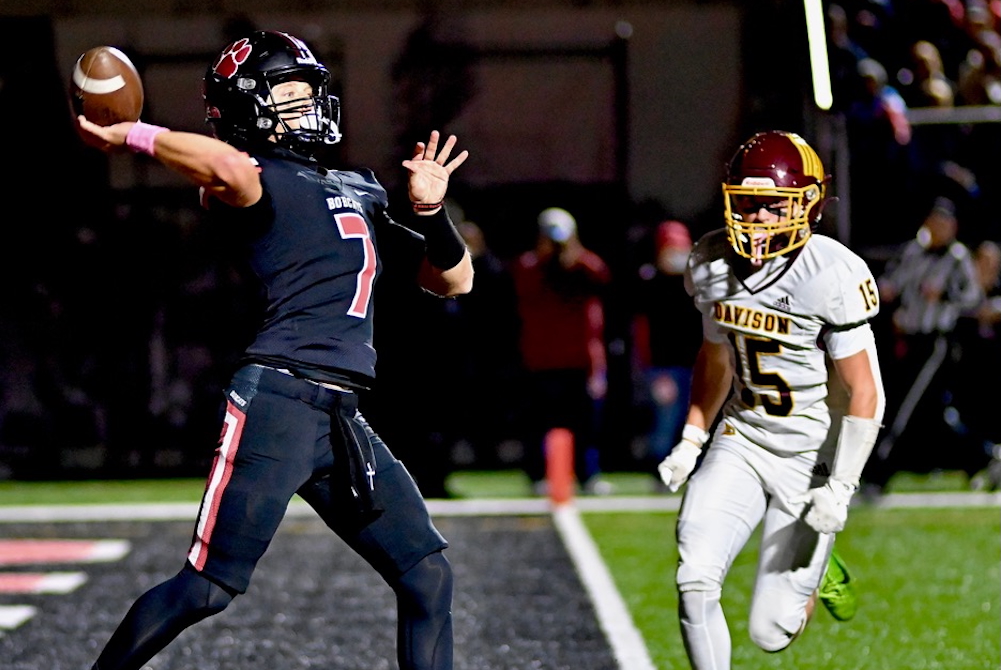
PHOTO Grand Blanc quarterback Jake Morrow throws a pass Friday with a Davison rusher in pursuit. (Photo by Terry Lyons.)