

Ice Man: Skyline's Copp sets football records, leaves legacy
October 27, 2011
Eventually, Andrew Copp may be best-known as a hockey star. His spot on the USA under-18 national team development program squad marks him as one of the top players his age in the country.
But he’ll be remembered as one of Ann Arbor Skyline’s first standout athletes for another sport he simply couldn’t give up.
Bittersweet and heart-breaking are how Copp described the end of this football season. The MHSAA playoffs begin this weekend, and he hoped to be a part -- a possibility that was likely closer than Skyline’s 3-6 record might imply, given four of those losses were by four or fewer points. And that’s not the worst part. Even if Skyline had earned a berth, Copp would’ve been forced to watch after breaking his right collarbone in multiple spots three weeks ago.
Still, there will be plenty to remember fondly for the first quarterback in his school’s four-year history. Two MHSAA records and his school’s first varsity football wins will top the list, even as the combination of football and the injury will force Copp the miss the first half of his USA team’s season.
“It means a lot, starting something new and trying to put your stamp on it,” Copp said. “As the quarterback, it’s a lot of weight on your shoulders to start something that 10, 20 years down the road people are going look at.
“Last year, when I got offered to play (USA) but had to quit football after the first game, I couldn’t do it. I just couldn’t quit on the team.”
That kind of leadership was “worth its weight in gold” for a school and program only just getting started, Skyline athletic director John Young said.
Copp likely would’ve attended Ann Arbor Pioneer -- like both of his parents had -- had Skyline not opened in fall 2008.
The Eagles’ football program started that first fall, but didn’t field a varsity team until 2010. Copp was the quarterback all four years until his he was injured on a run during the first quarter of his team’s Week 7 game against Temperance Bedford.
Two weeks earlier, against Ann Arbor Pioneer, Copp had thrown for an MHSAA record 557 yards and record-tying seven touchdowns. In six games this fall plus a few minutes of that seventh, Copp completed 96 of 156 passes for 1,732 yards and 27 touchdowns. Those season touchdown passes also qualify for an MHSAA record book listing, as do the 31 completions that led to his record-setting numbers against Pioneer.
“Obviously, I can’t throw for 557 yards without my line doing a great job, my receivers catching balls and making plays. And probably the most unsung heroes on our team are the running backs, who were blocking for me,” Copp said. “I just remember everything going our way, almost like a recess football game.”
But it took some flexibility from USA hockey and a tough decision by Copp to make it possible. Usually, USA players aren’t allowed to play other sports, Copp said, but he was granted that exception. He joined USA hockey after his junior football season, and this summer started that team’s workouts at 8 a.m. before then moving on to workouts and film study for football. This fall, after his five classes at Skyline to start the day, he’d work out for hockey from 1:30-4 p.m. every week Monday through Wednesday, then start football practice at 4:30. All while remaining a strong student and adhering to a hockey-imposed 9 p.m. curfew.
Ironically, the 6-foot, 185-pound Copp joined the football team to become more physical for hockey on the advice of his father Andy, a successful youth hockey coach. Andrew has seen some similarities between the two sports -- as a hockey center he also controls play. Hockey helped Copp be ready for a fast pace of play and developed the quick decision-making necessary to thrive at quarterback.
His football mind helped him help the Eagles when he could no longer lead them on the field. “He had surgery on Tuesday, missed Wednesday, and was back at practice the next day,” Skyline coach Rodrek Jones said. “That was the same day my offensive coordinator was not able to come to practice, and (Copp) called the entire practice for me. He stayed very focused.”
Copp still can’t carry his backpack around school, but hopes to play hockey by January. He is almost assured of an outstanding college hockey opportunity, and Jones thinks he has the ability to play college football as well. Young said Copp, along with receiver Jordan Woods (committed to Purdue) and volleyball player Maggie Halloran (committed to Michigan State), has put Skyline on the map. Despite the tough end this fall, it’s a legacy Copp is glad to leave for those who come after him.
“He’s one of the most popular kids in school, on the Homecoming king court ... a typical All-American kid,” Young said. “I’m extremely happy for him. I was disappointed he broke his collarbone, because he was on track for a more spectacular year. But he helped, along with other players, to elevate their play this year.”
PHOTO
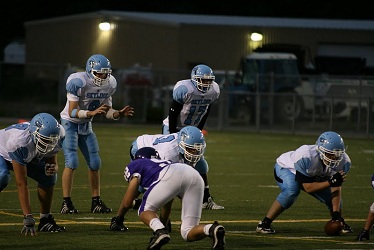
Skyline quarterback Andrew Copp (9) takes a snap against Ann Arbor Pioneer on Sept. 23. Copp threw for an MHSAA-record 557 yards and a record-tying seven touchdowns in a 52-49 loss. (Photo courtesy of Jeff Lepley. Head shot by Pete Draugalis.)
Drive for Detroit: Week 7 in Review
October 12, 2015
By Geoff Kimmerly
Second Half editor
Every game night provides the opportunity for teams and athletes to make history. From 11-player to 8, Week 7 saw its share of those moments.
In last week's preview, we noted at least 20 leagues with games that had immediate championship implications. As we now review, we touch on a number of those below.
Bay & Thumb
Algonac 21, Almont 7
Algonac continued its history-making run, clinching a share of the Blue Water Area Conference title, its first league championship since 1972. The Muskrats (7-0), also celebrating a first winning season and playoff berth since 2005, grabbed the title share against an Almont team that had won 17 straight league games and hadn’t been held to single-digit scoring since Week 3 of 2012. Almont (6-1) is now tied for second place with Richmond, Algonac’s opponent this week. Click for more from the Port Huron Times-Herald.
Also noted:
Vassar 36, Unionville-Sebewaing 24 – The Vulcans (6-1) clinched a share of the Greater Thumb Conference West title by outlasting second-place USA (5-2) and moved to 8-0 against the Patriots since they’ve been in the same league.
Marysville 48, Sterling Heights 21 – The Vikings (5-2) turned the Macomb Area Conference Gold race into a three-team battle with a league game to play by handing Sterling Heights (5-2) its first league loss; those two are tied with Marine City for first place.
Lapeer 49, Midland 21 – The Lightning (7-0) remains perfect for the regular season over its two-year history and earned a share of the Saginaw Valley League Red title by downing the second-place Chemics (6-1).
Sanford Meridian 30, Harrison 8 – The Mustangs (7-0) can clinch a share of the Jack Pine Conference title this week now that they’ve beaten both second-place teams, Clare and Harrison (5-2).
Greater Detroit
Plymouth 31, Canton 20
Plymouth broke a two-game losing streak to the rival Chiefs (5-2) to close out an outright championship in the Kensington Lakes Activities Association South, and after trailing Canton 20-10 at halftime. This was the eighth straight game between the two decided by 12 points or fewer, and earned Plymouth (6-1) the opportunity to host Northville in this week’s KLAA Kensington title game. Click for more from Observer & Eccentric.
Also noted:
Farmington Hills Harrison 13, Farmington 12 – Harrison (6-1) edged one neighbor, Farmington (4-3), to earn a share of the Oakland Activities Association White title, and can finish the run against another, North Farmington, this week.
Birmingham Groves 47, Berkley 14 – A 6-0 start for Groves last season turned into a 1-4 finish beginning with a three-point loss to Berkley (5-2), but the 2015 meeting was all Groves (7-0) as it earned a share of the OAA Blue title.
Orchard Lake St. Mary’s 14, Detroit Catholic Central 7 – The Shamrocks (5-2) and Warren DeLaSalle meet this week to figure out the rest, but those two and St. Mary’s (6-1) are all in the Prep Bowl mix.
Pontiac Notre Dame Prep 33, River Rouge 30 – Notre Dame Prep’s bounce-back from 3-6 last season to 6-1 this fall has included four wins by seven points or fewer including this one over previously-undefeated River Rouge (6-1).
Mid-Michigan
Brighton 14, Howell 11
These KLAA West rivals both played without key contributors and traded their share of momentum-stopping fumbles and interceptions before Brighton (6-1) closed out the win to earn a share of the division championship. The teams have split their last six games. Brighton also clinched a playoff spot, and Howell (5-2) remains alive for what would be a first playoff berth since 2012. Click for more from the Livingston Daily.
Also noted:
Hartland 30, Grand Blanc 27 (OT) – The Eagles (5-2) earned the other share of the KLAA West title by outlasting last season’s champion, Grand Blanc (4-3), and thanks to a win over Brighton two weeks ago also will play for the Lakes Conference title.
DeWitt 49, St. Johns 21 – It’s time to stop talking about DeWitt (7-0) being inexperienced and under the radar after it clinched an outright Capital Area Activities Conference Red title over three others still alive for playoff berths, including the Redwings (5-2).
East Lansing 14, Lansing Sexton 8 – The Trojans (4-3) are staying alive for the playoffs after going 1-8 only a year ago, although they face undefeated Grand Ledge next; Sexton (1-6) suffered its fifth loss by eight points or fewer.
Mount Pleasant Sacred Heart 48, Vestaburg 7 – The Irish’s win-out campaign to make the playoffs after an 0-3 start now includes claiming a share of the Mid-State Activities Conference title with this win over second-place Vestaburg (5-2) that put Sacred Heart at 4-3 overall.
Northern Lower Peninsula
Frankfort 27, Harbor Springs 7
The Panthers quietly are putting up one of the most impressive defensive stands in the state this fall. Since giving up 10 points on opening night in a four-point loss to Maple City Glen Lake, Frankfort (6-1) hasn’t given up more than one score in a game and 32 more points total. This win allowed the Panthers to equal their total for all of last season and got them within another of clinching the Northern Michigan Football League Legends title, while dropping fourth-place Harbor Springs to 4-3. Click for more from the Benzie County Record Patriot.
Also noted:
McBain 34, Lake City 13 – McBain (5-2) closed out a share of the Highland Conference championship with Beal City by downing third-place Lake City (3-4)
Whittemore-Prescott 30, Rogers City 22 – The Cardinals (4-3) are North Star Big Dipper champions for the second straight season but must beat Little Dipper champ Hillman this week to keep on track for an automatic playoff berth.
Hillman 46, Oscoda 39 – The Tigers (6-1) just survived Oscoda (4-3) to earn a playoff appearance for the 10th straight season.
Johannesburg-Lewiston 48, Lincoln Alcona 22 – Another impressive run continues for Johannesburg-Lewiston, which downed Alcona (5-2) thanks to two touchdown runs and 225 yards (plus 17 tackles) by Logan Huff and four scoring runs by cousin Brandon Huff.
Southeast & Border
Ypsilanti Community 34, Chelsea 24
The third-year Ypsilanti Community program, which emerged from the former Ypsilanti High, has beaten Chelsea all three times the teams have met – although this might be the best win in the young Grizzlies’ history. After opening 0-3 this fall, Community has won four straight and with this victory clinched a shared Southeastern Conference White championship with the Bulldogs (6-1). Click for more from AnnArbor.com.
Also noted:
Monroe St. Mary Catholic Central 41, Milan 14 – The Falcons (7-0) clinched a share of the Huron League by winning this matchup of first-place teams, with Milan (5-2) needing help from Monroe Jefferson this week to also earn a share.
Homer 44, Quincy 18 – This win, combined with Concord’s overtime loss to Springport, gave Homer (6-1) the outright championship in the Big 8 Conference.
Saline 28, Monroe 0 – The Hornets (7-0) closed out an outright title in the Southeastern Conference Red while pushing Monroe (3-4) into the pool of those hoping to make the playoffs with an at-large bid.
Ottawa Lake-Whiteford 34, Morenci 6 – The Bobcats (6-1) nearly reversed last season’s 49-0 loss to Morenci (5-2) to move into second place in the Tri-County Conference with first-place Clinton coming up in Week 9.
Southwest Corridor
Benton Harbor 10, Stevensville Lakeshore 7 (OT)
Benton Harbor (4-3) can’t win the Southwestern Michigan Athletic Conference West title and is tied for third place. But many statewide eyes have turned toward the Tigers, who are in pursuit of their first playoff berth and went 0-18 over the last two seasons – and 4-68 over the last eight. Benton Harbor held Lakeshore (4-3) scoreless to start overtime, then won on a 22-yard field goal. Click for more from the St. Joseph Herald-Palladium.
Also noted:
Mattawan 21, Battle Creek Central 18 – This turned the SMAC East into a three-team battle with one league game left to play; Mattawan, Central and Battle Creek Lakeview all are tied for first and none play each other the rest of the way.
Watervliet 56, Delton Kellogg 35 – The Panthers (6-1) won this matchup of first-place teams in the Southwestern Athletic Conference Lakeshore and earned an outright title; Delton (5-2) now must beat an undefeated team over the next two weeks to earn a first playoff berth since 2001.
Dowagiac 16, Sturgis 7 – The Chieftains (4-3) gave Wolverine B Conference leader Edwardsburg a hand, handing second-place Sturgis (5-2) a second loss that resulted in the Eddies gaining a share of the league title.
Schoolcraft 41, Gobles 12 – The Eagles (7-0) are enjoying their move to the new SAC Central; they earned the title outright with this win and gave up a total of 30 points over five league games. Gobles (4-3) was one of two opponents to put up more than one score.
Upper Peninsula
Ishpeming 22, Negaunee 16
The numbers got more incredible for Ishpeming: 38 wins over its last 39 regular-season games, three straight Mid-Peninsula Conference titles and only 49 points given up in six games this fall. The Hematites (6-0) earned a share of the league title and ended Negaunee’s final drive with an interception to run their latest string of success against the Miners (6-1) to six wins in their last seven meetings.
Also noted:
Kingsford 14, Iron Mountain 12 – The Flivvers (5-2) moved a win closer to returning to the playoffs after missing last season, while Iron Mountain (4-3) must now win out to ensure a second straight bid.
Calumet 34, L’Anse 14 – The Copper Kings (5-2) guaranteed a share of the Western Peninsula Athletic Conference title for the second time in four seasons by downing second-place L’Anse (4-3).
Munising 19, Bark River-Harris 12 – Munising (6-1) must beat Crystal Falls Forest Park this week to guarantee a piece of the Mid-Eastern Conference title, but earned the opportunity by handing Bark River-Harris (5-2) its second straight loss.
Lake Linden-Hubbell 46, Houghton 34 – The Lakes (7-0) continue to cruise, with this win equaling last season’s total and setting the team up to earn its best finish since 2010 with another victory.
West Michigan
Grand Rapids West Catholic 42, Comstock Park 35
This didn’t clinch the Ottawa-Kent Conference Blue for West Catholic (5-2), but it did give the Falcons a one-win lead and victories over both second-place teams, Comstock Park (5-2) and Allendale. West Catholic trailed by two touchdowns during the first half and then withstood a fourth-quarter blitz by the Panthers. Click for more from the Grand Rapids Press.
Also noted:
East Kentwood 30, Rockford 29 – After two straight losses, the Falcons (5-2) bounced back to stay out of must-win territory while forcing Rockford (4-3) to win out to guarantee extending a 20-year playoff streak.
Caledonia 52, Grand Rapids Christian 31 – Considering the Fighting Scots (3-4) have lost to East Grand Rapids, Muskegon Mona Shores, Rockford and Lowell, beating Grand Rapids Christian (4-3) seems like less of an upset.
Grand Rapids NorthPointe Christian 47, Wyoming Godwin Heights 6 – The Mustangs (7-0) earned a share of the O-K Silver title after finishing second each of the last two seasons, while sending Godwin Heights (4-3) into second place after the two entered tied for first.
Hesperia 47, Lakeview 20 – Hesperia’s best season since 2002 now includes a Central State Activities Association Silver championship and first winning record since 2007, and after the team finished just 1-8 a year ago; a win by Lakeview (4-3) would’ve split the title three ways.
8-Player
Stephenson 76, Rapid River 38
Suddenly it’s Stephenson (5-2), not Rapid River (5-2), that stands as Powers North Central’s top competition in the Western Upper Peninsula Conference. Eight-player football appears to be to the Eagles’ liking; they finished 1-8 a year ago in 11-player and appear to be reclaiming the success they enjoyed in the former format during the 1990s and 2000s. Click for more from the Escanaba Daily Press.
Also noted:
Battle Creek St. Philip 55, Waldron 16 – The Tigers (7-0) have won three straight Southern Michigan League Titles and every league game since falling to Waldron (6-1) in 2012.
Cedarville 29, Bellaire 28 – A week after falling by two to Posen, Cedarville (5-2) bounced back to edge rival Bellaire (4-3) in Bridge Alliance play.
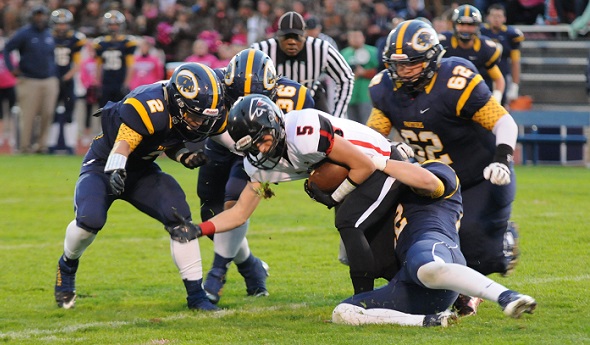
PHOTO: DeWitt defenders swarm a St. Johns ball-carrier during Friday's league title-clinching victory. (Click for more from HighSchoolSportsScene.com.)