

Ida Builds Greatest Season 'Brick by Brick'
By
Chip Mundy
Special for Second Half
November 5, 2015
By Chip Mundy
Special for Second Half
IDA – As the greatest football season in Ida High School history rolls into the second week of the MHSAA playoffs, it could be said that winning isn’t even the best thing the Bluestreaks have done this year.
 Winning certainly hasn’t been the most important thing they did this season.
With the community strongly backing the program throughout its undefeated season to date, which continues tonight in a Division 5 District Final at home against Dearborn Heights Robichaud, the team has given back – while building a collection of memories they will cherish no matter how long this history-making trip rolls on.
From hosting a fundraiser that hit much closer to home than they anticipated, to welcoming back a beloved member of the program after a health scare – and all while putting together the most successful run in school history – Ida has had a season to remember, even as it works to add more moments before the run is done.
Supporting a new teammate
The regular-season finale was designated as a fundraiser for childhood cancer awareness, and the game against rival Erie-Mason raised more than $4,000 for the St. Baldrick's Foundation, a private institution in California that gives grants to children who are battling cancer.
“I had seen something on Facebook and looked into it and decided that we needed to do something other than just get ready for football games,” Ida coach Tom Walentowski said. “We scheduled our Game 9 as a gold-out game with one of our rivals, Erie-Mason, and we raised money for childhood cancer awareness. The kids got big into that.”
Unknown at the time of the decision to raise funds for childhood cancer awareness, Chloe Arnold, a 5-year-old resident of the Ida community, was battling leukemia.
The close-knit Bluestreaks had room in their hearts to join another team. They joined Team Chloe. And in the regular-season finale, Team Chloe also was able to raise money through sales of merchandise.
One unique item was a helmet that had an Ida decal on one side and an Erie-Mason decal on the other. Players from both teams signed the helmets, which then were donated to Team Chloe for a silent auction that raised $665. A total of $2,315.42 was raised that night for Team Chloe.
“Gold is the color for cancer childhood awareness, and gold is in our school colors and it’s also in Erie-Mason’s school colors, so that’s why we decided that would be the game to do the gold-out,” Walentowski said. “We sold over 500 T-shirts. The kids were really into it.”
The greatest season
Entering the 2011 season, Ida had made the playoffs just three times and finished a regular season undefeated just once – in 1971. The Bluestreaks suddenly have made making the postseason a habit, going 6-3 before losing in the first round in 2011, just missing the postseason at 5-4 in 2012 and then returning to the playoffs each of the past three seasons. Last year, the team finished 8-3, tying the program record for victories with its most since 1991.
That is quite a turnaround for a program that had just three winning seasons from 1999-2010. The reversal of fortunes has been impressive. Prior to 2013, Ida had never scored more than 259 points in a season. The Bluestreaks scored 346 in 2013 and 349 in 2014, and they already have scored 428 this year.
This isn’t just an offensive juggernaut, either. Ida has allowed only 87 points through 10 games.
When asked what has made the difference, Walentowski opened the door to the weight room, where the players were busy doing their lifting on a Monday afternoon, and simply said, “These guys.”
Ida steamrolled its first seven opponents by a combined score of 310-40. Then, in the eighth week, Ida was tested. The Bluestreaks trailed Hillsdale 7-0 at halftime and pulled out a 20-17 victory in double overtime.
 “I think when you come out at halftime and you’re down 7-0 and you win the game, obviously that helps your confidence,” Walentowski said. “They never got rattled, they just went about their game.
“When you do that, it just reaffirms to them that you just keep playing your game and things will be fine.”
Ida completed the perfect regular season with a 63-7 victory over Erie-Mason and then won its first playoff game 35-23 over Ann Arbor Father Gabriel Richard. It was just the second home playoff game in school history, and tonight’s game will be the third.
“I love hearing all of our fans roar when we get a first down or a touchdown,” senior quarterback David Kolakowski said.
Needless to say, the Ida community has gotten behind the winning football team in a big way.
“We hear from a lot of coaches from other teams that they have never known a football team that had such a good community like we do,” senior guard/linebacker Mike Zlonkovicz said. “We drove into town on playoff day, and there was the score from every game on the light posts.
“It was really touching to see that. We’re not only representing the entire school but the entire town.”
The Bluestreaks run an odd-front defense and an offense that so heavily relies on the running game that Walentowski said the old saying of “three yards and a cloud of dust” offense applies to this team in phrase only.
“We don’t like three yards, though,” he said. “We prefer to average eight or nine.”
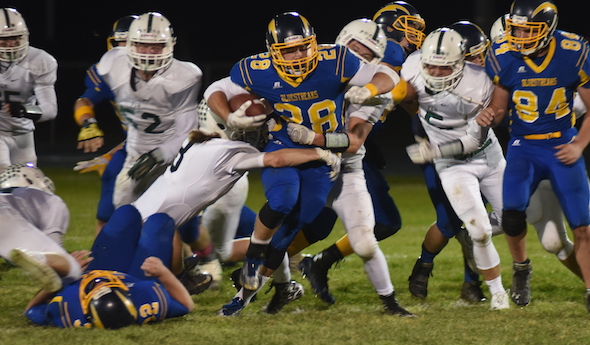
Ida boasts a pair of 1,000-yard running backs in Eric Bugg and Nick Levicki. Bugg broke the single-season rushing record and also has scored the most touchdowns in school history. Levicki is second on the all-time touchdown list.
“Eric is, I guess for lack of a better term, he’s the poster boy of this team,” Walentowski said. “He is really a good young man. He’s a 3.5 student, he’s solid in the classroom, he’s a great citizen, he’s humble, he just works hard. He doesn’t particularly care for all the fanfare.”
Bugg said the pressure from last season’s success weighed on his mind this season.
“I didn’t know how to live up to it since we did so well last year,” he said. “We’re just trying to beat how we progressed last year, and so far we have.
“We have to get past districts and keep doing what we’re doing.”
Brick by brick
Defensive line coach Gary Deland delivers a motivating speech prior to every game. His topic this week was “brick by brick.” The players listen to him, and that message had extra importance because Deland is experiencing it in his personal life.
Midway through the season, Deland had to undergo emergency triple-bypass heart surgery, but he is back on the sidelines coaching the team and progressively getting better from week to week. In his words, he is improving brick by brick.
“He didn’t know it at the time, but in the first half of our first game against Jefferson, he was having a heart attack,” Walentowski said of Deland. “He got through the game and said his chest was bothering him, but he thought it was indigestion.
“A couple of weeks later it was still kind of bothering him on and off, and he said he should get it checked. We were getting ready to play Blissfield, which was Game 4, and he went to the hospital on Wednesday morning, and they said you’re not leaving, you are having open-heart surgery Thursday morning.”
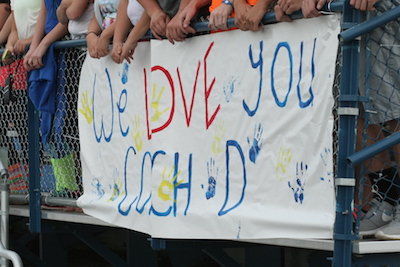 A week after triple-bypass heart surgery, Deland was back, giving a motivational speech to the players.
“It was a great talk,” Walentowski said. “He has quite a personality, and the kids love him. For us, it was like we hadn’t better screw anything up before Coach D gets back here. I think we all had that attitude.
“The following week, he was back on the sidelines.”
It seemed like nothing was going to keep Deland from returning to his boys.
“It was a blur,” Deland said. “I was less than a few weeks out of surgery, and I was back on the sidelines. My doctor did not approve, but he knew I was going to be on the sidelines and he wasn’t going to be able to stop me.
“I was there; I was with my team. These are a great group of kids. They work hard, and they deserve everything the coaching staff can give them, and that’s why I wanted to be there for them. They have been there for this school and this community all year long.”
Although Deland said he blocks out thinking about his health on the sidelines, the players remain very aware of it.
“The kids have gone out of their way to protect me on the sidelines,” he said. “When a play is coming out of bounds, I have to get out of the way. I cannot get run over. So they do protect me on the sidelines so I don’t get run over by any play out of bounds.
“The doctor doesn’t want me to get too excited, and I try not to. Each week I can feel the momentum of my strength coming back, and I get a little more vocal and a little more animated on the sidelines.
“I have a passion for football, and the kids know it. They know I can blow up at any time, or I can be the grandfather for them.”
And, every week, he is the motivator with his speeches.
“From that very first practice in the summer to the last game as a senior, everything is built brick by brick,” Deland said. “I can draw a correlation between that and my recovery, what I’ve gone through. It’s the same thing. It’s brick by brick.
“You might take two steps forward, and you think you’re getting on to where you want to be as a team, and I might be getting on to how I want to feel, and the next thing you take that giant step backwards. You don’t feel so great, or all of a sudden you were praised by the coach the day before and now you’re screwing up every which way.
“But you’re still going forward, and that is how I paint my recovery, brick by brick, the same as this team. They will progress in the season and the playoffs brick by brick.”
Nobody knows how the season will end, but it already is the greatest football season in school history. The Bluestreaks are giving back to the community with their work for childhood cancer awareness, and they are banding together to win football games.
It is the time of their young lives.
“Being a quarterback was not always my intention,” Kolakowski said. “I was a wide receiver, but in my JV season I had to play quarterback. Then, in the playoff game, I was like, ‘It would be so sweet to be able to run this offense,’ and now I’m getting to live out my dream, which is awesome.”
It is a season that has been building, excuse the expression, brick by brick.
“I think these guys have had a lot of goals,” Walentowski said. “Six of the seniors were with us as sophomores, and there were two freshmen who were with us back then, so those eight kids, they’re still here, and they’ve been building every year.
“They expected to work hard and do well, and that’s what they’re doing. They don’t just like to play football, they like to play football together. There’s a big difference.”
 Chip Mundy served as sports editor at the Brooklyn Exponent and Albion Recorder from 1980-86, and then as a reporter and later copy editor at the Jackson Citizen-Patriot from 1986-2011. He also co-authored Michigan Sports Trivia. E-mail him at [email protected] with story ideas for Jackson, Washtenaw, Hillsdale, Lenawee and Monroe counties.
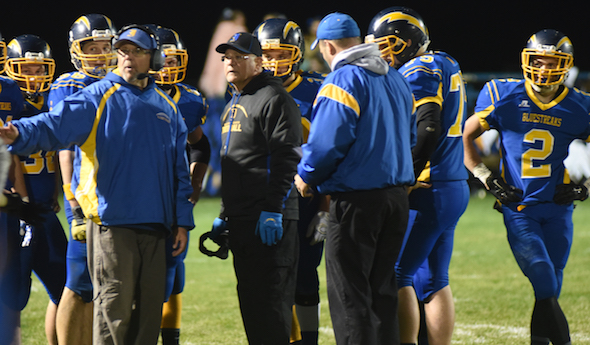
PHOTOS: (Top) Ida running back Nick Levicki attempts to run through tacklers during his team's win over Ann Arbor Gabriel Richard last week. (Middle) Head coach Tom Walentowski, far left, and assistant Gary Deland talk things over with the team looking on. (Below) Fans hung a sign supporting Deland upon his return. (Top and middle photos by Ray Leighton. Bottom photo by Kim Farver.)
Drive for Detroit: Week 9 in Review
October 26, 2015
By Geoff Kimmerly
Second Half editor
Week 9 of the football regular season brings with it a Twitter feed full of gems like these:
Enjoy perfection? Northville finished 9-0 for the first time since 1961. Portland did so for the first time since 1969. Birmingham Groves posted its first flawless regular-season finish since 1978. For Buchanan, it was the first since 1988.
How about streaks? Rockford continued a 20-season playoff streak, and Stevensville Lakeshore clinched 18 years in a row heading to the postseason. And of course there was at least one stat line worth a double take – like Pewamo-Westphalia running back Jared Smith finishing the regular season with 2,065 rushing yards and 38 touchdowns for the undefeated Pirates.
Those are just highlights. As we begin to focus on the first week of the playoffs, let's not forget the rest of the best from the final week of the regular season.
Bay & Thumb
Fenton 30, Linden 27 (OT)
Fenton upped its Flint Metro League winning streak to 29 straight games and its league title streak to five seasons either sharing the championship or winning it outright thanks to this victory over second-place Linden. The Tigers ended the regular season at 8-1 while Linden is 7-2; Fenton’s lone loss came on opening night to Davison by three points. Click for more from the Flint Journal.
Also noted:
Freeland 42, Frankenmuth 7 – The Falcons (9-0) won the only matchup between undefeated teams in the state this weekend, but could see Frankenmuth (8-1) again in a Division 5 District Final.
Midland Dow 49, Midland 28 – The Chargers (8-1) won this crosstown rivalry game for the second straight season … and earned a rematch with the Chemics (7-2) in a Division 2 opener.
New Lothrop 41, Montrose 0 – The Hornets (9-0) completed their sixth straight undefeated regular season and in the process gave Montrose (5-4) a boost that helped the Rams into the playoffs as an at-large team.
Saginaw Swan Valley 28, Bay City John Glenn 21 – The Vikings (6-3) secured a fourth-straight playoff berth, but John Glenn (5-4) also made the postseason for a second straight season.
Greater Detroit
Detroit Martin Luther King 27, Detroit Cass Tech 25
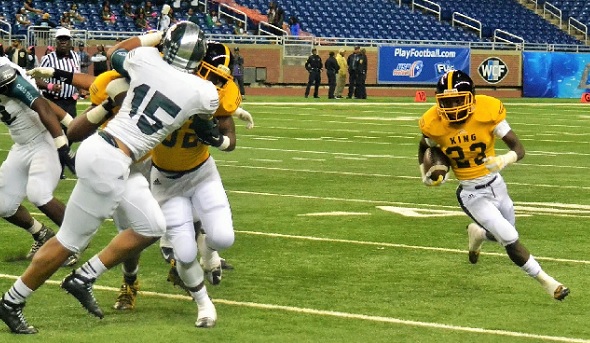
It wouldn’t surprise many if both of these teams ended up back at Ford Field in five weeks playing for MHSAA titles in Division 2 and Division 1, respectively. This Detroit Public League Division I Final was their second matchup this season and both were decided by a field goal or less; King won the Sept. 25 meeting 31-28. The Crusaders (9-0) locked down Cass Tech’s passing game in this one, holding the Technicians (7-2) to their season low in points. Click for more from the Detroit Free Press.
Also noted:
Orchard Lake St. Mary's 38, Warren DeLaSalle 0 – The Eaglets (7-1) look like strong favorites in Division 3 after defeating reigning Division 2 champ DeLaSalle (6-3) big in the Prep Bowl to avenge their only loss this season.
Utica Eisenhower 17, Romeo 14 – The Eagles (6-3) are one of the state’s hottest teams, beating opponents the last three weeks that are a combined 21-6 including handing Romeo (8-1) its only loss.
Detroit Collegiate Prep 26, Detroit Central Collegiate 12 – The Colts (9-0) won the PSL Division II title game to register their first perfect regular season in at least 65 years; Central Collegiate (6-3) is headed to the playoffs for the second straight season after going 0-9 in 2013.
West Bloomfield 20, Farmington Hills Harrison 14 – The Lakers (9-0) tied their school record for wins set last season with their first perfect regular season since going 8-0 in 1960; Harrison (7-2) is headed back to the playoffs for the ninth time in 10 seasons.
Mid-Michigan
Lansing Catholic 35, Monroe St. Mary Catholic Central 10
Reigning Division 6 champion Monroe St. Mary (8-1) has looked ready for another run since putting up 62 points on Tecumseh on opening night, but Lansing Catholic (8-1) reminded the rest of Michigan it’s one of the dangerous teams in Division 5 by going on the road and handing the Falcons their first regular-season loss since 2013. The Cougars rattled off 28 unanswered points during the second half. Click for more from MLive-Lansing.
Also noted:
Portland 25, Marshall 16 – The Raiders finished 9-0 for the first time since 1969, which was a lot easier said than done considering Marshall (7-2) was one of five playoff teams on the schedule.
Harrison 40, Clare 20 – The Hornets (7-2) locked down second place in the Jack Pine Conference with their first win over Clare since 2010, and in the process kept the Pioneers (5-4) out of the playoffs for the first time since 2005.
Grand Ledge 42, Holt 0 – The Comets (9-0) completed their outright Capital Area Activities Conference Blue title, finished their third perfect regular season over the last eight and in the process kept rival Holt (5-4) from making the playoffs (although the Rams did improve from 3-6 a year ago).
Mount Pleasant Sacred Heart 13, Mendon 7 – The Irish (6-3) ran off six straight wins after opening 0-3 against teams that finished a combined 25-2 to return to the playoffs for the eighth straight season; Mendon (5-4) also earned its ninth straight postseason bid despite the loss and after starting 1-3.
Northern Lower Peninsula
Harbor Springs 22, Charlevoix 20
The winner was guaranteed a playoff spot. And Harbor Springs had plenty to celebrate with its move to 6-3 earning both the first playoff berth since 2000 but also its first winning record in 16 years. Senior Mitch Hoffman drilled a last-second field goal to put his team over the top – and keep the Red Rayders out of the playoffs as they did not end up with enough playoff points to qualify as an at-large team despite finishing 5-4. Click for more from the Petoskey News.
Also noted:
Boyne City 35, Grayling 20 – Boyne City may have finished behind Traverse City St. Francis in the Northern Michigan Football Conference Leaders standings, but beating third-place Grayling (6-3) helped the Vikings (8-1) secure up to two home playoff games – with St. Francis likely awaiting in the Regional Final.
Lake City 28, Newberry 21 – The Trojans made quite a bounce-back from last season’s 2-7 finish and beat two straight playoffs teams in Lincoln Alcona and Newberry (6-3) the last two weeks to get back to the playoffs at 5-4.
Oscoda 48, AuGres-Sims 22 – The Owls (6-3) also are back in the playoffs for the first time since 2000 after finishing the regular season with two straight wins.
Onekama 21, Frankfort 8 – Before last season, Onekama hadn’t beaten Frankfort since 1994; now, the Portagers (8-1) have won two straight over the Panthers (7-2) and could see them again in a Division 8 District Final.
Southeast & Border
Jackson 35, Jackson Lumen Christi 34 (OT)
This season just keeps getting better for Jackson. By moving to 7-2, the Vikings equaled their wins from 2010-2014 combined. And although they didn’t play most seasons in between, it’s worth noting this was Jackson’s first win over Lumen Christi since 1988 – and after 27, 29 and 34-point defeats to the Titans (6-3) the last three years. Click for more from the Jackson Citizen-Patriot.
Also noted:
Grass Lake 19, Union City 16 – The Warriors (5-4) survived a three-game losing streak midseason to earn an at-large playoff bid, and with this win knocked Union City (4-5) out of the running.
Clinton 36, Ottawa Lake Whiteford 18 – The Redskins (9-0) finished their fourth straight perfect regular season and fourth straight Tri-County Conference title by beating Whiteford (7-2), one of three other playoff teams from the league.
Manchester 45, Homer 38 – The Flying Dutchmen (8-1) claimed this meeting of first-place teams in the Cascades and Big 8 conferences for the second straight season, putting up a season high points total while also giving up their most this season to Homer (7-2).
Parma Western 28, Dexter 0 – After missing by a win twice over the last six seasons, Western (6-3) finally has its first MHSAA playoff berth thanks to two straight victories to close the regular season.
Southwest Corridor
Benton Harbor 29, Portage Northern 23 (OT)
Benton Harbor is one of the best stories of this season. The Tigers (5-4) didn’t win a game in 2013 or 2014 and went a combined 4-68 over the last eight seasons, but with a new coach and new athletic director posted their first winning season since 1989 – and earned their first playoff berth ever. It took this overtime win over Portage Northern (4-5), which hadn’t lost to Benton Harbor since 1996. Click for more from the St. Joseph Herald-Palladium.
Also noted:
Dowagiac 49, Paw Paw 46 – The Chieftains (6-3) reversed their record of a year ago but needed a second straight win by three points or fewer to return to the playoffs.
Constantine 21, Hartford 6 – The Falcons kept their playoff streak alive for a 17th straight season by bouncing back from a Week 8 loss to finish 5-4; Hartford also made the playoffs at 5-4.
St. Joseph 22, Portage Central 6 – The Bears (8-1) gained a share of the Southwestern Michigan Athletic Conference East title by breaking a three-year losing streak against the Mustangs (8-1).
Schoolcraft 41, Delton Kellogg 15 – The Eagles (9-0) finished a perfect regular season for the second time in four and won all but one of their games by at least 18 points; Delton (5-4) still made the playoffs for the first time since 2001 with its first winning record since 2009.
Upper Peninsula
Escanaba 18, Kingsford 14
Escanaba was riding high this fall after opening with two wins under a new coach. Then came four straight losses against a string of opponents that ended up including three playoff teams. But the Eskymos (5-4) didn’t fold, instead finishing with three wins including two over playoff teams to earn their first postseason berth since 2011. Kingsford (6-3) ended up with a home game this week despite the loss. Click for more from the Iron Mountain Daily News.
Also noted:
St. Ignace 14, Fowler 7 – The Saints (8-1) deserve a lot of credit for stacking their nonleague schedule with undefeated Ishpeming last week and annual Division 8 power Fowler (6-3).
Negaunee 35, Ishepming Westwood 0 – Westwood (5-4) claimed a playoff spot for a second straight season despite the loss, but Negaunee (7-2) hopes it regained some momentum after two straight defeats by a combined seven points.
Munising 41, L'Anse 8 – The reigning Division 8 runner-up Mustangs (7-2) bounced back from a Week 8 loss by ending the playoff hopes for L’Anse (5-4).
Lake Linden-Hubbell 34, Crystal Falls Forest Park 28 – The Lakes (9-0) broke a five-game losing streak against Forest Park (5-3) to finish perfect for the regular season for the first time since 2009 … and earn a rematch with Forest Park this week.
West Michigan
Rockford 28, Hudsonville 27
At stake Friday was a share of the Ottawa-Kent Conference Red title – four teams were tied for first place, guaranteeing multiple champions. But also at stake was Rockford’s 20-season playoff streak, the longest-running in Michigan and third-longest in MHSAA history. A blocked extra point by a back-up quarterback and a pair of field goals by the back-up kicker were among contributions that paid off nicely for the Rams (6-3), who could see Hudsonville (6-3) again in a Division 1 District Final. Click for more from the Grand Rapids Press.
Also noted:
Grandville 18, East Kentwood 8 – This decided the other half of the O-K Red title, with the Bulldogs (6-3) not only earning a share but posting a sixth win for the first time since 2006; East Kentwood also is 6-3 and gets also third-place Hudsonville in the playoffs.
Lowell 28, Grand Rapids Christian 14 – The Red Arrows (8-1) finished a perfect run in the O-K White for the second time in three seasons and won their fourth straight against the Eagles (5-4).
Grand Rapids Forest Hills Northern 26, Ada Forest Hills Eastern 24 – The Huskies (7-2) fell shy in the O-K Bronze after a 5-0 start, but forcing rival Forest Hills Eastern (8-1) to share the title probably lessened any lingering disappointment.
Big Rapids 20, Morley-Stanwood 10 – After seasons of three and one win over the last two, Big Rapids is back in the playoffs thanks to two straight wins, this one over a Mohawks team also 6-3.
8-Player
Battle Creek St. Philip 47, Lawrence 44
St. Philip (9-0) got the better of Lawrence for the first time in their last four meetings, handing those Tigers (7-2) their first in-state loss since 2013 and cementing the top spot overall in the 8-player tournament with the highest final playoff-point average. The two could meet again in a Regional Final next week. Click for more from the Battle Creek Enquirer.
Also noted:
Pickford 62, Onaway 28 – It was this simple: Pickford (6-3) won and got into the playoffs, and Onaway (5-4) fell out of the top 16 with the loss.
Morrice 58, Portland St. Patrick 42 – The Orioles (8-1) still aren't getting much mention as a contender, but they haven’t lost since falling to St. Philip on opening night and clinched the Central Michigan 8-Man League title with this win over the Shamrocks (6-3).
PHOTO: A Detroit Martin Luther King ball-carrier follows his blocker during the Crusaders' Detroit Public School League Division I championship win. (Photo courtesy of the Detroit Public School League.)