

Inside Selection Sunday: Mapnalysis '14
October 26, 2014
By Geoff Kimmerly
Second Half editor
The pictures we drew Sunday morning at the MHSAA office won’t be found hanging on anyone’s walls.
But we worked toward something suitable for framing, designing this season’s football playoff brackets while considering the months and years of work put in by our schools and their teams, parents and fans to earn an opportunity to continue their seasons this weekend.
The work completed today to draw up the 2014 MHSAA Football Playoffs began long before opening night in August. Our football tournament is like none other sponsored by the MHSAA – it’s the only team tournament in which every team doesn’t qualify – and we began talking about this tournament not long after last season’s champions were decided.
Then came April and May and tracking down schedules for 613 MHSAA varsity football teams, plus 45 out-of-state opponents our Michigan schools were set to play including 14 from Ontario and one from Minnesota.
The fun part was monitoring the scores and standings for all of these teams over the nine weeks of the regular season, each Friday night a stream of chatter from kickoff into our weekly highlights show on Fox Sports Detroit.
And then came Sunday – and navigating the most difficult maps to draw in my four seasons assisting in the process.
We often have versions “a” and “b” and on occasion “c” when considering which best accomplishes our goal – to create the correct geographical picture for each of eight 11-player divisions and our 8-player bracket.
Sunday morning, we saw a version “e” for the first time I can remember and some shapes that didn’t make much sense without explanation.
Some of those explanations are below – the stories behind how we made some of the toughest decisions. I start with a quick history lesson you can skip if you’re familiar with this annual report or our playoff selection process in general, then move into some of the specifics many will be discussing this week as they begin focusing on their Pre-District opponents. (Click for the full schedule.)
The process
Our past: The MHSAA playoff structure – with 256 teams in eight divisions, and six wins equaling an automatic berth (or five wins for teams playing eight or fewer games) – debuted in 1999. An 8-player tournament was added in 2011, resulting in nine champions total each season.
The first playoffs were conducted in 1975 with four champions. Four more football classes were added in 1990 for a total of eight champions each fall. Through 1998, only 128 teams made the postseason, based on their playoff point averages within regions (four for each class) that were drawn before the beginning of the season. The drawing of Districts and Regions after the end of the regular season did not begin until the most recent playoff expansion.
In early years of the current process, lines were drawn by hand. Dots representing qualifying schools were pasted on maps, one map for each division, and those maps were then covered by plastic sheets. Districts and Regionals literally were drawn with dry-erase markers.
Our present: After a late Saturday night tracking scores, we file in as the sun rises Sunday morning for a final round of gathering results we may still need (which can include making a few early a.m. calls to athletic directors). Re-checking and triple-checking of enrollments, what schools played in co-ops and opted to play as a higher class start a week in advance, and more numbers are crunched Sunday morning as the fields are set.
This season, there were 229 automatic qualifiers by win total – with the final 27 at-large then selected, by playoff-point average, one from each class in order (A, B, C, D) until the field is filled.
Those 256 11-player teams are then split into eight equal divisions based on enrollment, and their locations are marked on digital maps that are projected on wall-size screens and then discussed by nearly half of the MHSAA staff plus a representative from the Michigan High School Football Coaches Association. Only the locations themselves are marked (by yellow dots) – not records, playoff point averages or names of the schools or towns. In fact, mentions of those are strictly prohibited. Records and playoff points are not part of the criteria. Matchups, rivalries, previous playoff pairings, etc. also DO NOT come into play.
The same process is followed for organizing the 8-player bracket, with the difference that the 16 teams are selected purely on playoff-point average.
Geography rules: This long has been rule number one for drawing MHSAA brackets in any sport, and is a repeat as well for those who have read this report the last three Octobers. Travel distance and ease DO come into play. Jumping on a major highway clearly is easier than driving across county-wide back roads, and that’s taken into consideration. Also, remember there’s only one Mackinac Bridge and hence only one way to cross between peninsulas – and boats are not considered a possible form of transportation. When opponents from both peninsulas will be in the same District, distance to the bridge is far more important than as the bird flies.
Tradition doesn’t reign: Every group of 32 dots is a new group – these 32 teams have not been placed in a bracket together before. That said, how maps have been drawn in the past isn’t considered – it’s hard to say a division has been drawn in a certain way traditionally when this set of 32 teams is making up a division for the first time.
Observations and answers: 2014
Class A ripple: A total of 80 Class A teams qualified for the playoffs in 2013 after three seasons of 79 each. But 89 Class A teams are part of the 2014 field, and that increase in turn shifted a number of smaller schools into different divisions – including some annual favorites. Muskegon, Division 2 runner-up the last two seasons, is in Division 3. Marine City, last season’s Division 4 champion, will play in Division 5. Five-time Division 5 champ Jackson Lumen Christi moved into Division 6, where it could be the toughest obstacle as Ithaca attempts to win that division for the fifth straight season.
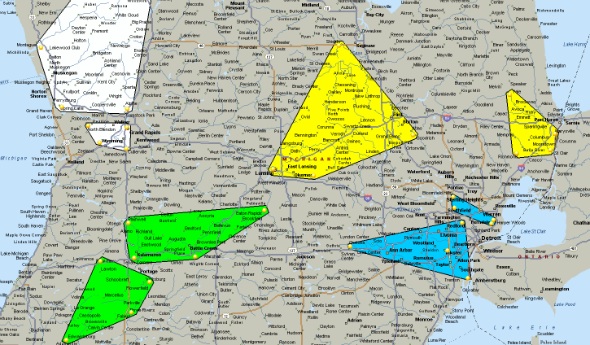
Stranger on paper: Yes, Division 1’s District 2 stretches from Grandville to Hartland. This isn’t a desirable outcome, but was necessary with this field. Six districts are filled with teams all east of U.S. 23, and a seventh is completely north and west of Grand Rapids. That left the four teams in the middle – Grandville, East Kentwood, Grand Ledge and Hartland.
Something similar came down in the 8-player bracket – why would we break up four teams in the Thumb to include three with Big Rapids Crossroads Academy all the way west of U.S. 127? It had to do with creating the appropriate semifinal matchup for whichever team emerges from the Rapid River/Cedarville/Engadine/Bellaire regional; keeping the Thumb teams together might’ve meant Lawrence or Waldron from near the Indiana border going all the way to Rapid River instead of Thumb teams that are still far away but closer to the convenient highways.
Line falls through Warren: Division 2 presented a few challenges. There are five districts made up of schools predominantly in the Greater Detroit and Port Huron areas, so one was going to end up potentially matching up farther from home. At first we drew a region across the bottom of the Lower Peninsula that connected teams from the Kalamazoo/Battle Creek area with a district from Ypsilanti and south of Detroit. But rearranging districts to draw a line between Warren DeLaSalle and Warren Counsino, although they’re nearly neighbors, helped make the rest of the map much cleaner – and eliminated that I-94 Regional we didn’t prefer.
Deconstructing D3: This was another toughie given the locations of teams involved. Three districts are all east of U.S. 23 and south of Pontiac, and four more are all west and/or north of Greater Lansing. Usually the Lansing area has a large share of Division 3 qualifiers – but not this season. So that left five schools somewhat without a sure home – St. Johns, DeWitt, Mason, Tecumseh and Linden. DeWitt is much closer to Mason and even Tecumseh, with the differences between St. Johns and DeWitt to Linden and St. Johns and DeWitt to Grand Rapids small enough to cancel out in the big picture.
Stretching Division 6: In the end, this map looks good – but there was a lot of conversation. The tough part was finding the fairest possible situation for whichever district champ might end up playing Negaunee – Bad Axe in the Thumb, Madison Heights Madison or Warren Michigan Collegiate as possibilities coming out of northern Detroit, or even Fennville near Lake Michigan south of Holland. Proximity to I-75 helped make this decision.
Crisscrossing Division 8: Figuring out this bracket started out easy enough with eight teams in the Upper Peninsula or just south of Mackinac Bridge and with the southwest and southeast Lower Peninsula set. But a group of 10 across the top of the Lower Peninsula – including neighbors Mount Pleasant Sacred Heart, Beal City and Coleman – made this interesting. A rule of thumb is we don’t want a team passing through a different district or regional to reach its opponent – and with three teams so closely bunched, that was a challenge in drawing this one out.
At the end of the day ...
What you see is what our committee decided upon after multiple discussions among multiple groups that broke down every sensible possibility we could muster. There are certainly points open to argument – and we likely made those arguments as well.
In the end, we present a group of dots on a map – as stated above, we don’t identify the schools until after the groupings are drawn. Part of the fun is then finding out what first-round matchups we’ve created: Muskegon Mona Shores vs. Caledonia and Detroit Martin Luther King vs. Southfield should be incredible, as well as the Ishpeming/Westwood and Iron Mountain/West Iron County rivalry games in the Upper Peninsula.
And no doubt, those who play for and support Burton Atherton, Ypsilanti Community, first-year Lapeer High School, Big Rapids Crossroads and New Haven Merritt Academy are ready to enjoy the playoff ride for the first time.
We’re excited to watch them all – and see which end up in Detroit with us to finish the fall over Thanksgiving weekend. We hope to see you there as well.
PHOTO: The Division 4 map for 11-player football has each region shaded; champion of the white plays green in a semifinal with yellow facing blue in the other.
Writer-Turned-Coach Enjoys Debut
November 3, 2016
By Dennis Grall
Special for Second Half
ESCANABA — Sam Eggleston has seen high school football from two drastically different viewpoints. Now, even though he is an unpaid volunteer, he enjoys being on the sideline as a coach.
 Eggleston just completed his first season as a high school head coach, with Eben Superior Central winning its final three games to finish 4-5 in 8-player football. The Cougars were among the first teams in the state to join the 8-player format in 2010, their first year of football.
Eggleston was a sportswriter before becoming a coach, giving him different perspectives to watching the same event.
The 1998 Rock Mid Peninsula High School graduate worked at newspapers in Escanaba, Kenai, Alaska; Northville and Novi, and Marquette before becoming a freelance writer and website blog editor in 2008. He started the writing phase of his career in 2000 with the Daily Press in Escanaba, under my direction.
He served as a volunteer assistant football coach in Northville, then moved back to the Upper Peninsula and became a volunteer coach at his alma mater in 2011 when the Wolverines went to 8-player football. He joined Superior Central in 2014 and spent two seasons as a volunteer aide until landing the head job just two weeks before the 2016 preseason began.
“In both careers … you took a shot on me and I ran with it, and the same with coaching; they gave me a shot and I’ve run with it as best I can,” he said.
In addition to his unpaid position at Superior Central, in rural Alger County, Eggleston is responsible for fundraising for the self-funded football program, a major priority for his offseason.
“My coaching is over (for the season) now and the majority of my time will be spent on raising funds so we can get new helmets, get new pads to replace ones that are broke, spending money we don’t have so we’ve got to make that up now,” he said. “We have to win now to have successful fundraisers.”
As a sportswriter, Eggleston would simply switch gears and move on to coverage of the next athletic season, for instance once fall sports moved into winter. He also never had to worry about how coaches managed off-field X’s and O’s once their seasons concluded.
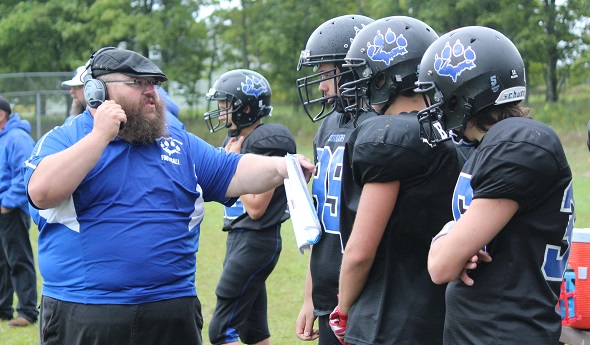
Life was totally different as a reporter. “I had a different approach, different viewpoint, different mindset to a game as a writer,” said Eggleston, who still has the heft of when he was a lineman but now looks like a lumberjack with his bushy beard and build.
“Now I have to worry about every kid and every position,” he said. “Sometimes I don’t even see the end result of the play because I’m watching the line play. I don’t even know how well my running back did until I see where they moved the stick.”
He may also be working on an injured player while the game goes on, trying to make play calls and other decisions at the same time.
As a sportswriter, he would be jotting down notes between plays or perhaps checking the result of a picture he took of the previous snap, totally unaware the coach was monitoring several assignments.
“I look back at the writer I was and as a coach now, and I would hate the type of writer I was,” he said.
Eggleston would analyze why a coach would switch to running a sweep rather than the counter that had been working, all while the coach may be working on an injured player that caused a change in offensive plans.
“As a writer I never had the insight to see everything. I just saw the overall game and kept track of every yard,” he said. “As a coach I can’t even tell if the play went five yards because I have three plays stacked up as the game goes on.”
While he was writing sports in the metro Detroit area, his weekly paper often covered games also being covered by the Detroit Free Press or the Oakland Press, with those stories appearing the next day. Eggleston’s story would appear maybe five days later, after everyone knew what happened.
 “I had to come in with a different angle. I tried to be a little more analytical and focus on strategy versus the flourish and try to get the meat of the game rather than get to the flowery parts,” he recalled. “I tried to take a different approach and make my stuff more interesting.”
His style apparently worked as the paper received several journalism awards and subscriptions remained strong.
Writing also provided some interesting backdrops. He had to use small charter planes to see some games in Alaska, or get to Nome to handle features about the Iditarod sled dog race.
He recalls covering a high school hockey game on an outdoor rink in Alaska and said “it was the first time I saw wind shear affect a hockey game.”
Eggleston also covered a football game where a kicker booted the ball off the uprights, then off a fence, and it bounced into the ocean in Homer.
He reported on a murder trial at that paper, where he would work the news desk in the morning, take time off and then handle sports at night. “It was super stressful,” he said.
Now walking the sidelines as a coach, he said “it definitely does feel like I’ve seen both sides of the coin, and I understand both sides of them better.”
He remembers just giving “little more rounded answers and (to) give both sides of the story” in postgame interviews. “A lot of coaches give canned answers. I try to be a little more in-depth and help try to write the story.”
In his early days as a sportswriter, he said “I would see the game unfold and see the pressures and why a coach would make a decision to go for it (on fourth down). I was a bit more critical of the coach and their decision,” he said, adding “I would probably have been a little more biting about it when I wrote the story.”
He admits in those days “I thought I knew everything there was to know about football. I played it,” he said. “I always approached the game like I was the professional and knew everything about the game. Now as a coach there are a host of responsibilities during every game. I am in completely different waters now. The hardest thing is keeping the kids pointed in the right direction as things go wrong.
“You’ve got the entire team and you’ve got to keep moving in a positive direction, keep the focus going forward. Forget the last play and work on the next one and get the kids to buy into that philosophy.”
He also compares his first writing assignment at the Daily Press with his first game this season at Ontonagon. “I did a (men’s baseball) story about the Escanaba Polecats, and you read my first line and said, ‘Did Yoda write this?’ I thought, oh my God, I don’t know what I’m doing.”
The Cougars lost their opener this fall 36-8, and Eggleston said “after being an assistant for four years, I still wasn’t prepared going into that Ontonagon game. We lost, and as I look back, if we played them right now I think we would beat them.
“I had no clue coming into that first game and didn’t have any idea how to get us back on track.”
He eventually figured enough out to finish 4-5 and found plenty of ways to enjoy being a coach.
Eggleston tries to eat lunch with his players every day, and he pays for his own meal.
“I want a family environment there; we all sit at the same table,” he said. “What I get back is relationships I never had before. I feel like I have 21 kids, and I love every minute of it.”
 Denny Grall retired in 2012 after 39 years at the Escanaba Daily Press and four at the Green Bay Press-Gazette, plus 15 months for WLST radio in Escanaba; he served as the Daily Press sports editor from 1970-80 and again from 1984-2012. Grall was inducted into the Upper Peninsula Sports Hall of Fame in 2002 and serves as its executive secretary. E-mail him at [email protected] with story ideas for the Upper Peninsula.
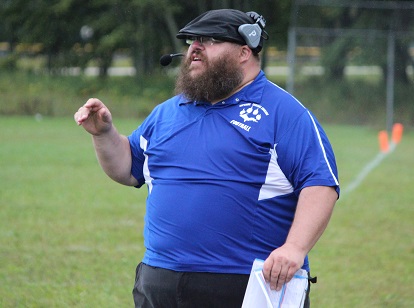
PHOTOS: (Top) Eben Junction Superior Central football coach Sam Eggleston speaks with some of his players during a game this season. (Middle) Eggleston monitors the action on the field. (Photos by Dennis Grall.)