

Inside Selection Sunday: Mapnalysis '15
October 26, 2015
By Geoff Kimmerly
Second Half editor
Consider that one hour Sunday night was the product of nine weeks of games on top of two more weeks of practice, hours of lifting weights, conditioning and camps and a total of six months of work at the MHSAA office, in addition to hours upon hours put in by athletic directors scheduling years in advance.
The anticipation for the release of another year's MHSAA Football Playoff pairings is matched by a giant exhale only after the results are broadcast on Fox Sports Detroit, streamed online and posted on locker room doors and Facebook walls all over our state.
 And then the fun begins again.
But the Selection Sunday Show is the favorite hour of the season for many fans across our state. And that’s why, for the fifth year, we’ll explain our most difficult decisions in this Mapnalysis 2015 breakdown of how we paired 272 teams that will play next month for championships across nine divisions.
For those familiar with our playoff selection process, or who have read this report in the past and don’t want a refresher on how we do what we do, skip the next section and go directly to the “Observations & Answers: 2015.” For the rest, what follows is an explanation of how we selected the playoff pairings during the morning hours Sunday, followed by how we made some of the toughest decisions and a few thoughts on the breakdown of the field.
Ground Rules
Our past: The MHSAA 11-player playoff structure – with 256 teams in eight divisions, and six wins equaling an automatic berth (or five wins for teams playing eight or fewer games) – debuted in 1999. An 8-player tournament was added in 2011, resulting in nine champions total each season.
The first playoffs were conducted in 1975 with four champions. Four more football classes were added in 1990 for a total of eight champions each fall. Through 1998, only 128 teams made the postseason, based on their playoff point averages within regions (four for each class) that were drawn before the beginning of the season. The drawing of Districts and Regionals after the end of the regular season did not begin until the most recent playoff expansion.
In early years of the current process, lines were drawn by hand. Dots representing qualifying schools were pasted on maps, one map for each division, and those maps were then covered by plastic sheets. Districts and Regionals literally were drawn with dry-erase markers.
Our present: After a late Saturday night tracking scores, we file in as the sun rises Sunday morning for a final round of gathering results we may still need (which can include making a few early a.m. calls to athletic directors). Re-checking and triple-checking of enrollments, what schools played in co-ops and opted to play as a higher class start a week in advance, and more numbers are crunched Sunday morning as the fields are set.
This season, there were a record-low 216 automatic qualifiers by win total – with the final 40 at-large then selected, by playoff-point average, one from each class in order (A, B, C, D) until the field was filled. There were only four Class D additional qualifiers with 5-4 or 4-4 (playing eight games) records from which we could choose – so after those four we added 12 teams each from Class A, Class B and Class C.
Those 256 11-player teams are then split into eight equal divisions based on enrollment, and their locations are marked on digital maps that are projected on wall-size screens and then discussed by nearly half of the MHSAA staff plus a representative from the Michigan High School Football Coaches Association. Only the locations themselves are marked (by yellow dots) – not records, playoff point averages or names of the schools or towns. In fact, mentions of those are strictly prohibited. Records and playoff points are not part of the criteria. Matchups, rivalries, previous playoff pairings, etc. also DO NOT come into play.
The same process is followed for organizing the 8-player bracket, with the difference that the 16 teams are selected purely on playoff-point average.
Geography rules: This long has been rule number one for drawing MHSAA brackets in any sport. Travel distance and ease DO come into play. Jumping on a major highway clearly is easier than driving across county-wide back roads, and that’s taken into consideration. Also, remember there’s only one Mackinac Bridge and hence only one way to cross between peninsulas – and boats are not considered a possible form of transportation. When opponents from both peninsulas will be in the same District, distance to the bridge is far more important than as the bird flies.
Tradition doesn’t reign: Every group of 32 dots is a new group – these 32 teams have not been placed in a bracket together before. How maps have been drawn in the past isn’t considered – it’s hard to say a division has been drawn in a certain way traditionally when this set of 32 teams is making up a division for the first time.
Observations & Answers: 2015
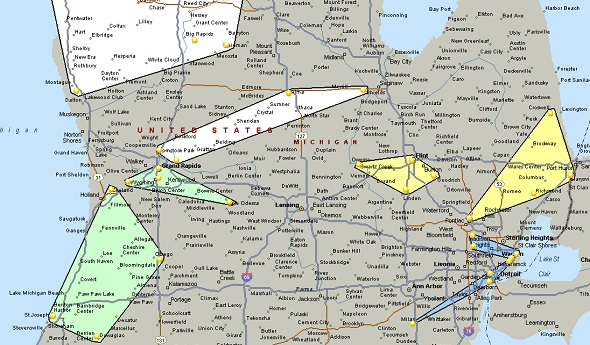
Go north with ease: For the most part, most Regional pairings were easier to draw than in past years. For the most part. Divisions 2 and 4 were not easy, specifically when it came to deciding which teams would be paired with an Upper Peninsula qualifier or a team from the Traverse City area. Keep in mind, distance on these maps isn’t based on how the bird flies, but how a bus would drive. In Division 2, that meant putting Muskegon, Muskegon Mona Shores and Grand Rapids Forest Hills Northern – near U.S. 31 and U.S. 131 – with Traverse City Central instead of sending Midland and Midland Dow west, up I-75 and then east-to-west again on more non-highway roads. In Division 4, we considered pairing Alma and Saginaw Swan Valley with Escanaba instead of Big Rapids and Remus Chippewa Hills. That decision came down to Big Rapids being about 14 miles closer to Escanaba than Swan Valley (Whitehall would go with Big Rapids and Chippewa Hills regardless.).
Four counties wide: Yes, on first glance it looks a little odd that Bay City John Glenn and Orchard Lake St. Mary’s would be in the same Division 3 District – but look at the map as a whole. Eight Division 3 teams are located south and mostly east of St. Mary’s, and John Glenn is the only team that could be considered in the northeastern quarter of the Lower Peninsula (Mount Pleasant and Gaylord are right down the middle and naturals to go with Sault Ste. Marie and Petoskey.). With the thumb playoff qualifiers of near-similar size in Division 4, there were no other options than to create this four-county trip between the Eaglets and Bobcats.
Semifinal selection: When all the Regional lines are drawn for a division, we also must figure out which Regionals will meet for Semifinals. This annually provides some challenges. Do we match east vs. west or north vs. south? If something seems iffy in four weeks when those games are played, again, keep in mind the entire map and entire Regionals that are matched up.
Scheduled strong: Because we’re looking only at dots on a map, we don’t see the matchups until everything is drawn – and in that way, we’re like everyone else. It wasn’t lost on us that two 9-0 teams will have road games this week or three 5-4 at-large qualifiers will be at home. For those 9-0 teams, it’s true: there’s nothing more they could’ve done on the field. But here’s why they will travel.
- Clinton, in Division 6, hasn’t lost a regular-season game since 2011, and in fact plays in a strong Tri-County Conference made up of Class C schools and one Class D. Four of eight from the league made the playoffs, and the competition was so strong that Morenci and Petersburg-Summerfield will host games in Division 8. But Clinton’s opponent, Monroe St. Mary Catholic Central, while it did have one loss, fell to one-loss Class B Lansing Catholic – and the Falcons played eight Class B and one Class A school this season. Beating a Class B team is worth 16 points more than beating a Class C and 32 more than beating a Class D (with those points then divided over the number of games a team plays that season) – and all of that made the difference in St. Mary’s final eight-point playoff average edge over Clinton.
- Saugatuck in Division 7 is a similar story. The Indians are one of three undefeated teams in their District, and did play a pair of Class B opponents. But by no fault of their own, especially in league play where the schedule is set, Saugatuck didn’t face a team this season that won more than five games. Hesperia played three Class B opponents including one that finished 6-3 – enough for the slim 1.8 points more in playoff average that earned the Panthers homefield advantage. Pewamo-Westphalia has the highest average in the District and didn’t play a Class B – the Pirates actually played three Class D teams. But they also beat four teams that made the playoffs including two that finished 8-1 – giving them a 2.7-point edge on Hesperia and 4.5 edge on Saugatuck.
- The 5-4 teams that will host – Redford Thurston in Division 3 and Escanaba and Benton Harbor in Division 4, all earned their spots. Escanaba faced six playoff teams and beat three, Class B Benton Harbor played eight Class A teams, and Thurston played five playoff teams and a sixth that just missed an at-large bid.
At the end of the day ...
What you see is what our committee decided upon after multiple discussions among multiple groups that broke down every sensible possibility we could muster. There are certainly points open to argument – and we likely made those arguments as well.
Those who would like to see the playoff selection process changed are in favor of a larger strength-of-schedule component, and it’s interesting to see how strength of schedule inadvertently made a larger impact this season than in the recent past – especially given the examples above of undefeated teams going on the road and at-large teams hosting.
Why were there fewer automatic qualifiers than ever before? Here's one theory. There were 11 fewer teams in 11-player football this season than in 2014 (most moved to 8-player). An argument can be made that there were fewer wins to be gained against teams that last season might have struggled to field 11-player teams, shifting the balance to fewer automatic qualifiers and more parity with stronger teams facing each other to fill their schedules.
Meanwhile, the 8-player field grew by nine teams this fall and has its strongest ever, with seven teams that finished 5-4 missing the postseason after a team with a sub-.500 record got in just a year ago.
Given how some matchups shook out this fall, the next argument by those seeking change likely will center on seeding entire Regionals instead of just Districts. But keep this in mind as well: if Regionals were seeded with this year's groupings, it would create possibilities of first-week trips like Battle Creek to Traverse City and Cedar Springs to Sault Ste. Marie. We're fairly sure most coaches and players would dread such journeys for a first-round game.
It's a lot to digest, and the scrutinizing will surely continue long after these playoffs are done as we all work to conduct the best tournament possible.
But at the end of the day – and the end of these next five weeks – to be the best, teams will need to beat the best no matter the matchups. And we’ve got plenty to look forward to starting this weekend and all the way through the 11-player Division 3 Final on Nov. 28 at Ford Field.
The MHSAA Football Playoffs are sponsored by the Michigan National Guard.
PHOTO: The Division 4 map was among the most difficult to draw during this year's selection process.
Drive for Detroit: Week 6 in Review
October 7, 2019
By Geoff Kimmerly
Second Half editor
There were a handful of newly-crowned league champions celebrating by the end of this football weekend, and 54 more teams were able to start making playoff plans.
 And then there were the handful of teams turning things upside-down.
For all of the predictions made at the beginning of each season and even over the course of every week, there are still plenty of surprises to enjoy even at this late date. Read more below about all of the above as we head into the final third of this regular season.
"Drive for Detroit" is sponsored by MI Student Aid.
Bay & Thumb
HEADLINER Midland 22, Mount Pleasant 21 Midland controls the Saginaw Valley League Red title race after avenging the 2018 loss that eventually resulted in Mount Pleasant (5-1) becoming last year’s league champion. This time, the teams traded leads throughout the game before the Chemics (6-0) went up for good during the fourth quarter. Click for more from the Midland Daily News and see highlights below from WJRT.
Midland outlasts Mt. Pleasant 22-21 to remain perfect on the season@midlandchemics @tommyjohnstonee https://t.co/SOf4aj5fmE
— ABC12WJRT (@ABC12WJRT) October 5, 2019
Watch list Hemlock 30, Ithaca 6 While the Yellowjackets (5-1) still finished with a share of the Tri-Valley Conference West I title, the headliner from this league finale was Hemlock (4-2) handing Ithaca its first league loss since 2009. Midland Bullock Creek ended up with a share of the title as well thanks to the Huskies’ feat.
Remember this one Goodrich 49, Lake Fenton 14 The Martians (5-1) secured a share of the Flint Metro League “Lower” division title and can win it outright this week again winless Clio. Lake Fenton (3-3), meanwhile, will hope for an upset to claim a share of the championship but also must win out to guarantee a playoff berth after missing the postseason a year ago.
More shoutouts Fenton 24, Linden 21 The Tigers (5-1) earned a share of the Flint Metro League “Upper” division title, their eighth league championship in nine seasons after finishing third in the formerly unified Metro last fall. Richmond 14, North Branch 7 The Blue Devils (6-0) will meet Almont this week with a share of the Blue Water Area Conference title on the line after knocking North Branch (4-2) out of contention.
Greater Detroit
HEADLINER Belleville 20, Dearborn Fordson 19 Belleville made a number of clutch plays during the final six minutes to continue its unbeaten run, first stopping a 2-point conversion attempt after Fordson’s final score and then driving for the game-winning touchdown. Belleville (6-0) remains tied with Livonia Franklin for first in the Kensington Lakes Activities Association East. Those two meet Week 8 – but Franklin also must face Fordson (5-1) this week as the Tractors try to keep their hopes alive for a three-team shared championship. Click for more from M-Live Detroit and see highlights below from State Champs Sports Network.
VIDEO: Check out the highlights from the Belleville at Dearborn Fordson (@Fordsontractors) football game from tonight. @JermainCrowell @BHS_Sec1
Brought to you by @LawrenceTechU, @MHSAA & @hungryhowies pic.twitter.com/kYnY5aMEfs— STATE CHAMPS! (@statechampsnet) October 5, 2019
Watch list Detroit Martin Luther King 32, Detroit Denby 14 The Crusaders (4-2) won this matchup for first place in the Detroit Public School League Division 2, claiming a share of the title while handing Denby (5-1) its only loss.
Remember this one Detroit Renaissance 25, Detroit Cass Tech 20 The Phoenix (4-2) earned a share of the DPSL Division 1 title with something of a historic win; the Technicians (2-4) hadn’t lost a league game since 2015, and to any other league opponent besides King since falling to Detroit Crockett in 2011.
More shoutouts Oak Park 41, Birmingham Seaholm 21 The Knights (5-1) pulled within one more win of locking up a third straight Oakland Activities Association White title by sending Seaholm (4-2) into second place with its first defeat in league play. Clarkston 22, Southfield Arts & Technology 21 (OT) After falling to Southfield 28-14 in Week 1, the Wolves (3-3) got past the Warriors (3-3) in the rematch and held onto control of their playoff prospects as they look to extend a 16-year postseason streak.
Mid-Michigan
HEADLINER Mason 21, Fowlerville 14 Continued improvement was expected from Mason this fall after the Bulldogs jumped from two wins in 2017 to five last season. Check that box, and then some. They are 6-0 for the first time since 2009 and barreled to a share of the Capital Area Activities Conference Red title by handing Fowlerville (5-1) its lone loss. Click for more from the Lansing State Journal.
Watch list Holt 21, East Lansing 14 A week after the Trojans (4-2) shook up the CAAC Blue with a win over DeWitt, Holt has brought half the league back into the race. Those three and Grand Ledge all have one league loss, and the Rams (4-2) have their most wins in a season since 2016.
Remember this one Perry 27, Leslie 21 The Ramblers (3-3) surely are being careful to not look ahead. But it’s tough to not consider what’s happened and what’s coming up as the program continues to seek its first playoff berth. Perry has won four or five games three straight seasons, its best stretch since the early 1990s, and could make a run at six wins with its next three opponents a combined 4-14 this fall.
More shoutouts Stockbridge 16, Lake Odessa Lakewood 14 The Panthers (1-5) earned their first win and in the process locked up part of the Greater Lansing Activities Conference title for Olivet, which meets Lakewood (2-4) this week to either win it outright or share with the Vikings. Central Montcalm 27, Remus Chippewa Hills 14 The Hornets’ incredible turnaround continued as they moved within a win of clinching a share of the Central State Activities Association Gold title. The Hornets were 0-9 a year ago and a combined 3-24 over the last three seasons.
Northern Lower Peninsula
HEADLINER Johannesburg-Lewiston 22, Charlevoix 6 The Cardinals moved to 6-0 for the first time since 2000, and four of those victories have come against teams 3-3 or better including the Rayders (4-2). After two straight non-league games, Johannesburg-Lewiston meets Harbor Springs this week to decide at least partially the Northern Michigan Football League Legacy title. Click for more from the Traverse City Record-Eagle and see highlights below from MI Sports Now.
D8 No. 5 Johannesburg-Lewiston rallies past Charlevoix https://t.co/tPBPJq3n4O pic.twitter.com/qFd027KYCw
— MISportsNow (@MISportsNow) October 5, 2019
Watch list Traverse City St. Francis 17, Boyne City 14 The Gladiators (4-2) kept themselves in the NMFL Legends title mix, one game behind leader Kingsley but with the Stags closing the regular season against two more teams (including Boyne City) with only one league loss.
Remember this one Mancelona 36, Frankfort 18 The Ironmen (4-2) had lost all three games against Frankfort (2-4) since the two became part of the NMFL Leaders division. This win also strengthened Mancelona’s pursuit of a first playoff berth since 2014 with Charlevoix up next but its final two opponents a combined 1-11.
More shoutouts Houghton Lake 20, Evart 6 While still hoping for some help catching Beal City in the Highland Conference, second-place Houghton Lake (4-2) has now doubled up last season’s win total by getting past another improved foe in the Wildcats (3-3). Kingsley 67, Benzie Central 40 The Stags (6-0) are scoring 44 points per game, with this week’s output their highest since 2013 – although Benzie (2-4) also scored its season high.
Southeast & Border
HEADLINER Hillsdale 35, Blissfield 28 After sharing the Lenawee County Athletic Association title last season, Hillsdale (6-0) finds itself a major step closer to another championship after getting past the first of four tough opponents down the stretch. The Hornets moved into first place alone, with Blissfield (4-2) the only team one game back and four more tied for third place – although three of those teams make up Hillsdale’s final three opponents. Click for more from the Hillsdale Daily News.
Watch list Ottawa Lake Whiteford 28, Sand Creek 6 The Bobcats (4-2) did their part to set up this week’s Tri-County Conference-deciding matchup with Clinton, downing a Sand Creek team that stands 4-2 and fell by only six to Clinton three weeks ago.
Remember this one Saline 24, Temperance Bedford 21 Three of the four closest wins during Saline’s 31-game Southeastern Conference winning streak came over Bedford (4-2) – which also handed the Hornets (5-1) their last league loss, in 2013.
More shoutouts Jonesville 46, Springport 0 The Comets (5-1) have guaranteed their best finish since at least 2013 and will square off this week with Reading for a first share of the Big 8 Conference championship. Adrian Madison 38, Petersburg Summerfield 14 After breaking an 11-game losing streak against Summerfield (2-4) this past week, Madison (3-3) has more wins than the last two seasons combined and playoff possibilities as it seeks its first postseason appearance since 2009.
Southwest Corridor
HEADLINER Schoolcraft 27, Constantine 24 While the Falcons became the first team this season to hold Schoolcraft (6-0) under 50 points, the Eagles’ defense also came through by locking down a Constantine offense averaging 40.5 points per game. Schoolcraft extended its winning streak over the Falcons (4-2) to five and remains tied for first in the Southwestern Athletic Conference Valley. Click for more from the Kalamazoo Gazette.
VIDEO: Check out the highlights of the Schoolcraft (@SCSEagles1) at Constantine football game from Friday afternoon.
Brought to you by @LawrenceTechU, @MHSAA & @hungryhowies pic.twitter.com/xkiMuDpUQK— STATE CHAMPS! (@statechampsnet) October 5, 2019
Watch list Cassopolis 41, White Pigeon 0 After giving up its first points this fall (11) to Decatur in Week 5, Cassopolis (6-0) rolled out its fifth shutout of this season to take over first place alone in the Southwest 10 Conference. White Pigeon (5-1) entered tied for first and averaging 34 points per game.
Remember this one Coldwater 21, Marshall 20 All three of Coldwater’s final opponents also have playoff hopes, making this win over Marshall (3-3) of particular importance as the Cardinals (5-1) look to get back to the postseason after a year away. Marshall’s three defeats were by a combined nine points.
More shoutouts Battle Creek Central 32, Kalamazoo Central 29 The Bearcats broke a three-game losing streak to the rival Maroon Giants and kept their playoff hopes alive as both teams sit at 2-4. St. Joseph 34, Portage Central 7 The Bears have two massive nonleague opponents up next – Battle Creek Lakeview and then DeWitt – but with this win over the Mustangs (3-3) guaranteed the Week 9 matchup with Portage Northern will be for the outright Southwestern Michigan Athletic Conference West title.
Upper Peninsula
HEADLINER Iron Mountain 15, Calumet 14 What may end up the game of the year in the Upper Peninsula couldn’t have been more evenly matched. Iron Mountain scored first and Calumet (5-1) scored last, and the teams piled up nearly the same amount of yardage and first downs. But the Mountaineers (6-0) emerged alone atop the Western Peninsula Athletic Conference Copper and having now avenged both of its league defeats from a year ago. Click for more from the Iron Mountain Daily News.
Watch list Escanaba 26, Menominee 20 The Great Northern Conference could finish up any number of ways, as these two are among three teams with one league loss behind leader Marquette – which is only 2-4 overall and has yet to play Menominee (4-2). Escanaba (5-1) has just one league game left and will have to wait and watch through Week 9 to see if it ends up as the league’s overall or co-champion or having fallen just short.
Remember this one Gladstone 20, Sault Ste. Marie 8 The Braves’ schedule is becoming more impressive by the week and could end up featuring three league champions. After three straight losses Gladstone (3-3) got back on track with a needed win over the Blue Devils (4-2).
More shoutouts Ishpeming Westwood 36, Hancock 23 The Patriots (4-2) have won three straight and put themselves in position to earn a third-straight playoff berth with this key win over the improved Bulldogs (4-2). West Iron County 24, Lake Linden-Hubbell 16 The Wykons (5-1) earned an opportunity to play Ishpeming this week for first place in the West PAC Iron, getting past another possible playoff team in the Lakes (3-3).
West Michigan
HEADLINER Muskegon Orchard View 30, Ludington 14 The Cardinals clinched a share of their first Lakes 8 Conference title since 2008 and can finish the run outright this week against Muskegon Heights Academy. The Cardinals were just 2-7 a year ago, but avenged last season’s loss to Ludington (4-2) to get to 6-0 for the first time since 2005. Click for more from the Local Sports Journal and see highlights below from FOX 17.
Orchard View improves to 6-0 with win over visiting Ludington https://t.co/OxrSQlKvLv
— FOX 17 Blitz (@FOX17Blitz) October 5, 2019
Watch list Hudsonville 44, Grandville 21 The Eagles (5-1) were never forgotten in the Ottawa-Kent Conference Red, of course, with that lone loss by a point to nonleague Holt. But the Week 8 Grandville/Rockford matchup was starting to look like the likely decider in the league title race. Instead, that unofficial championship game could come this week when the Eagles meet the Rams. Hudsonville came back from a halftime deficit, scored its most points since Week 1 and held the Bulldogs (5-1) to their season low.
Remember this one Cedar Springs 30, Grand Rapids Forest Hills Central 6 Four of seven teams in the O-K White are 4-2 or better, and with this win reigning champ Cedar Springs (5-1) set itself up to play Lowell this week for first place. The Red Hawks have wins already over the other contenders including now the Rangers (4-2).
More shoutouts East Grand Rapids 59, Grand Rapids South Christian 35 The O-K Gold race appears down to EGR (4-2) and Grand Rapids Christian, although South Christian (3-3) still could make an impact as it takes on the Eagles this week. Ravenna 17, Montague 7 North Muskegon or Hart could play spoiler this week, but if not the West Michigan Conference title will be decided in Week 8 when Ravenna (5-1) takes on Muskegon Oakridge as they’ve handed back-to-back defeats to reigning champion Montague (4-2).
8-Player
HEADLINER Martin 60, Bridgman 16 The Clippers have begun their 8-player history as league champions, downing another first-year 8-player program Bridgman (5-1) to lock up a share of the inaugural Southwest Michigan 8-Man Football League title. Martin (6-0) did so scoring its second-most points of the season, and can clinch the championship outright Week 8 against St. Joseph Michigan Lutheran. Click for more from TownBroadcast.com.
Watch list Gaylord St. Mary 48, Suttons Bay 47 This didn’t affect any league race but did provide a glance at what could become one of the key playoff matchups in two months. Had the playoffs started this past week, St. Mary (6-0) and Suttons Bay (5-1) would’ve entered tied for the third-highest playoff point average in 8-player Division 1.
Remember this one Powers North Central 34, Crystal Falls Forest Park 8 Not only did this win over the rival Trojans (4-2) pull North Central within one more victory of clinching a share of the Great Lakes Conference West title, but the Jets (6-0) were tied for first and the Trojans fifth in last week’s projected 8-player Division 2 playoff listings.
More shoutouts Deckerville 44, Mayville 12 Five of six teams in the North Central Thumb League Blue are 4-2 or better, and Deckerville (6-0) remains tied with Kingston atop the league after handing Mayville (4-2) its first Blue defeat. Kinde North Huron 22, Peck 14 The Warriors (5-1) should be eager for their chance at Deckerville this week coming off a solid win over the Pirates (4-2).
Second Half’s weekly “Drive for Detroit” previews are powered by MI Student Aid, a part of the Office of Postsecondary Financial Planning located within the Michigan Department of Treasury. MI Student Aid encourages students to pursue postsecondary education by providing access to student financial resources and information. MI Student Aid administers the state’s 529 college savings programs (MET/MESP), as well as scholarship and grant programs that help make college Accessible, Affordable and Attainable for you. Connect with MI Student Aid at www.michigan.gov/mistudentaid and find more information on Facebook and Twitter @mistudentaid.
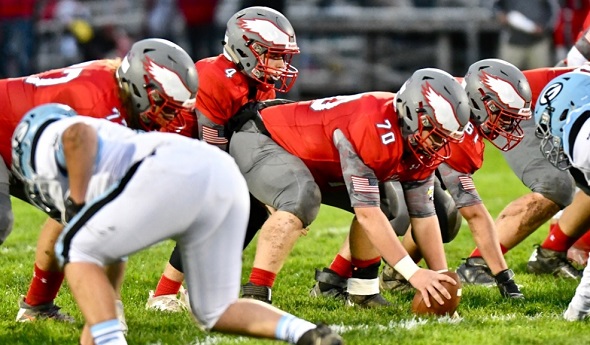
PHOTO: Frankenmuth's quarterback surveys the Essexville Garber defense before the snap during Friday's Eagles win. (Photo by Dan Brovont.)