

Inside Selection Sunday: Mapping the Football Playoffs
October 24, 2011
Sitting on the other side of this process for a number of years, I can admit to occasionally scratching my cynical head over some of the matchups that have come out of Selection Sunday.
How could teams so far from each other play in the same district? Why would two schools in the same town play in different regionals? Are they picking out of a hat at 1661 Ramblewood Drive?
Now, I have answers.
Sunday morning, we filed into headquarters for what might be the most important non-game day on the MHSAA calendar. “We” were made up of half of the MHSAA staff, plus a representative from the Michigan High School Football Coaches Association.
Here’s some of what I learned from being a part of the process:
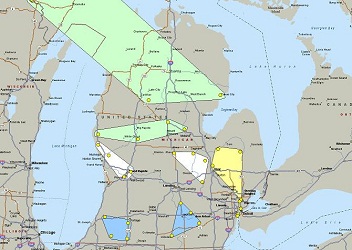
? First, a brief history lesson. In early years (or until the middle of the last decade), lines were drawn by hand. Dots representing qualifying schools were pasted on maps, one map for each division, and those maps were then covered by plastic sheets. Districts and regionals literally were drawn with dry-erase markers. No longer. Using a variety of spreadsheets and mapping software, we’ve gone digital. Staff is split into two teams, each considering four divisions (and the 8-player map) before we reconvene and look at all nine divisions together.
? We are presented digital maps of the state covered in dots. That’s about it. The rule of the day, simply, is “geography rules.” Which teams are represented by the dots is not considered, much less discussed, until lines are drawn. While considering my group’s first map, I began to bring up teams – and immediately was shot down (with good reason). Teams, matchups, rivalries, previous playoff pairings, etc. DO NOT come into play. We draw boxes in what we figure are the most logical ways of making districts and regions work.
? Travel distance and ease DO come into play. This especially is true when considering which districts will include teams from the Upper Peninsula. An example: Marquette is closer to the schools we placed in its district – Fenton, Bay City Western and Okemos – than some other options because those schools are closer to I-75. Schools further north on the map but farther from a main highway would’ve created longer trips.
? Sometimes, maps get ugly. And sometimes, it was a matter of choosing the least ugly situation. Of course, a D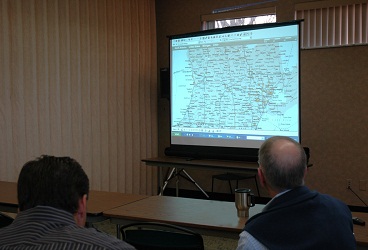 ivision 4 District of Lansing Sexton, Dearborn Heights Robichaud, Battle Creek Pennfield and Vicksburg isn’t ideal. But with no other Division 4 schools within 35 miles of Lansing, we were put in a tough spot. Add in that there were 13 teams in the Detroit area, leaving one as the odd team out of three districts based there. Something had to give, and drawing things up as we did caused the fewest messes.
? Considering how to set up the entire state is different than figuring out what teams make the most sense for just one school or area. And shifting just one dot on a map can change things for all 32.
? Back to “geography rules.” The Division 8 district including Saugatuck, Muskegon Catholic, Mendon and St. Joseph Lake Michigan Catholic might be the most competitive, on paper, in the state. Saugatuck is the reigning MHSAA runner-up in the division, and Muskegon Catholic and Mendon were ranked Nos. 1 and 2, respectively, in the most recent Association Press poll. Seeing that after we’d drawn the line caused a collective “ouch.” But again, the line was drawn based on dots on a map.
I thought back on some of the matchups I’d questioned in the past, and came back to what I’d ask people now: How would you do things differently?
I imagine there would be some creative answers, but I also would guess we considered those scenarios too.
And remember, determining the playoff schedule is just one step in many. Eight state champions must survive it, regardless of which opponents they face along the way.
Community Backs Maple Valley's Surge
August 13, 2015
By Geoff Kimmerly
Second Half editor
VERMONTVILLE – It’s almost with disbelief that first-year coach Marty Martin considers the recent history of his once-feared Maple Valley football program.
“It’s been nine years since we’ve had a winning season,” said Martin, who was part of the team’s first outright league title as a senior in 1983. “It gives me goose bumps to think about that.”
But he’s had similar reactions to the outpouring of neighborly support his program has received as it works to start a revival.
Members of the community, made up of about 3,500 residents, have donated $46,000 to go with $15,000 allocated by Maple Valley's school board for the purchase of new equipment that will be used this fall. Some was necessary to fit an influx of players, but the additional funds allowed the program to update and replace some of its older gear as well.
Confidence. Comfort. Swagger. The players anticipate a little more of all three when Maple Valley opens against Fowler on Aug. 28 outfitted in new uniforms over new shoulder pads and with new helmets topping them off.
Those good feelings come with heightened expectations, of course – which are welcomed by a program that made the playoffs seven of eight seasons and played in an MHSAA Final during the stretch preceding its recent struggles.
“It’s coming back. You can feel it,” Maple Valley senior Isiah Garn said. “On the field, the coaches are expecting more … not letting you short yourself. And the community is jumping in on us; there is so much support there. Everyone wants us to be a success again.”
Dressed to impress
Martin is deeply rooted in the school. His father was a 1953 graduate of the former Vermontville High and started middle school basketball and football and summer league baseball programs in the community before also coaching at the new Maple Valley High School after it opened in 1963. Marty played football for Dan Watson on the Maple Valley varsity after playing junior varsity for Guenther Mittelstaedt, who followed Watson and led the varsity to a 173-70 record over 24 seasons through 2008.
After playing two years of baseball in junior college, Martin came back to the community to work as a postal worker and coach, and under Mittelstaedt helped the Lions to their first playoff appearance, in 1987. He remained on Mittelstaedt’s staff through 2000, then coached a year at Battle Creek St. Philip, four years at Battle Creek Lakeview where he also taught after earning his degree, then with Mittelstaedt again for two years at Lakeview in Montcalm County.
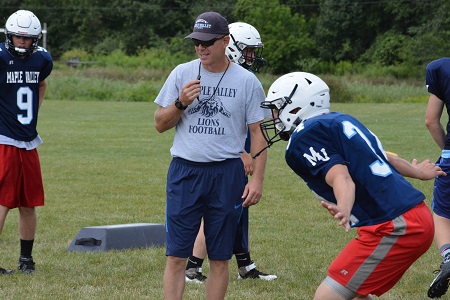 Martin returned to teach at Maple Valley a year ago and became only the third varsity football coach in 30 years during this offseason.
Maple Valley is a little different place than even a decade ago. The school’s enrollment briefly passed 500 during the 2007-08 school year but fell to just over 370 students as of this spring – and Martin said there are fewer than 70 seniors in this fall’s class. The community’s economics also have changed, he added, with fewer families farming or enjoying jobs with General Motors in Lansing or Kellogg in Battle Creek.
Near the top of his to-do list was simply getting more players back into the program. Maple Valley had 40 last year, which at least worked for the amount of equipment the school had in stock.
But 69 students signed up to play this fall and 54 ended up at practice this week – good news, except for the helmet supply.
In addition to new helmets to outfit the new players, Martin also surmised eight more would need to be replaced at the end of this season, followed by 12 more needed after 2016 and 13 after 2017.
Instead, Martin began investigating if his program could get a better price by replacing the entire supply in bulk. After considering two helmets, he worked with his Riddell representative to get a deal on the helmets that included discounts on shoulder and girdle pads as well. The school board responded with its contribution – and then the community came on strong to help the rest of the way.
Martin was called out of class one day to receive a $5,000 check. Then came $1,500 from one family and $3,500 from another. He was at a graduation open house this spring when someone placed a $1,000 check in front of him. Longtime residents, some retired, gave $100; some who had graduated from Vermontville High or the other former school in Nashville, donated a few hundred as well.
Martin’s team spent parts of the summer (and will this Saturday as well) providing muscle to local service projects, but he’s never asked the community for financial help for the program. It just made sense to provide, said 1992 grad and former player and assistant coach Paul Adrianson, whose local business Hickey Electric was among the first to contribute.
“We want people to see the game of football doesn’t just necessarily survive. We think it can thrive if you put safety first or good fundamental education on it,” Adrianson said. “It can be a great sport for our future. … We really feel that if we get all behind and lead as a district and doing safety first, we think that’s going to set a positive trend for the game of football.”
Safety first
Maple Valley is one of 70 high schools statewide taking part in a pilot sideline concussion testing program sponsored this school year by the MHSAA. The Lions will work with XLNTbrain Sport, which incorporates baseline testing done at the start of the season to assist in return-to-play decisions after possible head injuries at practices and during games.
In addition, the Riddell SpeedFlex helmets Maple Valley purchased include the InSite Impact Response System, a series of sensors that alert sideline staff after a player’s helmet sustains what is considered a significant impact. That player will then be evaluated by training staff; Maple Valley also has a trainer this fall for the first time in 15 years, Martin said.
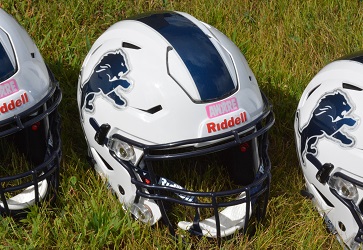 “That was our initial thing. We want our kids to be the safest kids,” Martin said. “We want to be one of those leaders; we want to get this district, this community, out front so everyone in the state of Michigan and the United States knows in this area that people care about their kids to the extent they’re willing to invest $27,000 in purchasing helmets.”
The helmets require reconditioning each offseason and new batteries for the InSite sensors – to the tune of $2,200. But another donor stepped in with $22,000 – enough to keep the new helmets ready to wear for a decade.
“This community identifies with this football team,” Martin said. “So they were ready for a change, and they were looking for this opportunity. I’m very blessed and humbled to think they’re showing trust in my leadership and my coaching staff and in the fact we can turn things around.”
His players have heard the stories of successes past, some before they were born. They’ll try to extend the “look good, feel good” cliché into their play on the field this fall as they work to write a restart into Maple Valley’s winning history that goes with the other renovation projects that are popping up at the school and on its grounds.
“I think there’s going to be tons of people coming out,” senior Brock Weiler said. “It’s the new coach, everything getting re-done in the school. I think the pride’s coming back.”
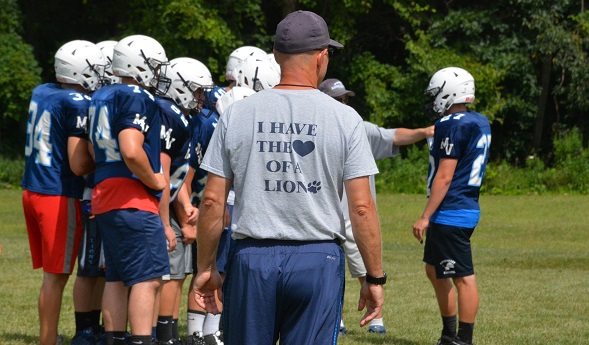
PHOTOS: (Top) Maple Valley huddles during offensive drills at Wednesday afternoon’s practice. (Middle) Coach Marty Martin leads the Lions through agility work. (Below) Maple Valley will wear new helmets this fall thanks in part to community donations.