

Inside Selection Sunday: Mapping the Football Playoffs
October 24, 2011
Sitting on the other side of this process for a number of years, I can admit to occasionally scratching my cynical head over some of the matchups that have come out of Selection Sunday.
How could teams so far from each other play in the same district? Why would two schools in the same town play in different regionals? Are they picking out of a hat at 1661 Ramblewood Drive?
Now, I have answers.
Sunday morning, we filed into headquarters for what might be the most important non-game day on the MHSAA calendar. “We” were made up of half of the MHSAA staff, plus a representative from the Michigan High School Football Coaches Association.
Here’s some of what I learned from being a part of the process:
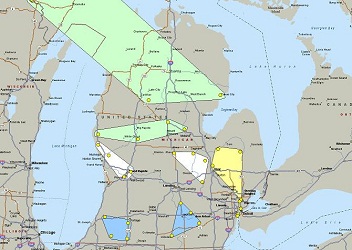
? First, a brief history lesson. In early years (or until the middle of the last decade), lines were drawn by hand. Dots representing qualifying schools were pasted on maps, one map for each division, and those maps were then covered by plastic sheets. Districts and regionals literally were drawn with dry-erase markers. No longer. Using a variety of spreadsheets and mapping software, we’ve gone digital. Staff is split into two teams, each considering four divisions (and the 8-player map) before we reconvene and look at all nine divisions together.
? We are presented digital maps of the state covered in dots. That’s about it. The rule of the day, simply, is “geography rules.” Which teams are represented by the dots is not considered, much less discussed, until lines are drawn. While considering my group’s first map, I began to bring up teams – and immediately was shot down (with good reason). Teams, matchups, rivalries, previous playoff pairings, etc. DO NOT come into play. We draw boxes in what we figure are the most logical ways of making districts and regions work.
? Travel distance and ease DO come into play. This especially is true when considering which districts will include teams from the Upper Peninsula. An example: Marquette is closer to the schools we placed in its district – Fenton, Bay City Western and Okemos – than some other options because those schools are closer to I-75. Schools further north on the map but farther from a main highway would’ve created longer trips.
? Sometimes, maps get ugly. And sometimes, it was a matter of choosing the least ugly situation. Of course, a D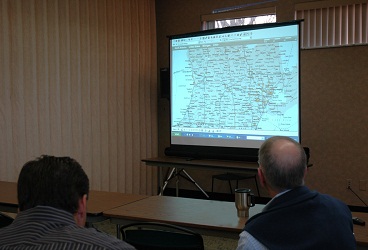 ivision 4 District of Lansing Sexton, Dearborn Heights Robichaud, Battle Creek Pennfield and Vicksburg isn’t ideal. But with no other Division 4 schools within 35 miles of Lansing, we were put in a tough spot. Add in that there were 13 teams in the Detroit area, leaving one as the odd team out of three districts based there. Something had to give, and drawing things up as we did caused the fewest messes.
? Considering how to set up the entire state is different than figuring out what teams make the most sense for just one school or area. And shifting just one dot on a map can change things for all 32.
? Back to “geography rules.” The Division 8 district including Saugatuck, Muskegon Catholic, Mendon and St. Joseph Lake Michigan Catholic might be the most competitive, on paper, in the state. Saugatuck is the reigning MHSAA runner-up in the division, and Muskegon Catholic and Mendon were ranked Nos. 1 and 2, respectively, in the most recent Association Press poll. Seeing that after we’d drawn the line caused a collective “ouch.” But again, the line was drawn based on dots on a map.
I thought back on some of the matchups I’d questioned in the past, and came back to what I’d ask people now: How would you do things differently?
I imagine there would be some creative answers, but I also would guess we considered those scenarios too.
And remember, determining the playoff schedule is just one step in many. Eight state champions must survive it, regardless of which opponents they face along the way.
Cass City Chases History in Rematch
By
Paul Costanzo
Special for MHSAA.com
November 8, 2019
Sandyn Cuthrell and his Cass City teammates have a simple way to make sure they are properly prepared for each game – treat every week like it’s Laker week.
 As they prepare for their District Final, the Red Hawks won’t have to pretend, as for the second time this season, it’s actually Laker week.
The Red Hawks will host archrival Elkton-Pigeon-Bay Port Laker at 7 p.m. Friday for the Division 7 Region 4, District 1 championship. The winner will advance to the Regional Final against either Madison Heights Madison or Detroit Loyola.
The win-or-go-home nature of the postseason adds more to this rivalry game, but it’s also a chance at some program firsts for the Red Hawks. A win would give them their first ever District championship and first ever 10-win season.
“This one, it’s probably the biggest game in Cass City history,” said Cuthrell, a four-year starter at quarterback for the Red Hawks. “We’re not going to let it be ruined.”
Plenty is on the line, but what the Red Hawks have accomplished to this point already puts them among the best teams in school history.
Cass City won nine straight games after a season-opening 16-14 loss against Montrose – a team that is still alive in the Division 6 playoffs – and won the Greater Thumb Conference West for the second straight season.
It has also allowed 50 points. Total. All season.
“We’re not like huge; we’re all just super fast,” said Cuthrell, who also plays defensive back. “All these years building up to this year, we’ve been really heavy on the weight room every year. We’re all not huge guys, but we’re all really quick and fast. We can swarm to the ball, and there’s not a lot of big plays that can happen when the defensive backs are quicker than the receivers.”
Outside of the Montrose game, the Red Hawks haven’t allowed more than eight points in a game this season and had four shutouts. During six conference games, they allowed a total of 22 points. It’s the program’s best defensive performance since the 1950s.
 “Coach does a really good job preparing us throughout the week,” junior running back and linebacker Alex Perry said. “We’ve been able to communicate with each other really well. The line gets a good push, so the linebackers can come in and clean it up. And the defensive backs shut down the pass.”
The offense has done its fair share, as well, averaging 40.1 points per game despite scoring just 14 in Week 1. So, while the defense’s numbers are eye-popping, most of the season has seen the Red Hawks be dominant in all phases.
“When you coach this long, hopefully you come across a team that gels really well, and that’s what happened this year,” Cass City coach Scott Cuthrell said. “We have a good group of kids, and they all get along really well on and off the field, and they all have a common goal. This is a group of kids that I’ve enjoyed going to coach every night.”
Players vouch for the camaraderie on and off the field and cited that as a main reason this year’s team has been special and capable of doing what no team at Cass City has ever done.
“We’re more than a team. We hang out all the time,” Perry said. “This year, we just flow and really mesh together.”
Perhaps at no time this season did the Red Hawks mesh together as well as they did the first time they lined up against Laker. A 51-0 win in Week 4 marked the second-straight year Cass City had defeated its rival, but prior to the 2018 win, Laker had won nine straight in the series.
“Last season’s win meant a lot to us,” senior halfback and cornerback Hadyn Horne said. “We’re 10 minutes apart, and it’s just a battle for our area. It’s always been a really big game around here, probably the biggest game in the Greater Thumb Conference. We know in the playoffs it’s pretty much like coming in with a 0-0 record. They’re going to be a lot better than what they were when we played them the first time. Obviously we beat them bad last time, but it’s all about who wants it more.”
The two teams have met twice in a District Final (2014 and 2017). Some of the current players were on the field for the 2017 loss, including Sandyn Cuthrell, who said it was “like getting stabbed in the heart.”
Not wanting to have that feeling again is quite the motivation, but so is making program history.
“That would mean a lot,” Horne said. “I think down the road, I’ll look back at that and know, ‘That was our team that did that.’”
 Paul Costanzo served as a sportswriter at The Port Huron Times Herald from 2006-15, including three years as lead sportswriter, and prior to that as sports editor at the Hillsdale Daily News from 2005-06. He can be reached at [email protected] with story ideas for Genesee, Lapeer, St. Clair, Sanilac, Huron, Tuscola, Saginaw, Bay, Arenac, Midland and Gladwin counties.
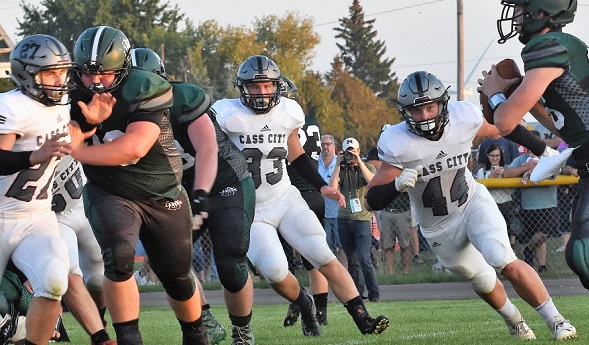
PHOTOS: (Top) Cass City defenders including Alex Perry (44) pursue the Laker quarterback during this season’s first game against their rival. (Middle) Sandyn Cuthrell (6) breaks through the line for the Red Hawks. (Photos courtesy of the Cass City athletic department.)