

Jefferson Helps End Muskegon's Heartache
By
Tom Markowski
Special for Second Half
November 25, 2017
DETROIT – The wait is over for Muskegon.
 The Big Reds lost in MHSAA Division 3 Finals four of the last five seasons. And when Ben Williams of Farmington Hills Harrison returned Saturday’s opening kickoff 91 yards for a touchdown, the hearts of Muskegon fans sank a bit.
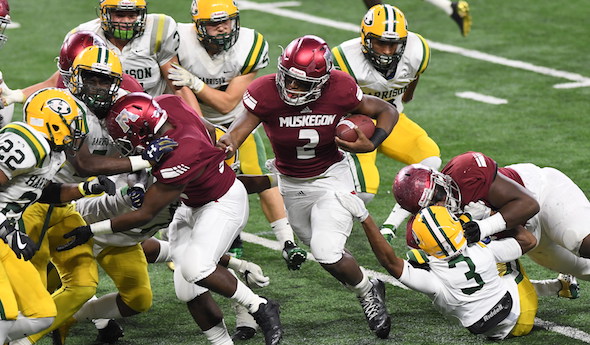
No reason to be concerned. Senior quarterback La’Darius Jefferson did what he’s done all season. Jefferson scored four touchdowns, and the defense allowed just three points as the Big Reds defeated Harrison, 28-10, in the weekend’s final championship game at Ford Field.
Muskegon (14-0) won its first title since 2008, and it helped take away some of the sting that lingers from last season’s 29-28 Division 3 Final loss to Orchard Lake St. Mary’s – a game where the Eaglets went ahead on a touchdown pass in the closing seconds.
That final score was posted in the Muskegon locker room all season. Every player and every coach saw it every time they walked in.
Not anymore. Coach Shane Fairfield will take that down now that the journey to the championship is over.
“It’ll be all white now,” Fairfield said. “We’ll start all over again with a clean slate.”
This is Fairfield’s first title as Muskegon’s coach. Expectations are high at Muskegon. Fans and alumni expect nothing less than a title, and close doesn’t count.
“I got it off my back,” Fairfield said. “I get to continue what I love to do.”
The Big Reds answered Williams’ kickoff return with an 80-yard, 13-play drive to tie the score at 7-7. Jefferson ended the drive with an 8-yard touchdown run.
Harrison regained the lead, 10-7, on David Hiser’s 26-yard field goal on the last play of the first quarter.
The Big Reds took their first lead during the second quarter on a 69-yard, two-play drive. Jefferson ran 55 yards on the first play, then scored from 14 yards out with 4:29 left in the half.
“We did well with that start,” Harrison coach John Herrington said. “But when you go against that type of size, you get worn down. I thought our defense played well. Passing is not our thing, and they did a good job of stopping our run.”
Muskegon held Harrison (10-4) to 61 yards rushing on 23 attempts., and also just 53 yards on nine completions through the air. The Hawks were held to 42 yards in the second half as Muskegon imposed its will.
Jefferson scored on short runs in the third and fourth quarter, and the defense did the rest.
He rushed for 245 yards on 32 carries, and his four touchdowns upped his total to 33 on the ground this season. He also threw 21 touchdown passes. On this night he didn’t have to throw much; he attempted only two passes, without a completion.
“We’ve gone against some great players here like (Birmingham Brother Rice quarterback Alex) Malzone and (Brother Rice receiver Grant) Perry. I was just hoping our guys could handle it and they did,” Fairfield said.
“La’Darius? What an amazing young man. I watched him play since he was in the seventh and eighth grades. He’s a selfless kid who loves his family. He wants all the kids (in Muskegon) to experience what he and his team have.”
 As he has done many times this season, Jefferson went to the opposing team’s huddle at the end of the game to congratulate them on their play. In particular, he went to Harrison’s outstanding linebacker/tight end Ovie Oghoufo, who is committed to Notre Dame, and offered some advice.
“I told him to cherish this moment,” Jefferson said. “Not everyone is going to play in college. Not everyone is going to Notre Dame. Be thankful.”
Herrington, the state’s winningest coach, completed his 48th season at Harrison. The school is expected to close after the 2018-19 school year, and he said he’d be back for the finale.
The last time Harrison was in an MHSAA Football Final was 2010, when the Hawks won their state record 13th title with a 38-28 victory over Lowell in Division 2.
Harrison was one of only two teams to hold the Big Reds to fewer than 35 points this season, giving them their second-closest game of the fall and closest of a playoff run that saw Muskegon beat five opponents by an average of 37 points.
“Nobody stopped Muskegon all year,” Herrington said. “It was one of the better seasons we’ve had in a while. I enjoy them all. I can’t point out one more than the others.
“We have a few guys coming back. We’ll have 25 or so and go at it again.”
The MHSAA Playoffs are sponsored by the Michigan Army National Guard.
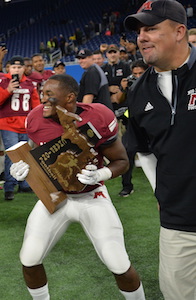
PHOTOS: (Top) Muskegon quarterback La’Darius Jefferson slices into the Harrison defense during Saturday’s Division 3 Final. (Middle) Muskegon coach Shane Fairfield hands off the championship trophy as his players begin to celebrate.

Friday Night Football
September 23, 2016
There continues to be among high school athletic administrators a great gnashing of teeth over encroachment of televised college football on the Friday night turf that long tradition reserves for high school football games. Little by little and year by year, college games drift to all times of the day and all days of the week, and Friday night is no longer hallowed ground for the high school game alone.
The Friday night intercollegiate fare remains mostly irrelevant games by second tier teams, but televised nonetheless because of the overabundance of production entities and networks seeking live sports events. But high school leadership is right to be on guard.
Known to very few people is a million dollar offer in the 1970s by then NCAA Executive Director Walter Byers to the National Federation of State High School Associations if it would not oppose televised college football games on Friday nights. Clifford Fagan, then executive director of the National Federation, declined the offer from his good friend; and the mutual respect these two men enjoyed brought an end to the negotiation.
Then, as now, the National Football League was prohibited by law (part of its anti-trust exception) from televising games on Friday nights and Saturdays from mid-September through mid-December where the broadcast would conflict with a live high school or college game. Under Byers, and until the NCAA lost control of intercollegiate football broadcasting as a result of a legal challenge by what was then called the College Football Association, college football leadership voluntarily gave high school football the same deference on Friday nights that the NFL did under federal law.
Today, major college football is such a ravenous revenue beast that it will schedule play at any time on any day in any location, televising every game – on college conference-controlled networks if the matchup is not attractive enough for national or even regional broadcasts. The Friday night high school football tradition can expect to be trampled as college football swarms and grunts around the feed trough like hungry hogs.