

King Avenges Early Defeat to Reign Again
November 24, 2018
By Tom Kendra
Special for Second Half
DETROIT – Rematches are rare in high school football, especially for teams located on opposite sides of the state.
But Detroit Martin Luther King on Saturday got the chance to avenge a Week 2 loss at Muskegon, and star senior quarterback Dequan Finn and his talented supporting cast made the most of it.
Finn, a 6-foot-1,190-pound senior who has committed to sign with Central Michigan University, threw four touchdown passes and ran for another as the Crusaders’ offensive versatility was the difference in a 41-25 victory over previously unbeaten Muskegon in the Division 3 Final at Ford Field.
“So many great King teams have lost to Muskegon, and it felt great to be the first to beat them,” said Tyrone Spencer, who has two MHSAA titles and a Semifinal appearance in his three years as King’s head coach. “They are a great program with a rich tradition, and it feels good to beat them for a state championship.”
King (12-2) won its third Finals championship in four years, after claiming back-to-back Division 2 crowns in 2015 and 2016. The Crusaders have won four titles overall, with their first also in Division 2 in 2007.
Muskegon (13-1) was shooting for its seventh MHSAA title, but instead finished runner-up for the fifth time, and saw its state-best 27-game winning streak snapped.
The final championship game of the weekend was a matchup between arguably the two best quarterbacks in the state – and neither disappointed.
Muskegon junior Cameron Martinez (5-11, 190) was once again the workhorse for the Big Reds, carrying 37 times for 211 yards and two touchdowns. He completed only 1-of-4 passes, but that completion was good for a 13-yard touchdown to senior Ali’vonta Wallace.
Finn, meanwhile, was deadly with his arm and feet.
Finn completed 9-of-13 passes for 173 yards and the four scores, as his offensive line gave him plenty of time to pick apart the Muskegon secondary. He was also King’s second-leading rusher with 11 carries for 73 yards and another touchdown.
“I’m just happy with the whole team, the effort that we gave,” said Finn. “It’s a surreal moment right now. I’m lost for words.”
The quarterback matchup went back-and-forth for three quarters, and when Martinez plunged in from two yards out late in the third quarter to draw his team within 21-17, it appeared the stage was set for a fantastic finish.
Instead, King’s myriad offensive weapons overwhelmed Muskegon over the final 12 minutes.
Three players scored in the fourth quarter as the Crusaders pulled away – senior receiver Ahmad Gardner on a 22-yard pass from Finn, junior running back Peny Boone on a 52-yard run and senior receiver Darrell Wyatt on a three-yard pass from Finn that was nearly intercepted in the end zone.
“There were a lot of plays that could have been big for us, but there were dropped passes and a missed interception,” said Martinez, who finished his junior year with a school-record 2,527 rushing yards. “In a game like this, you can’t afford to make mistakes.”
Muskegon, which was playing in an MHSAA Finals game for the sixth time in seven years, got off to a great start.
The Big Reds forced a punt on King’s first possession, and despite taking over at their own 3-yard line, marched 97 yards in 13 plays behind their dominating offensive line. Martinez sprinted in from 10 yards out for a 7-0 lead.
 Making openings for Martinez were four seniors up front – tackles Anthony Bradford (6-5, 360) and Evan Towers (6-4, 285) and guards Marquis Cooper (6-1, 330) and Da’Quarious Johnson (6-0, 260) – along with junior center DeAndre Mills-Ellis (6-0, 290).
King countered with the passing of Finn, who connected with senior wideout Dominick Polidore-Hannah on a pair of first-half touchdown passes covering 42 and 22 yards as the Crusaders took a 14-10 halftime lead.
The third quarter was even as Finn and Martinez each had scoring runs, but King’s athleticism prevailed over Muskegon’s size and strength during the final quarter.
“We won 27 games in a row, and you have no idea how remarkable that is,” Muskegon ninth-year head coach Shane Fairfield told his huddled team on the Ford Field turf afterwards. “It hurts and it should hurt, but we haven’t felt this in a while.”
Boone made Muskegon pay for spreading out to cover the pass, hammering his way for 111 yards on 14 carries. Gardner and Polidore-Hannah each caught three passes. Leading King defensively was junior free safety Joe Frazier with 11 tackles, sophomore safety Jaylen Reed and senior safety Ray Williams with 10 tackles apiece and senior linebacker Rich Miller with nine stops.
The victory was sweet revenge for the Crusaders and especially Finn. In the Week 2 meeting, he mishandled a snap with 35 seconds remaining. Muskegon’s Billie Roberts recovered the fumble, and the Big Reds held on for a 24-21 win at Hackley Stadium in Muskegon. They went on to be ranked No. 1 in Division 3 the entire regular season and heading into the playoffs
“Our kids didn’t have any quit in them,” Spencer said. “I told them to give more effort, and that’s what they did. We got some breaks tonight, but (Muskegon) had some breaks when we went to their place and played. It’s a part of the game, and I’ll take it all day. Our guys never quit, and I’m proud of them.”
Senior Demario Robinson was the second-leading rusher for the Big Reds with 47 yards on six carries, while senior Carlos Hernandez booted a 37-yard field goal on the final play of the first half. Wallace led the defense with seven tackles, junior linebacker Tarran Walker had six and senior defensive back Isaiah Moore made five stops.
Muskegon, the winningest team in state history with 844 victories over 124 years of football (dating back to 1895), beat Farmington Hills Harrison last year for the Division 3 title. The Big Reds also have lost twice to Birmingham Brother Rice (2012 and 2013), twice to Orchard Lake St. Mary’s (2014 and 2016) and now King in championship games.
Fairfield scheduled the regular-season game against King to help prepare his team for the type of athletes it might see at Ford Field. He did not expect to see King again, as the Crusaders have traditionally slotted into the Division 2 bracket. But a drop in enrollment put both teams in the same division – and on a collision course.
Both had to survive Pre-District playoff scares, as Muskegon edged East Grand Rapids by one score (42-35), while King beat River Rouge by just one point (7-6).
After that, both teams rolled over their next three opponents en route to Ford Field.
Saturday’s matchup was the second time the two schools have met in an MHSAA Finals game, with the first meeting in the Class A Final in 1989 at the Pontiac Silverdome. Muskegon, which is now 5-1 all-time against King, prevailed in that title game 16-13.
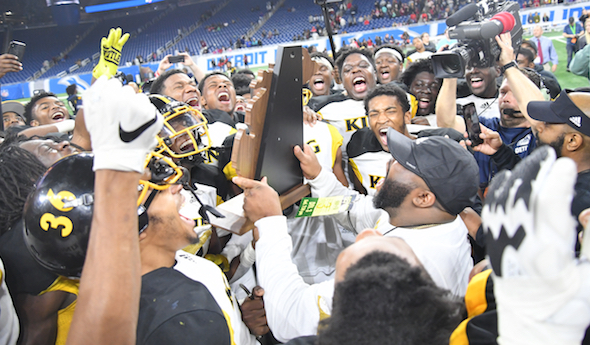
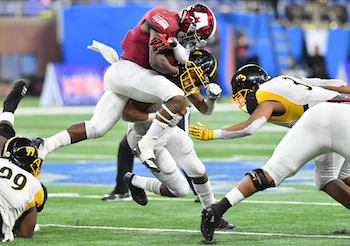
PHOTOS: (Top) Detroit Martin Luther King raises the Division 3 championship trophy Saturday night at Ford Field. (Middle) Crusaders defenders work to bring down a Muskegon ball carrier.
St Mary's Scores 3-Peat on Late TD
By
Tom Markowski
Special for Second Half
November 26, 2016
DETROIT – Orchard Lake St. Mary’s has been bitten before by teams that made last-second winning plays.
This time St. Mary’s bit back.
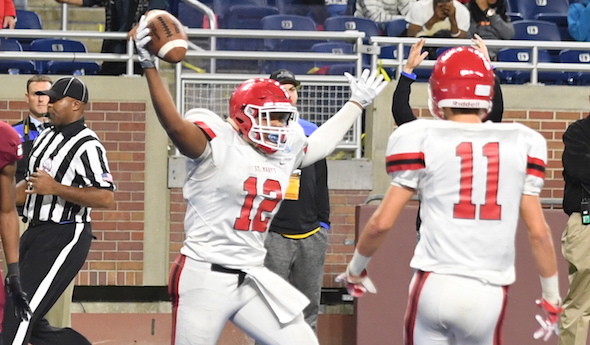
Ky’ren Cunningham’s 18-yard touchdown reception with four seconds left gave the Eaglets a thrilling 29-28 victory over Muskegon in the Division 3 Final on Saturday at Ford Field.
St. Mary’s (10-4) began its last drive on its 20-yard line with 1:55 left. A pass interference penalty by Muskegon and Rashawn Allen’s 22-yard run placed the Eaglets in a good position to go for the winning score.
On 3rd-and-3 from the 22, quarterback Caden Prieskorn scrambled for four yards and a first down. An incomplete pass preceded the winning score.
“It was a pistol right,” Prieskorn said. “All we knew was we were going to have man-on-man coverage.”
Make no mistake. This was desperation, and it was a makeshift play. Cunningham is a starting running back. The last time he lined up as a receiver was in the first game this season against Macomb Dakota. Coach George Porritt ditched that plan afterward. Cunningham would stay in the backfield.
But not this time. St. Mary’s had five wideouts and to confuse matters more, Cunningham went to the slot, then switched spots with Clay Antishin, with Antishin moving inside.
“I play running back,” said Cunningham, a junior. “It was one-on-one and the safety didn’t come over the top. Caden just threw it. He just made the read.
“My body felt so weak (when I caught it). I don’t remember much.”
If Cunningham was stunned, Muskegon was more so.
The only loss the Big Reds (12-2) had this season was to a team from Illinois (Lincolnshire Stevenson). They rolled through the playoffs with their Semifinal game against Edwardsburg (19-8) the only close one.
“I just didn’t do a good enough job of teaching coverage,” Muskegon coach Shane Fairfield said.
“People say we can’t win the big one," he added. "We won a lot of big games to get here. The football game doesn’t define you. It’s what you do and the way you act afterwards that defines you.”
It was Muskegon’s fourth loss in a Final since winning its last title in 2008. Meanwhile, the championship was St. Mary’s third straight and eighth overall.
 Muskegon took a 21-20 lead on its second possession of the second half. It took the Big Reds 1:48 to go 50 yards with senior quarterback/running back Kalil Pimpleton going the final 18 to give Muskegon the lead with 11:21 remaining.
St. Mary’s then went on one of its patented long, time-consuming drives to retake the lead. The Eaglets took 12 plays to go 47 yards, and Ben Fee set an MHSAA Finals record with a 49-yard field goal to give his team a short-lived 23-21 lead with 4:47 left.
Clinton Jefferson, Jr., returned the ensuing kickoff 49 yards to midfield to give the Big Reds great field position, and they made it count. Jefferson carried five times on the drive for 32 yards, including the last three for a touchdown with 1:55 left.
As it turned out, that was too much time to leave for St. Mary’s.
“Cade made some big throws against DeWitt (in a Regional Final),” St. Mary’s coach George Porritt said. “What amazes me is we were 5-4 at one point, and we battled back.”
St. Mary’s is the fifth team to win an MHSAA football title having lost four games.
Muskegon led 14-13 at the end of an entertaining first half.
The Big Reds went 70 yards during the opening drive and took a 7-0 lead on Pimpleton’s 18-yard touchdown run. Pimpleton’s 27-yard pass to Jefferson helped set up the score.
St. Mary’s then went 69 yards, but its drive stalled and Fee kicked a 32-yard field goal.
La’darius Jefferson took over at quarterback for Pimpleton in the second quarter, and Muskegon increased its lead to 14-3 as Jefferson completed an 80-yard drive with a 2-yard touchdown run. He carried five times on the drive for 25 yards. His 54-yard pass to Pimpleton was the key play.
After another Fee field goal, Muskegon had possession late in the half. But on 3rd-and-9 Jefferson handed off to Pimpleton, who threw a halfback pass that was intercepted by Shermond Dabney, who returned it 30 yards to the Muskegon 30. On St. Mary’s 3rd-and-9, Prieskorn threw a 29-yard touchdown pass to Antishin, who made a diving catch in the end zone with 35 seconds left before the break.
Allen was a workhorse in the backfield, and ran with determination. A junior, he rushed for 136 yards on 25 carries, and Cunningham had 15 carries for 46 yards. Prieskorn was 13 of 21 passing for 200 yards and two touchdowns.
For Muskegon, Pimpleton had three receptions for 88 yards, was 3 of 4 passing for 58 and rushed nine times for 56 yards and two touchdowns.
The MHSAA Football Finals are sponsored by the Michigan National Guard.
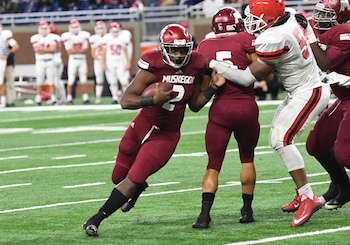
PHOTOS: (Top) St. Mary’s Ky’ren Cunningham (12) celebrates his game-winning touchdown. (Middle) Muskegon’s La’darius Jefferson breaks around his blocker Saturday.