

Lung Transplant Survivor Inspires, Teaches Through Football
By
Doug Donnelly
Special for MHSAA.com
September 1, 2021
ADRIAN – As the final seconds ticked off the clock in the 2019 Division 8 Regional Football Final at Reading, Adrian Lenawee Christian assistant coach Jon Willett started looking for his wife.
 Reading would be going on to play the next week, while the LCS’s season was over. Willett desperately needed oxygen. He could barely breath.
Hillary Willett, Jon’s wife, pulled the car as close to the Reading field as she could, and Jon opened the door.
“I got in the car and sat down,” Willett said. “And I looked at her and I said, ‘I just coached my last game.’”
As miracles go, Willett was wrong. Less than two months after that football game that Willett thought was his last, he underwent a double lung transplant at the University of Michigan Hospital. He still doesn’t know how he survived so long, but is certain there was divine intervention.
“I’ve always had a close relationship with Jesus Christ,” Willett said. “And I’ve always been passionate about football. I always thought that if I survived, I would use football as a tool to reach younger people. I’m doing that today.”
Willett helped coach the Cougars to last season’s 8-Player Division 1 championship and is back on the sidelines this season, coaching the Cougars JV team and continuing to serve as an assistant with the varsity.
He even gets in on some drills now and then, such as doing push-ups with the quarterbacks.
“Jon has been with me for seven or eight years,” LCS varsity head coach Bill Wilharms said. “He’s a great man and a great football coach. The kids love having him around, and he loves them. I love coaching with him, and he’s a big part of our coaching family.”
Willett grew up in Sand Creek, about 10 minutes south of Adrian in Lenawee County. He played on some outstanding Aggies football teams for Hall of Fame coach Ernie Ayers. Willett led the 1990 Aggies in rushing, finishing just shy of 1,000 yards his senior season.
He got into coaching when his sons, Noah and Isaiah, began playing flag football.
“I coached them in flag football, then in Pop Warner,” Willett said. “I love coaching football. When Noah was in middle school I coached him one year, then became an assistant for the varsity.”
 Wilharms tabbed Willett to be the JV head coach, a position he’s held for the last couple of years. He also coaches varsity wide receivers and defensive backs and will assist the LCS scout team quarterbacks at practice. He jumps in whenever needed.
Sometimes, it’s as a motivational speaker.
“I share my testimony whenever possible,” Willett said. “I tell my players that life is short. You never know how long you are going to have. You truly don’t. You have to live your life to the fullest.”
Willett first was diagnosed with idiopathic pulmonary fibrosis – chronic, progressive lung disease – in April 2017 when he visited the doctor due to a constant cough and shortness of breath. The prognosis was not good.
“The doctor said at that point I had 65-percent capacity of my lungs,” he said. “They gave me three to five years unless I could get a double lung transplant. They said that would be the only option and that there was no cure.”
Willett believed the doctors, of course, but admits he wasn’t the best patient.
“I figured if I could make it 10 years, my kids would be out of school,” he said.
The disease had other ideas. While he was put on oxygen due to shortness of breath, his LCS football players had no idea.
“I never did it in front of them,” he said. “I should have. I wasn’t a very good patient. I was wanting to be with the team. I wanted to coach.”
In July 2019, he noticed a big change.
“My lung capacity had dropped,” he said.
He continued to coach. He had some doctors’ appointments here and there but remained coaching the entire season.
“It was a mental thing,” he said. “I wanted to get through the season.”
He rode the bus to the LCS-Reading game. When the game was over, he told Wilharms that he had to go home.
“I told Coach Wilharms that I was just getting in the car with my wife,” he said. “She pulled the car up to the gate because it was so hard to walk. I couldn’t get air because of not having oxygen.”
When he told his wife that he thought he would never coach again, she said no.
“She looked at me and she said, ‘(You’ve coached your last game) with those lungs.’”
By Christmas of 2019, Willett had been in and out of the hospital on numerous occasions. He was on oxygen tanks around the clock. He went home at Christmas, believing it was his last.
“I said I want to go home. I think it’s my last Christmas. I wanted to be with my family,” he recalled.
When he returned to the hospital after Christmas, his son Noah sat in the backseat during the car ride changing out oxygen tanks every few minutes just to keep his father alive. Willett’s oxygen levels were dangerously low.
 “When I got to U-M, there was a whole team of people waiting for me. They worked on me and sent me up to ICU. It was bleak,” he said.
The LCS community sent out word via social media to pray for Coach Willett, his wife, two sons and two daughters, Emily and Abigail. Willett said those prayers were answered.
Willett was told by doctors he had to have a double lung transplant within 24 hours, or he would die. Seven hours and 13 minutes later, the doctor walked in, with tears in his eyes, and told the family they found a match.
Willett is feeling better now. In February of this year, about a month after Willett watched from the sidelines as LCS won the championship in Brighton, the medications he had been on took hold and he began to improve.
When the season started this summer, Willett was no doubt going to be part of the Cougars staff.
“Everything is very stable right now,” he said. “My lungs keep getting better. I can tell at football practice, walking from end zone to end zone, I’m feeling better. I’m building up. That exercise helps.”
Some day he plans on reaching out to the family of the person who donated lungs to him. For now, he’s grateful to be alive and thankful for every moment he gets to spend coaching football.
“I’m feeling great and loving the opportunity I have to keep coaching and be with the kids,” Willett said. “The story I get to share with my players is truly a miracle. God took me to the point where it was 100 percent out of my control.
“If I can use football as a tool to keep talking to the youth and help them become better men, I’m going to do that. Football is what drives me.”
 Doug Donnelly has served as a sports and news reporter and city editor over 25 years, writing for the Daily Chief-Union in Upper Sandusky, Ohio from 1992-1995, the Monroe Evening News from 1995-2012 and the Adrian Daily Telegram since 2013. He's also written a book on high school basketball in Monroe County and compiles record books for various schools in southeast Michigan. E-mail him at [email protected] with story ideas for Jackson, Washtenaw, Hillsdale, Lenawee and Monroe counties.
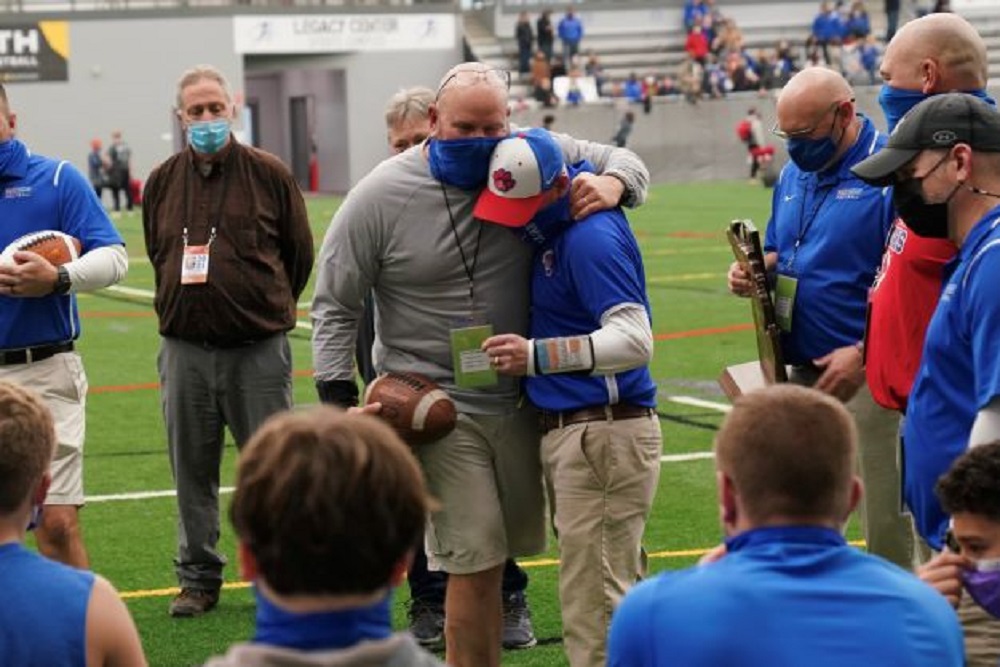
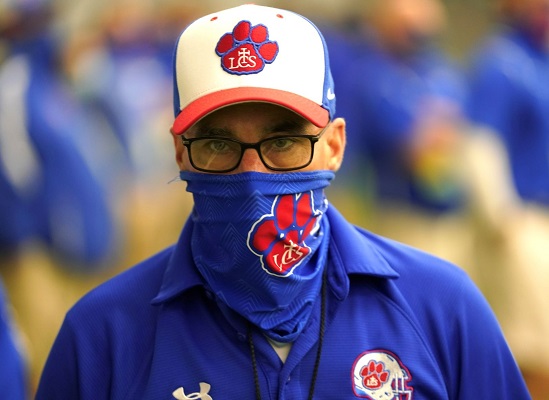
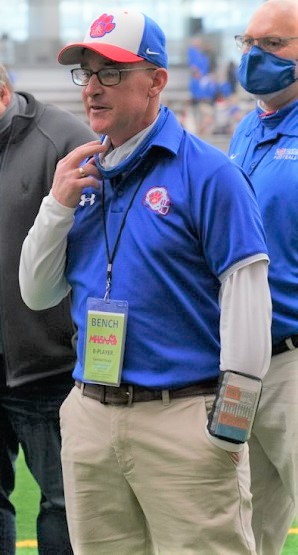
PHOTOS: (Top) Lenawee Christian head varsity coach Bill Wilharms (holding football) gives assistant Jon Willett a hug after last season’s 8-Player Division 1 Final win. (Middle) Willett returned to the sideline a year after a double lung transplant. (Below) Willett serves as junior varsity head coach and varsity assistant. (Photos by Jeff Jameson/Lenawee Christian Schools.)
Final-Seconds Field Goal Ends Defensive Stalemate, Delivers Gladwin's 1st Title
By
Paul Costanzo
Special for MHSAA.com
November 26, 2022
DETROIT – As Treyton Siegert warmed up with the kicking net on the Gladwin sideline late in the Division 5 Football Final on Saturday, he was kind of hoping it wouldn’t be necessary.
“I was just trying to focus on making good contact with the ball, and just hoping they would score a touchdown,” the junior kicker said. “I knew it would probably come to me.”
It did, and Siegert delivered with a 21-yard field goal from the right hash to give Gladwin a 10-7 win against Frankenmuth and its first MHSAA football title.
“It was a crazy moment,” Siegert said. “I never doubted it once we got up close enough, but it was just a crazy moment. I’m really speechless. It was awesome to have that feeling. … I wouldn’t have that opportunity without a team behind me. It was really a great moment.”
Siegert’s moment capped a defensive struggle between two unbeaten teams, each in search of a first Finals title. For Frankenmuth, it was the second trip to the Finals in three seasons. Gladwin, meanwhile, was making its first appearance in a Final, and it came just three seasons after the team went 1-8 to cap a four-year stretch during which it won seven games total.
 The 1-8 season was the first for coach Marc Jarstfer and his staff. Two players who were on the field Saturday – receiver/safety Kaden McDonald and running back/linebacker Logan Kokotovich – played on the 1-8 team as freshmen.
“The culture,” McDonald said of what changed. “The culture was a huge thing. And the brotherhood. We worked out all the time and got after it in the offseason.”
Gladwin needed every bit of that culture and brotherhood to overcome a Frankenmuth team that had been building the same thing for decades.
With the game tied at 7 midway through the fourth quarter, it was the Flying Gs who found just a little bit more.
Senior quarterback Nick Wheeler connected with senior receiver Lucas Mead for a 43-yard gain down the sideline to put Gladwin at the Frankenmuth 28-yard line. Senior running back Earl Esiline then chipped away for 24 yards over the next five plays to set up Siegert’s game-winning field goal.
The junior soccer player left little doubt on it, too, smashing the kick through the middle of the uprights with two seconds remaining. That was only enough time for Frankenmuth to unsuccessfully attempt multiple laterals on the ensuing kickoff.
“I never doubted it for a second,” Jarstfer said of Siegert’s kick. “I was thinking of taking knees a little bit earlier to just ensure that we had that opportunity. Upstairs, on the phones, they were telling me to keep punching it and maybe we’ll break one through and we can seal the deal that way. I have a lot of trust and faith in him, and I’m glad he’s back for another year.”
The drive that set up the winning kick was a rare win for an offense in the game. It covered 74 yards, and Gladwin finished the game with 225 of total offense.
Frankenmuth, meanwhile, was held to 199 yards of offense, and 3.9 yards per play.
“Both defenses have been pretty sound all year,” Frankenmuth coach Phil Martin said. “I think both offenses probably left a little bit on the field that they would have liked to cash in on; I know we did. But again, I thought the kids played a whale of a smash-mouth football game. Small-town football in Division 5 is a lot of fun.”
 The first offensive breakthrough didn’t come until late in the third quarter, when Frankenmuth junior Griffin Barker scored on a 2-yard run. He was helped with a push from behind by senior Brenden Marker, who had started as his lead blocker. The Frankenmuth drive covered 90 yards, and featured a 56-yard pass from senior quarterback Aidan Hoard to junior receiver Hunter Bernthal.
Gladwin immediately responded, putting together a four-play, 80-yard drive that ended with a 30-yard pass from Wheeler to McDonald.
The rare flash of offense wasn’t matched previously, nor after, until the game-winning drive.
Gladwin looked to have broken the deadlock on the first play of the second quarter, but a 55-yard touchdown run by Esiline was wiped off the board by an illegal formation penalty.
The Flying Gs did get into the red zone twice in the first half, but both trips came up empty. The first ended on downs at the Frankenmuth 16. The second ended with an incomplete pass on a fake field goal at the Frankenmuth 9.
“I just couldn’t be more thankful for the defense that I have on this team,” Hoard said. “They kept us in it the entire thing, and as the quarterback, seven points, that’s not really acceptable. We should have done a better job. The defense was what really kept us in it, and it was the main key of our team. That was our identity right there, a strong defensive team. All the way from the coaching staff to every player who played on the defensive side of the ball, I couldn’t be more proud of you guys.”
Hoard was 4 of 10 passing for 77 yards for the Eagles, while Barker led the rushing attack with 43 yards. Colin Main had nine tackles to lead Frankenmuth’s defense, while Dalton DeBeau added eight.
Wheeler had 123 yards on 7 of 15 passing, and Esiline led the Gladwin rushing attack with 67 yards. Mead had 81 yards on four catches. Esiline was the leading tackler for Gladwin with eight, while McDonald had seven.
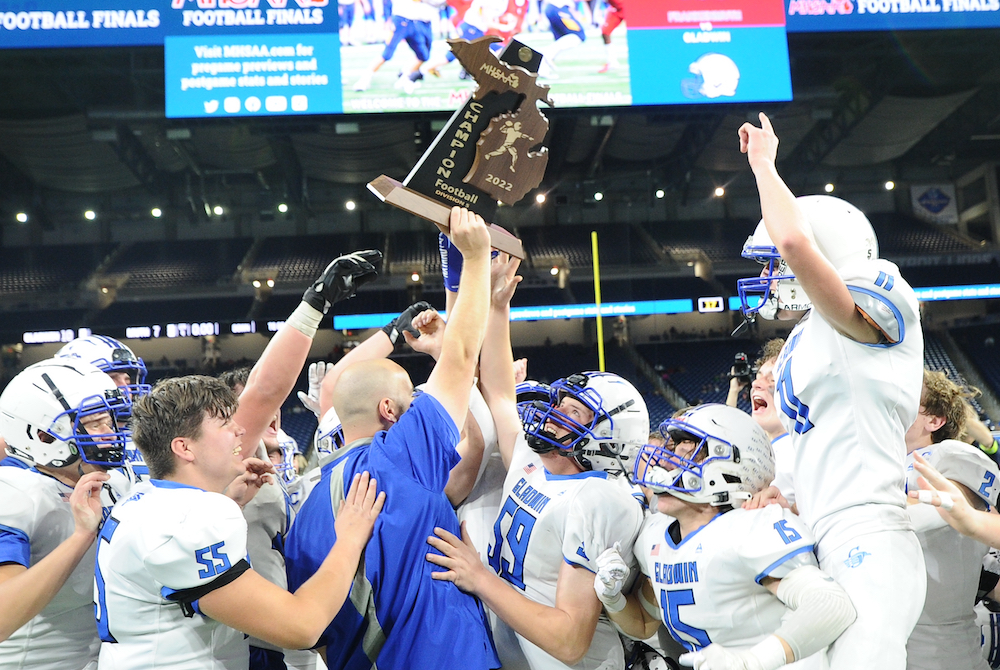
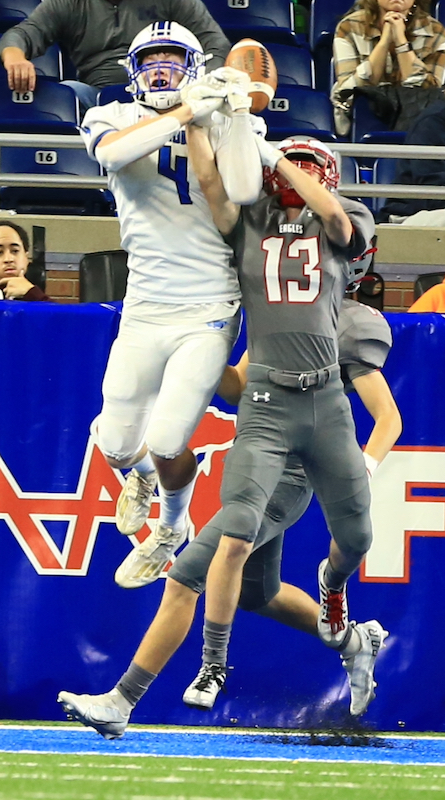
PHOTOS (Top) Gladwin celebrates its first Finals championship Saturday at Ford Field. (Middle) The Flying Gs’ Lucas Mead (4) and Frankenmuth’s Will Soulliere (13) contend for a jump ball in the end zone. (Below) Mead (4) wraps up Frankenmuth’s Hunter Bernthal (3). (Click for more from Hockey Weekly Action Photos.)