

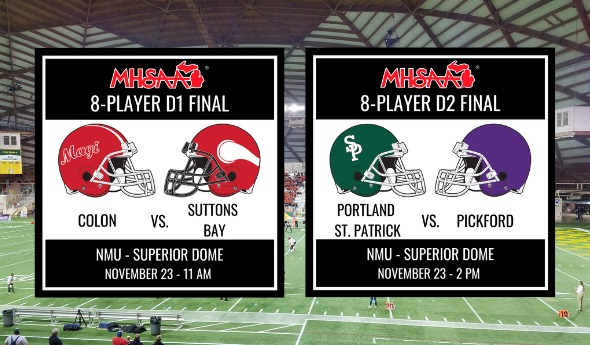
March to Marquette: 8-Player Preview
November 22, 2019
By Geoff Kimmerly
Second Half editor
For the second straight season, the majority of teams making the trip to the 8-Player Finals at Northern Michigan University’s Superior Dome will come seeking their first MHSAA football championship.
Colon, Suttons Bay and Pickford will be first-time title hopefuls Saturday. Portland St. Patrick is seeking its first football title since 1992, long before any of these current players was born.
Kickoff for the Division 1 game is 11 a.m., with the Division 2 game following at 2 p.m. Tickets cost $10 and one is good for admittance to both games. Both games also will be broadcast live on FOXSportsDetroit.com and the FOX Sports app, and replayed on FOX Sports Detroit’s primary channel on Nov. 26 – Division 1 at 8 p.m. and Division 2 at 11 p.m. Audio of both games will be streamed live on MHSAANetwork.com.
Below is a look at all four finalists. Team “rankings” are based on their playoff-point averages heading into the postseason.
 Division 1
COLON
Record/rank: 12-0, No. 2
Coach: Robbie Hattan, fourth season (28-13)
League finish: First in Southern Central Athletic Association A
Championship history: Has never played in an MHSAA Final.
Best wins: 27-8 over No. 6 Morrice in Semifinal, 56-12 over No. 3 Martin in Regional Final, 60-12 (Pre-Regional) and 55-0 over No. 13 Camden-Frontier, 43-8 over No. 11 Bellevue, 42-0 over Division 2 No. 5 Climax-Scotts.
Players to watch: RB/DL Brandon Crawford, 6-2/240, jr. (1,491 yards/22 TDs rushing); SL/DB/P Jonathan West, 6-2/160, sr. (653 yards/7 TDs rushing, 498 yards/12 TDs receiving); QB/DB Phillip Alva, 5-9/140, sr. (954 yards/19 TDs passing, 903 yards/17 TDs rushing).
Outlook: Colon moved to 8-player before the 2018 season after a nice recent run in 11-player that had included eight playoff appearances over the previous 14 seasons. But the Magi have succeeded at a higher level since making the switch, putting up double-digit wins last season for the first time and again this fall. Last season’s champion Morrice was the first opponent to hold Colon to under 34 points and also the first to come within 34 of catching the Magi this fall. Crawford and West both earned all-state honorable mentions in 2018, and 6-4 junior Brayden Ireland gives Alva another big target in the passing game. West also has scored off interceptions and punt and kickoff returns this season.
SUTTONS BAY
Record/rank: 12-0, No. 4
Coach: Garrick Opie, second season (21-2)
League finish: First in Midwest Central Michigan Conference West
Championship history: Division 6 runner-up 2004 (11-player).
Best wins: 45-14 over No. 8 Kingston in Semifinal, 36-30 over No. 14 Gaylord St. Mary in Regional Final, 36-14 over No. 16 Brimley in Pre-Regional, 20-14 and 29-18 over Division 2 No. 9 Onekama.
Players to watch: RB/DB Lucas Mikesell, 5-11/175, sr. (1,259 yards/29 TDs rushing, 501 yards/9 TDs receiving), QB/DB Bryce Opie, 6-4/194, sr. (1,167 yards/15 TDs passing, 692 yards/13 TDs rushing); OG/DT Gavyn Shananaquet, 6-0/230, sr.
Outlook: Suttons Bay has run its record over three seasons of 8-player to a combined 28-6 after being forced to end its final 11-player season early in 2016. The Norsemen had only three games decided by single digits this fall. The first was a six-point win over Onekama, and Suttons Bay won the rematch by 11, and the other two were against Gaylord St. Mary – a one-point loss on the field that became a forfeit win and a six-point win in the Regional Final. The defense has been especially impressive, giving up 16.7 points per game on the season but more than 18 only twice (both times to St. Mary). Bryce Opie also has five interceptions, and the team had a 23-14 turnover advantage heading into last week’s Semifinal.
 Division 2
PORTLAND ST. PATRICK
Record/rank: 12-0, No. 3
Coach: Patrick Russman, 13th season (88-48)
League finish: Does not play in a league.
Championship history: Division 2 runner-up 2017 (8-player), Class D champion 1992, runner-up 1991 and 1997 (11-player).
Best wins: 49-6 over No. 5 Climax-Scotts in Semifinal, 51-16 over No. 11 Kinde North Huron in Regional Final, 45-0 over No. 16 Bay City All-Saints in Pre-Regional, 42-24 over No. 9 Onekama.
Players to watch: RB/DL Ned Smith, 5-10/195, sr. (1,510 yards/24 TDs rushing); QB/DB Connor Cross, 6-2/175, jr. (1,688 yards/36 TDs passing); WR/DB Zach Spitzley, 6-2/180, sr. (1,133 yards/19 TDs receiving).
Outlook: The Shamrocks have made at least the Semifinals the last three seasons and four times since switching to 8-player in 2012, and this has been their most successful run of all four. St. Patrick has won all of its games by at least 18 points (not counting a 2-0 forfeit in Week 3) and by an average score of 52-10. Senior linebacker Alex Kissane, sophomore linebacker Derec Fedewa, senior defensive back Riley Kissane and senior lineman Jeff Davlin are among leaders of a defense that has given up more than 16 points only twice and a combined 22 points over three playoff games.
PICKFORD
Record/rank: 11-1, T-No. 1
Coach: Josh Rader, 16th season (110-55)
League finish: First in Great Lakes Eight Conference East
Championship history: Division 1 runner-up 2018 (8-player).
Best wins: 22-14 over T-No. 1 Powers North Central in Regional Finals, 40-8 over No. 4 Hillman in Semifinal, 57-12 (Pre-Regional) and 58-15 over No. 6 Engadine, 48-16 over No. 7 Crystal Falls Forest Park, 64-20 over No. 12 Cedarville, 46-23 over Division 1 No. 14 Gaylord St. Mary.
Players to watch: QB/LB Jimmy Storey, 6-0/185, sr. (1,400 yards/19 TDs passing, 1,809 yards/24 TDs rushing); TE/DE Nick Edington, 6-7/220, sr. (307 yards/3 TDs receiving); RB/DB Stephen Lamothe, 5-10/175, sr. (752 yards/11 TDs rushing, 813 yards/11 TDs receiving).
Outlook: After reaching last season’s Division 1 championship game with a junior-heavy roster, Pickford is back playing for its first Finals championship with many of the same standouts. Edington, Storey and senior lineman Isaiah May all made the all-state team last season, and Storey was the statewide Player of the Year for 8-player by The Associated Press. The team’s only loss this fall came in Week 3, by six points, to Powers North Central – and the Panthers avenged the defeat in the Regional Final. The Jets also were the only team able to hold Pickford under 40 points this fall. Senior running back Isaac Brown provides another valuable option on offense with 613 yards and 12 touchdowns rushing.
Drive for Detroit: District Semis in Review
November 5, 2013
By Geoff Kimmerly
Second Half editor
Upsets seemed to fall with the raindrops that unexpectedly cropped up in spurts during the first weekend of the 2013 MHSAA football playoffs.
From Romeo to Dowagiac, Britton-Deerfield to Wayland with Parchment and Bath in between, teams celebrated wins that probably weren't expected by most when the brackets were revealed during the Sunday Selection Show.
A telling stat: While teams with higher playoff points averages host during the first three rounds, nearly 23 percent (31 of 136) of road teams won last weekend.
Here’s a look at the results from each division that stuck out most from the 11-player District openers and 8-player Regional Semifinals:
Division 1
Detroit Catholic Central 35, Northville 14
Detroit Catholic Central (8-2) opened the playoffs against Northville (8-2) for the second time in three seasons and with hopes of again starting off smoothly on a third straight trip to the MHSAA Finals. This opener certainly was closer than the 2011 56-6 DCC win, but the result was the same as the Shamrocks ended an outstanding run by the Kensington Lakes Activities Association overall champion. Click to read more from the Detroit Free Press.
Also noted:
Macomb Dakota 19, Warren DeLaSalle 14: DeLaSalle (6-4) gave Dakota (10-0) its closest game this season and was the first to come within single digits of the Cougars since opening night.
Walled Lake Western 44, Canton 41: Western (9-1) advanced to the District Final for the third straight season but only after holding off a late comeback by Canton (8-2).
Romeo 24, Lake Orion 21: Likely considered an upset because of Lake Orion’s playoff history, there is some back story. In three playoff games during 2005-08, Lake Orion (7-3) beat Romeo all three times by a combined six points – but this time the Bulldogs (6-4) captured a close one.
Brighton 14, Grand Blanc 7: Grand Blanc (7-3) won the KLAA West thanks to a 44-21 win over Brighton in Week 4, but the Bulldogs remain alive after entering the postseason 5-4.
Division 2
Birmingham Seaholm 17, Southfield 16
Seaholm (9-1), the Oakland Activities Association Blue champion, scored twice during the final seven minutes to eliminate OAA White winner Southfield (7-3). The Maples will play in their first District Final since 2001, the last time the team also won nine or more games. Click to read more from The Oakland Press.
Also noted:
Wyandotte Roosevelt 45, Ypsilanti Lincoln 40: Downriver League champion Roosevelt (10-0) outlasted another league title winner, Southeastern Conference White winner Lincoln (7-3).
Midland Dow 30, Fenton 21: The Chargers (8-2) returned to the playoffs for the first time since 2010 and opened by beating Flint Metro League co-champ Fenton (8-2).
Pinckney 14, South Lyon 10: In its first playoff appearance since 2001, Pinckney (7-3) won its first playoff game ever and finished a season sweep of South Lyon (6-4), also its opening-night opponent.
Detroit U-D Jesuit 37, Warren Woods Tower 14: Jesuit’s first winning season since 2002 will continue; the Cubs (6-4) ended quickly the first playoff appearance for Warren Woods Tower (6-4) since 2007.
Division 3
Grand Rapids Christian 14, Grand Rapids Forest Hills Northern 13
The reigning Division 3 champion got a scare from Forest Hills Northern (7-3), which led 13-0 in the third quarter of its first playoff game since 2002. The Eagles (8-2) made an impressive comeback to move on to their fourth straight District Final. Click to read more from the Grand Rapids Press.
Also noted:
Zeeland West 44, Zeeland East 13: The Dux (9-1) received their lone loss from East (5-5) in Week 2, but this one wasn't as close as that six-point defeat.
Byron Center 28, Battle Creek Harper Creek 3: Harper Creek (7-3) made the Semifinals the last two seasons, but were stopped quickly this time by the Bulldogs (7-3).
Wayland 38, Plainwell 28: A year after finishing 0-9 (after three straight ending 1-8), Wayland is 6-4 and knocked out a solid contender in Plainwell (8-2).
Eaton Rapids 49, Charlotte 21: Although Eaton Rapids (6-4) beat Charlotte in Week 3, it was expected by at least a few that the Greyhounds’ first playoff appearance would be a short one since Charlotte (7-3) had won five straight.
Division 4
Dowagiac 21, Edwardsburg 17
Dowagiac has been exceptional over the last three seasons – the Chieftains (7-3) are playing to reach 10 wins for the third straight. But it was hard to see this one coming with Edwardsburg (9-1) undefeated and having beaten Dowagiac 36-0 only two weeks ago to decide the Wolverine B West championship. Click for to read more from the Kalamazoo Gazette.
Also noted:
Belding 21, Spring Lake 20: This spoke to the strength of the O-K Blue, as third-place Belding (7-3) beat Lakes 8 Conference champion Spring Lake (8-2).
Allendale 24, Grand Rapids Catholic Central 21 (OT): Also from the O-K Blue, league runner-up Allendale (8-1) survived a scare from frequent playoff power GRCC (6-4).
Battle Creek Pennfield 21, Paw Paw 17: The Kalamazoo Valley Association was pretty strong too, with Pennfield (9-1) one of three co-champs and the winner in this one over Wolverine B East champ Paw Paw (8-2).
Saginaw Swan Valley 14, Yale 13: Swan Valley’s hope of returning to the Semifinals – and going to Ford Field – nearly ended until the Vikings (10-0) scored the go-ahead points with two minutes to play to escape Yale (6-4).
Division 5
Parchment 40, Jackson Lumen Christi 35
In a weekend full of upsets, this was the one that rang the statewide bell loudest. Parchment has had a nice run in a tough KVA and is 7-3 overall after finishing 3-6 only a year ago. But Lumen Christi had the highest playoff point average in Division 5 by a substantial chunk and was considered a definite contender as it pursued its first MHSAA championship since 1999. Click to read more from the Kalamazoo Gazette.
Also noted:
Reed City 49, Clare 7: The Central State Activities Association champion Coyotes (10-0) continued their dominating play in eliminating Jack Pine Conference champ Clare (7-3).
Millington 28, Almont 21: The Cardinals’ two regular season losses were their most since 2006, but Millington (8-2) is looking strong again after opening with a win over Blue Water Area Conference runner-up Almont (8-2).
Grand Rapids West Catholic 27, Portland 14: This rematch of last season’s Division 5 Final ended the opposite way, with West Catholic (6-4) continuing a five-game winning streak while Portland (7-2) closed with two straight defeats.
Detroit University Prep 42, Clinton Township Clintondale 34: University Prep (8-2) equaled its 2012 record in only its eighth season as a program and handed a first loss to Macomb Area Conference Bronze champion Clintondale (9-1) in one of its best wins during that brief history.
Division 6
Grandville Calvin Christian 14, Grand Rapids NorthPointe Christian 12
These two and Hopkins played to a three-way tie for the O-K White championship during the regular season, which resulted in part because of NorthPointe’s 13-8 win over Calvin Christian (7-3) in Week 3. This time the Squires came out on top in a matchup of teams both looking for their first playoff wins. NorthPointe finished 8-2. Click to read more from the Grand Rapids Press.
Also noted:
Montrose 42, Reese 13: The Rams (10-0) won their 10th game for the third straight season and made it two this fall over solid Reese (8-2).
Shelby 35, Montague 23: Montague (6-4) played West Michigan Conference champion Shelby (9-1) closer than in Week 4, but the Tigers (9-1) bounced back from its lone loss, in Week 9, against Division 4 Spring Lake.
Schoolcraft 28, Niles Brandywine 21: Co-KVA champ Schoolcraft (9-1) hasn't lost in two months, although Brandywine (8-2) gave the Eagles one of their closest games in a while.
Constantine 41, Michigan Center 26: This win over Michigan Center (8-2) gave Constantine (6-4) at least one postseason victory in each of the last 12 seasons.
Division 7
Britton-Deerfield 42, Hudson 28
Britton-Deerfield has made the playoffs all three seasons since its creation from the merging of the Britton-Macon and Deerfield districts. In fact, the Patriots reached the Regional Final in just their second season last fall. But Lenawee County Activities Association co-champion Hudson has reached the MHSAA Semifinals three of the last five seasons and had to be considered a possibility to get back again this month. Click to read more from the Adrian Daily Telegram.
Also noted:
Iron River West Iron County 21, Traverse City St. Francis 7: Given St. Francis’ history of postseason success, this seemed ripe for an upset – but West Iron (10-0) broke away from the Gladiators (5-5) in the second half.
Pewamo-Westphalia 57, Saugatuck 21: The Central Michigan Athletic Conference champion Pirates (9-1) bounced back from their lone loss the week before to finish the season for Southwestern Athletic Conference North winner Saugatuck (8-2).
Bath 27, Elkton-Pigeon-Bay Port 14: This is not only Bath’s first playoff run since 2000, but first winning season since that fall – and the Bees (6-4) continued with a stunner against Greater Thumb Conference West runner-up Laker (7-3).
Madison Heights Bishop Foley 42, Royal Oak Shrine 10: A Week 3 loss to Shrine (6-4) got Bishop Foley off to a rough start in the Catholic League Intersectional, but the Ventures (7-3) scored their second-most points of the season in this rematch.
Division 8
Detroit Allen 54, Adrian Lenawee Christian 32
Detroit Allen (7-2) built on its first playoff berth with its first playoff win, ending a similarly historic season for Lenawee Christian – the Cougars set a team record for wins in finishing 7-3. Both programs have been in existence for only six seasons, and this fall Allen finished second to much larger River Rouge in the Michigan Metro Athletic Conference. Click to read more from the Adrian Daily Telegram.
Also noted:
Waterford Our Lady, 34, Clarkston Everest Collegiate 7: These two previously were one as a co-op team before splitting this season; Our Lady (8-2) will move on while Everest (7-3) finished an impressive first season on its own.
Powers North Central 35, Munising 21: Although Munising (6-4) made the playoffs for the second time in three seasons, neither of these teams has much recent postseason history – but Powers (8-2) made its own with this first playoff win.
Crystal Falls Forest Park 30, Bessemer 16: The Trojans (10-0) beat the Miners (6-4) for the second time in three weeks and have 10 wins again for the first time since 2010.
L’Anse 52, Lake Linden-Hubbell 34: The Purple Hornets (8-2) bounced back from a Week 9 loss with their most points of the season to outlast one of the best offensive performances as well by Lake Linden-Hubbell (5-5).
8-Player
Engadine 28, Cedarville 26
Perhaps a little under the radar, Engadine has been arguably the hottest team in 8-player football with five straight wins after beginning this season 1-4. The Eagles’ third loss this fall was 42-16 to Cedarville (8-2) – but in six weeks, Engadine (6-4) found a way to reverse the tide just enough. Click for more from WWTV 9&10.
Also noted:
Peck 32, Deckerville 14: The 8-player champion could come from the Thumb area for the third straight season; in 2012 it was Deckerville (5-5), and Peck (10-0) is looking like a favorite this time.
Carsonville-Port Sanilac 54, Portland St. Patrick 18: The Tigers (7-3) made it two straight wins and two straight over the Shamrocks (7-3) after also beating St. Patrick 45-12 in Week 9.
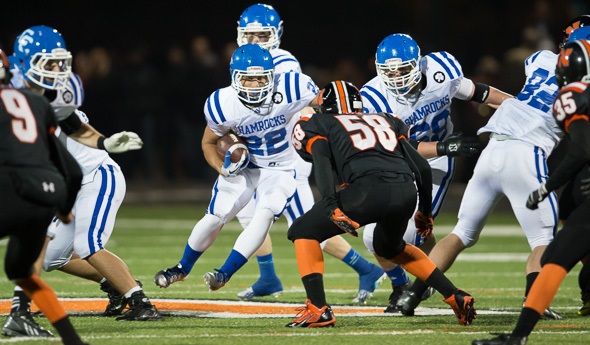
PHOTO: Detroit Catholic Central running back Connor Holton (22) prepares to sprint through a hole in the line while Northville linebacker Jack Ernst works to stop him. (See more at Terry McNamara Photography.)