


MHSA(Q&)A: Mendon football coach John Schwartz
February 2, 2012
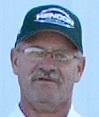 John Schwartz didn’t really want the Mendon football head coaching job when a group of players convinced him to take it before the 1989 season. And his first contract started out on a napkin. The rest is history.
Mendon won its 11th MHSAA football championship this fall, downing Fowler 33-0 in the Division 8 Final, to tie for third-most football titles won by one program. Schwartz has coached in the program for all 11, including 10 as head coach, and his record of 236-39 gives him a winning percentage of .858, tops in the MHSAA record book. He recently was selected as this year’s recipient of the high school Duffy Daugherty Award, annually given for career contributions to the game. He follows recent winners Ralph Munger of Rockford and Herb Brogan of Jackson Lumen Christi.
His Mendon teams have had just one losing season. And although he retired a year ago after 36 teaching middle school science, and then fought off cancer over the summer, he has no plans to leave his post on the Hornets’ sideline.
How would you characterize your program?
I think we have very good coaches and I think the kids respect the coaches, and they know the coaches think more of them than just being football players. They care about them. We have their attention, and what we really try to do is form a team concept as soon as we can. We try to stay away from giving any one person too much recognition. We don't give out MVP awards at the end of the year. It's a program where we're all in it together: coaches, kids and community. We try to get the best out of the kids, give the kids the best shot we have at being the best we can be.
How does a small school continue to reload every season?
My first year there, the first thing I did as a head coach was I started the junior high program. I think that's where everything starts. We even have the younger kids called the rocket kids, and those coaches come in and talk about (football) terms so when kids move from one level to another there's no re-teaching. Everyone has an ego, coaches have egos, and they like to do some things differently. But we don't have that. They do what we do. We give them a lot of flexibility, but we have certain drills we want to run. By the time we get them, these kids are in tune with what we are doing. The summer program also is something I started my first year as head coach too. ... It means that during the season we can concentrate more on teaching than conditioning.
You went from 3-6 in 2006 to 12-0 in 2007. Explain how you bounced back.
The losing season we had, we didn't have a lot of kids, and our two best kids were hurt early in the season and couldn't play. We never did bounce back. Even in that season, we were ahead at halftime in all but one game. We just didn't have enough to come back and pull the game out, and we had some very tough games. It wasn't a good season, but I thought those kids played awfully hard for what we had. We got a lot of experience, and it paid off the following year.
Our JVs practice with the varsity. When I work with inside linebackers, I work with (grades) 9-12. Kids learn quicker from kids than from coaches, as far as I'm concerned. ... Football's really changed. It's become a lot more complex. I think we have to delegate more and more every year so we can stay with the changes. It's too much for one person. I remember my first three, four or five years it was just three of us at the varsity level. The other two, neither one taught at the school. We were pretty successful right off the bat, and we started getting more and more interest from people. Now 9-12 we have seven coaches, and we have three at the junior high, and all the coaches but two have played for me. They know what I expect, what I'm looking for, what I want. ... And they want to win. I'd be lost without those guys.
Are there certain seasons that have meant more than others?
The first year I took the job, in 1989, we went undefeated and won a state title. A lot of those kids are very good friends of mine yet, and they're pretty special to me. They were a big boost to my program. In the '95 year, my son was a sophomore on that state title team. I remember a lot about that team.
They all have something they did very well. They either threw the ball well or played great defense or had a big line. When I hear a year now, I think about those teams.
You grew up in a small town (Colon) and have taught and coached in a small town. Was that important for you to do?
I've never taught anywhere else. I never felt I really had a reason to leave. I've gone through at least six superintendents since I've been there. The fourth or fifth said to me, "The only thing that bothers me about Mendon is these people think an awful lot of winning. There are other things." He asked me, "How do you feel about it?" I said, if they didn't feel that way, I wouldn't be here.
Who was your biggest coaching influence?
I would say Morley (Fraser, Jr., under whom Schwartz was an assistant for three seasons). Years before I got there, Mendon was pretty good in the early 70s, and then in the mid 70s football wasn't very good. I was the JV coach the first year, and the second year after two games they brought me up to varsity. The best thing I did was I told them I would not take the head job, but I'll assist. I knew (Fraser) was the kind of person and personality we needed there. It wasn't necessarily all of his football knowledge, but his energy and excitement that he brought to the game.
You said during the Finals postgame press conference that you'd battled cancer during the summer. How did you come back, and did you ever think that might be time to step down?
Everything's fine. I had coaches that took over. At the same time that that happened, I was retiring. If you retire in Michigan, you can't be at the school for one month. So I couldn't be at summer weights all the way through June. So my coaches did all the summer weights. But I had no intention of stepping down. If something (bad) came down ... but once they said they got it, everything went as normal.
After a championship season, how do you ramp things back up for the next fall and a new group of players?
When we go to the playoffs, we take all the JVs unless there are couple who don't want to go. They experience that and get an extra five weeks of practice if we win a state title. And they're excited about it. They want to do that. They’ve' tasted it, and they want a part of that the next year. We remind them it's not what you did, it's what can you do for me now. ... This is your year.
We talk about winning state championships from day one. A lot of people say we shouldn't do that, but why not? Isn't that the ultimate goal? I can't imagine telling a team we think we could be 7-2 this year. We expect to be 9-0 every year. Of course, that's not going to happen. But at same time, I think the losses make you better the following week. We've won state titles where we haven't won the league title. ... You get better.
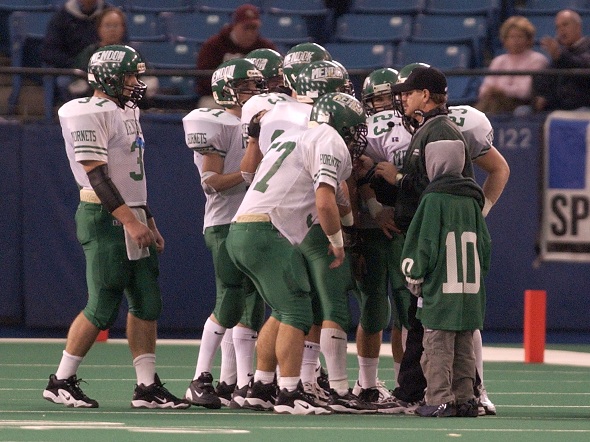
PHOTO: Mendon coach John Schwartz talks things over with his players during the Hornets' 21-14 win over Decatur in the 2002 Division 7 Final at the Pontiac Silverdome.
1st & Goal: 2021 11-Player Semifinals Preview
By
Geoff Kimmerly
MHSAA.com senior editor
November 19, 2021
Our final 32 11-player football teams are one more win from playing at Ford Field.
 At this time of year, and with the added detail we have on each Semifinal below, that’s plenty of introduction.
All 16 games will be broadcast live. Bally Sports Detroit will feature on its primary channel the Division 1 Semifinal between Sterling Heights Stevenson and Belleville, and the other 15 games can be watched on MHSAA.tv.
Division 1
Rochester Adams (12-0) vs. Grand Blanc (12-0) at Howell
This might be one of the weekend’s most difficult games to predict, because these teams seem to match up so well. Senior running back Elijah Jackson-Anderson (1,119 yards/16 TDs rushing) and senior quarterback Hunter Ames (1,795 yards/21 TDs passing), plus a defense giving up 15 points per game, has keyed Grand Blanc’s school-record playoff run. Adams, aiming for its first Final since 2003, is giving up 11 points per game and following the lead of junior quarterback Parker Picot (1,165 yards/18 TDs rushing, 4 TDs passing) and senior running back Griffin Henke (863 yards/15 TDs rushing).
Sterling Heights Stevenson (10-2) vs. Belleville (11-1) at Troy Athens
Belleville is playing a Semifinal for the fourth-straight season and hoping to book its first trip to Ford Field. Freshman quarterback Bryce Underwood is a player to remember this weekend and for the next three years. Stevenson is playing in its second Semifinal in three seasons and seeking its first Finals berth since 2009 on the rushing attack of seniors Jordan Ramsey (1,204 yards/16 TDs rushing ) and Jordan Kwiatkowski (1,283 yards/15 TDs). Senior Biagio Madonna is another big-time playmaker, running for 872 yards and 12 touchdowns and throwing for 1,011 yards and five scores.
Division 2
Traverse City Central (11-1) vs. South Lyon (12-0) at Greenville
A long-awaited opportunity is on the line for both; Central is seeking to reach the Finals for the first time since 1988 (and first time since Traverse City West opened), while South Lyon last played in a championship game in 1995. Senior Josh Burnham (6-foot-4, 230 pounds) has exceeded high expectations, running for 1,315 yards and 25 touchdowns and throwing for 934 yards and 14 scores while also starting at linebacker. Junior Reed Seabase (1,175 yards/12 TDs rushing) carries a significant load on offense as well. Last week’s 29-23 overtime win over Portage Central was South Lyon’s first by fewer than 14 points. Junior Tommy Donovan (895 yards/16 TDs rushing) is among playmakers, and senior Braden Fracassi (865 yards/8 TDs passing) has stepped in well after the Lions lost their starting quarterback to injury midway through the regular season.
Livonia Franklin (7-5) vs. Warren De La Salle Collegiate (11-0) at Hazel Park
The Pilots – last season’s Division 2 runners-up – have been one of the teams most expected to reach this point, especially after their undefeated run through the Detroit Catholic League Central. Junior quarterback Brady Drogosh led last season’s run and remains tough to slow down – he’s run for 1,440 yards and 21 touchdowns and thrown for 1,285 yards and 10 scores. Franklin entered the playoffs 4-5 and defeated three teams that were a combined 22-8. Two of the Patriots’ top three scoring outputs of the season have come during the postseason run.
Division 3
St. Joseph (8-4) vs. DeWitt (11-1) at Jenison
The reigning Division 3 champion Panthers returned the majority of their playmakers this fall and have scored 48 points per game led by senior quarterback Tyler Holtz (2,483 yards/36 TDs passing, 829 yards/11 TDs rushing) and senior receiver Tommy McIntosh (1,107 yards/19 touchdowns receiving). St. Joseph is playing to make the Finals for the first time since 1988. The Bears are grinders, with more than 2,800 yards rushing led by juniors Trey McGinnis (902 yards/14 TDs) and Joron Brown (850 yards/12 TDs).
Mason (10-2) vs. Detroit Martin Luther King (11-1) at Wayne Memorial
The Bulldogs coming off one of the biggest wins in their history, 20-17 over Bloomfield Hills Brother Rice, to reach the Semifinals for the first time. Next up is another team most expected to be back at this level. King is looking to return to Ford Field for the third time in four seasons. Junior quarterback Dante Moore is one of the most heralded players in Michigan, and for plenty of reasons – he’s thrown for 2,626 yards and 37 touchdowns over 10 games on the field (two wins were by forfeit). Mason has put together more than 4,000 yards of total offense, with sophomore running back AJ Martel (1,430 yards/23 TDs rushing) the key cog.
Division 4
Edwardsburg (12-0) vs. Hudsonville Unity Christian (12-0) at Portage Northern
A pair of recent champions will face off – both won titles in 2018, Edwardsburg in Division 4 and Unity in Division 5. Three years later, both are on similar paces as those title winners. Edwardsburg’s average margin of victory this fall is 48 points, thanks to a defense giving up less than five points per game and a rushing attack that’s run for 4,400 yards with five backs gaining between 400-700. Unity’s average margin of victory is 45 points with an offense that has scored at least 40 every game. Senior Drew Chandler has run for 1,242 of the Crusaders’ 4,500 on the ground.
Freeland (11-1) vs. Chelsea (12-0) at Lapeer
The Falcons are playing in their fifth Semifinal – and second straight – hoping to reach the Finals for the first time. Senior quarterback Bryson Huckeby (1,522 yards/15 TDs passing, 8 TDs rushing) and senior Garrett Pistro (1,037 yards/18 touchdowns rushing) lead a balanced offense. Chelsea has reached the Semifinals four straight seasons and eliminated reigning champion Detroit Country Day last week. The Bulldogs hope to return to Ford Field for the first time since 2018 with senior running back Trenton Hill (1,400 yards/29 TDs rushing) and senior quarterback Lucas Dunn (1,440 yards/18 TDs passing) leading a similarly-balanced attack.
Division 5
Frankenmuth (12-0) vs. Grand Rapids Catholic Central (12-0) at Mount Pleasant
This is a rematch of last season’s Division 5 championship game, a 48-21 Catholic Central win. The Cougars lost star quarterback Joey Silveri to injury early this season, but senior John Passinault (1,765 yards/33 TDs passing) has stepped in and been outstanding as well with lots of help from senior tight end Nolan Ziegler (1,039 yards/23 TDs receiving). Frankenmuth also returns one of its best playmakers in senior running back Cole Lindow (1,794 yards/20 TDs rushing), while senior Cole Jankowski has stepped in well at quarterback with 18 rushing touchdowns and six more passing.
Portland (10-2) vs. Marine City (12-0) at Novi
These are two more teams familiar with this stage, as both last made the Semifinals in 2018 and won championships during the last decade. Marine City is giving up only nine points per game and has three players averaging at least 10 yards per carry, led by junior Zach Tetler (1,302 yards/27 TDs rushing). Portland’s strategy also isn’t a secret, and just as effective – four Raiders have run for 700 or more yards and eight touchdowns apiece.
Division 6
Standish-Sterling (10-2) vs. Lansing Catholic (11-1) at Clare
Standish-Sterling is one of the comeback stories of the year, after finishing 1-6 a season ago. The Panthers now run into Lansing Catholic, making its third-straight trip to the Semifinals and having won Division 5 in 2019. Senior Joey Baker (2,523 yards/27 TDs passing) is the latest great Cougars quarterback, and senior Alex Watters (1,063 yards/14 TDs receiving) also was among stars of that 2019 team. Standish-Sterling’s defense has been outstanding during the playoffs, giving up 21 points over three games, and senior Laine Thibault (1,396 yards rushing) is solid leading the offense.
Michigan Center (11-1) vs. Warren Michigan Collegiate (10-2) Ypsilanti Lincoln
Both are seeking their first championship game appearances. Michigan Center has gotten here with a defense giving up 11 points per game and an offense keyed by multi-talented senior quarterback Kaydin Hiland (1,322 yards/19 TDs rushing, 7 TDs passing, 7 TDs receiving). Michigan Collegiate is paced by an excellent dual-threat QB as well – senior Deion Black has run for 1,134 yards and 14 touchdowns and thrown for 13 scores.
Division 7
Pewamo-Westphalia (12-0) vs. Traverse City St. Francis (12-0) at Cedar Springs
These two combined have played in seven Semifinals and three championship games over the last five years. P-W complements a defense giving up six points per game with an offense led by two runners with at least 800 yards and 10 touchdowns apiece. All of the Pirates’ nonleague wins, including in the playoffs, have been over teams that won conference titles this fall. St. Francis is the reigning Division 7 runner-up, having fallen by just seven points in last season’s Final. The Gladiators haven’t scored less than 48 points during the playoffs, led by senior quarterback Charlie Peterson (1,677 yards/21 TDs passing).
Lawton (12-0) vs. Jackson Lumen Christi (11-1) at Battle Creek Harper Creek
These two have vastly different playoff pasts but could look very similar when they meet. Lawton is playing in its first Semifinal, relying on a defense giving up eight points per game and a senior running back in Jake Rueff with incredible numbers – 2,253 yards and 46 touchdowns on the ground. Lumen Christi is a regular in late November, and the recipe is similar – the defense gives up 13 points per game, and the offense runs the ball with five backs gaining between 400-900 yards this fall.
Division 8
Ubly (12-0) vs. Beal City (11-1) at Mt. Morris
Reigning runner-up Ubly has yet to play a single-digit game this fall. Sophomore quarterback Evan Peruski is averaging 11.1 yards per carry for 1,009 total, along with 17 touchdowns rushing, and he’s thrown for eight more scores. Beal City’s only loss was opening night by a point to Ravenna, and the Aggies have been rarely challenged otherwise. They are winning by 29 points per game, giving up just under nine on average.
Ottawa Lake Whiteford (11-1) vs. Hudson (12-0) at Adrian College
Hudson’s defense has been an intriguing follow, giving up just under six points per game and last allowing more than eight in Week 5. The Tigers match that with an offense that’s rushed for 3,600 yards, led by senior Nick Kopin’s 1,397 with 16 touchdowns on the ground. Whiteford is undefeated in-state, with its lone defeat to an opponent from Ohio, and all of the Bobcats’ wins have been by double digits. Senior Cole Giesige is a big part of a balanced offense, running for 1,241 yards and 21 scores this fall.
Second Half’s weekly “1st & Goal” previews and reviews are powered by MI Student Aid, a part of the Office of Postsecondary Financial Planning located within the Michigan Department of Treasury. MI Student Aid encourages students to pursue postsecondary education by providing access to student financial resources and information. MI Student Aid administers the state’s 529 college savings programs (MET/MESP), as well as scholarship and grant programs that help make college Accessible, Affordable and Attainable for you. Connect with MI Student Aid at www.michigan.gov/mistudentaid and find more information on Facebook and Twitter @mistudentaid.
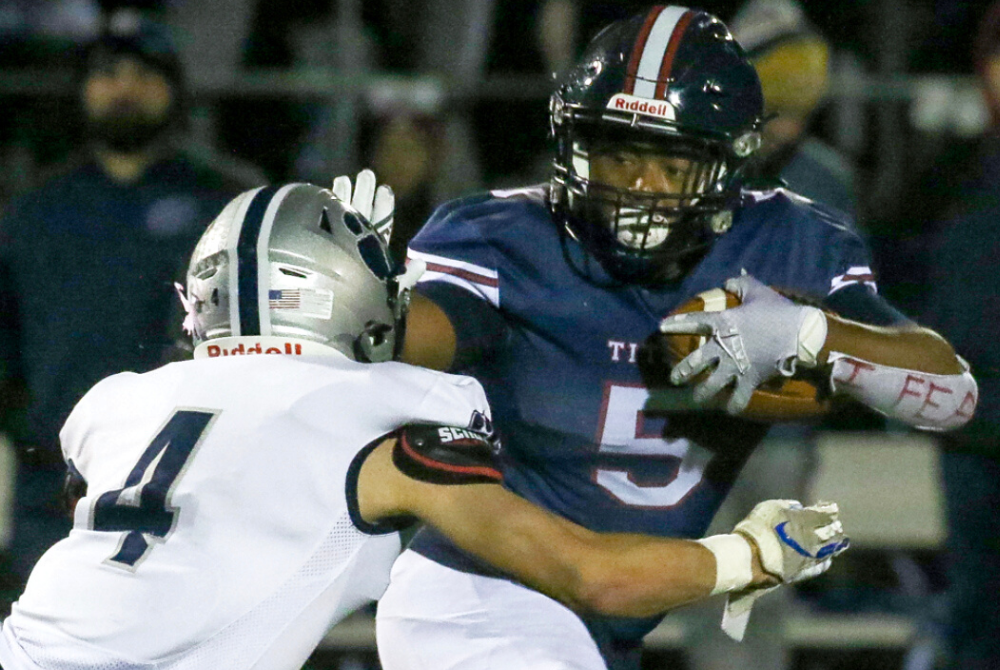
PHOTO Sterling Heights Stevenson’s Jordan Ramsey (5) fends off a potential tackler during his team’s Semifinal win. (Photo courtesy of C&G Newspapers.)