


MHSA(Q&)A: Mendon football coach John Schwartz
February 2, 2012
 John Schwartz didn’t really want the Mendon football head coaching job when a group of players convinced him to take it before the 1989 season. And his first contract started out on a napkin. The rest is history.
Mendon won its 11th MHSAA football championship this fall, downing Fowler 33-0 in the Division 8 Final, to tie for third-most football titles won by one program. Schwartz has coached in the program for all 11, including 10 as head coach, and his record of 236-39 gives him a winning percentage of .858, tops in the MHSAA record book. He recently was selected as this year’s recipient of the high school Duffy Daugherty Award, annually given for career contributions to the game. He follows recent winners Ralph Munger of Rockford and Herb Brogan of Jackson Lumen Christi.
His Mendon teams have had just one losing season. And although he retired a year ago after 36 teaching middle school science, and then fought off cancer over the summer, he has no plans to leave his post on the Hornets’ sideline.
How would you characterize your program?
I think we have very good coaches and I think the kids respect the coaches, and they know the coaches think more of them than just being football players. They care about them. We have their attention, and what we really try to do is form a team concept as soon as we can. We try to stay away from giving any one person too much recognition. We don't give out MVP awards at the end of the year. It's a program where we're all in it together: coaches, kids and community. We try to get the best out of the kids, give the kids the best shot we have at being the best we can be.
How does a small school continue to reload every season?
My first year there, the first thing I did as a head coach was I started the junior high program. I think that's where everything starts. We even have the younger kids called the rocket kids, and those coaches come in and talk about (football) terms so when kids move from one level to another there's no re-teaching. Everyone has an ego, coaches have egos, and they like to do some things differently. But we don't have that. They do what we do. We give them a lot of flexibility, but we have certain drills we want to run. By the time we get them, these kids are in tune with what we are doing. The summer program also is something I started my first year as head coach too. ... It means that during the season we can concentrate more on teaching than conditioning.
You went from 3-6 in 2006 to 12-0 in 2007. Explain how you bounced back.
The losing season we had, we didn't have a lot of kids, and our two best kids were hurt early in the season and couldn't play. We never did bounce back. Even in that season, we were ahead at halftime in all but one game. We just didn't have enough to come back and pull the game out, and we had some very tough games. It wasn't a good season, but I thought those kids played awfully hard for what we had. We got a lot of experience, and it paid off the following year.
Our JVs practice with the varsity. When I work with inside linebackers, I work with (grades) 9-12. Kids learn quicker from kids than from coaches, as far as I'm concerned. ... Football's really changed. It's become a lot more complex. I think we have to delegate more and more every year so we can stay with the changes. It's too much for one person. I remember my first three, four or five years it was just three of us at the varsity level. The other two, neither one taught at the school. We were pretty successful right off the bat, and we started getting more and more interest from people. Now 9-12 we have seven coaches, and we have three at the junior high, and all the coaches but two have played for me. They know what I expect, what I'm looking for, what I want. ... And they want to win. I'd be lost without those guys.
Are there certain seasons that have meant more than others?
The first year I took the job, in 1989, we went undefeated and won a state title. A lot of those kids are very good friends of mine yet, and they're pretty special to me. They were a big boost to my program. In the '95 year, my son was a sophomore on that state title team. I remember a lot about that team.
They all have something they did very well. They either threw the ball well or played great defense or had a big line. When I hear a year now, I think about those teams.
You grew up in a small town (Colon) and have taught and coached in a small town. Was that important for you to do?
I've never taught anywhere else. I never felt I really had a reason to leave. I've gone through at least six superintendents since I've been there. The fourth or fifth said to me, "The only thing that bothers me about Mendon is these people think an awful lot of winning. There are other things." He asked me, "How do you feel about it?" I said, if they didn't feel that way, I wouldn't be here.
Who was your biggest coaching influence?
I would say Morley (Fraser, Jr., under whom Schwartz was an assistant for three seasons). Years before I got there, Mendon was pretty good in the early 70s, and then in the mid 70s football wasn't very good. I was the JV coach the first year, and the second year after two games they brought me up to varsity. The best thing I did was I told them I would not take the head job, but I'll assist. I knew (Fraser) was the kind of person and personality we needed there. It wasn't necessarily all of his football knowledge, but his energy and excitement that he brought to the game.
You said during the Finals postgame press conference that you'd battled cancer during the summer. How did you come back, and did you ever think that might be time to step down?
Everything's fine. I had coaches that took over. At the same time that that happened, I was retiring. If you retire in Michigan, you can't be at the school for one month. So I couldn't be at summer weights all the way through June. So my coaches did all the summer weights. But I had no intention of stepping down. If something (bad) came down ... but once they said they got it, everything went as normal.
After a championship season, how do you ramp things back up for the next fall and a new group of players?
When we go to the playoffs, we take all the JVs unless there are couple who don't want to go. They experience that and get an extra five weeks of practice if we win a state title. And they're excited about it. They want to do that. They’ve' tasted it, and they want a part of that the next year. We remind them it's not what you did, it's what can you do for me now. ... This is your year.
We talk about winning state championships from day one. A lot of people say we shouldn't do that, but why not? Isn't that the ultimate goal? I can't imagine telling a team we think we could be 7-2 this year. We expect to be 9-0 every year. Of course, that's not going to happen. But at same time, I think the losses make you better the following week. We've won state titles where we haven't won the league title. ... You get better.
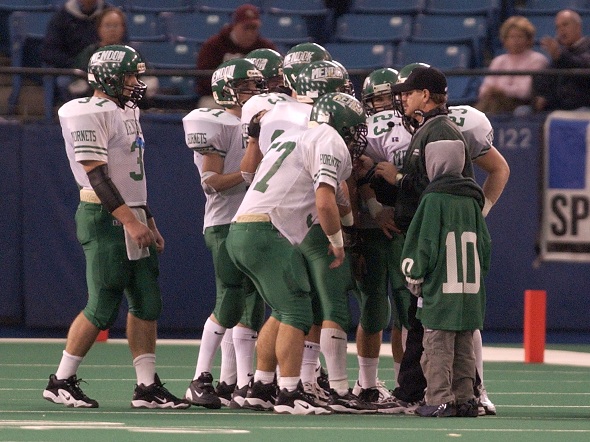
PHOTO: Mendon coach John Schwartz talks things over with his players during the Hornets' 21-14 win over Decatur in the 2002 Division 7 Final at the Pontiac Silverdome.
Trojans Find Familiar Success in 8-Player
October 5, 2016
By Dennis Grall
Special for Second Half
Football players, coaches and fans all know what it takes to produce winning teams: score a lot of points, don’t give up many, run, pass, catch and tackle.
 While 11-player football is the traditional way to play the game, declining school enrollments have forced numerous schools to adjust if they want to keep offering the sport. They are learning that 8-player football requires the same things to be successful.
Crystal Falls Forest Park for decades dominated the ranks of Class D, which later became Division 8. The Trojans used a pretty simple game plan: find a stud running back, hitch their wagon to his burly shoulders and overpower any team which happened to be on the field.
Forest Park claimed the initial two Class D championships when the playoffs began in 1975 and added another title in 2007. The Trojans also won 23 Great Western Conference crowns.
But enrollment kept dropping, as it has throughout the state, and a year ago Forest Park officials decided to join the movement to 8-player football. There are 51 teams at that level this year, and nearby Felch North Dickinson, another long-time small-school power, will join the mix in 2017.
The decision was controversial when it was accepted by a 4-2 board of education vote last October, and many staunch Forest Park fans were aghast. But that apparently has cooled down, no doubt helped by a 5-1 start to this initial season.
“I don’t hear the griping of people against it,” said veteran coach and former Forest Park player Dave Graff. “The people in the know realize where our numbers are. That type of (negative) talk has gone by the wayside.
“We still have traditionalists out there who think 8-man is not football. This program is steeped in tradition, and you don’t get acceptance in one year’s time.”
The Trojans suit up 22 players for each varsity game, but nine are freshmen and sophomores who would be playing junior varsity football if Forest Park offered that level. “If we had jayvees we would not be able to function as a varsity unit,” Graff said.
The school enrollment is about 150 students this year, and Graff said he has been hearing it may drop by about 25-30 students next year. Forest Park has not fielded a full jayvee schedule for the past six years.
 Even more astounding is this observation from Bill Santilli, the school’s athletic director since Aug. 1 and a former all-state running back and long-time coach: “I really fear that in the next two years Forest Park will not have a football program.”
Wow … this tradition-laden, statewide power on the threshold of no football?
Santilli added: “I’m fearful in the sense that four freshmen are playing, and we lose eight seniors. You do the math.”
He said Graff and Forest Park are being proactive and have worked with their Western Eight Conference to institute a junior high level of 8-player football and are also trying to get a grade 5-6 program started, possibly in flag football.
The school’s youth program has stayed with the 11-player game, and 2015 8-player MHSAA champion Powers North Central has kept an 11-player junior varsity. “It just doesn’t seem to be working because we’re all struggling with numbers there also,” said Santilli.
To give football a chance to hang around, he said, “We have to focus our attention on that youth level. We’re trying to build interest.”
While declining enrollment is forcing the switch to 8-player football, Santilli said, “Declining participation is probably more of a factor than it is enrollment. There are athletes in our school that in my opinion would make our football team better, but for some reason have not elected to play.”
Noting the game “nationwide is under attack,” he said it is safer now than ever because of increased improvement in equipment and extensive stress on safety. “Changes being made at every level are making the game as safe as it can be,” Santilli added.
Graff and Santilli, as players and coaches, have seen the values the sport provides.
“What are you trying to teach in football? We’re trying to teach work ethic, morals, not doing what is wrong when people aren’t watching, trying to teach character,” Graff said. “We are trying to raise people to be successful in our society and improve our society. We stress doing it right, we stress not missing the opportunity to do something good, the little things in life.
“Football is not just a rough sport. There are such great opportunities to teach things in life like discipline, teamwork, effort, enthusiasm, mental toughness, making good people.”
Santilli pointed out those lessons occur in both the 11-player game and the 8-player game. “It is still football. I’ve seen some great blocks and tackles and collisions out there,” said Santilli, who still resembles the powerful fullback who led the Trojans to their first Class D title in 1975 en route to a distinctive U.P. Sports Hall of Fame playing and coaching career.
 “I don’t see that any different with 8-man; there are just fewer players.”
Santilli said some of his former teammates who now have youngsters playing have been hard to convince the switch to 8-player was necessary. “It is taking them a little bit longer to adapt to the change,” he said.
But, he said, “The players have slowly bought into the change. For them it is still the same game. There is the same excitement with the players, the same intensity when they take the field. They are just ready and waiting for the competition.”
Santilli, with his strong and successful background with the Trojans, might be the ideal observer of the switch, agreeing the game still requires athletes to make plays to stop other athletes.
“It is a different technique, a different style player more geared to open field situations (on both sides of the ball). Dave is still bringing Forest Park style football into his coaching, giving the ball to (Dan) Nocerini and powering it right at you.”
Nocerini is the latest standout back in a string of stars from Santilli and Graff who also included Mark Flood, Lee Graff, Dan Lato, Gerard Valesano and Dean Arcand. In just six games this season, the 6-foot-2, 217-pound senior has rushed for 1,186 yards and 20 touchdowns, highlighted by an opening-game 414 yards rushing and seven TDs.
“It is definitely a lot more open than I expected,” Nocerini said after that explosive opener at Rapid River. “Instead of beating a safety or a corner, you just have to beat one guy (downfield).”
He also said the players “have moved on. Everybody likes football; you just put your helmet on and go play.”
The acceptance of 8-player has been easier because the Trojans are as powerful as ever, losing only to North Central 60-42 in Week 2. They are averaging 56.3 points per game and allowing 28.3.
“People will see we have to go 8-man. There isn’t a choice,” Graff said. “We as coaches have come to grips with that ,and I think the community is coming to grips with it. The tradition is always there.”
 Denny Grall retired in 2012 after 39 years at the Escanaba Daily Press and four at the Green Bay Press-Gazette, plus 15 months for WLST radio in Escanaba; he served as the Daily Press sports editor from 1970-80 and again from 1984-2012. Grall was inducted into the Upper Peninsula Sports Hall of Fame in 2002 and serves as its executive secretary. E-mail him at [email protected] with story ideas for the Upper Peninsula.
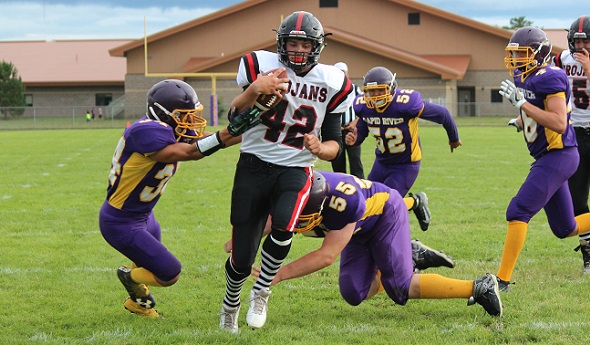
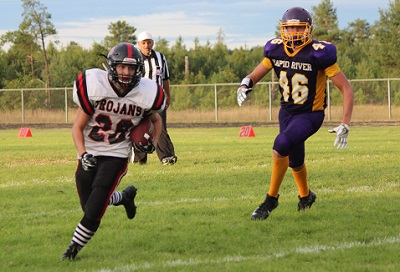
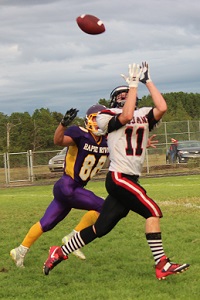
PHOTOS: (Top) Dan Nocerini of Crystal Falls Forest Park barges through a huge hole for a four-yard touchdown against Rapid River defenders David Johnson, left, and Gavin Harris (55) in their season opener. (Middle) Parker Sundell finds some running room after getting around Rockets defender Levi Miller. (Below) Roy Hagglund of Crystal Falls Forest Park reaches for a pass as Austin Wicklund of Rapid River defends. (Photos by Dennis Grall.)