


MHSA(Q&)A: Menominee football coach Ken Hofer
June 28, 2012
By Brian Spencer
Second Half
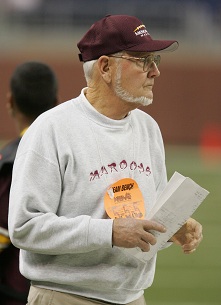
Ken Hofer has been nothing short of legendary during more than three decades as Menominee’s head football coach -- a tenure that came to an end earlier this month when he announced his retirement.
In 41 seasons -- including his first two, at Stephenson -- he won three MHSAA championships (1998, 2006, and 2007) and built a record of 342-136-3. He is one of nine coaches in MHSAA football history with at least 300 wins.
He guided more than a thousand athletes, and that influence extended to league rival Kingsford -- where his son Chris Hofer is the football coach. Ken also is known statewide as the guru of the single wing offense, a rarely-used but for the Maroons frequently unstoppable attack that does not utilize a traditional quarterback.
Hofer is a member of the Michigan High School Football Coaches Association and Upper Peninsula Sports Halls of Fame. He also served as the Menominee athletic director, principal, and assistant principal. He grew up in Stephenson, where he was an all-stater in football and track and field, and later competed in both sports at the University of Wisconsin.
Did you always want to become a football coach?
I was predicted to be a coach somewhere in our (Stephenson) annual (yearbook). So I suppose I was always predetermined to coach. However, before coaching I was in the service as a Lieutenant and spent two years in Germany. After Germany, I spent another five years working for Wilson Sporting Goods before I finally came back in 1964 to coach football and teach social studies for Stephenson.
How did you decide it was time to hang up the whistle?
Well, I’m 77 years old, so age was definitely a determinant. The biggest factor was that as much as my mind said I could continue, my body said “slow down.” So I guess age and my inability to continually go full throttle and stay energetic helped me make my decision.
In your 45 seasons, what is the most helpful piece of advice you are going to take away?
The best advice I will take away is to treat young people the way I like to be treated.
 What do you plan to do with your free time, now that your schedule has opened up slightly?
I am going to try and catch up on stuff that should have been done a long time ago. I’m sure that my wife will give me plenty of stuff to do, too. I also want to try to travel more and visit my kids. I now have a grandson who will be playing for Kingsford, so I will become a fan of my grandson’s at his Kingsford games.
Now that your grandson and son both have affiliations with Kingsford, will you become a Kingsford man?
No (chuckling), I will cheer for my son and grandson, but I will forever be connected with Menominee and Stephenson.
What was it like to be recognized by both the Michigan High School Football Coaches Association and Upper Peninsula Sports Halls of Fame?
It was like a utopia for coaching. When your peers give that honor it is a pretty special time. As a coach you don’t strive for that kind of accolade; however, it is definitely a special honor to receive.
What has been, in your opinion, your greatest achievement as Menominee’s head football coach?
My greatest achievement will always be working with younger people; I think that is the most important thing that most coaches would like to have, is the ability to stay young by working with these young men. You don’t always have to win to have that experience. Winning on the field doesn’t always correlate winning in other aspects of your life.
What advice can you give aspiring or current coaches who look to share similar successes as a head coach?
The biggest thing is to make sure that you treat the players like you like to be treated. Using that approach will get a great response.
Of your 300-plus career wins, is there any one that you find particularly special?
I always found that whenever I could beat Kingsford when my son was coaching (he said, followed by a bellowing laugh). My son Chris will like that one.
There are so many that I consider to be special. There were a ton of close games, too many to count. Two years ago, we had one of those close games where we played Morley-Stanwood, and won 41-40 in overtime (in a 2010 Regional Final). The young men played very hard. It was very special.
Do you think that your son will follow in your footsteps and coach for 45-plus seasons?
I think Chris has that type of coaching in his blood. He’s struggling physically with a knee injury; however he has a coaching mind that is as strong as ever. I think he’ll coach until he won’t be able to.
Drive for Detroit: 11-Player Semis Review
November 20, 2017
By Geoff Kimmerly
Second Half editor
Five of Saturday’s 11-player Semifinals were decided by seven points or fewer.
 Four reigning champions earned opportunities to repeat as champions.
Three teams advanced to the Finals for the first time.
Two of the five winningest coaches in MHSAA history – and the top two among active coaches – will make the trip again.
One more weekend remains to decide the last of this season’s football champions.
The countdown is on for our annual voyage to Detroit’s Ford Field. West Bloomfield, Saginaw Swan Valley and Edwardsburg earned first-time MHSAA Finals berths Saturday, while a handful of surprises also helped shape an intriguing championship field.
Below is a glance at all 16 Semifinals, plus links to coverage both print and broadcast. The MHSAA Playoffs are sponsored by the Michigan Army National Guard, and “Drive for Detroit” is sponsored by MI Student Aid.
Division 1
Clarkston 27, Detroit Catholic Central 7
The Wolves (11-2) held the reigning Division 1 runner-up Shamrocks (8-5) scoreless until late in the third quarter to earn their return to Ford Field looking for a third title in five seasons after winning Division 1 back-to-back in 2013-14. Click for more from the Oakland Press.
ICYMI: Watch the highlights from from Clarkston's 27-7 win over Detroit Catholic Central as the Wolves advanced to the @MHSAA Division 1 State Final for the first time since 2014! @CtownAthSec @ClarkstonWolves @ClarkstonFB2013 @ClarkstonBball @TheeJungle pic.twitter.com/yw6SDvJ6sT
— STATE CHAMPS! (@statechampsnet) November 19, 2017
West Bloomfield 9, Detroit Cass Tech 7
West Bloomfield (11-2) held off the reigning champion Technicians (9-3) to advance to the MHSAA Finals for the first time, with Nick O’Shea kicking a 31 and two 26-yard field goals. Click for more from the Detroit News.
ICYMI: Check out the highlights from West Bloomfield's win over Cass Tech as the Lakers advanced to the Division 1 State Championship game for the first time in school history! @wbhslakernation @wbhsTHESWAMP @19Bellamy pic.twitter.com/9TFH4EOtEr
— STATE CHAMPS! (@statechampsnet) November 19, 2017
Division 2
Livonia Franklin 20, Grand Rapids Forest Hills Central 0
Franklin (11-2) earned its first Finals berth since the first year of MHSAA playoffs in 1975, shutting down a Forest Hills Central offense that averaged 38 points per game during a 12-0 start. Click for more from Observer & Eccentric.
Forest Hills Central's comes up short against Livonia Franklin in State Semis https://t.co/6rVIOGYiNM
— FOX 17 Blitz (@FOX17Blitz) November 19, 2017
Warren DeLaSalle 14, Detroit Martin Luther King 13
In a matchup of Detroit area powers, Catholic League Central champion Warren DeLaSalle (11-2) edged Public School League champion and back-to-back Division 2 title winner King (11-2); the Pilots will be going for their second title in four seasons after winning Division 2 in 2014. Click for more from the Macomb Daily.
ICYMI: Watch the highlights from Warren De La Salle's @MHSAA Division 2 Semifinal win over Detroit King as the Pilots are headed back to the D-2 Final for the first time since 2014! @delasallehs @DLSBrozone @DeLaSalleAD @DLSFootball_MI @mgiannone pic.twitter.com/O4p1rIUlQ9
— STATE CHAMPS! (@statechampsnet) November 19, 2017
Division 3
Muskegon 42, Battle Creek Harper Creek 0
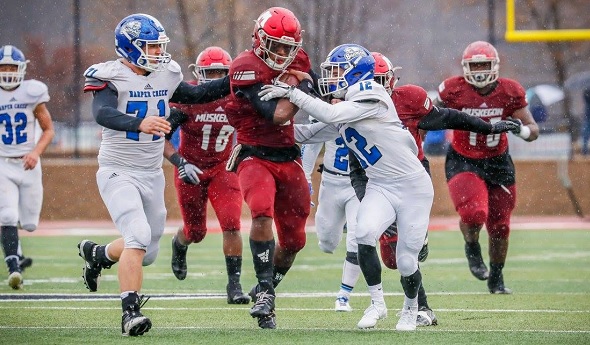
This Muskegon playoff drive is becoming legendary; the Big Reds (13-0) haven’t given up a point in their last two games and this time handed Harper Creek (12-1) its first and only loss of the season. Click for more from the Muskegon Chronicle.
ICYMI: Watch the highlights from Muskegon's 42-0 win over Harper Creek as the Big Reds advanced to the Division 3 State Championship Game for the second straight year! @OnMuskegon @BigRed_RNetwork @HoopsBigReds @LaDariusJ2 pic.twitter.com/6E0E2txo9C
— STATE CHAMPS! (@statechampsnet) November 19, 2017
Farmington Hills Harrison 21, Riverview 0
Likewise, Harrison’s run is becoming something of a storybook end for a program guided by the newly-anointed all-time winningest coach in state history that will also will play only one more season as the school will close in 2019. The Hawks (10-3) earned their second shutout of the playoffs as well, this time as Riverview (11-2) was averaging 35 points per game. Click for more from Observer & Eccentric.
ICYMI: Be sure to check out the highlights from Farmington Hills Harrison's 21-0 win over Riverview to advance to the @MHSAA State Finals for the 18th time in school history! @FHHarrisonFB @rod_heard @OvieOghoufo @HersteinJon @FPSInformation pic.twitter.com/40OvkYeyOh
— STATE CHAMPS! (@statechampsnet) November 19, 2017
Division 4
Grand Rapids Catholic Central 24, Escanaba 0
The reigning champion Cougars (13-0) ran into one of few opponents that has slowed down its offense; GRCC scored fewer than 32 points for the first time since Week 2. But Escanaba (10-3) didn’t manage a point for the first time since last year’s Regional Final, when GRCC downed the Eskymos 34-0. Click for more from the Grand Rapids Press.
Defense and Nolan Fugate fuel Grand Rapids Catholic Central's state semifinal win: https://t.co/JPZiCQug3z Highlights at 11. #Frenzy8 pic.twitter.com/HkLopjAFQ1
— WOOD TV8 (@WOODTV) November 18, 2017
Edwardsburg 32, River Rouge 21
Edwardsburg (12-1) scored the final 14 points of the game to earn its first trip to the MHSAA Finals and tie a program record for most wins in a season with last year’s semifinalist team. River Rouge (10-3) was playing in a Semifinal for the third straight season and hadn’t lost to an instate opponent since opening night. Click for more from the Niles Daily Star.
Division 5
Saginaw Swan Valley 29, Reed City 14
Both teams were playing to make the MHSAA Finals for the first time, and Swan Valley (12-1) earned the trip while also tying a program record for wins in a season. Four rushing touchdowns including two by Chase Mendoza doomed the Coyotes (11-2), who won a program-record 11 games for the second straight season. Click for more from the Saginaw News.
Grand Rapids West Catholic 25, Frankenmuth 21
Four-time reigning champion West Catholic (11-2) came back from a 21-0 deficit to clinch a sixth straight MHSAA Finals appearance, holding off the Eagles (12-1) as they attempted to reach the Finals for the first time. Click for more from the Grand Rapids Press.
ICYMI: Check out the highlights from Grand Rapids West Catholic's comeback win over Frankenmuth to advance to the Division 5 State Championship Game for a sixth consecutive year! @GRWCatholic @GRWCFootball @wcatholicsports @WEST_is_BEST17 pic.twitter.com/Rq4JSa2QWR
— STATE CHAMPS! (@statechampsnet) November 19, 2017
Division 6
Ithaca 27, Traverse City St. Francis 0
Most of the time, Ithaca’s offense is cast in the starring role. But the Yellowjackets (13-0) have two shutouts this playoffs and are giving up only 7.8 points per game – and St. Francis (11-2) hadn’t been held scoreless since 2013. Click for more from the Mount Pleasant Morning Sun.
Jackson Lumen Christi 44, Warren Michigan Collegiate 12
Reigning champion Lumen Christi (11-1) earned a shot at its first repeat title since winning two straight in 2003-04. The Titans put up 38 points in the first half and held Michigan Collegiate (12-1) to its fewest since opening night 2016. Click for more from the Jackson Citizen Patriot.
Lumen Christi vs. Warren Michigan Collegiate Semifinal Football Video Highlights - JTV Jackson https://t.co/EgHr35Gkqw
— JTV (@JTVJackson) November 18, 2017
Division 7
Pewamo-Westphalia 51, Lake City 8
The reigning champion Pirates are headed back to the Finals after holding Lake City scoreless until the final minutes. Over four playoff games, P-W (12-1) has outscored its opponents 158-29. Lake City did set a program record for wins in finishing 12-1, making the Semifinals for the first time and all after going 2-7 a year ago. Click for more from the Lansing State Journal.
Pewamo-Westphalia Rolls past Lake City in division 7 semifinal https://t.co/xOcZuvQ6zm
— FOX 17 Blitz (@FOX17Blitz) November 19, 2017
Saugatuck 14, Madison Heights Madison 7
The Indians (10-3) earned their first Finals berth since 2010 with a third straight playoff win by seven points or fewer – an incredible showing of perseverance considering also that this run has come after they missed out on a league title because of a Week 9 loss. Madison (12-1) entered the postseason with the highest playoff point average in the division by a large margin, but couldn’t get an offense going that averaged 33 points heading into the weekend. Click for more from the Holland Sentinel.
Defense leads Saugatuck to semifinal win over Madison Heights Madison https://t.co/KDTQpkCSGK
— FOX 17 Blitz (@FOX17Blitz) November 19, 2017
Division 8
Saginaw Nouvel 17, Iron River West Iron County 14
Nouvel (13-0) outlasted a physical West Iron front on both sides of the ball and made a third-quarter field goal stand for 22 minutes to reach the Finals for the first time since winning Division 7 in 2011. While West Iron (11-2) did hold the Panthers to their season low points, the Wykons also scored their fewest since Week 5. Click for more from the Saginaw News.
Ottawa Lake Whiteford 50, Mendon 21
This shouldn’t be called an upset, but Mendon (12-1) had to be considered the Division 8 favorite by at least a few after eliminating reigning four-time champ Muskegon Catholic Central in the District Final. Instead, reigning runner-up Whiteford (13-0) scored 50 points for the 10th time in 11 games, those points accounting for 39 percent of all the points the staunch Hornets gave up this season. Click for more from the Monroe Evening News.
VIDEO: Highlights and post-game interviews from Whiteford's 50-21 win over Mendon in the Michigan D-VIII State Semifinal game. Whiteford will head back to the state championship game for the second-straight year. Bobcats will face Saginaw Nouvel Friday at 10 a.m. at Ford Field pic.twitter.com/Aaf0jsZ0MV
— Danielle Dwyer (@danielleWTOL11) November 18, 2017
Second Half’s weekly “Drive for Detroit” previews and reviews are powered by MI Student Aid, a part of the Student Financial Services Bureau located within the Michigan Department of Treasury. MI Student Aid encourages students to pursue postsecondary education by providing access to student financial resources and information, including various student financial assistance programs to help make college more affordable for Michigan students. MI Student Aid administers the state’s 529 savings programs (MET/MESP) and eight additional aid programs within its Student Scholarships and Grants division. Click for more information and connect with MI Student Aid on Facebook and Twitter @mistudentaid.
PHOTO: Muskegon quarterback La'darius Jefferson breaks into the second level of Harper Creek's defense Saturday as a pair of tacklers work to wrap him up. (Photo by Tim Reilly.)