


MHSA(Q&)A: NFL official Ronald J. Winter
July 19, 2012
By Brian Spencer
Second Half
 Kalamazoo's Ron Winter has officiated in the National Football League for nearly two decades, and became a referee in 1999. But long before he joined the highest level of the game, he got his start on Michigan's high school fields.
Winter has officiated that sport at all three levels and also high school and college basketball. He's also served as a source of knowledge for officials around the state -- and an example for those hoping to start at the high school level and climb to the pros.
Winter remains registered as an MHSAA official, as he's been for 42 years. An associate professor emeritus of human performance and health education at Western Michigan University, Winter was appointed earlier this month to serve a two-year term on the Governor's Council on Physical Fitness, Health and Sports. The council focuses on increasing physical activity and health improvements.
He served on the WMU faculty first beginning in 1969 and then again from 1992-2008. Winter earned bachelor and master's degrees at Michigan State University.
Did you play any sports in high school or college?
I played football, basketball, baseball, and track in high school. However, once I got to Michigan State University, I started playing lacrosse. A couple guys that lived near me played lacrosse and asked me to come out to throw the ball around. After throwing with them a couple times they asked me to come out for the team. I ended up playing lacrosse for MSU for four years.
How did you decide to choose football as the sport you would officiate?
I started officiating as a student at MSU in their intramural program, officiating touch football and basketball. The next logical step was to then officiate in the high school leagues. From there, I began to proceed to all the different levels.
Are there specific requirements for becoming an NFL official?
The biggest requirement is experience. The progression that I went through went like this:
After officiating high school games, I went to the MIAA (Michigan Intercollegiate Athletic Association). They (MIAA) were looking for people that had 3-5 years of experience at the high school level. From there I went to the Mid-Continent conference. I wasn’t able to go to the Mid-American Conference because I was employed at Western Michigan University.
From there I went to the Big Ten. The Big Ten was looking for people with 5 to 10 years of experience in high school and people that had experience at different positions as an official. I ended up officiating in as a Big Ten football official for 10 years and a Big Ten basketball official for 15 years. I then submitted an application to the National Football League. Coincidentally, the NFL was scouting officials, and had followed me for four years before they finally asked me to be a part of the staff. The NFL decides on who they want to pursue through recommendations and personal interest. They look for personality traits as well as how (officials) carry themselves through different situations.
What has been your favorite level to officiate; High school, college or professional?
I enjoyed officiating all of them, but for different reasons.
I found high school to be the most fascinating because it’s all about the kids; they are playing the game for the love of the game. That is the purest sense of the sport. I loved being involved with kids simply because they love the game.
I found the Big Ten to be most exciting because of the kind of atmosphere that exists on a Big Ten campus on a Saturday afternoon. It’s electric. You don’t get that same sense or the same feel on Sunday afternoon in a pro stadium.
I found the NFL to be most intense. The NFL really has three or four different levels of play during the season. There is preseason play, the first third of the season, the second third of the season, and the last five games of the season. Each level is ramped up another notch as the season progresses. Playoffs are entirely different all together. In terms of the intensity and pure speed of the game, there is nothing like the NFL playoffs.
How important is getting along with your fellow officials on the field?
It’s imperatively important if you want to have a smooth and well-run game. This doesn’t mean that you have to buddy-buddy off the field, but on the field you have to be committed to one goal. We spend two or three hours on meetings Saturday afternoon to go over rules tests, tape, and more to prepare for the next game (and) to get over rough patches that develop on a personal level in a previous week. I need to know that the other six guys are focused and thinking about football like me. Everyone has to have confidence in one another. We spend plenty of time on Saturday to get to the point that we need to on Sunday.
What has been the most exciting game you’ve officiated?
I’ve been in plenty of exciting games from NFL playoff games, to the first Orange Bowl game, to the Rose Bowl, to the Division III Hope vs. Calvin basketball game, to when Indiana played Purdue in basketball. All of them were incredible to be a part of. During the Indiana vs. Purdue game, the arena was electric. The players, coaches, fans were intense. Everybody is totally focused on the game. Each coach had a tremendous respect for one another. Neither one wanted to show up or embarrass their counterpart. This game wasn’t that drastically different at the Division III level, however. The intensity of both was very similar.
Are there games that you get excited to officiate more than others, presently?
Not in terms of specific teams. It really just depends on the circumstances, of course. Pittsburgh vs. Baltimore is an intense game. The Jets vs. Patriots game is great. There are clearly rivalries that are very exciting to be a part of. The level of play and intensity of the athletes in the NFL is unmatched and can provide excitement every week.
What is the most difficult aspect of being a NFL official?
I would say that preparation and being able to maintain intensity on the field on Sunday are key aspects. The preparation is difficult because it’s time-consuming. It is a misconception that we simply show up on Sunday to work the game. By the time Sunday rolls around, I’ve spent over 20 hours during the week trying to prepare for a Sunday game. It isn’t hard in terms of physical labor, but difficult in terms of a time commitment. You have to have an understanding family to be in the occupational field that I am in.
Do you have any advice for aspiring officials who hope to make it to the league?
Practice, practice, practice. Be able to work any game at any level and get as much experience as you can. Be a good partner on the field. It takes time; it isn’t something that just happens. Like anything else, it takes practicing your trade to be able to make it to the top level.
Morenci Rallies to Support 3-Sport Standout
By
Doug Donnelly
Special for MHSAA.com
March 22, 2021
MORENCI – It would have been easy for Rodney Zimmerman to take a night off and no one would have thought twice.
 But the three-sport athlete at Morenci High School in Lenawee County wouldn’t even consider it. Even while his mom was going through cancer treatments, battling COVID-19 and pneumonia, Zimmerman hit the weight room every morning, showed up for practice every afternoon and, now, has taken a step toward his dream of becoming a college athlete.
Zimmerman committed this week to Saginaw Valley State University to run track.
“He’s just one of those kids that everyone rallies around,” said Morenci track and football coach Stefan Wilkinson. “He works really hard at everything he does. He goes all out, every time he’s on the court or field or track. He’s a very humble kid.”
Outside of his own community, few people were aware that his mother was going through cancer treatments in the fall, causing her to miss some of his games. Morenci rallied around the quiet senior.
“Everyone knew what was going on,” Zimmerman said, reluctantly. “Morenci is a small town. The parents and coaches were great to me. They would cook meals for us. That was really nice.
“Sports is a way for me to put that out of my mind,” he said. “I just go out and play the game. It is hard, but you have to do it. Football became my escape from all of that. That really helped. It wasn’t too hard to focus. Well, it was, but I just had to do it. I wanted to keep playing.”
Sports has been a part of his life since grade school. He grew up near Waldron in Hillsdale County and attended Pittsford until seventh grade when he moved schools and started going to Morenci. It was a good fit for him and the community.
His first interest was basketball, but he decided to pick up other sports as well.
“At first when I came here, I just played basketball, but I eventually picked up football and then track,” he said. “The coaches always told me it was good to play all of the other sports.”
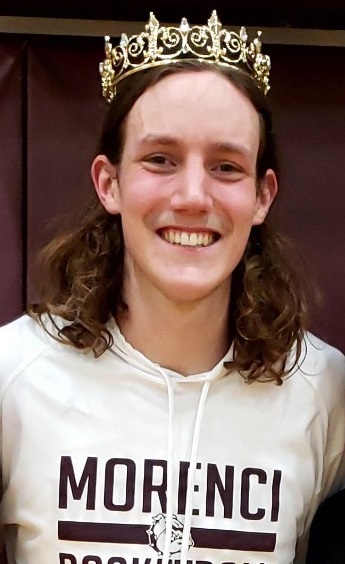 He’s a familiar face at Morenci events because he stands out in three sports. He also wears a signature headband.
Zimmerman was a running back for the Morenci football team in the fall, is a point guard for the Bulldogs basketball team as they head into next week’s Division 3 postseason, and he can’t wait to return to the track this spring. He’s a sprinter and a good one.
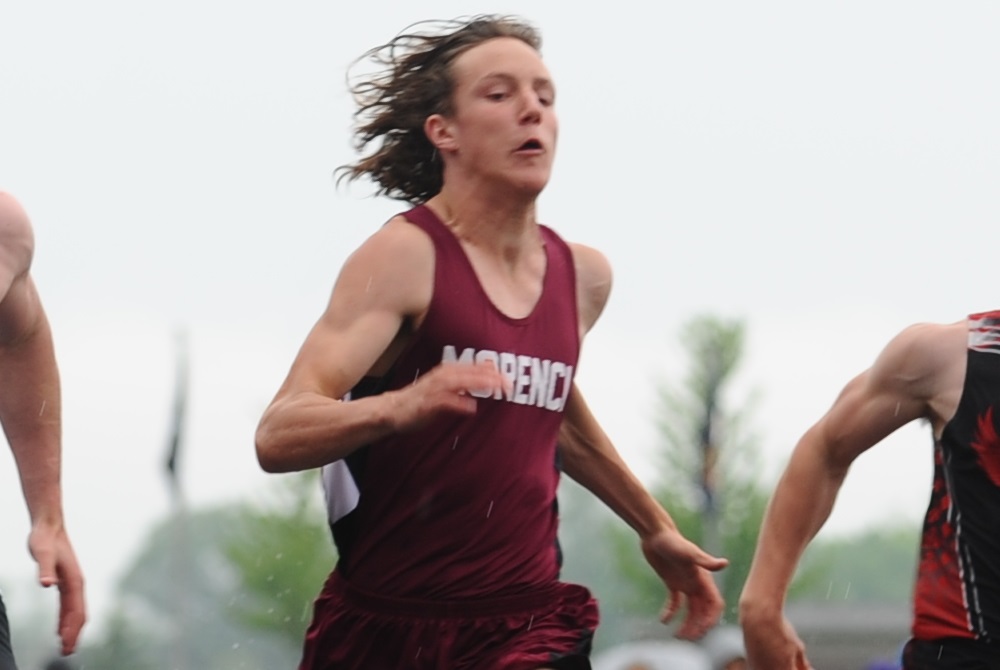
As a sophomore, Zimmerman finished second at the Tri-County Conference meet in both the 100 and 200 meters. At the Division 4 Finals, he placed fourth in the 100 and helped the Bulldogs 400 relay team place fourth as well. He also qualified in the 200.
He likes how track is somewhat of an individual sport.
“I like all of the sports, but I like that in track I have total control,” he said. “The only one responsible for your performance is you. It’s all up to you.”
He missed his junior year of track due to the season being canceled because of COVID-19.
“I was really disappointed that I missed my junior season because that’s a big season for recruitment,” he said. “I was thinking we were going to still have a season. I was working out and getting ready, then it was canceled. I was still lifting and trying to stay ready.”
He has goals for this season.
“I want to go to state again, and I want to be in the top three in my events,” he said.
He committed to Saginaw Valley State, a Division II college, after visiting the campus and finding out the Cardinals were able to give some scholarship money.
“They made the best offer,” he said. “I’ve always wanted to go to college. That’s been my plan. I want to do something in business, maybe own my own gym.”
College is still a while away. Right now, there is the District tournament looming for Morenci, then track season. His mother had a scan recently to find out where she stands with cancer.
For now, he’s happy to have her in the stands, watching him compete. The community continues to rally around him. His teammates do, too. During football season, Zimmerman and other players wore green on their shoes or wrist – a lime green ribbon promotes Lymphoma cancer awareness.
“It’s nice to have her watching again,” he said. “She missed some football games. She just had a pet scan last week to see if it is all gone. We are hoping for the best.”
 Doug Donnelly has served as a sports and news reporter and city editor over 25 years, writing for the Daily Chief-Union in Upper Sandusky, Ohio from 1992-1995, the Monroe Evening News from 1995-2012 and the Adrian Daily Telegram since 2013. He's also written a book on high school basketball in Monroe County and compiles record books for various schools in southeast Michigan. E-mail him at [email protected] with story ideas for Jackson, Washtenaw, Hillsdale, Lenawee and Monroe counties.
PHOTOS: (Top) Morenci's Rodney Zimmerman sprints toward the finish of a preliminary race during the 2019 Track & Field Finals. (Middle) Zimmeran was named this winter's Homecoming king. (Top photo by RunMichigan.com; middle photo submitted.)