


Mixed Messages
November 27, 2013
One of the very few enjoyable aspects of waiting in an airport is the guiltless time it allows me to visit its bookstores and page slowly through some of the old classics I vaguely remember and the new releases I can’t wait to read.
Two months ago in one of the terminals of Sky Harbor Airport in Phoenix, my attention went quickly to a prominent display of books about football. Five titles were mostly critical of the game, focusing on the sport at the major college and professional levels. Down at the bottom of the display was one title that addressed the positive value of football to students, schools and communities.
One month ago, while I was eating breakfast, the television news reported on the results of new research about youth concussions. While the narration mentioned multiple sports, the video was mostly of football. I saw that story repeated on another television channel that evening. I wondered, how many times on how many channels did how many people get this gift of the latest youth concussion statistics for all sports presented in football-only wrapping paper?
The public is getting mixed messages about school-sponsored football. The problem of college and professional football is not the problem of school-sponsored football. And what problems of head trauma that do exist in school sports are not exclusively problems of football.
In fact, school-sponsored football has never been freer of serious injury than it is today – that’s true whether we are talking about heads, necks, knees or nicks. It’s the result of the most careful and cautious rules making, coaching and officiating ever. And it’s safer – not less so – as we ever more quickly assess and refer injuries to ever more educated and capable health care professionals.
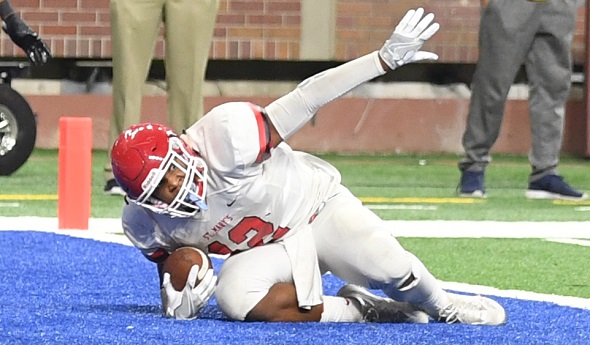
Moment: Eaglets Clinch on Late TD Catch
September 24, 2020
By Geoff Kimmerly
Second Half editor
More than three months had passed since the last time Ky’ren Cunningham had lined up as a receiver for Orchard Lake St. Mary’s.
But with one last desperate chance to win the Division 3 championship on the line during the 2016 Final, the Eaglets’ running back moved back into unfamiliar territory.
Cunningham even switched spots in the alignment with teammate Clay Antishin, moving outside as St. Mary’s lined up from the Muskegon 18-yard line trailing 28-23 with 10 seconds to play.
But Cunningham was in the right spot all along.
Six seconds later he split a pair of defenders in the Ford Field end zone and hauled in Caden Prieskorn’s pass to give the Eaglets a 29-28 lead it wouldn’t relinquish.
“I play running back,” said Cunningham, a junior at the time. “It was one-on-one and the safety didn’t come over the top. Caden just threw it. He just made the read.
“My body felt so weak (when I caught it). I don’t remember much.”
Longtime Detroit sportswriter Tom Markowski described the play’s setup this way in his report for Second Half:
Make no mistake. This was desperation, and it was a makeshift play. Cunningham is a starting running back. The last time he lined up as a receiver was in the first game this season against Macomb Dakota. Coach George Porritt ditched that plan afterward. Cunningham would stay in the backfield.
“It was a pistol right,” Prieskorn said after the game. “All we knew was we were going to have man-on-man coverage.”
St. Mary’s had entered the playoffs 5-4, running its record to 10-4 with the victory. The championship finished a string of three straight Division 3 titles for the Eaglets.
PHOTO: Orchard Lake St. Mary’s Ky’ren Cunningham rolls up with the ball tucked after scoring the game-winning touchdown in his team’s 2016 Division 3 championship victory over Muskegon.