

Neighbors Rally, Revive 'Community' Stadium
August 31, 2015
By Geoff Kimmerly
Second Half editor
MOUNT PLEASANT – Josh Wheaton stood admiring the Community Memorial Stadium grass a little less than a year ago, and he knew what was coming next.
The weeks of trampling to come would produce the same result as every year beginning in mid-September.
 “I’m looking at it and thinking, I can’t believe a week ago it was exactly the way you’d want your yard to look,” said Wheaton, a varsity assistant coach for Mount Pleasant’s football team. “And now, it’s this. It’s the same every year. I knew it was coming – and by weeks 7, 8, 9, we were going to be playing in a mud pit.”
But less than a year later, as the team prepared for its first game last week, Wheaton and his Oilers – and co-tenant Mount Pleasant Sacred Heart as well – all were enjoying something that defied any expectation: a project pulled off so quickly, it spoke well to the name of the stadium the schools share.
In less than a year, supporters of Mount Pleasant High and Sacred Heart Academy raised $600,000, secured another $300,000 in donated work, and assisted in the transformation of the stadium from an aging landmark built 50 years ago to what should again be one of mid-Michigan’s athletic jewels for years to come.
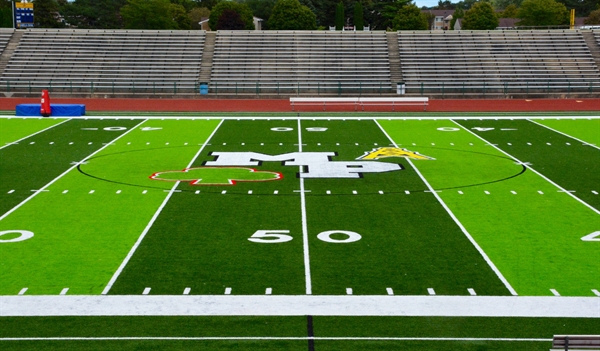
The schools reopened the stadium Friday for a doubleheader. Sacred Heart fell to rival Beal City in the opener, and Mount Pleasant then defeated Midland Dow to finish a night that saw more than 5,000 fans pass through the new gates and witness the official debut of stunning two-tone green turf that served as the main focus of a renovation that has only just begun.
“It is a community that believes in young people and certainly believes in athletics,” Mount Pleasant athletic director Jim Conway said. “I think being in a college town (with Central Michigan University), there’s that collegiate portion to it where the kids start (here), and many end up matriculating over there. And we sit right here in the middle of the city, and being the shared facility, that is kind of the focal point. We were able to use that and people latched on and wanted to be a part of it, and we’re still going.”
If you rebuild it …
Community Memorial Stadium opened in 1965 as the shared home of the Mount Pleasant High and Sacred Heart football and track and field programs. Prior to its construction, the programs had a variety of homes – CMU’s Alumni Field for the Oilers and at times the Irish, who also played at Fancher Field and at Island Park going back to at least the mid 1930s.
The new stadium construction was funded solely by the community and opened Sept. 25, 1965, for what ended as a 26-26 tie between Mount Pleasant and East Lansing. The field has remained a point of local pride since, with junior high games and the town’s rocket football teams also taking regular turns on the grass.
 Most weeks during the fall see the stadium host three or four games. But Wheaton said last fall there were three weeks during which 11 games were played.
It’s not that all the activity tore up the field. But it didn’t allow the grass time to regrow after the older kids did their damage on Fridays and Saturdays.
All of that caused Wheaton to casually suggest last fall to Oilers coach Jason McIntyre that the grass should be replaced with synthetic turf. Never will happen, McIntyre responded. That conversation had been had before – including briefly when a bond was passed eight years ago that led to the repair of the locker rooms, concession stand, press box and track at the stadium – and talks about going to turf had never progressed past the idea stage.
Wheaton told his boss he’d take care of it, but nothing more was said on the topic for a couple weeks … until someone else brought it up, and McIntyre joked that Wheaton was all over it.
This time, he ran with it.
In October, Wheaton formed a committee made up of supporters of both schools. They decided they would need to raise all of the money for turf over six months – by April 1 – and split into sub committees to handle fundraising and construction.
“When I first heard about it, I was a little skeptical,” said Sacred Heart athletic director and football coach Rick Roberts, who like McIntyre is a second-generation football coach in the 26,000-resident town and has led his program for 23 years.
“I wasn’t sure we could raise that much money in that short of a time; the economy isn’t the greatest at the moment. But when I went to a meeting, and saw the energy that was around the table, I knew it was going to happen.”
Pillars of the Community
Mount Pleasant High is a Class A public school with about 1,070 students. Sacred Heart is a Class D Catholic school with about 140 enrolled. In those ways, they couldn’t be more different.
But kids at the schools grow up playing Little League baseball or youth basketball together, and a number of Mount Pleasant High families attend Sacred Heart Parish.
 And there was plenty of work for all to do, and do quickly.
With money rolling in, the old grass field would need to be dug out to eight inches below the surface. Materials would need to be brought in to refill the base where the synthetic surface would be laid.
Pennsylvania-based ProGrass did the turf work, but the rest was done with local hands and equipment.
Wheaton made contact with the Isabella County-based Morey Foundation, which pledged to match $200,000 in donations from the community. Committee member Doug Moore is a president with Fisher Companies, which does concrete and asphalt work as well as construction transportation in mid-Michigan, and his company contributed much of the $300,000 in in-kind work.
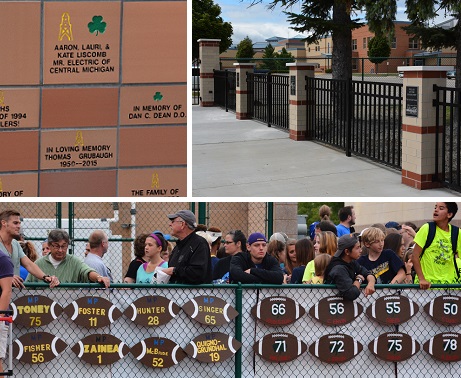
McGuirk Sand-Gravel, which had also contributed when the stadium originally was built, hauled out the old field, while Malley Construction built the concrete curbs and long jump pits. Contractor Eric Borodychuk constructed the new entrance. Straus Masonry continues to build the wall of bricks and pillars purchased by donors, and other volunteers landscaped the hill near the front gate.
“If you don’t have those kind of people in your community, this doesn’t even get off the ground,” Wheaton said.
“We thought that was there,” Conway said of the support. “This is proof.”
Still work to do
Oilers senior Zach Heeke remembers teammates turning ankles on the old practice fields in holes left over from shot put tosses the previous spring.
Those are more or less a memory now – the varsities for both schools practice daily at the stadium, sometimes splitting the field down the middle. The subvarsity teams still practice on other fields, but the track and field throwing areas are inside the stadium as part of the new construction.
 Heeke is more connected to athletics than a typical high schooler – his dad Dave Heeke is CMU’s athletic director – and Zach appreciates greatly what’s gone into his team’s new home field.
“It’s an honor, for sure. It gives us a lot of motivation,” Heeke said. “All the people who donated money to have this happen, we have to show them that we’re good enough and we want to play here, and we’ve got to play for them. It’s awesome to think of all the people who come to our Friday night games, and maybe they’re not showing up in the stands, but they’re on the wall and they’re thinking about us.”
Two members of the original 1965 stadium committee attended a celebration of the new field Thursday. Roberts, who remembers the stadium’s initial construction, believes the original contributors who have since died would be “thrilled” with how the current community has taken up their work and improved upon it.
Bricks and pillars continue to be sold, for as little as $250 and as much as $25,000, as part of the Pillars for the Community fundraising group the renovation committee set up. That money will fund a phase two that likely will include replacing original concrete and possibly adding new bleachers. Both schools are contributing together annually to a fund that will allow for the necessary regular maintenance and then replacement of the turf in 10-12 years.
“(The committee) all wanted the same thing. And when you get a bunch of ex-athletes in a room who all want the same thing for kids in the community, it goes pretty well,” Conway said.
“It’s just been a Mount Pleasant family, if you will."
 Geoff Kimmerly joined the MHSAA as its Media & Content Coordinator in Sept. 2011 after 12 years as Prep Sports Editor of the Lansing State Journal. He has served as Editor of Second Half since its creation in Jan. 2012. Contact him at [email protected] with story ideas for the Barry, Eaton, Ingham, Livingston, Ionia, Clinton, Shiawassee, Gratiot, Isabella, Clare and Montcalm counties.
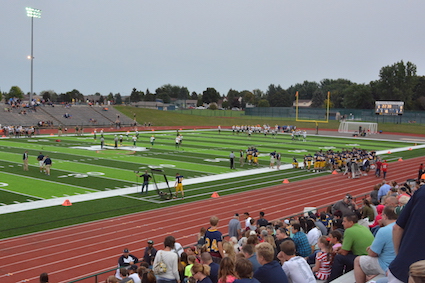
PHOTOS: (Top) The Community Memorial Stadium turf includes the logos of both its home teams, the shamrock for Sacred Heart and the oil derrick for Mount Pleasant High. (Middle top) Supporters have given to the stadium and the schools' players in multiple ways, from buys bricks and pillars to hanging signs. (Middle below) Sacred Heart runs a play against Beal City during Friday's game. (Bottom) Mount Pleasant High and Midland Dow players warm up before their game Friday night.
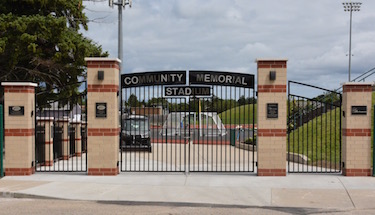 A new gate at the north entrance welcomes fans to Mount Pleasant's Community Memorial Stadium. The gate is anchored by pillars highlighting some of the project's largest donors.
 The parking lot-side of the stadium pressbox, like field below, includes banners of both teams that share the field.
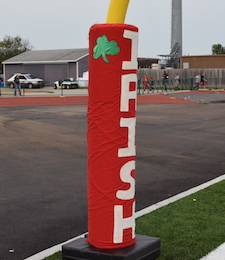 The uprights are padded specific to the team on the field; red for Sacred Heart's Irish and dark blue for Mount Pleasant High's Oilers.
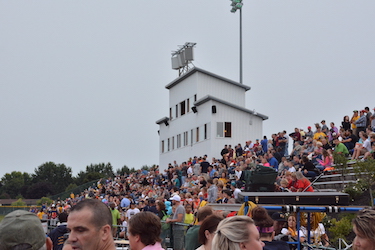 More than 5,000 fans filled the stadium for Friday's doubleheader, these mostly supporters of Mount Pleasant High after the Sacred Heart game against Beal City had ended.
Writer-Turned-Coach Enjoys Debut
November 3, 2016
By Dennis Grall
Special for Second Half
ESCANABA — Sam Eggleston has seen high school football from two drastically different viewpoints. Now, even though he is an unpaid volunteer, he enjoys being on the sideline as a coach.
 Eggleston just completed his first season as a high school head coach, with Eben Superior Central winning its final three games to finish 4-5 in 8-player football. The Cougars were among the first teams in the state to join the 8-player format in 2010, their first year of football.
Eggleston was a sportswriter before becoming a coach, giving him different perspectives to watching the same event.
The 1998 Rock Mid Peninsula High School graduate worked at newspapers in Escanaba, Kenai, Alaska; Northville and Novi, and Marquette before becoming a freelance writer and website blog editor in 2008. He started the writing phase of his career in 2000 with the Daily Press in Escanaba, under my direction.
He served as a volunteer assistant football coach in Northville, then moved back to the Upper Peninsula and became a volunteer coach at his alma mater in 2011 when the Wolverines went to 8-player football. He joined Superior Central in 2014 and spent two seasons as a volunteer aide until landing the head job just two weeks before the 2016 preseason began.
“In both careers … you took a shot on me and I ran with it, and the same with coaching; they gave me a shot and I’ve run with it as best I can,” he said.
In addition to his unpaid position at Superior Central, in rural Alger County, Eggleston is responsible for fundraising for the self-funded football program, a major priority for his offseason.
“My coaching is over (for the season) now and the majority of my time will be spent on raising funds so we can get new helmets, get new pads to replace ones that are broke, spending money we don’t have so we’ve got to make that up now,” he said. “We have to win now to have successful fundraisers.”
As a sportswriter, Eggleston would simply switch gears and move on to coverage of the next athletic season, for instance once fall sports moved into winter. He also never had to worry about how coaches managed off-field X’s and O’s once their seasons concluded.
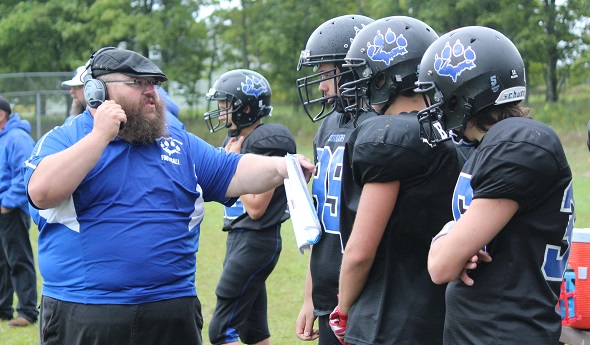
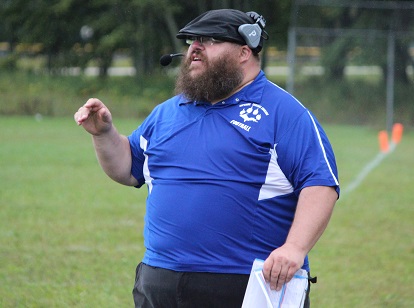
Life was totally different as a reporter. “I had a different approach, different viewpoint, different mindset to a game as a writer,” said Eggleston, who still has the heft of when he was a lineman but now looks like a lumberjack with his bushy beard and build.
“Now I have to worry about every kid and every position,” he said. “Sometimes I don’t even see the end result of the play because I’m watching the line play. I don’t even know how well my running back did until I see where they moved the stick.”
He may also be working on an injured player while the game goes on, trying to make play calls and other decisions at the same time.
As a sportswriter, he would be jotting down notes between plays or perhaps checking the result of a picture he took of the previous snap, totally unaware the coach was monitoring several assignments.
“I look back at the writer I was and as a coach now, and I would hate the type of writer I was,” he said.
Eggleston would analyze why a coach would switch to running a sweep rather than the counter that had been working, all while the coach may be working on an injured player that caused a change in offensive plans.
“As a writer I never had the insight to see everything. I just saw the overall game and kept track of every yard,” he said. “As a coach I can’t even tell if the play went five yards because I have three plays stacked up as the game goes on.”
While he was writing sports in the metro Detroit area, his weekly paper often covered games also being covered by the Detroit Free Press or the Oakland Press, with those stories appearing the next day. Eggleston’s story would appear maybe five days later, after everyone knew what happened.
 “I had to come in with a different angle. I tried to be a little more analytical and focus on strategy versus the flourish and try to get the meat of the game rather than get to the flowery parts,” he recalled. “I tried to take a different approach and make my stuff more interesting.”
His style apparently worked as the paper received several journalism awards and subscriptions remained strong.
Writing also provided some interesting backdrops. He had to use small charter planes to see some games in Alaska, or get to Nome to handle features about the Iditarod sled dog race.
He recalls covering a high school hockey game on an outdoor rink in Alaska and said “it was the first time I saw wind shear affect a hockey game.”
Eggleston also covered a football game where a kicker booted the ball off the uprights, then off a fence, and it bounced into the ocean in Homer.
He reported on a murder trial at that paper, where he would work the news desk in the morning, take time off and then handle sports at night. “It was super stressful,” he said.
Now walking the sidelines as a coach, he said “it definitely does feel like I’ve seen both sides of the coin, and I understand both sides of them better.”
He remembers just giving “little more rounded answers and (to) give both sides of the story” in postgame interviews. “A lot of coaches give canned answers. I try to be a little more in-depth and help try to write the story.”
In his early days as a sportswriter, he said “I would see the game unfold and see the pressures and why a coach would make a decision to go for it (on fourth down). I was a bit more critical of the coach and their decision,” he said, adding “I would probably have been a little more biting about it when I wrote the story.”
He admits in those days “I thought I knew everything there was to know about football. I played it,” he said. “I always approached the game like I was the professional and knew everything about the game. Now as a coach there are a host of responsibilities during every game. I am in completely different waters now. The hardest thing is keeping the kids pointed in the right direction as things go wrong.
“You’ve got the entire team and you’ve got to keep moving in a positive direction, keep the focus going forward. Forget the last play and work on the next one and get the kids to buy into that philosophy.”
He also compares his first writing assignment at the Daily Press with his first game this season at Ontonagon. “I did a (men’s baseball) story about the Escanaba Polecats, and you read my first line and said, ‘Did Yoda write this?’ I thought, oh my God, I don’t know what I’m doing.”
The Cougars lost their opener this fall 36-8, and Eggleston said “after being an assistant for four years, I still wasn’t prepared going into that Ontonagon game. We lost, and as I look back, if we played them right now I think we would beat them.
“I had no clue coming into that first game and didn’t have any idea how to get us back on track.”
He eventually figured enough out to finish 4-5 and found plenty of ways to enjoy being a coach.
Eggleston tries to eat lunch with his players every day, and he pays for his own meal.
“I want a family environment there; we all sit at the same table,” he said. “What I get back is relationships I never had before. I feel like I have 21 kids, and I love every minute of it.”
 Denny Grall retired in 2012 after 39 years at the Escanaba Daily Press and four at the Green Bay Press-Gazette, plus 15 months for WLST radio in Escanaba; he served as the Daily Press sports editor from 1970-80 and again from 1984-2012. Grall was inducted into the Upper Peninsula Sports Hall of Fame in 2002 and serves as its executive secretary. E-mail him at [email protected] with story ideas for the Upper Peninsula.
PHOTOS: (Top) Eben Junction Superior Central football coach Sam Eggleston speaks with some of his players during a game this season. (Middle) Eggleston monitors the action on the field. (Photos by Dennis Grall.)