

New Coach, Same Standard for SMCC
By
Chip Mundy
Special for Second Half
August 27, 2015
By Chip Mundy
Special for Second Half
MONROE – It would be understandable if first-year Monroe St. Mary Catholic Central head football coach Adam Kipf felt like he was taking over for University of Michigan legend Bo Schembechler a year after the Wolverines won the national championship.
Kipf, a graduate of SMCC, said he doesn’t feel that way at all as he replaces his former coach and mentor Jack Giarmo, a local icon who retired after 17 seasons leading the Falcons, including last year when they won the MHSAA Division 6 title.
 “I feel I’m replacing Coach Giarmo after a state title,” Kipf said with a laugh. “Coach Giarmo is a good coach. He spent 17 years here, and I spent 11 years of my life with him on a football field.
“It’s certainly not an easy task, but I’m not trying to be Coach Giarmo. I’m trying to be the best version of myself.”
SMCC got off to a winning start Thursday night with a 62-39 victory at Tecumseh, but it will need more than a season-opening victory to live up to the standard that was introduced by the former coach.
Giarmo’s teams were 144-54 in 17 seasons, made the MHSAA playoffs 13 times and captured five Huron League titles. The Falcons made the MHSAA Semifinals eight times and played for the championship four times, finally winning it all last year – when, at Ford Field, they also ended Ithaca’s national-best 69-game winning streak.
Then, Giarmo decided to step down, and Kipf was chosen as the new head coach.
“It wasn’t a total surprise,” Kipf said of Giarmo’s decision. “He had sort of let on that he might be thinking about it, so when it came out, I wasn’t surprised at all.”
“I don’t think there is any other job out there that would mean as much. There are other jobs that would have a lot of meaning to them, but coaching at your alma mater and having the tradition that we have here – having the success we have here – I think that’s just awesome. It’s tough for me to even put into words what it means to me being back at my alma mater coaching football.” – Adam Kipf
It certainly was not an automatic choice for SMCC to promote Kipf from the head coach on the junior varsity to head coach of the varsity. He went through several interviews before landing the job.
“They asked me, ‘How do you determine success?’ ” Kipf said. “I said, ‘There are two ways. One is wins and losses, and that’s OK. But the other way is seeing what kind of men they become, five, 10, 15, 20 years down the road.”
Kipf, a social studies and religion teacher at Monroe Catholic Elementary School, did not set out to become a coach and teacher. He went to Western Michigan University to play football and was pursuing another field, but he left after one year.
“I didn’t know what I wanted to do with my life, and then I got involved in coaching in 2003 with one of my former coaches,” Kipf said. “He was coaching his son in the Monroe Catholic Youth Organization, and he got me into it, and I enjoyed it. The next year, he went to Monroe High as an assistant and I went with him, so I ended up coaching two years there.
“One Friday night after a game at Monroe, two coaches talked me into going into coaching. They said teaching was going to be my best bet to get into coaching.”
With that in mind, Kipf went back to school and attended Eastern Michigan University. In 2010, he graduated with a Bachelor of Arts degree in secondary education. By that time, he was back with SMCC coaching the offensive and defensive lines on the junior varsity.
Kipf had been an offensive lineman and defensive tackle from 1998-99 at SMCC. He played for Giarmo and then joined his coaching staff in 2006, giving him a unique insight into the mind of the man who was most responsible for building the successful program.
“He was a stickler for details,” Kipf said. “He coached every last little detail, and I am finding myself on offense doing the same thing. Jack and I will talk, and I will seek advice on plays and blocking and things like that. We talk probably once a week football-related, and we will talk more than that about other things. We still talk football.
“He isn’t going to distance himself from the program. He has strong roots here. I think he misses football. I don’t know if he would admit it, but he misses football.”
“We’ve basically kept the same concepts that Coach Giarmo kept, but we’ve added a lot of new traditions into it. We’re getting new traditions. We’ve got a couple of new decals on our helmets, and originally we had our straight gold helmets.” – senior running back Justin Carrabino
When Kipf played at SMCC, the helmets were green with decals of yellow birds on them. Lately, the helmets have been without decals, but the birds have returned this year.
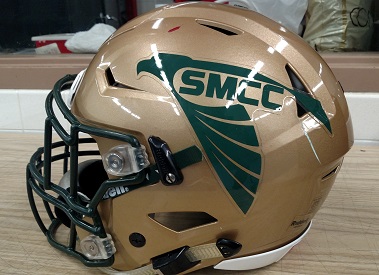 “To me, that bird, I worked so hard when I was a freshman to get that bird when I got to varsity,” Kipf said. “It was a thing of honor because you took those birds off at the end of the year and kept them. I still have them in scrapbooks.
“We have brought those back. With the gold helmet we’ve got green birds, but we didn’t put them on until two days before the first game.”
The decals on the helmets might be the easiest change to notice, and Kipf said there won’t be a lot of others made right away.
“I don’t know that I want to bring a whole lot different to the program,” he said. “I’ve added a few things here and there that are a little different than last year, but I’m not prepared to share that.
“We might throw the ball more, but finding people to catch and throw isn’t an easy task, especially since in the last 14, 15 years in the system it has been 95 percent run. I’m a big proponent of, ‘If it’s not broken, don’t fix it.’ ”
Not every change is going to be related to strategy or scheme. Everyone has a different personality, and Kipf’s high-intensity style could light a spark under the Falcons.
“He’s very vocal and gets into it with the players a lot,” senior guard/linebacker Hunter Coombe said. “He gets us hyped. He’s very intense. It’s good.”
The word intense seems to go hand-in-hand when describing Kipf.
“Practices are run with a lot of intensity,” Carrabino said. “There is a lot of physicality, but there is with a lot of defenses. You can tell by the tone of practice that it’s a lot different.”
“I don’t feel pressure coming off a state title because I know what we have and what we are capable of. People have high expectations and expect success. To me, success is more than a state title. If we go 14-0 but don’t get better, it’s a state title but it’s not successful. I want kids who are going to compete and get better every day, and at the end of the season, if they are better football players, better student-athletes, better Catholics, better Christians, than we’ve done our job. That’s success.” – Adam Kipf
Success breeds expectations, and MHSAA championships sometimes breed unrealistic expectations. Teams don’t win an MHSAA title every year.
The Falcons have made the playoffs 14 of the past 16 years with double-digit win totals during nine of them. The program has become not just recognized regionally, but statewide.
The players reflect the attitude of a new season and a new challenge and said they refuse to look back.
“We have to totally forget about last year,” Coombe said. “This is a new team with the same goal, obviously, but we aren’t thinking about it. We’ll just go week-by-week and game-by-game.”
Carrabino, who rushed for 1,300 yards and 17 touchdowns last season, echoed those comments.
“I think you have to prove yourself every year,” Carrabino said. “Nobody has a set spot. You just have to give your all in practice.”
Senior quarterback/defensive back Austin Burger feels the same way.
“We feel no pressure at all,” he said. “We feel like we’re a different team from last year, but we are trying to keep the tradition.”
Tradition is important at SMCC. Giarmo was a player on the 1980 team that went 9-0 but failed to land a spot in the playoffs.
Kipf is one of three brothers who played football for the Falcons. It’s family.
“We’ve got 12 years in my family of playing football at this school, and now this will be my 10th of coaching football at this school,” he said. “Twenty-two years I’ve been a Falcons football supporter either through my family or myself, so it certainly means a lot to me.”
Maybe it’s the tradition – or maybe it’s the “band of brotherhood,” as Burger called it – but something special seems to happen to a bunch of young football players who don’t necessarily look like they should be championship football players.
“We don’t always have the best athletes or the biggest athletes or the fastest athletes, especially in this day and age,” Kipf said. “We have kids who are undersized for the most part, but they have heart and they work hard, and that’s what made our program successful over Coach Giarmo’s tenure. Between him and (former defensive coordinator) Scott Hoffman, they brought out the best in guys.
“They had guys on the field you would think had no business being on a football field. They bring out the best in our kids, and our kids give them everything they’ve got in order to succeed.”
 Chip Mundy served as sports editor at the Brooklyn Exponent and Albion Recorder from 1980-86, and then as a reporter and later copy editor at the Jackson Citizen-Patriot from 1986-2011. He also co-authored Michigan Sports Trivia. E-mail him at [email protected] with story ideas for Jackson, Washtenaw, Hillsdale, Lenawee and Monroe counties.
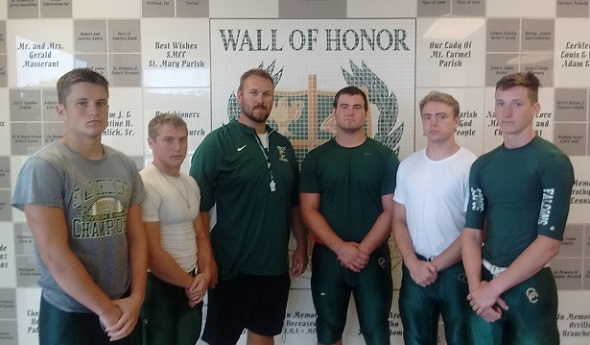
PHOTOS: (Top) Monroe St. Mary’s coach Adam Kipf and his captains stand together earlier this month (from left to right): Hunter Coombe, Justin Carrabino, Kipf, Riley Woolford, Mitchell Poupard and Austin Burger. (Middle) The Falcons’ helmets will feature decals again after going without during the program’s recent past.
Drive for Detroit: Week 3 in Review
September 12, 2016
By Geoff Kimmerly
Second Half editor
Streaks are made to be broken, it is said. And that being the case, Week 3 saw plenty of the inevitable all over Michigan high school football fields.
See below for quick details on some of the most intriguing results, including a number of teams adding to their best starts in a number of seasons, and a few breaking streaks by beating opponents for the first time in more than a decade.
Bay & Thumb
Lake Fenton 61, Flint Beecher 14
This round of one of the Flint area’s top rivalries goes to Lake Fenton, which fell to Beecher by a point last year (and 38 in 2014) but is definitely one of a few favorites now in the Genesee Area Conference Red. The Blue Devils (3-0) unloaded their highest point total since 2012, with Beecher giving up its most points since 2004. Click for more from the Tri-County Times.
Also noted:
Alma 26, Saginaw Swan Valley 0 – The Panther's first win over Swan Valley (1-2) since 2011 corresponded with Alma’s first 3-0 start since 2012.
Fenton 28, Ortonville-Brandon 22 – The Tigers (1-2) were looking for a jumpstart as they pursue another Flint Metro League title, but Brandon (2-1) has shown it may be the team to take advantage if Fenton does fall again along the way.
Grand Blanc 42, Plymouth 27 – The Bobcats’ play to get back into the playoffs after two seasons away definitely will get a bump from starting 3-0 for a second straight season; Plymouth must bounce back from 1-2 to keep its three-year playoff streak intact.
Richmond 29, Croswell-Lexington 26 – Reigning Blue Water Area Conference champion Richmond (2-1) needed a late score to get past the Pioneers (2-1) for the fourth straight season.
Greater Detroit
Clarkston 38, Oxford 7
The Oakland Activities Association Red is sorting itself out quite a bit already this season, with preseason contender Clarkston losing to Southfield Arts and Technology in Week 2. But the Wolves (2-1) stormed back by downing an Oxford team that while 1-2 did open with a win over reigning Division 1 champion Romeo. Clarkston’s top three ground gainers – led by Michael Fluegel and his 114 yards – all averaged at least 7.8 yards per carry. Click for more from the Oakland Press.
Also noted:
Detroit Mumford 26, Detroit Collegiate Prep 14 – A nine-point loss to still-undefeated Detroit U-D Jesuit in Week 1 is looking even better for Mumford, which moved to 2-1 by beating a Collegiate Prep team (0-3) that went 9-1 last fall.
Walled Lake Western 48, Northville 34 – The Warriors’ 3-0 start has now included three wins over 2015 playoff teams, and Northville (2-1) didn’t lose during the regular season last year.
Rochester 38, Pontiac Notre Dame Prep 32 (OT) – The Falcons' move to 1-2 gave them as many wins as last season and 2014 as well, and with an impressive one against a Notre Dame Prep team that is 2-1 and went 8-3 last fall.
Dearborn Fordson 34, Belleville 25 – The Tractors (3-0) avenged a six-point loss last season to the Tigers (1-2), who went on to win the Western Wayne Athletic Conference Blue title while Fordson was among those tied for second.
Mid-Michigan
Bath 17, Fowler 14
Before Friday, Bath coach Matt Stephens was among the few on his sideline who had had football success against Fowler, having quarterbacked Fulton teams that beat the Eagles during the mid-2000s. But his Bees – which won a combined two games over the last two seasons – downed Fowler (2-1) for the first time since 1989 to move to 2-1 this fall. Click for more from the Lansing State Journal.
Also noted:
Laingsburg 27, Dansville 20 – The Wolfpack (3-0) broke a four-game skid against the Aggies (1-2), and with the Fowler loss as well suddenly look like the team to challenge favorite Pewamo-Westphalia in the Central Michigan Athletic Conference.
Breckenridge 40, Mount Pleasant Sacred Heart 34 – After posting a best record in more than a decade in 2014, the Huskies stepped back to winless a year ago; fast forward and they’re 3-0 with a win over a perennial winner in the Irish, who are 0-3 but also started that way on the way to 6-4 last fall.
Eaton Rapids 42, Ionia 41 (OT) – The Capital Area Activities Conference White looks even stronger than usual, which made handing Ionia (2-1) a first loss especially key as Eaton Rapids (2-1) looks to bounce back from 4-5 a year ago.
Mason 31, St. Johns 15 – The Redwings (0-3) may be struggling out of the gate, but that doesn’t take away from a Mason 3-0 start that’s seen its defense give up 22 points total so far.
Northern Lower Peninsula
Traverse City Central 10, Traverse City West 8
As usual, the "Patriot Game" between these neighbors turned into a classic – Central downed West for the third straight season, but four of the last five meetings between these two have been decided by seven points or fewer. Although both entered the game averaging at least 40 points per, defense and turnovers were the narrative at Thirlby Field. Click for more from the Traverse City Record-Eagle.
Also noted:
East Jordan 34, Central Lake 6 – The Red Devils are 3-0 after winning two games last season and none in 2014, and this one was especially impressive with Central Lake (1-2) a playoff team the last two seasons.
Oscoda 22, Whittemore-Prescott 14 (OT) – The Owls (2-1) bounced back from a five-point loss last week against AuGres-Sims to avenge last season’s 27-point defeat to the Cardinals (2-1).
AuGres-Sims 50, Hillman 32 – While this is starting to look like a down season after two straight league titles for the Tigers (0-3), it’s also starting to look like one of offensive outbursts for the Wolverines (3-0), who have scored 128 points.
Roscommon 26, Sanford Meridian 14 – The Bucks have to be enjoying their first 3-0 start since 2000, and especially after downing reigning Jack Pine Conference champion Meridian (1-2).
Southeast & Border
Parma Western 32, Marshall 30
It was only a few seasons ago that Parma Western couldn’t be counted on to do much in a game like this Interstate 8 Athletic Conference opener. But the Panthers (1-2) surely learned something from their early struggles this season as they avenged losses of one and then 28 points over the last two to Marshall (1-2). Parma Western made the playoffs in 2015 for the first time ever, and this nearly was a must-win for the Panthers to do the same this fall. Click for more from the Jackson Citizen-Patriot.
Also noted:
Clinton 28, Adrian Madison 20 – Make that Clinton regular-season win streak 39 straight with another 3-0 start, but Madison (2-1) again gave the Redskins one of the rare tests of this run.
Hudson 26, Brooklyn Columbia Central 14 – The Tigers’ turnaround has thrown them into the conversation again in the Lenawee County Athletic Association, as Hudson (3-0) is now one win shy of last year’s total after beating reigning league runner-up Columbia Central (2-1).
Temperance Bedford 22, Ann Arbor Pioneer 21 – The Mules (3-0) reversed a six-point loss to Pioneer (0-3) last season and have now nearly also reversed last year’s 0-4 start.
Springport 48, Union City 26 – The Spartans are 3-0 for the first time since 2011 and have avenged two of last year’s five losses, handing Union City (2-1) its first defeat after falling to the Chargers by 16 a year ago.
Southwest Corridor
Battle Creek Harper Creek 24, Jackson Lumen Christi 14
The Beavers’ bounce-back season continued as their 3-0 start gives them as many wins as all of 2015, and the victory over Lumen Christi (1-2) was their first since the formation of the Interstate 8 Athletic Conference. One game into the I8 schedule, Harper Creek is the only undefeated team in a league with at least four that would scare most area opponents. Click for more from the Battle Creek Enquirer.
Also noted:
Coldwater 17, Battle Creek Pennfield 6 – Reigning I8 champion Coldwater (2-1) kept pace a win behind Harper Creek after falling to Marshall in Week 2; Pennfield also is 1-1 in the league and 2-1 overall.
St. Joseph 27, Portage Northern 23 – This was the sixth straight time the Bears (3-0) and the Huskies (1-2) played to within 10 points of each other, with St. Joseph winning five of the recent nail-biters.
South Haven 28, Plainwell 19 – The Rams have won only three games each of the last two seasons and no more than that since 2008, but are 2-1 having downed a Plainwell team (1-2) that has made the playoffs the last five years.
St. Joseph Lake Michigan Catholic 20, Niles Brandywine 6 – One of the toughest losses of two seasons of ups and downs for Lake Michigan Catholic was a 57-18 defeat to Brandywine last fall; this one put Brandywine at 1-2 and the Lakers at 3-0 after they won two games total in 2015.
Upper Peninsula
Newberry 48, Bark River-Harris 34
As expected, these Mid-Eastern Conference contenders combined to put up plenty of points. But Newberry (3-0) continued to put up more, running its total to 154 over three games and putting itself in fine position in the league standings by downing the reigning co-champion. Bark River-Harris (2-1) had beaten the Indians in two straight, including 56-34 a year ago. Click for more from the Escanaba Daily Press.
Also noted:
Iron Mountain 48, Iron River West Iron County 21 – The Mountaineers’ great start keeps picking up steam as they’re now 3-0 for the first time since 2011 and with a second straight win over the rival Wykons (1-2).
Ishpeming Westwood 18, L’Anse 16 – The Patriots (1-2) got a much-needed win as they go for a third-straight playoff berth but now head into Mid-Peninsula Conference play; the Purple Hornets (0-3) have a similarly hard road coming up.
Escanaba 27, Gaylord 13 – The Eskymos are 3-0 for the first time since 2010, with Gaylord (1-2) the second straight 2015 playoff team to fall to the Great Northern Conference contenders.
Felch North Dickinson 24, Munising 6 – The Nordics are hoping to climb back to their elite status from the start of this decade, and at 2-1 they’re only a win shy of equaling their total of both of the last two seasons; they’ll meet Munising (0-3) again in Week 6.
West Michigan
Zeeland West 38, Grand Rapids West Catholic 22
The battle of reigning MHSAA champions went to the Division 4 winner, as West (3-0) continued its 28-game regular-season winning streak with one of its most impressive over a run that’s been especially stellar this fall. Adding in the reigning Division 5 champion Falcons (2-1), West has beaten teams that went a combined 28-7 in 2015. Click for more from the Grand Rapids Press.
Also noted:
Leroy Pine River 34, Beal City 7 – The Bucks (2-1) had last beaten Beal City (1-2) in 2000 and have helped the always-powerful Aggies to their toughest start since that year.
Lowell 34, East Grand Rapids 7 – Even when it’s not much of a game, Lowell (3-0) taking on East Grand Rapids (1-2) is still going to be a game of statewide interest.
Rockford 37, Muskegon Mona Shores 23 – The Rams’ 21-season playoff streak got a needed jolt; beating Mona Shores (1-2) is a much better way for Rockford (1-2) to enter the Ottawa-Kent Conference Red schedule.
Hamilton 34, Zeeland East 21 – The Hawkeyes (3-0) are soaring after winning a combined four games over the last three seasons; handing annually-strong East (2-1) a loss makes the start even more impressive.
8-Player
Rapid River 36, Webberville 34 (OT)
Rapid River made a long drive south for one of the most intriguing nonleague matchups of the 8-player season and headed back across the bridge at 2-1 after edging the home Spartans in overtime. Webberville had given up only 26 points over its first two games. Click for more from the Escanaba Daily Press.
Also noted:
Engadine 42, Pickford 32 – The Eagles also are 3-0 for the first time since 2011 after finding openings in a Pickford defense that had given up only six points over its first two games of a 2-1 start.
Owendale-Gagetown 70, Flint International Academy 50 – No team statewide is scoring like the Bulldogs (3-0), who went over 70 points for the second straight week – although first-year Flint International (1-2) scored the most O-G has given up since 2013.
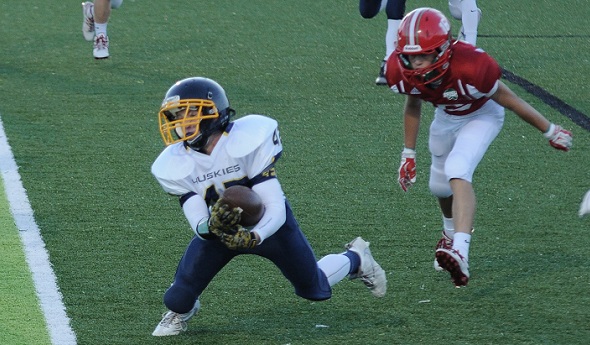
PHOTO: A Breckenridge ball carrier works to beat a Mount Pleasant Sacred Heart defensive player to the goal line during the Huskies' Week 3 win. (Click to see more from HighSchoolSportsScene.com.)