

Northern Schools Find Solution in NMFL
September 6, 2019
By Chris Dobrowolski
Special for Second Half
With 17 schools spread across 11 counties, the Northern Michigan Football League has created an indelible footprint since it was born into existence five years ago.
 The conference, made up of three divisions of schools in varying size, has been able to sustain and evolve despite an ever-changing football landscape up north that has made for a revolving door of membership from year to year.
“It continues to morph,” said Frankfort athletic director Dave Jackson, the conference’s commissioner and one of the founders of the league.
From the biggest schools in the Legends division — Benzie Central, Boyne City, Cheboygan, Grayling, Kalkaska, Kingsley and Traverse City St. Francis — to the smaller schools in the Leaders (Charlevoix, Elk Rapids, Frankfort, Mancelona and Maple City Glen Lake) and Legacy divisions (Harbor Springs, East Jordan, Inland Lakes, Johannesburg-Lewiston and St. Ignace) the NMFL has provided easy avenues for scheduling as well as good, competitive balance for the programs that call it home.
“The scheduling aspect is where I go back to it,” said Johannesburg-Lewiston football coach and athletic director Joe Smokevitch. “It’s just been huge for us. Going into 2020 and 2021 my schedule is full, basically with teams from within the conference. They’re not all division games. I am crossing over and playing those other schools. It’s really helped with scheduling. Not having to go far away to play somebody. You look at our schedule. We play some quality opponents. I think the conference is very strong from top to bottom.”
The idea for the league was hatched in 2012 between schools in the Lake Michigan and Northwest conferences. Both leagues were seeing problems from smaller schools trying to compete with larger ones, and neither side benefitting from the affiliation. So, the two merged as a 13-team league comprised of two divisions of similar-sized enrollments.
The league has rarely stayed intact from year to year, switching to the three-division alignment with the growth to 20 teams in 2016 when it absorbed the remaining teams in the Ski Valley Conference, as well as withstanding the loss of six schools to 8-player football in the span of four years.
“We’ve taken schools in the league that didn’t last very long,” said Jackson. “We took in Newberry and they lasted just a year, then suddenly they’re 8-man. We took in Gaylord St. Mary. We took in Central Lake. Those teams were just a year or two and suddenly they’re gone. Our constitution calls for a two-year process of getting out, but those teams that had to go 8-man, they’re out for the next year. So, suddenly you’re scrambling again, which is the one thing we were trying to keep from having to do because there is no planning when that last-minute 8-man decision comes along and schools decide to make that plunge. There’s nothing you can really do when a school says they’re going to do that. You can’t say, ‘Well, the constitution says … .’ They’re going to do what they need to do.”
 Fortunately for the league, it has been able to find suitable replacements at every turn. In fact, Ogemaw Heights and Sault Ste. Marie are set to join in 2020 to become part of the Legends division, bolstering the league to a robust 19 schools. Kalkaska and Boyne City will slide over to the Leaders division and Frankfort — one of the smallest 11-player football teams in the state — is moving to the Legacy division.
“It made sense to apply,” said Ogemaw Heights athletic director Jon Studley, noting four future conference foes already are on this year’s schedule. “We’re very excited about the opportunity to be a part of that. We’re going to be able to create some rivalries.
“I think fans of northern Michigan football benefit the most. They’re seeing competitive football week in and week out.”
As the NMFL has shown, the quality of football being played within the conference is at a high level, too. At least one team from the league has reached the Semifinal round of the MHSAA playoffs every season. Boyne City was a semifinalist in Division 6 in 2014, while St. Francis has represented the league in the Semifinals in 2015, 2017 and 2018. In 2016 two teams advanced that far — St. Ignace in Division 8 and Maple City Glen Lake in Division 6 — with Glen Lake reaching the Finals before falling to Jackson Lumen Christi 26-14.
“I think we’re really starting to get some respect,” said Glen Lake coach Jerry Angers. “I’ve talked to the teams downstate that we’ve played, they want to come up and play us. They’re not saying, ‘This is going to be an easy game.’ They’re saying, ‘This is going to be a fun game, and they’re going to give us something.’”
There remains the possibility the league will undergo more changes before it more comfortably stabilizes. Some schools have expressed interest in joining, and the threat of losing members to 8-player football remains for a few of the smallest schools. It’s nothing the league hasn’t dealt with before, however. Jackson said it comes down to maintaining a commitment to the schools that are in the conference and carefully examining any growth that could occur.
“We had our big meeting in December, and one thing we talked about is how we have to look out for each other,” said Jackson. “We’re trying to guarantee that the league will provide eight of your nine games. In most cases the league is providing all nine of the games. So, you know you’re going to have somebody to play and you’re not going to have to go looking. There’s a time we may control 11-man football for everything north of Lansing. I don’t know. It continues to grow because teams are looking for that stability and consistency year in and year out, so they know who their games are with and they know who they play.”
 Chris Dobrowolski has covered northern Lower Peninsula sports since 1999 at the Ogemaw County Herald, Alpena News, Traverse City Record-Eagle and currently as sports editor at the Antrim Kalkaska Review since 2016. He can be reached at [email protected] with story ideas for Manistee, Wexford, Missaukee, Roscommon, Ogemaw, Iosco, Alcona, Oscoda, Crawford, Kalkaska, Grand Traverse, Benzie, Leelanau, Antrim, Otsego, Montmorency, Alpena, Presque Isle, Cheboygan, Charlevoix and Emmet counties.
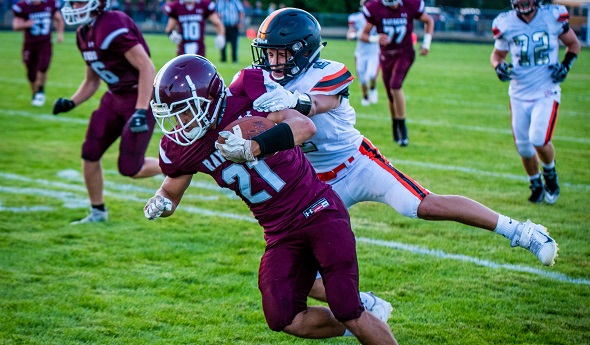
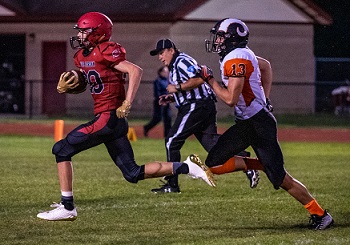
PHOTOS: (Top) Charlevoix, carrying the ball, opened this season with a 40-26 win over Elk Rapids. (Middle) East Jordan got a step on Harbor Springs on this play last week, but the Rams emerged with a slim 34-33 win. (Photos by Sports in Motion.)

Drogosh & De La Salle Cap 3rd-Straight Finals Trip as Repeat D2 Champs
By
Scott DeCamp
Special for MHSAA.com
November 25, 2022
DETROIT – Two years ago, Brady Drogosh started at quarterback for Warren De La Salle Collegiate as a skinny, nervous sophomore in the MHSAA Division 2 championship game against Muskegon Mona Shores.
The University of Cincinnati commit and his Pilots classmates have come a long way since then. They’ve grown by leaps and bounds.
Drogosh & Co. walked out of Ford Field on Friday with a second-straight Division 2 championship after a 52-13 defeat of Grand Rapids Forest Hills Central.
“I know a bunch of us walked off the field saying, ‘We don’t ever want to feel like this again,’” Drogosh said of the 25-19 Finals loss to Mona Shores in 2020, “and now we’ve gone back-to-back years going off as winners. I think mental preparation is a big part of it.”
De La Salle (13-1) captured its fifth Finals championship overall, and also fifth over the last nine years – the Pilots also seized titles in 2014, 2017, 2018 and 2021. In March, De La Salle claimed the Division 1 boys basketball championship to make it three big trophies in two major sports over a 13-month span. Drogosh was among the football players also on the basketball team.
He exhibited major growth from his sophomore to senior seasons on the big stage of Ford Field.
Two years ago against Mona Shores, Drogosh was 5-of-11 passing for 59 yards with no touchdowns, and he ran five times for 13 yards with one score. Last season, in a 41-14 Finals win over Traverse City Central, Drogosh was 14-of-19 passing for 142 yards with three TDs and no picks, plus he ran 19 times for a game-best 173 yards and one TD.
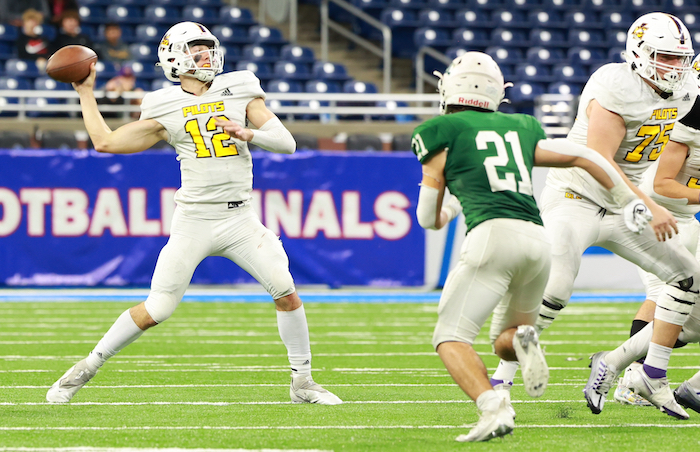
On Friday against Forest Hills Central, the 6-foot-4, 215-pound dual-threat QB was nearly flawless in the passing game. He completed 21 of 23 passes for 249 yards and two TDs with no interceptions. He was nearly unstoppable on the ground, too, piling up a game-high 152 yards and three scores on 15 carries.
 Forest Hills Central (13-1) was making its first Football Finals appearance since 1994, when the Rangers lost 17-13 to Farmington Hills Harrison in the Class A title game at the Pontiac Silverdome.
“I coach the defense, and we just couldn’t slow down the quarterback,” Rangers coach Tim Rogers said about Drogosh. “Why he’s not recruited by Alabama, I don’t know. He’s a darn good quarterback. He can make all the throws, he runs really well, he obviously checks a lot of things at the line of scrimmage. Man, he’s an excellent football player.”
As Rogers and his team found on film study and then even more so in person, De La Salle’s very large roster boasts several excellent players.
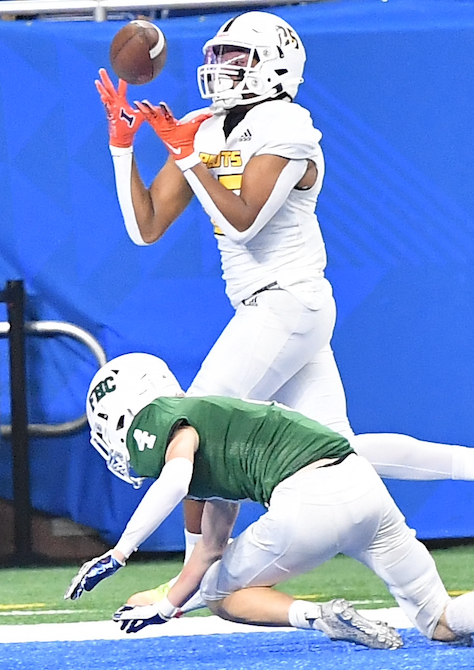
One of them, senior wideout Triston Nichols, played on a torn ACL and scored on a 9-yard pass from Drogosh to give the Pilots a 35-0 lead near the midway point of the second quarter.
De La Salle scored barely two minutes into the game on a Drogosh 3-yard run. The Pilots led 21-0 after one quarter and 38-13 at halftime. They put up two more TDs in the third quarter to go up 52-13 and start the running clock.
The majority of Drogosh’s numbers were accumulated during the first half.
The prolific point total was nothing new to De La Salle, which shattered its program’s single-season scoring record with 614 points. That eclipsed the 562 points amassed by last year’s team. The Pilots threatened the MHSAA Finals record of 56 points, but a drive to the Rangers’ 1 by the reserves was snuffed out by a high shotgun snap.
In five playoff games, De La Salle outscored opponents by a combined 223-42 margin.
“Coming in with this group three years ago, I asked a lot out of them and they stood up tall and they accepted every challenge we gave them,” said Dan Rohn, who took over as De La Salle’s head coach in 2020 when Drogosh and his fellow seniors were much less experienced.
“They might walk out of De La Salle, which has had some tremendous football teams and tremendous groups, as maybe the most decorated and successful class of football players. I know I couldn’t be more proud to be part of that.”
Rohn previously guided Grand Rapids West Catholic to four Finals titles between 2010 and 2015.
De La Salle senior defensive end Mason Muragin, who is committed to the University of Illinois, knew what to expect when Rohn took over at De La Salle.
“Three years, three state championship appearances, two wins – I think he’s really building a dynasty here and it’s an honor to play for him,” Muragin said.
De La Salle outgained Forest Hills Central in total offense, 476-151. Junior Rhett Roeser scored two rushing TDs for the Pilots, while senior Jack Yanachik hauled in a scoring pass from Drogosh. Junior Landon Ryska kicked a 25-yard field goal and went 7-for-7 on PATs.
 For Forest Hills Central, senior Justin Osterhouse completed 4 of 14 passes for 84 yards with two TDs and one interception. He connected with juniors Roman Brummel and Ty Hudkins for second-quarter scoring tosses.
“We got outplayed in all facets of the game. That’s a really good football team. We looked long and hard to find weaknesses on De La Salle’s team – we couldn’t find it on film,” Rogers said.
Forest Hills Central played a number of close games this season, most recently a 20-17 double-overtime victory over Dexter in a snowy Semifinal.
The conditions were much different inside Ford Field, but De La Salle proved too much for the Rangers.
“A lot of people doubted us and before the year no one really knew what to expect because we graduated a lot of seniors (30 from the 2021 team), but this is the toughest team I’ve ever played on and the most courageous guys and it just means a lot to get here,” said Hudkins, who paced the Rangers defensively with a game-high 12 tackles and a fumble recovery.
De La Salle’s lone loss this season came in Week 4 against Catholic League rival Bloomfield Hills Brother Rice in a wild 43-42 game.
The Pilots learned from that defeat, just like Drogosh and his teammates grew from the disappointing Finals loss two years ago.
“Me and one of the other captains, Dante Pancotto, who’s an offensive lineman, we watched the sophomore state championship game on YouTube and it really just shows the growth of how (far) we’ve come in three years,” Drogosh said.
“I think it’s all about the mental preparation. I think we were mentally challenged our sophomore year with COVID and everything, and I think we bounced back a lot our junior year and got even better this year.”
PHOTOS (Top) De La Salle’s Brady Drogosh (12) attempts to find an opening during his team’s Division 2 championship win Saturday. (Middle) The Pilots’ Triston Nichols (25) hauls in a scoring pass. (Below) Drogosh steps into a throw with FHC’s Nolan Hartl (21) in pursuit. (Click for more from Hockey Weekly Action Photos.)