

Northern Schools Find Solution in NMFL
September 6, 2019
By Chris Dobrowolski
Special for Second Half
With 17 schools spread across 11 counties, the Northern Michigan Football League has created an indelible footprint since it was born into existence five years ago.
 The conference, made up of three divisions of schools in varying size, has been able to sustain and evolve despite an ever-changing football landscape up north that has made for a revolving door of membership from year to year.
“It continues to morph,” said Frankfort athletic director Dave Jackson, the conference’s commissioner and one of the founders of the league.
From the biggest schools in the Legends division — Benzie Central, Boyne City, Cheboygan, Grayling, Kalkaska, Kingsley and Traverse City St. Francis — to the smaller schools in the Leaders (Charlevoix, Elk Rapids, Frankfort, Mancelona and Maple City Glen Lake) and Legacy divisions (Harbor Springs, East Jordan, Inland Lakes, Johannesburg-Lewiston and St. Ignace) the NMFL has provided easy avenues for scheduling as well as good, competitive balance for the programs that call it home.
“The scheduling aspect is where I go back to it,” said Johannesburg-Lewiston football coach and athletic director Joe Smokevitch. “It’s just been huge for us. Going into 2020 and 2021 my schedule is full, basically with teams from within the conference. They’re not all division games. I am crossing over and playing those other schools. It’s really helped with scheduling. Not having to go far away to play somebody. You look at our schedule. We play some quality opponents. I think the conference is very strong from top to bottom.”
The idea for the league was hatched in 2012 between schools in the Lake Michigan and Northwest conferences. Both leagues were seeing problems from smaller schools trying to compete with larger ones, and neither side benefitting from the affiliation. So, the two merged as a 13-team league comprised of two divisions of similar-sized enrollments.
The league has rarely stayed intact from year to year, switching to the three-division alignment with the growth to 20 teams in 2016 when it absorbed the remaining teams in the Ski Valley Conference, as well as withstanding the loss of six schools to 8-player football in the span of four years.
“We’ve taken schools in the league that didn’t last very long,” said Jackson. “We took in Newberry and they lasted just a year, then suddenly they’re 8-man. We took in Gaylord St. Mary. We took in Central Lake. Those teams were just a year or two and suddenly they’re gone. Our constitution calls for a two-year process of getting out, but those teams that had to go 8-man, they’re out for the next year. So, suddenly you’re scrambling again, which is the one thing we were trying to keep from having to do because there is no planning when that last-minute 8-man decision comes along and schools decide to make that plunge. There’s nothing you can really do when a school says they’re going to do that. You can’t say, ‘Well, the constitution says … .’ They’re going to do what they need to do.”
 Fortunately for the league, it has been able to find suitable replacements at every turn. In fact, Ogemaw Heights and Sault Ste. Marie are set to join in 2020 to become part of the Legends division, bolstering the league to a robust 19 schools. Kalkaska and Boyne City will slide over to the Leaders division and Frankfort — one of the smallest 11-player football teams in the state — is moving to the Legacy division.
“It made sense to apply,” said Ogemaw Heights athletic director Jon Studley, noting four future conference foes already are on this year’s schedule. “We’re very excited about the opportunity to be a part of that. We’re going to be able to create some rivalries.
“I think fans of northern Michigan football benefit the most. They’re seeing competitive football week in and week out.”
As the NMFL has shown, the quality of football being played within the conference is at a high level, too. At least one team from the league has reached the Semifinal round of the MHSAA playoffs every season. Boyne City was a semifinalist in Division 6 in 2014, while St. Francis has represented the league in the Semifinals in 2015, 2017 and 2018. In 2016 two teams advanced that far — St. Ignace in Division 8 and Maple City Glen Lake in Division 6 — with Glen Lake reaching the Finals before falling to Jackson Lumen Christi 26-14.
“I think we’re really starting to get some respect,” said Glen Lake coach Jerry Angers. “I’ve talked to the teams downstate that we’ve played, they want to come up and play us. They’re not saying, ‘This is going to be an easy game.’ They’re saying, ‘This is going to be a fun game, and they’re going to give us something.’”
There remains the possibility the league will undergo more changes before it more comfortably stabilizes. Some schools have expressed interest in joining, and the threat of losing members to 8-player football remains for a few of the smallest schools. It’s nothing the league hasn’t dealt with before, however. Jackson said it comes down to maintaining a commitment to the schools that are in the conference and carefully examining any growth that could occur.
“We had our big meeting in December, and one thing we talked about is how we have to look out for each other,” said Jackson. “We’re trying to guarantee that the league will provide eight of your nine games. In most cases the league is providing all nine of the games. So, you know you’re going to have somebody to play and you’re not going to have to go looking. There’s a time we may control 11-man football for everything north of Lansing. I don’t know. It continues to grow because teams are looking for that stability and consistency year in and year out, so they know who their games are with and they know who they play.”
 Chris Dobrowolski has covered northern Lower Peninsula sports since 1999 at the Ogemaw County Herald, Alpena News, Traverse City Record-Eagle and currently as sports editor at the Antrim Kalkaska Review since 2016. He can be reached at [email protected] with story ideas for Manistee, Wexford, Missaukee, Roscommon, Ogemaw, Iosco, Alcona, Oscoda, Crawford, Kalkaska, Grand Traverse, Benzie, Leelanau, Antrim, Otsego, Montmorency, Alpena, Presque Isle, Cheboygan, Charlevoix and Emmet counties.
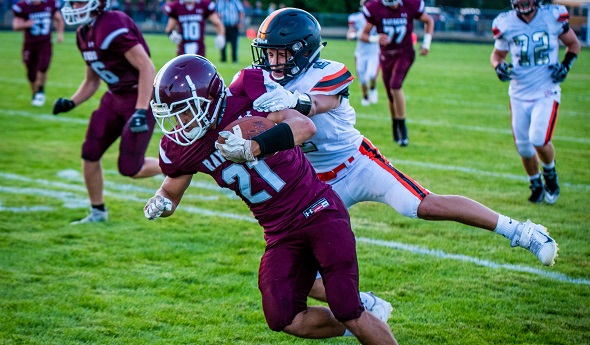
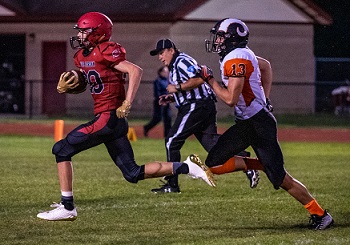
PHOTOS: (Top) Charlevoix, carrying the ball, opened this season with a 40-26 win over Elk Rapids. (Middle) East Jordan got a step on Harbor Springs on this play last week, but the Rams emerged with a slim 34-33 win. (Photos by Sports in Motion.)
Resilient Shelby Turning Struggles Into Strength During 1st Playoff Run in 12 years
By
Tom Kendra
Special for MHSAA.com
November 6, 2025
SHELBY – Not many football teams could sustain back-to-back heartbreaking losses to end the regular season – compounded with losing their senior starting quarterback to a broken hand during the first of those defeats – and still go on a playoff run.
 But not many football programs have endured half the adversity Shelby has over the past 10 years.
“Show me a place of struggle, and I’ll show you a place of strength,” said fifth-year Shelby coach Phil Fortier, who started as an assistant in 2009 at the Oceana County school, located near the towering Silver Lake Sand Dunes.
“We struggle with a lot of things here at Shelby, but there is a resilience. These kids don’t quit, and they are used to bouncing back.”
Shelby (6-4) shook off season-ending road losses at Mason County Central and Muskegon Orchard View with an impressive, 20-2 road victory at LeRoy Pine River in last weekend’s Division 7 District Semifinal – the school’s first playoff win in 12 years.
The Tigers will travel a little farther north this Friday to Harrison (8-2), seeking their first District championship since advancing to the Semifinals in 2012 and 2013.
What has transpired with Shelby football since that high-water mark is a case study in what can happen at a small, rural school when things start snowballing in the wrong direction. The Tigers have not won more than three games over the past 11 years, with five winless seasons.
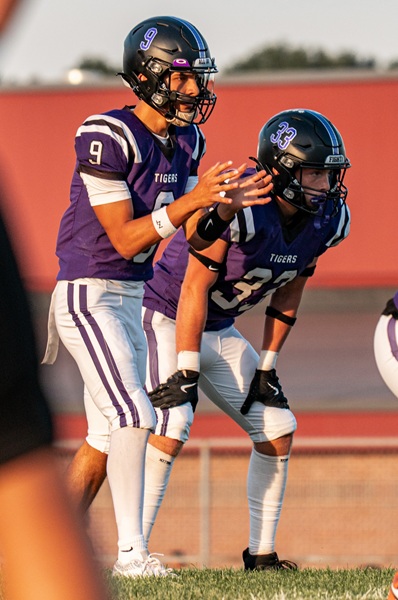 When Fortier stepped up to the head coaching job in 2021, he had his eyes on a dynamic group of middle schoolers who could turn things around.
Among that special group are senior Isaac Garcia and junior Jaylin Henderson, who have led the Tigers’ turnaround season by sharing the crucial quarterback spot in the veer-option offense.
While a two-quarterback system is not unique, one that is split exactly 50-50 certainly is rare. Garcia and Henderson both have attempted 67 passes and completed 35 of them, with Henderson having a slight edge in passing yardage (624 to 620) and Garcia the edge in touchdown passes (6 to 4).
Garcia has leadership skills galore – he is the one his teammates look to in times of trouble, and he is also extremely accurate in the short-passing game.
Henderson, an MHSAA Individual Wrestling Finals qualifier last winter at 157 pounds, has athletic ability coming out of his ears, according to Fortier. He can throw a deadly deep ball on one play, then run over a linebacker on the next.
“I have been watching Tony Annese up at Ferris using all types of different quarterbacks in this offense,” said Fortier, who works closely with offensive coordinator Forrest Courtright. “Here we are with these two super-talented kids who bring different skills to the position, so why not use them both?”
In addition, Garcia was serving as a mentor for his talented, but younger, teammate.
“Isaac has really helped me a lot with my reads,” explained Henderson, who is second on the team with 95 carries for 617 yards and 10 touchdowns. “He gives me feedback and helps me to get better every week.”
The system was working beautifully, as Shelby raced to a 5-2 start, highlighted by a 28-18 win over rival Hart and a 44-8 manhandling of Muskegon Catholic Central.
Then came the first half of the Week 8 game at Mason County Central, when Garcia’s right (throwing) hand got crunched against a helmet on a kickoff, resulting in a broken metacarpal bone.
Just like that, the training wheels were off for Henderson, who is now Shelby’s all-the-time QB and has responded with his legs against Orchard View (19 carries for 144 yards and two TDs) and his arm against Pine River (8-of-14 passing for 155 yards and one TD).
It helps that the Tigers have a pair of 6-3 wide receivers in Trevor Weiss and Evan Waller, dangerous slot receiver DayDay Garcia and the constant threat of junior fullback and leading rusher Brody Fessenden (140 carries for 786 yards and 11 TDs).
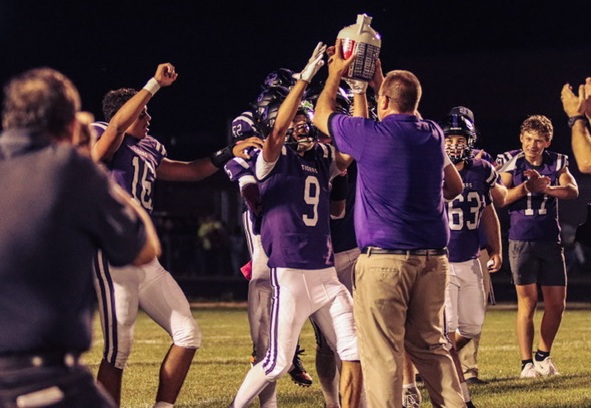 “At this point in the season, our chemistry is really good,” said Henderson. “I trust all of our receivers. If I give them a chance, they will make the catch.”
Meanwhile, Garcia has been fitted with a club to protect his right hand and is back starting at safety, where he came up with a huge sack on third down and a pass deflection on fourth down to stop a late Pine River drive during last week’s playoff opener.
His return to the field has energized and motivated his teammates, who are watching their leader refuse to let even a broken throwing hand stop him in his senior year.
“At first, when the injury happened, I was very sad and depressed and didn’t want to leave my room,” said Garcia, a three-sport athlete who also competes in basketball and track.
“Then when they told me that I could play with a club, that brought my mood way up. It’s kind of like our team, we’re not gonna let anything stop us.”
 Tom Kendra worked 23 years at The Muskegon Chronicle, including five as assistant sports editor and the final six as sports editor through 2011. E-mail him at [email protected] with story ideas for Muskegon, Oceana, Mason, Lake, Oceola, Mecosta and Newaygo counties.
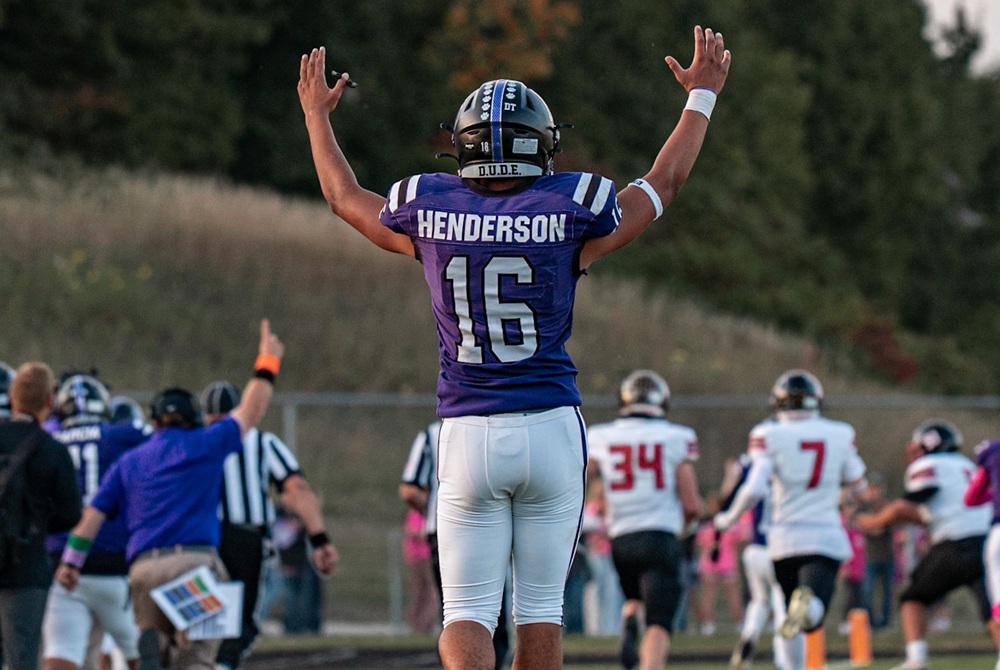
PHOTOS (Top) Jaylin Henderson celebrates a Shelby touchdown during the Tigers' 28-18 win over rival Hart in Week 3. (Middle) Isaac Garcia waits for the snap as running back Brody Fessenden stands ready. (Below) Garcia and coach Phil Fortier celebrate with the "Blood, Sweat & Tears" trophy after Shelby's win over Hart. (Photos courtesy of the Shelby football program.)