

Playmaking Sargent Powers Chargers
November 25, 2015
By Bill Khan
Special for Second Half
FLINT — Most high school football coaches aren't comfortable having their quarterbacks, no matter how athletic they are, perform double duty by playing defense.
 The risk of injury or excessive fatigue is simply too great.
Flint Powers Catholic's Bob Buckel is no different than the majority of his peers.
"I'll be honest, I don't feel comfortable having him on the field all the time," Buckel said of senior quarterback Noah Sargent.
And, yet, having Sargent play defensive back when he isn't running the offense is one of the reasons why Powers (11-2) will play Zeeland West (13-0) for the MHSAA Division 4 championship at 7:30 p.m. Friday at Ford Field.
Sargent's team-high third interception of the season played a major role in Powers' 21-14 come-from-behind victory over Detroit Country Day in the Semifinals last Saturday in a snowstorm at West Bloomfield
He had already ignited a comeback from a 14-0 halftime deficit by tossing a 38-yard touchdown pass to Peyton Beauchamp. Sargent's one-handed interception later in the third quarter at the Country Day 20-yard line set up a 20-yard touchdown run by Reese Morgan.
Showing off one more aspect of his skill set, Sargent scored the winning touchdown on a 2-yard run with 26 seconds left in the game, putting Powers in the MHSAA championship game for the third time in school history. The 2005 team won the Division 4 championship, while the 2011 squad won the Division 5 title.
Putting an exclamation point on his performance, Sargent knocked down Country Day's final desperation pass as time expired.
"Noah understands we don't want him to get killed on defense," Buckel said. "We really try to put him on the best receiver and keep him out of harm's way. I heard someone earlier in the year say, 'When you get to the playoffs, you've got to save him.' I said, 'When you get to the playoffs, you have to play every play like it's your last play.' You throw him out there and hope for the best; the best happened last Saturday."
Sargent has 19 tackles, ranking ninth on the team. He is part of a defense that has allowed only 21 points in four playoff games and posted a school-record six shutouts.
"Coach really only plays me as a cover guy," Sargent said. "He doesn't like to throw me down (near the line). He uses me in coverage on third-and-long situations and passing downs."
As a quarterback, Sargent has displayed the kind of dual-threat capability that was integral to Powers' last MHSAA championship four years ago. Garrett Pougnet ran for 159 yards and two touchdowns and threw for 258 yards and four touchdowns in Powers' 56-26 rout of Lansing Catholic in the 2011 title game.
Sargent is Powers' leading rusher, in addition to its leading passer. He's run 134 times for 1,026 yards and 15 touchdowns, including an 83-yard scramble on third down for a touchdown in the playoff opener at Goodrich. He's 104 for 181 for 1,563 yards, 18 touchdowns and only four interceptions. Five of those touchdown passes came in a 41-0 victory over Goodrich, as he had a hand in all six touchdowns.
 "We knew Sargent was the show," Goodrich coach Tom Alward said. "They've got good receivers, but Sargent's the one that makes them go."
Sargent is the son of Mike Sargent, an all-state linebacker at Powers in 1983 and a tight end on Michigan State's 1988 Rose Bowl championship team. Both of Sargent's parents went to Powers, and Noah attends his parents' alma mater with his sister, Nikole, who was the MHSAA Lower Peninsula Division 2 shot put champion as a junior last spring.
"He's a good leader," said senior tight end Nick Thompson, Powers' leading receiver with 27 catches for 448 yards and seven touchdowns. "He's humble. He's not selfish. He has the aspects of a good leader. You can see it on the field, obviously, and at practice. We trust him."
Sargent isn't the only Charger with a rich Powers pedigree.
Running back Reese Morgan and receiver Matt Wiskur had brothers on the 2011 championship team. Brooks Morgan was a starting receiver, while Ethan Wiskur was a starting defensive back who had an interception in the 2011 title game.
Watching in the stands as middle school students, the younger Morgan and Wiskur brothers had all the incentive they needed heading into high school.
"That's my main motivation," said Wiskur, who has 23 catches for 383 yards and five touchdowns. "They're the strongest team I've ever seen. They had great leaders. They were 5-4 going into the playoffs. They knew they were going to win states the whole time. They were confident in themselves, and they lived up to that."
A similarity between the 2011 and 2015 teams is their slow starts. Powers was on the brink of playoff elimination after six games, starting out 2-4 in Buckel's first season at the helm. This year's team lost its opener, 27-11, to a Flushing team that went 3-5 the rest of the way. The Chargers were 3-2 before winning their last eight games.
"I remember they didn't have a very good start, but they had a lot of heart and they made a big run in the playoffs and kind of shocked everyone," said Morgan, who has run 146 times for 987 yards and 10 touchdowns while catching 27 passes for 317 yards and two scores.
"The talent on that team was incredible. We have the same chance they did of winning."
When Powers steps foot onto the turf at Ford Field on Friday, the current team will play under the watchful eye of youngsters who hope to one day have the same experience.
"Any high schooler wants to leave a legacy when they leave," Sargent said. "Our whole team is trying to make a mark on Powers history."
 Bill Khan served as a sportswriter at The Flint Journal from 1981-2011 and currently contributes to the State Champs! Sports Network. He can be reached at [email protected] with story ideas for Genesee, Lapeer, St. Clair, Sanilac, Huron, Tuscola, Saginaw, Bay, Arenac, Midland and Gladwin counties.
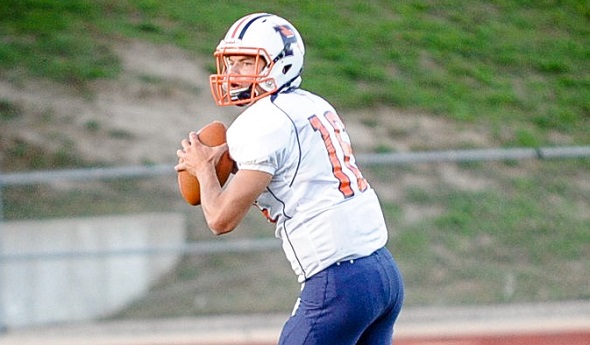
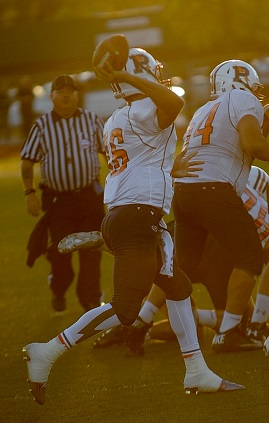
PHOTOS: (Top) Powers Catholic quarterback Noah Sargent drops back to pass against Midland Dow this season. (Middle) Sargent unloads a throw during the 35-30 loss, but has led the Chargers to an 11-2 record this fall. (Click for more from HighSchoolSportsScene.com.)
After Slight Delay, Veteran Spring Lake Impresses in Long-Awaited Launch
By
Tom Kendra
Special for MHSAA.com
September 9, 2021
Spring Lake returned 17 starters and, understandably, couldn’t wait to get this season started.
 But just as the Lakers were revving up their engine for takeoff, they were idled for another week.
Spring Lake picked up a forfeit victory in Week 1 after Muskegon Orchard View decided to not field a varsity team this fall, so the Lakers put in another week of practice and then unleashed all of their pent-up energy on Zeeland East last Thursday.
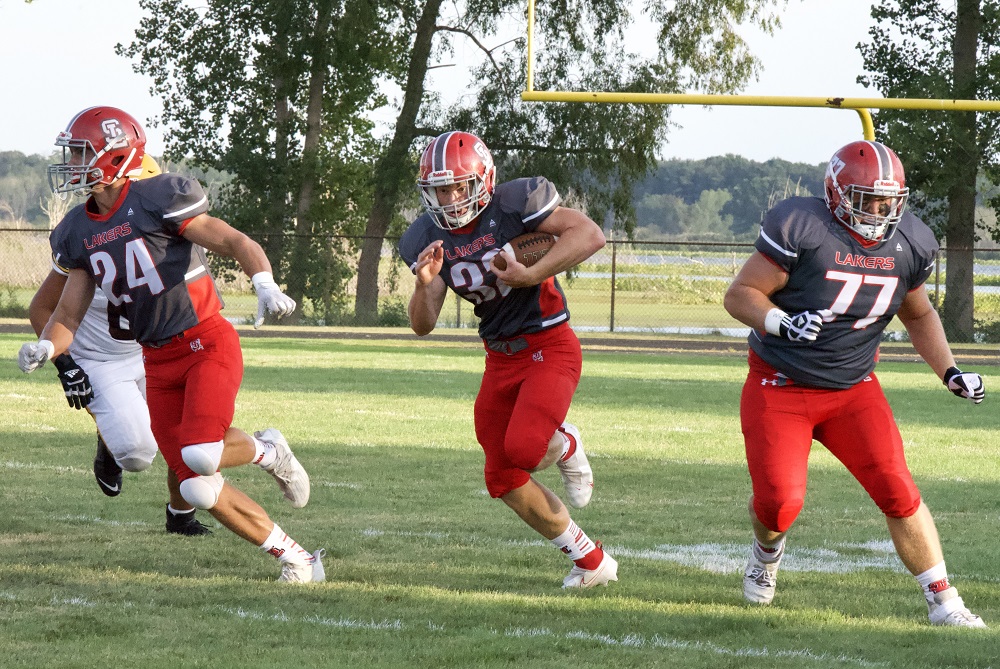
Christian Folkert rushed 11 times for 211 yards and four touchdowns as Spring Lake sprinted to a 42-0 halftime lead and then cruised to a convincing 56-21 nonleague victory.
“We were so excited and pumped,” said Folkert, a 5-foot-11, 195-pound senior. “We wanted to go out there and send a message and show everyone what we have this year.”
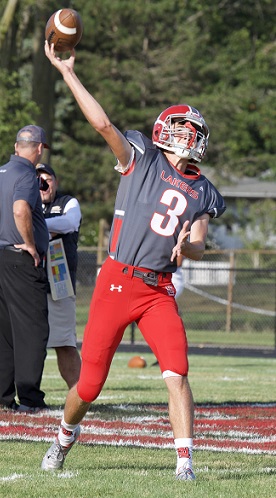
After the Lakers’ front line and Folkert established itself in the first quarter, senior quarterback Jackson Core (6-1, 170) did his thing in the second quarter, connecting on touchdown passes to senior Joe Westhoff and junior Derrick Paggeot.
Core finished 6-of-7 passing for 90 yards, and Paggeot had four catches for 71 yards. SL piled up 401 total rushing yards, with eight ball carriers.
The final score was a surprise to many throughout West Michigan, considering Zeeland East plays in the larger Ottawa-Kent Conference Green and has qualified for the playoffs 10 straight seasons. About the only people not surprised were Spring Lake’s 19 seniors, who are used to winning – and winning big.
 The Lakers’ senior class went undefeated in seventh grade, lost one game in eighth grade (to Hudsonville Unity Christian), then went unbeaten as freshmen and sophomores – despite having five of the best players from the class playing on the varsity as sophomores. Those five who were called up in 2019 were Folkert, twin brothers and linemen Travis and Hunter Throop, RJ Lisman (C/LB) and Ty French (H-back/DE).
“Our senior class is used to winning, and that gives us confidence,” explained Core, whose father, Bill, is Spring Lake’s longtime basketball and softball coach. “It’s not just a couple of us seniors, we have a lot guys who can play and push each other. I guess that’s why we’re so excited for this season.”
Spring Lake broke through last season and beat Fremont (48-0) in a Division 4 District opener, snapping a 12-game playoff losing streak dating back to 2001, before falling to Ada Forest Hills Eastern (28-21) in the District Semifinal.
The bulk of that 5-3 team is back, led by Folkert, who combines size and speed – and now another intangible, according to sixth-year Lakers coach Dan Start.
“In the past, Christian was more of a battering ram who ran people over,” explained Start, a former player at Grandville, who coached football in Florida before taking the Spring Lake job in 2016. “He can still do that, for sure, but he’s learned how to make them miss, too. His change of direction and vision is much-improved.”
Folkert is also a leader of the Lakers’ 4-2-5 defensive look from his defensive end position. With Folkert and French setting the edge at the two defensive end spots and the Throop brothers plugging up the middle, Zeeland East was unable to run the ball.
Spring Lake begins league play in the rugged O-K Blue this week at Holland Christian. The real test comes over the final four weeks of the conference season at home against Hudsonville Unity Christian and Coopersville, at Grand Rapids West Catholic and at home against Allendale – all of whom are 2-0 thus far.
“We’ve only won one game, so we obviously have a long way to go,” said Folkert, who also gave a shout out to his school’s student section, which was loud and raucous for the Zeeland East game, clad in matching black shirts. “You never know what is going to happen. We have a lot of good players, but we have to go out there and ball and get it done. I mean, everyone said we were going to lose to Zeeland East and that didn’t happen.”
 Spring Lake has had two undefeated teams during the playoff era, in 1980 and 1982, but neither qualified for the playoffs – which at that time included just 32 teams in the entire state, broken into four classes. The 1982 team was a particularly hard-luck story, posting eight shutouts in nine games and outscoring its opponents by a combined score of 266-6.
The Lakers’ best playoff run came in 2000, when they made it all the way to the Division 5 championship game at the Pontiac Silverdome, losing to Jackson Lumen Christi, 42-15.
Spring Lake reached the second round the following year, but before last fall, the Lakers went “one and done” in the playoffs 11 straight times.
After snapping that skid, this year’s senior-laden Lakers squad is focused on making a long playoff run.
Spring Lake is the largest school in Division 4 with 825 students, which means many of its conference opponents could become early-round playoff foes as well.
“First off, we do play in a very difficult conference,” said Start, whose assistants include offensive coordinator Kyle Jewett and defensive coordinator Aaron West. “So we feel like if we can do well in our conference, then we can do well in the playoffs.
“But honestly, that is so far away. Our goal right now is to get one percent better every day. If we actually do that, the results will take care of themselves.”
 Tom Kendra worked 23 years at The Muskegon Chronicle, including five as assistant sports editor and the final six as sports editor through 2011. E-mail him at [email protected] with story ideas for Muskegon, Oceana, Mason, Lake, Oceola, Mecosta and Newaygo counties.
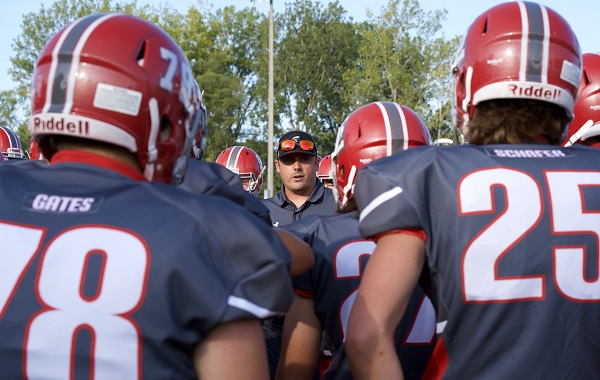
PHOTOS: (Top) Spring Lake senior running back Christian Folkert breaks through a huge hole on a 57-yard touchdown run in the first quarter of the Lakers' 56-21 win over visiting Zeeland East on Sept. 3. Joe Westhoff (24) and Hunter Throop (77) provide additional blocking for Folkert, who finished with 11 carries for 211 yards and four touchdowns. (Middle) Spring Lake senior quarterback Jackson Core launches a pass during his team's win over Zeeland East. He completed 6-of-7 passes for 90 yards and two touchdowns. (Below) Spring Lake coach Dan Start, now in his sixth season, addresses his team before the start of last Thursday’s game. (Photos by Kelly Gates.)