

Process, Relationships Still Matter Most as 4-Time Champ Shillito Coaches 41st Season
By
Steve Vedder
Special for MHSAA.com
October 18, 2024
It was John Shillito's third year as Muskegon Orchard View football coach, and while the wolves weren't exactly knocking at the door, some faint low growls could clearly be heard.
Shillito had been successful at Comstock Park with his teams going 21-8 over three seasons, but the move to Orchard View included 3-6 and 4-5 records the first two.
While there wasn't yet widespread anxiety, Shillito recalls there was a bit of concern.
"I was much younger then and wasn't as successful yet in education," Shillito said. "But we weathered it and came through the other side. But you wonder a little; there's always a little self-doubt. I think it was important to go through it, because you can learn as much even when you're not winning."
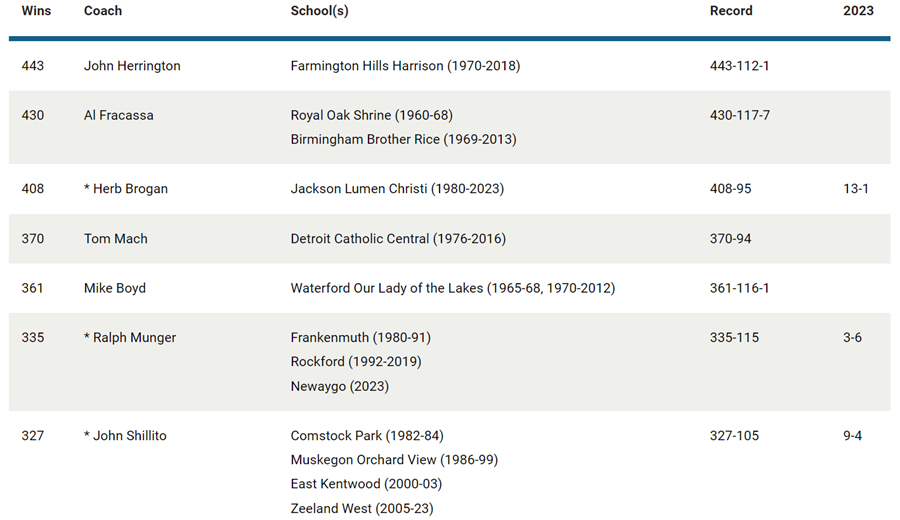
Michigan high school football is the better for Shillito sticking it out. Two schools later, Shillito finds himself as the state's third winningest active coach and seventh overall with a 333-106 mark over 41 seasons.
His Zeeland West team is 6-1 this season and likely to become his 27th team – and 15th in a row – to qualify for the playoffs. Shillito's teams at Byron Center, Muskegon Orchard View, East Kentwood and Zeeland West have won a combined 16 conference titles.
Not bad for someone whose first love was baseball. Shillito's father, Harry, played three seasons professionally in the Brooklyn Dodgers system during the "Boys of Summer" era of the 1940s and 50s. Shillito grew up as a talented catcher in the spring and top football prospect as a defensive lineman in football. When programs such as Central Michigan, Eastern Michigan and Northern Michigan began showing an interest, the lure of a football scholarship made it an easy decision which sport he would follow.
After playing three years at Central Michigan, his coaching career kicked off with an assistant gig at Central Bucks East in Pennsylvania in 1980. He became head coach at Comstock Park in 1982.
 Shillito said the same motivation which drove him into coaching has kept him in the sport for nearly five decades. It's not necessarily winning state championships – he’s won four at Zeeland West – or fulfilling a deep competitive drive or even the lure of Friday Night Lights in a small community. It's showing up at practices, adhering to a process and building and honing relationships with players and other coaches.
Take those away and the 67-year-old Shillito, a member of the Michigan High School Football Coaches Association Hall of Fame, would definitely be looking elsewhere to spend Friday nights in the fall.
"It's the process; I love a good practice. You know when (it's good) and when it isn't. More than even the football, it's the coaching process and the people I work with," he said.
"Winning is a week-to-week deal. This week's game is what we're all about. And then in the offseason, it's preparation for the year coming up. The state titles are always a bonus."
Which isn't to say Shillito isn't competitive. Whether it’s been playing hockey, wiffle ball, 3-on-3 basketball or backyard football with his brothers, Shillito's competitive spirit has thrived.
"Oh yeah," he said. "But I'm a glass half full-type competitor. I can find the positive side in either wins or losses. But for me it's about the preparation, no doubt about it."
Shillito's success has come even with opponents knowing exactly what they'll see offensively from his teams: the famed wing-T offense, which he's run since the mid-1990s and was taught to him by famed West Michigan coach Irv Sigler. In fact, Shillito said if there is anything responsible for his success, it's the ability to implement what he's learned from coaches as a whole such as Mike Henry, the longtime basketball coach at Orchard View, or former Remus Chippewa Hills football coach Ron Reardon.
When he first got into coaching, Shillito said the wing-T seemed the easiest to teach. He's tweaked the process over the years, but it's been highly successful for him wherever he's coached. The number of Michigan teams which run the wing-T has probably lessened over the years as passing has taken over many high school offenses. But Shillito said the run-first philosophy can still be found in pockets all over the state. Shillito said he has no second thoughts about devoting his offense to the wing-T, and the success only underscores the point.
"It can be difficult if you're not winning, no doubt about it," said Shillito, who figures he's coached about three dozen 1,000-yard rushers. "But the value in the system is that it's an easier process. That is, if you get a buy-in from the players and community. We've had that at Zeeland West."
 As the sun begins to set on Shillito's coaching career, he's hard-pressed to pick his best, favorite or most surprising teams. For starters, there's the 1983 Byron Center team which reached the Class C Semifinals, or the 1995 and 1999 Orchard View teams which played in Class B Finals and combined for a 24-3 mark.
Or maybe the 13-1 Division 1 runner-up club at East Kentwood in 2002, and the 2006 Zeeland West team which claimed the Division 4 title after winning its last 11 games by an average of 35 points per. Or the 2011 Zeeland West team which went 14-0 to kick off a phenomenal five-year stretch during which the Dux went a combined 60-6.
Ask Shillito about any of those seasons, and his answer as to what he remembers most about his coaching career may be surprising. Many of his most cherished moments include his teams going just 5-6 over the years against Muskegon, including three playoff losses that ended the Dux's season. Balance that with his record against other programs, such as a 73-16 mark against other Lakeshore teams, including an 18-7 record against rival Zeeland East. Or a 10-4 record against traditional Grand Rapids-area powers such as Lowell, Grand Rapids Catholic Central, South Christian, West Catholic and Hudsonville. In the postseason, Shillito's teams are an amazing 54-22 over 26 seasons in the MHSAA Playoffs.
As for knocking heads with Muskegon, Shillito said the thrill of a great rivalry and the consistency his teams have shown over the years is what has always driven him.
"It's the longevity and consistency," Shillito said. "I've gotten to work with great people who have had an equal share in this. I've had such a wide variety of guys I've worked with in four programs, and it’s meaningful. "
He is coy on when he might finally call it a career. He could wake up tomorrow and decide it's the time, or it could be next week, the end of the season or maybe one more season. Who's to say?
"We're getting close now," he will say. "We're always in the moment; that's just where we are. Then we'll evaluate things after the season. That's been true now for several seasons."
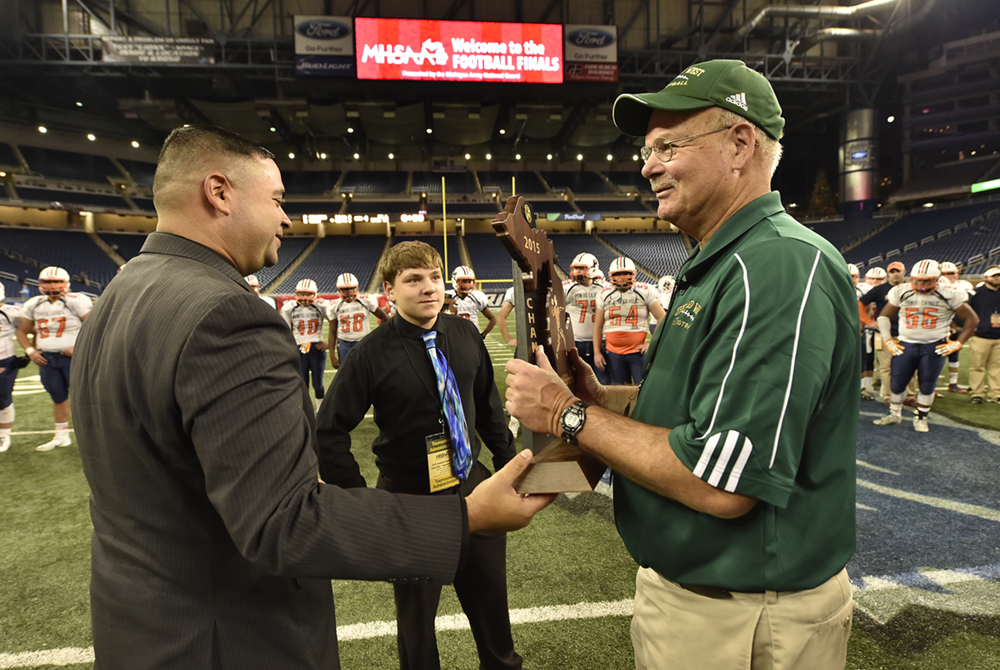
PHOTOS (Top) Zeeland West football coach John Shillito, right, receives the Division 4 championship trophy from MHSAA Representative Council member Orlando Medina in 2015 at Ford Field. (Middle) Entering this season, Shillito ranked seventh all-time and third among active coaches for football victories in the MHSAA record book. (Below) Shillito prepares to send in one of his East Kentwood players during the 2002 Division 1 Final at Pontiac Silverdome. (MHSAA file photos.)
Country Day Two-Time Champ Moore Building Perennial Winner at Harvard
By
Keith Dunlap
Special for MHSAA.com
July 16, 2026
Carrie Moore says her high school sports experience in Michigan has “left a lifetime impression on me.”
 Back in the early 2000s, Moore certainly had a fulfilling one while starring as a two-sport standout at Detroit Country Day.
In basketball, she was a four-year varsity performer for legendary head coach Frank Orlando, helping guide Country Day to Class B titles in 1999 as a freshman and 2002 as a senior. During the latter, she was a first-team all-state performer and scored a team-high 18 points in a Semifinal win over Flint Powers Catholic.
Moore also was a standout soccer player on that Country Day varsity powerhouse for three years.
“Who I am as a leader, as a competitor, and a team player is because of what I learned about the process in high school as a student-athlete,” Moore said. “The pursuit of excellence isn’t always easy, but I learned at such a young age that I can do hard things. I was challenged because I was surrounded by the best on the court and in the classroom, but ultimately it brought out the best version of myself and I was so prepared for what came next after graduation.”
Make no mistake about it, Moore has continued to do great things since graduating from Country Day in 2003.
She is currently the head women’s basketball coach at Harvard, where she just completed her fourth season and has amassed an 80-41 record with the Crimson. This past season, she helped guide her team to a 20-12 record and the Women’s Basketball Invitational Tournament.
Moore was a terrific college player at Western Michigan, finishing as the school’s all-time scoring leader with 2,216 points and earning Mid-American Conference Player of the Year in 2007 after averaging 25.4 points per game. But she initially wasn’t planning on being a coach once her time at Western was over.
After playing one season professionally in Poland and then being cut twice by WNBA teams during training camp, Moore had an opportunity to join the coaching staff at Princeton in 2010.
From there, the coaching bug bit her, so to speak.
“Being a part of that program allowed me to see the lasting impact I could have on young women in growing them as people and players, and ultimately, give back to the game that gave me so much,” Moore said.
Moore was on the staff for two seasons at Princeton, and then moved on to Creighton, where she spent five years as an assistant coach.
Following a second stint as an assistant coach at Princeton that lasted four years, Moore moved on to North Carolina, where she spent two years as an assistant coach and recruiting coordinator for the program.
 A native of Lathrup Village, Moore then briefly returned to her home state for the 2021-22 season, serving as an assistant coach and recruiting coordinator for University of Michigan’s team that went 25-7.
After that season, the opportunity at Harvard came about, and Moore has proved she can be successful running a program as well.
In her first season, Moore set a program record for most wins by a first-year head coach (20). Two years later, she guided the Crimson to its first Ivy League Tournament title and back to the NCAA Tournament for the first time in 18 years.
Even to this day, Moore is influenced by her time at Country Day and in Michigan. She speaks regularly to Orlando, picking his brain for advice or an answer to any other question that might come up.
“I keep in touch with Coach O as often as I can,” Moore said. “He reaches out after big wins or tough losses and always reassures his belief in me as a leader of young women. His mantra ‘Believe It’ is living on within our program at Harvard, and I hope he feels deeply connected to it because of it. I will always honor him in any way that I can, as he has shaped me greatly as a human and coach.”
Moore hasn’t had a player from her home state on her Harvard roster. But she said Michigan is an important recruiting area, and she’s keeping an eye out for prospects.
“I’m very hopeful that it will happen one day,” Moore said.
2026 Made In Michigan
July 9: Multi-Sport Career at TC West Helps Gillis Thrive as Pro in Game She Once Left Behind - Report
July 2: Inspired by Home, Eager to Give Back, Spencer Hosts Hoop City Alumni Games - Report
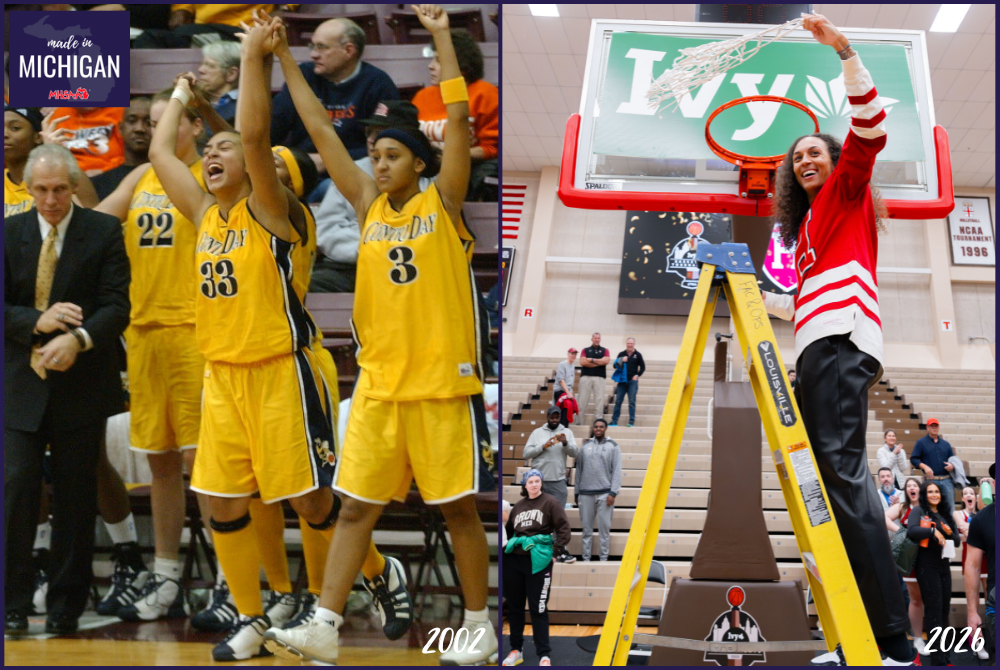
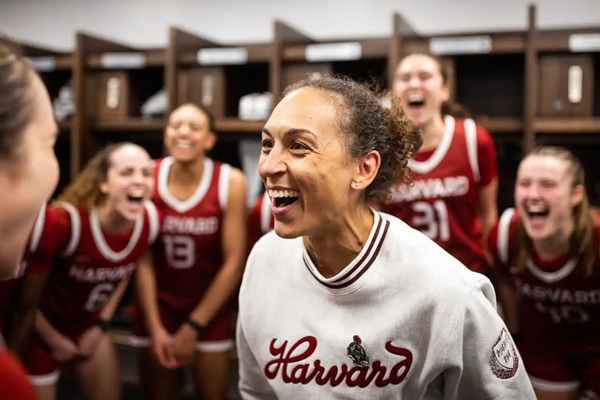
PHOTOS (Top) At left, Detroit Country Day’s Carrie Moore (33) celebrates with her teammates at the end of a Class B Semifinal win over Flint Powers Catholic in 2002. At right, Moore holds up the net after making the last cut this past season to celebrate Harvard’s Ivy League Tournament championship. (Middle) Moore enjoys a moment with her Crimson players. (Harvard photos courtesy of the Harvard athletic department.)