


'Sailor Salute' Honors Those Who Serve
September 5, 2016
By Tom Kendra
Special for Second Half
It’s hard to believe a game with the magnitude of Zeeland West at Muskegon Mona Shores could be anti-climactic.
 But that was certainly the case on a special night Thursday at Sailor Stadium in Muskegon, where the real story unfolded before the opening kickoff.
The “Sailor Salute” was a massive tribute to all of those who serve their country and their community, combining the magic of a high school football game with military responder vehicles, a U.S. Army Lakota Helicopter, 300 motorcycles, 1,500 students and community members decked out in red, white and blue singing “God Bless America” and the national anthem on the field and then two flyovers by the Hooligan Formation Flying Flight Team.
And that was all before the game began.
“We have done a military appreciation night for quite a few years now, but this year we decided to try and step it up a little bit,” said Mona Shores athletic director Ryan Portenga, explaining a pre-game event which drew national television exposure. “These people that serve our country and our communities deserve it. So we just kept bringing in more groups and ended up with huge, patriotic community event.”
The pre-game festivities went off pretty much without a hitch, helped by sunny skies and ideal temperatures in the low 70s.
 The football game capped off a day where Mona Shores also hosted volleyball, soccer and tennis competitions. School officials opened the gates to the stadium at 5 p.m. to allow time for fans to walk around the north side of the track and explore and get pictures with 10 different military and emergency responder vehicles.
Around 6:30 p.m., an estimated 300 riders from different motorcycle groups who support military veterans roared into the stadium and filled the south side of the track. At 6:50 p.m., the community choir joined the marching band on the field for two emotional songs, timing things perfectly as the four military planes flew by in their precise formation, white smoke trailing them, just as the giant choir sang “home of the brave” with a booming crescendo.
Having to compete against a pre-game show to end all pre-game shows, the game itself certainly held up its end of the bargain – continuing the excitement for more than 4,000 fans in a classic matchup of the wing-T system and precision execution of Zeeland West against the speed and athletic ability of Mona Shores.
Zeeland West put on a power blocking and running clinic and jumped out to a 24-14 halftime lead. Mona Shores fought back valiantly in the second half, sparked by a 95-yard touchdown pass from junior quarterback Tristan Robbins to junior wideout Keyshawn Summerville late in the third quarter, then taking its first lead, 28-24, on a 14-yard run by bruising running back Marcus Collins on its next possession.
 But that’s when the Dux did what they do best, churning out a 16-play, 73-yard drive – using up more than 7 minutes off the clock – before senior Drake Fincannon scored what proved to be the winning touchdown on a 1-yard plunge with 1:50 remaining.
Perhaps inspired by the pre-game festivities, the Sailors did not quit. Shores marched down to the 10-yard line, and Summerville made an amazing one-handed catch in the back of the end zone on fourth down, but was unable to get a foot down in-bounds.
“Tonight was a terrific game from both teams,” said veteran Zeeland West coach John Shillito. “We’re happy to be part of something so good. I compliment Mona Shores for doing it in such a classy way where it didn’t interfere with the football game at all.”
In terms of an early-season, nonconference matchup, high school games don’t get much bigger.
Zeeland West is the defending Division 4 champion, with that latest title its third in the past five years and fourth overall since its first year of football in 2005 – all under Shillito, who previously took Muskegon Orchard View (1995 and 1999) and East Kentwood (2002) to MHSAA championship games.
 Mona Shores, meanwhile, is emerging as a new football force after years of struggle. The Sailors made the playoffs for the first time in school history in 2013, then followed that up with a run to Ford Field and a Division 2 runner-up finish in 2014. Shores registered its first 9-0 regular season last year, before falling to rival Muskegon, the winningest program in state history, in the District Finals.
Shores graduated 21 of 22 starters off its 2015 team, but has proven in a big opening win over Holland West Ottawa and its hard-fought loss to Zeeland West that it’s a program that isn’t going anywhere. The tough schedule continues this week with a trip to Rockford before Ottawa-Kent Conference Black play begins.
The victory moves Zeeland West to 2-0, after winning a grueling defensive battle, 14-9, over visiting Cedar Springs in Week 1. The Dux, who compete in the O-K Green, play another blockbuster nonconference game this week at defending Division 5 champion Grand Rapids West Catholic in not only a battle of unbeatens, but also defending title winners.
But no matter what happens the rest of the way, it’s unlikely that either team or its fans will be part of another event quite like the Sailor Salute.
“It was an awesome community atmosphere, and on top of that, a great football game,” Mona Shores coach Matt Koziak said afterward. “If you love high school football and the United States of America, this was the place to be.”
 Tom Kendra worked 23 years at The Muskegon Chronicle, including five as assistant sports editor and the final six as sports editor through 2011. E-mail him at [email protected] with story ideas for Muskegon, Oceana, Mason, Lake, Oceola, Mecosta and Newaygo counties.
PHOTOS: (Top) The Mona Shores logo on the field was painted red, white and blue as part of the Sailor Salute tribute to those who serve the country and the community Sept. 1 at Mona Shores High School. (Middle above) More than 300 motorcycle riders who support veterans roared into Sailor Stadium shortly before kickoff as part of the Sailor Salute. (Middle below) A giant choir of 1,500 students and community members from both Mona Shores and Zeeland West sing “God Bless America” and the national anthem as part of the tribute. (Below) The Hooligan Formation Flying Flight Team flies high over Sailor Stadium at the conclusion of the national anthem. (Photos courtesy of Mona Shores High School.)
Capac Ends 14-Year Postseason Drought, Eager to Begin 8-Player Playoff Run
By
Paul Costanzo
Special for MHSAA.com
October 29, 2025
Not having the option to qualify for the 8-player postseason wasn’t something the Capac football concerned itself with the past three seasons.
 Enrollment was too high at the school to be included in the MHSAA playoff field, and while the 2024 team most certainly would have made it, co-coach Troy Schneider said that since there was nothing that could be done about it, the players weren’t really concerned with it.
But this year, with the opportunity finally there, it lit a fire under the Chiefs.
“It was very motivating for us,” Capac senior quarterback Brody Tesnow said. “All summer, we had decent numbers show up to workouts. Our senior group was really pushing everyone. Our coaches have been on us all year, telling us this is our year that we can do this. I mean, really, we had a decent season last year, and I just feel like that pushed me more to come back this year and be even better.”
Capac is back in the playoffs for the first time since 2011, and at 7-2 is coming off its best regular season since 2001.
That year, the Chiefs advanced to the Division 5 Semifinals. This year’s run will start Friday night with a matchup at Brown City in 8-Player Division 1. A win would be the program’s first in the postseason since 2009.
“I’d love that,” Tesnow said. “That would be a great feeling for us, all the seniors. I remember that win over Deckerville (in Week 8), that was a surreal feeling. I could only imagine what a playoff win would feel like, especially after 14 years of not being in the playoffs.”
It’s been a long road for Capac, which has now had its first back-to-back winning seasons since running off four straight from 2008-11.
Enrollment at the school was near its height back then, peaking at 613 in 2008 before starting a steady decline. It first dipped below 400 in 2015, and by 2020 it was under 300.
That, naturally, led to a decline in football participation as well, and the team was unable to complete the 2020 season, a year where nearly everyone was granted access to the postseason because of the COVID-19 pandemic.
After a 1-8 run in 2021, with a total school enrollment of 211, Capac made the decision to switch from 11-player to 8-player. In each of its first three seasons under the new format, Capac was over the 215-student limit for competing in the postseason. This year, the school is at 203.
 “I didn’t have any decision in that, but our numbers had dropped steadily for a number of years in the school,” said Schneider, who had coached at Capac in 2000s, and took over as varsity coach with Bill Nestle in 2024. “When we came out of the (Blue Water Area Conference), we were a small school, and we were getting pretty well destroyed. Once we moved into the other conference (Greater Thumb), we were with Ubly and Harbor Beach, and I wasn’t coaching at the time, but those are some really good teams, too. There were quite a few people who did not want to make a move to 8-man, but the writing was on the wall with the numbers at the school and the numbers in the football program. It’s been a good move for us. Obviously, a lot of schools have gone to that in the last five years.”
When the program moved to 8-player in 2022, the current senior class was entering high school. Schneider and Nestle had been coaching that group in middle school, and it had shown quite a bit of promise.
There are currently 15 seniors on the varsity team, and while there are only 18 players total on the roster, the junior varsity and middle school programs are thriving, which has people in the high school program optimistic about a future that was pretty uncertain not long ago.
“We’ve got some potential coming up – things are looking pretty good,” Schneider said. “The junior group is small, so they’re going to have small numbers next year as seniors, but the three juniors we have are starters. The next three to four years, it should stay steady and we should be solid.”
But there’s still plenty of work to be done this year, and Capac is confident heading into the postseason despite the fact it lost to Brown City 61-22 in Week 3.
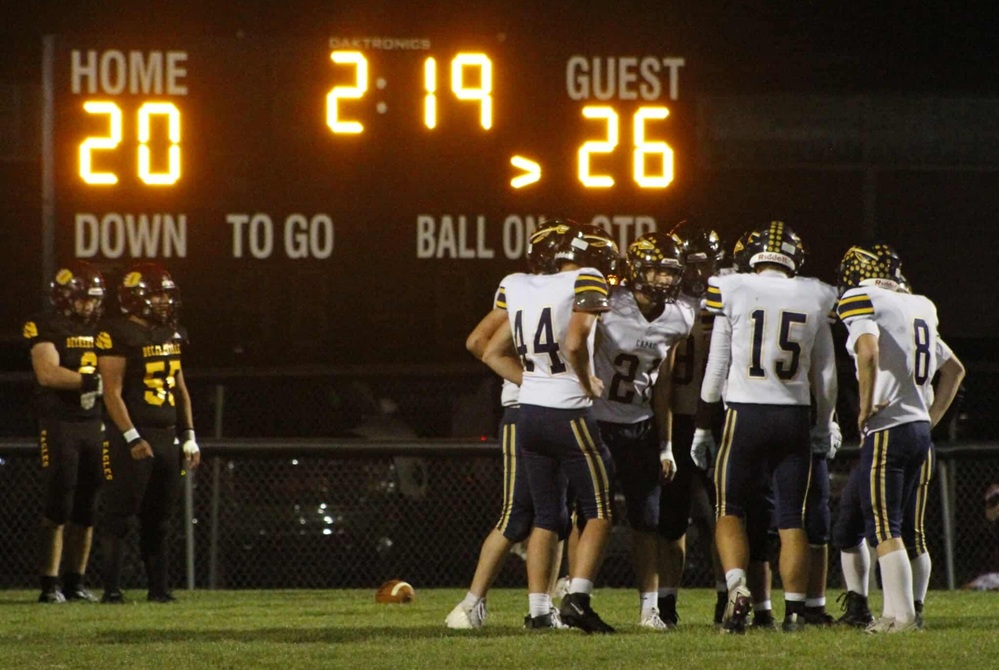
Much of that confidence comes from that Week 8 win against 2024 8-Player Division 1 champion Deckerville. The 28-20 triumph ended Deckerville’s 20-game win streak, as it had not lost since the 2023 Semifinals. It was the first regular-season loss for the Eagles since Sept. 29, 2023.
“Starting the season we went kind of slow, but beating Deckerville told us that we were on that top tier,” senior defensive end and tight end Wiley Roose said. “I mean, after that game, it was crazy. To me, it was definitely the highlight of my sports career in high school. The whole team really came around.”
Beating Deckerville is an accomplishment in its own right, but the fact the Eagles had this season defeated Brown City and Kingston – which delivered Capac’s two losses – was another boost of confidence for the Chiefs, who are ready to show how far they’ve come this fall.
“We watched some film from the game (against Brown City) earlier in the season, and we were just comparing what we were then to how we are now,” Tesnow said. “It’s a huge difference. I’m pumped. We’re proving everyone wrong, and I love that feeling of being the underdog and surprising people.”
Tesnow and his teammates are hoping to continue doing that, but what they’ve done already to get the Capac program back on the right track is a massive accomplishment in itself.
“Coach Nestle and I care about all our players, but seeing these kids develop for five years, go through school, go through some of the losing seasons early in middle school then slowly build and get better – I can think of a number of kids and how they improved with being more aggressive, being tougher and taking the next step,” Schneider said. “It’s really nice to see the kids develop through the program. It’s been sweet. It’s that much better because it’s a great group of kids. They’re wonderful.”
 Paul Costanzo served as a sportswriter at The Port Huron Times Herald from 2006-15, including three years as lead sportswriter, and prior to that as sports editor at the Hillsdale Daily News from 2005-06. He can be reached at [email protected] with story ideas for Genesee, Lapeer, St. Clair, Sanilac, Huron, Tuscola, Saginaw, Bay, Arenac, Midland and Gladwin counties.
PHOTOS (Top) Capac huddles up during the closing minutes of its Week 8 win over Deckerville. (Middle) Sam Schneider (22) carries the ball and follows his Chiefs blockers as they attempt to create an opening against the Eagles. (Photos courtesy of the Capac football program.)