


Tales of the Tape from Bygone Days
September 10, 2014
By Rob Kaminski
MHSAA benchmarks editor
How’s this for a new reality/espionage TV series? Participants have just hours to exchange valuable video to counter-intelligence representatives at random drop points along state highways, then return to home base, study the footage and devise an action plan that same day.
Oh, and there are no cell phones or any other form of portable communication should plans go awry en route.
For longtime Escanaba High School football coach Dan Flynn, it’d be like watching reruns of his days as an assistant coach for the Eskymos. As one of the largest schools in the Upper Peninsula, Escanaba’s road through the MHSAA Playoffs almost always meant facing opponents from below the bridge, which made film exchange a challenge to say the least.
“I’ve logged thousands of miles, maybe more than anyone ever, exchanging film, tapes and DVDs with our opponents during the MHSAA Playoffs,” Flynn said.
“Being in Region 1 geographically, we knew we’d travel,” Flynn added. “And you couldn’t afford to just look at anyone and everyone that you might play. You had to do your homework to narrow down possible opponents if you wanted to go and scout.”
Today, with the MHSAA publishing Football Playoff Points on a weekly basis following Week 4, much of the guesswork as to potential first-round opponents has disappeared.
Additionally, most schools upload game footage to the web within 24 hours following each contest. On Selection Sunday, within minutes after a school’s Pre-District foe is announced, a coaching staff and players can be watching video of their opponent.
“We’d started calling coaches or they’d call me in Week 8 or 9, looking at possible matchups and also planning a place to meet to exchange film,” Flynn said.
Plans had to be firm and communications had to be clear, because once hitting the road, there was no way to contact one another.
“This was before cell phones,” Flynn explained. “I had one of first cell phones, which actually was an old bag phone. I’d accumulate outrageous rates for roaming charges going tower to tower.”
Old-school video exchange might be a thing of the past, but a generation of high school football coaches will never forget gas stations, fast-food joints and 24-hour stores nestled off exit ramps across Michigan.
“On that Sunday night, I’d get in the car, and typically drive to Gaylord, or maybe Grayling. In Gaylord it would be the McDonald’s. In Grayling, it’d be Glen’s Food Market. You’d try to arrange to meet at a place that was open 24 hours,” Flynn recalled. “I always got in the car understanding the meeting would be below the (Mackinac) Bridge. Sometimes we’d get lucky and the meeting place would be the Shell gas station just below the bridge on the Mackinaw City side.”
The 200-mile drive to Gaylord routinely took four hours. The further Escanaba advanced in the playoffs, the more times Flynn wore down the tread on his tires. He specifically recalls a hectic weekend in 1979, when Escanaba traveled to Lansing Sexton and defeated Livonia Stevenson in the MHSAA Semifinals to earn a berth in the Finals the following weekend vs. Detroit Catholic Central. Part of the reward for Flynn was another trip to McDonald’s.
“We came from behind in that Semifinal, and we were thrilled that we were going to the Finals. We got back home late Saturday night, then I got in the car the next morning to meet the Catholic Central coaches at 1 p.m.,” Flynn said.
“Coach (head coach Jerry) Cvengros had a meeting set for 5 or 6 that night. I made it back in time, but our guys were still feeling good about the win, so I suggested we hold off a day before showing them the CC film (16 mm film, by the way). Those guys were pretty good.”
Indeed they were, winning the Class A title the following weekend. The Eskymos, however, would return to the Final in 1981, winning the crown, 16-6 over Fraser, as Flynn no doubt logged more miles in preparation.
The most pressing concern today might be quality of the online video, lighting at the fields, or angle of the camera.
Back in the day, just getting a tape felt like victory.
“One year, I traveled all the way to the southeast part of the state, and the opposing coach simply wouldn’t exchange,” said Flynn, explaining that playoff film exchange at the time was only a recommendation, not a regulation. “I learned later that the coach had video of us from a friend who lived in Escanaba. I left on Saturday morning and came back Sunday night. We did eventually get some film later in the week. We lost by two points, but as coaches we didn’t make it a big vendetta and were up front with our kids.”
The MHSAA Representative Council, which included Flynn at the time, upgraded film exchange from a recommendation to a playoff policy in 1990, when schools were required to supply one another with the two most recent game films.
Even so, and as 16 mm film evolved to VHS tapes and then DVDs, coaching delegates still had to make itineraries for October and November weekends. Sometimes twice in the same weekend.
“Even with advancements in technology as we progressed from DVDs to digital, you still need people to operate the devices,” Flynn said. “I met another coach at the Shell station at the Bridge, but he said our software wasn’t compatible with theirs. I drove back the next day, pushed a button, and it worked. I drove all that way to push a button; 16 mm film would have been better.”
Today’s coaches might be a bit more well-versed in technology than those of Flynn’s era, and it’s a good thing. They likely need MapQuest and a GPS to traverse the regions in Northern Michigan that Flynn and his cohorts knew like the back of their hands.
A Game for Every Fan: Week 7
October 7, 2015
By Geoff Kimmerly
Second Half editor
We're at the point every football season when conference champions begin to be crowned. But for the Week 7's schedule to fall together like this is nearly inconceivable.
Fifteen leagues statewide will feature matchups of teams tied for first place, with five more conferences bracing for tilts between first and second-place teams that could have immediate title implications.
Many of those games are discussed in detail below; all are tonight unless noted. Check MHSAA Score Center for results as they come in, updated standings and playoff-point averages.
Bay & Thumb
Almont (6-0) at Algonac (6-0)
What gives this matchup the slight edge in intrigue over undefeated teams facing off in the Saginaw Valley League (see below)? This is shaping up as arguably the most meaningful game in Algonac football history. The Muskrats’ perfect start is earning attention statewide and is a great story after the team went 1-8 a year ago and last had a winning record in 2005. But a league title, clinched tonight, would be the team’s first since 1972 – and standing in the way is reigning champion Almont, which hasn’t lost in the Blue Water Area Conference since Week 4 of 2013.
Others that caught my eye: Lapeer (6-0) at Midland (6-0), Vassar (5-1) at Unionville-Sebewaing (5-1), Detroit Cesar Chavez (4-2) at Mayville (4-2), Sterling Heights (5-1) at Marysville (4-2).
Greater Detroit
Canton (5-1) at Plymouth (5-1)
Plymouth’s championship-contending golfers this fall could land a ball at Canton in two strokes, these schools are so near to each other. And their last seven football meetings have been about that close too, all decided by 12 points or fewer. The Wildcats own a share of the Kensington Lakes Activities Association South title by way of Canton’s loss last week to Livonia Churchill – but the reigning champion Chiefs can grab a share as well by extending a current winning streak against Plymouth to three.
Others that caught my eye: Berkley (5-1) at Birmingham Groves (6-0), Farmington Hills Harrison (5-1) at Farmington (4-2), River Rouge (6-0) at Pontiac Notre Dame Prep (5-1), Warren Mott (5-1) at Sterling Heights Stevenson (5-1).
Mid-Michigan
St. Johns (5-1) at DeWitt (6-0)
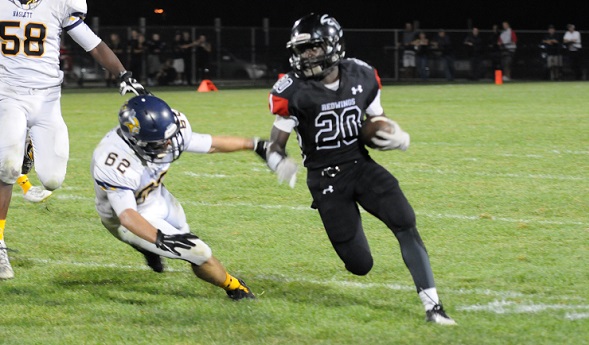
These neighbors are meeting to decide the Capital Area Activities Conference Red title for the second straight season, with DeWitt the reigning champion thanks to last year’s 16-10 victory. The Panthers have won five straight against the Redwings and won’t have trouble drumming up enthusiasm despite coming off facing its other rival, Haslett, last week. The Redwings have lost only to one-loss Grand Rapids Catholic Central, in Week 2, and feature speedy MHSAA track champion Steven Linton in the backfield and a defense that could slow this game down substantially.
Others that caught my eye: Sanford Meridian (6-0) at Harrison (5-1), Howell (5-1) at Brighton (5-1), Vestaburg (5-1) at Mount Pleasant Sacred Heart (3-3), Pewamo-Westphalia (6-0) at Laingsburg (5-1).
Nothern Lower Peninsula
Harbor Springs (4-2) at Frankfort (5-1)
Most of the best up north this weekend are nonleague matchups, but Harbor Springs could make some noise in the Northern Michigan Football League Legends division as it seeks to guarantee its best finish since 2000. The Rams earned an impressive victory last week over 4-2 Indian River Inland Lakes and have won two of the last three against Frankfort – which is first in the Legends and undefeated since opening night. The Panthers have given up 35 points total.
Others that caught my eye: Lincoln Alcona (5-1) at Johannesburg-Lewiston (5-1), Oscoda (4-2) at Hillman (5-1), Gaylord (5-1) at Petoskey (4-2), Maple City Glen Lake (4-2) at Traverse City St. Francis (6-0).
Southeast & Border
Monroe St. Mary Catholic Central (6-0) at Milan (5-1)
St. Mary hasn’t given up more than seven points in a game since Week 3 as it’s cruised during the first two-thirds of its Huron League repeat pursuit. But Milan arguably has been more impressive; the Big Reds, who won the league in 2012 and 2013, are a one-point loss to 5-1 Marshall on opening night from a perfect record this fall – and after losing to the Falcons 43-0 last year, would love to break St. Mary's 11-game winning streak.
Others that caught my eye: Ottawa Lake-Whiteford (5-1) at Morenci (5-1), Ann Arbor Skyline (3-3) at Ann Arbor Pioneer (5-1), Hudson (3-3) at Ida (6-0), Chelsea (6-0) at Ypsilanti Community (3-3).
Southwest Corridor
Watervliet (5-1) at Delton Kellogg (5-1)
This is the product of the reconfigured Southwestern Athletic Conference, which added teams – including Delton Kellogg – from the former Kalamazoo Valley Association this fall and split into three divisions. The SAC Lakeshore division has provided an extra boost to a Delton program that hasn’t made the playoffs since 2001 but has upped its win total three seasons running. Watervliet is a little more used to this with three 10-win seasons over the last four, but this fall both teams are in similar position – both one-point losses from perfection.
Others that caught my eye: Mattawan (3-3) at Battle Creek Central (3-3), Parchment (4-2) at Berrien Springs (6-0), Plainwell (4-2) at Edwardsburg (6-0), Portage Northern (3-3) at Portage Central (6-0).
Upper Peninsula
Negaunee (6-0) at Ishpeming (5-0)
Ishpeming has won 37 of its last 38 regular-season games. The only team to beat the Hematites? Negaunee, back in 2012, but the Miners came close in 2013 and remain Ishpeming’s toughest annual obstacle despite being shut out 28-0 a year ago. Ishpeming is coming off an open week and has had a little extra time to prepare, although a defense that has given up 33 points in five games has looked plenty ready to match a Negaunee offense scoring 41 points per contest.
Others that caught my eye: Calumet (4-2) at L'Anse (4-2), Bark River-Harris (5-1) at Munising (5-1), Iron Mountain (4-2) at Kingsford (4-2), Houghton (3-3) at Lake Linden-Hubbell (6-0) (Sat.).
West Michigan
Grand Rapids West Catholic (4-2) at Comstock Park (5-1)
Most teams would be fine with a 6-5 blip like Comstock Park experienced in 2014 after three seasons with a combined record of 33-6. But the Panthers look like themselves again, with a win over Ottawa-Kent Bronze co-leader Cedar Springs and the only loss to O-K Green co-leader Zeeland West by 10. West Catholic, which won the O-K Green last season thanks to a 47-33 win over Comstock Park, looked like it might be in for an off season after a 1-2 start. But the two-time reigning Division 5 champion has found a source of offense the last three weeks and looks good to make the playoffs for the 13th straight season regardless of what happens tonight. (This game can be viewed live with subscription on MHSAA.tv.)
Others that caught my eye: Byron Center (5-1) at Zeeland West (6-0), Wyoming Godwin Heights (4-2) at Grand Rapids NorthPointe Christian (6-0), Big Rapids (4-2) at Remus Chippewa Hills (5-1), East Kentwood (4-2) at Rockford (4-2).
8-Player
Waldron (6-0) at Battle Creek St. Philip (6-0), Saturday
This has been a history-making season for Waldron, off to its first 6-0 start since 1978 and approaching at least eight wins for the first time since 1984 (its final two opponents, Litchfield and Carsonville-Port Sanilac, are winless). Beating St. Philip would put the Spartans’ run into another echelon. The Tigers’ only losses the last two seasons were three times to reigning 8-player champion Lawrence – and they have a 49-0 win over 4-2 Webberville and a 65-32 win over 5-1 Morrice this fall.
Others that caught my eye: Portland St. Patrick (5-1) at Webberville (4-2), Lawrence (6-0) vs. Prairie Farm, Wis. (7-0) at Madison Middleton, Wis. (Sat.).
PHOTO: St. Johns' Steven Linton (20) turns the corner during a two-point win over Haslett in Week 4. (Click for more from HighSchoolSportsScene.com.)