

Talking Practice: Texas, Illinois Revise Policies
December 20, 2013
By Rob Kaminski
MHSAA benchmarks editor
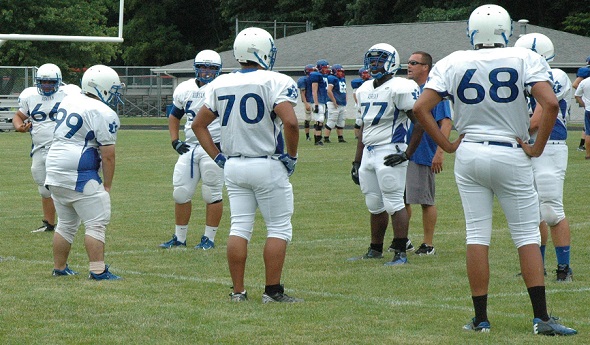
Coaches and players in Texas and Illinois adapted to new football practice limitations this fall, with the Texas policy focusing on contact, and the Illinois regulation emphasizing length of preseason practices.
Following are the main changes those states put in place heading into the 2013-14 season:
The University Interscholastic League, which governs school sports in Texas, put into writing that, “During the regular season and postseason, no football player is allowed to participate in more than ninety (90) minutes of full contact practice per week,” effective with the first day of practice this fall.
The complete policy follows:
For the purposes of the of rule, "full contact" is defined as football drills or live game simulations where "live action" occurs. Live action, as defined by USA Football, is contact at game speed where players execute full tackles at a competitive pace taking players to the ground. A team may continue to dress in full pads for practice, but may only participate in live action drills and game time simulations no more than ninety minutes per athlete per week. It is assumed that when players are in shells (shorts, shoulder pads, and helmets) no live action drills or simulations will occur. This rule is intended to limit live action drills and simulations and not the number of practices a team may participate in full pads. A team may participate in "air," "bags," "wrap," and "thud" drills and simulations at any point. These contact levels are defined below:
• Air - Players should run unopposed without bags or any opposition
• Bags - activity is executed against a bag, shield or pad to allow for a soft-contact surface, with or without the resistance of a teammate or coach standing behind the bag.
• Wrap - Drills run at full speed until contact, which is above the waist with the players remaining on their feet.
• Thud - Same as wrap but tempo is competitive with no pre-determined winner and the players are not tackling to the ground.
 The rule came to the UIL Legislative Council as a recommendation from the UIL Medical Advisory Committee, a permanent advisory committee to the Legislative Council which meets twice each year to discuss and review safety policies for UIL participants. The committee, which is made up of leading medical professionals in various specialties and includes representatives from the Texas High School Coaches Association, the Texas Girls Coaches Association, and the Texas State Athletic Trainer Association, unanimously recommended this limitation in full-contact football practice.
The rule formulates into a formal policy the existing actions of the majority of coaches across Texas, and most coaches have had to make few adjustments, if any. In fact, according to a story on statesman.com, the proposal caused more of an uproar on social media than from coaches.
“It’s not going to affect us in anyway,” Vandegrift HS coach Drew Sanders said in the story. “Most good coaches were way below that 90-minute amount already. Prior to legislation we still monitored it ourselves – the only change is now we have to keep up a log more publicly.”
Illinois put standards in place for its first 14 days of football practices, known as the state’s Preseason Football Acclimatization Practice Period. At the core of the policy is a three-hour practice limit for the first five days, during which teams can also conduct a one-hour walk-through.
 Teams must observe a minimum two hours rest between the practices and walk-throughs. Players may wear helmets only on the first two days, then helmets and shoulder pads for the next three. From days seven through 14 of the acclimatization period, schools may practice for a maximum of five hours per day, as long as that day is followed by a three-hour day, or an off day. During the five-hour days, no session can last more than three hours and must include a two-hour break between practices. Full pads may be worn for the final seven dates leading up to the first contest.
“This policy was the result of a collaborative effort between the IHSA Sports Medicine Advisory Committee and the Football Advisory Committee,” said SMAC committee member and University of Illinois Associate Professor of Orthopedic Surgery Dr. Preston M. Wolin. “The guidelines are based on the most recent scientific evidence, as well as the expertise of the coaches who will help implement them. Both committees believe the guidelines represent a significant positive contribution to the health of our athletes.”
“This new policy undoubtedly changes the way we, as coaches, approach preseason practice,” said Metamora HS coach Pat Ryan, who is a member of the FAC and a past President of the Illinois High School Football Coaches Association. “Coaches have to get more creative with when and how they schedule practices, as well what they do with their time. The proposals were strongly supported by both committees. It is a crucial final step to the process of being able to effectively prepare our teams in a safe manner. Change is always difficult, but the game is changing and we need to adapt to continue to put the safety of our players first.”
The IHSA offered multiple interactive online webinar meetings for high school coaches leading up to the start of practice where questions were answered, along with further clarifications on the policy and the science behind it.
“I think most coaches understood that changes were on the horizon,” said IHSA Executive Director Marty Hickman. “We wanted to be in a position to give our coaches as much information as possible to make sure they are comfortable with the new policy. Their input will be critical moving forward as we develop educational materials, like a best practices presentation. I commend our committees on a policy that is supported by medical experts, football coaches and school administrators.”
A Game for Every Fan: Regional Finals
November 8, 2012
By Geoff Kimmerly
Second Half editor
Let's face it. In high school football especially, it's tough to predict which teams will be around when the big trophies are awarded Thanksgiving weekend. It wouldn't take much research to figure out how many top-ranked favorites have fallen long before finishing the drive for Detroit.
But here's a little indicator that's bearing out as this season's playoffs rush into their third weekend.
Of 64 teams still alive in the 11-player brackets, 53 ranked among the top half of their respective divisions in playoff point average. The four teams remaining in the 8-player bracket all ranked among the top six in that division.
That's rather logical, you might say. But it's also an endorsement for playing tough competition, and further makes it special when a team with a lower average breaks through at the end.
Those teams still alive despite bottom-16 playoff point averages? Congrats on great efforts by Detroit Catholic Central, Caledonia, St. Johns, Three Rivers, Clare, Newaygo, Constantine, Britton-Deerfield, Pewamo-Westphalia, Flint Beecher and Johannesburg-Lewiston.
This week's games are split evenly between Friday and Saturday, with 17 each day. Four Friday games will be streamed live on FoxSportsDetroit.com's Prep Zone: Montrose at Ithaca, Detrot Cass Tech at Saline, Saginaw Swan Valley at Croswell-Lexington and Three Rivers at Grand Rapids South Christian.
Below are all of the Regional Finals with a little extra on some of the best matchups, plus a look at both 8-player Semifinals. Visit the MHSAA Score Center for game times and dates, and all weekend for updated scores and schedules.
Division 1
Rockford (9-2) at Clarkston (11-0)
These two easily come to mind when Division 1 football is discussed. But oddly enough, they've never met. The Wolves are playing for their fourth Semifinal berth and second in four seasons, and were the most popular pick in Division 1 heading into the playoffs. But three-time MHSAA champion Rockford is finally humming after opening 1-2 this fall and losing quarterback Kyle Short for a time. He’s back, and the Rams are playing in their fifth-straight Regional Final.
Other Regional Finals: Detroit Catholic Central (7-4) at Plymouth (9-2), Detroit Cass Tech (9-2) at Saline (10-1), Macomb Dakota (10-1) at Lake Orion (10-1).
Division 2
Muskegon (10-1) at Midland (11-0)
The Big Reds no doubt enjoyed a sigh of relief after edging Lowell in last week’s District Final. But life gets no easier. Midland is working toward what would be the first 14-0 season in its similarly-impressive history, and is keyed by a likely all-state candidate at quarterback in Alec Johnson. Not that Muskegon will be intimidated – this will be its eighth game this fall against a playoff team.
Other Regional Finals: Caledonia (8-3) at Mattawan (10-1), Birmingham Brother Rice (9-2) at Walled Lake Western (9-2), Oak Park (9-2) at Wyandotte Roosevelt (10-1).
Division 3
Grand Rapids Christian (10-1) at Stevensville Lakeshore (11-0)
This may be the game of the weekend in Michigan. Neither has lost to an in-state team – Christian’s only defeat was to Ohio power Cincinnati Moeller – and both have crushed the majority of their opponents this fall. The Eagles scored a season-high 68 points against Zeeland West last week thanks to four touchdown passes plus four touchdown runs by quarterback Alex VandeVusse. This is Lakeshore’s fifth Regional Final over the last decade, and comes after a perfect run through the Southwest Michigan Activities Conference West – one of the state’s most competitive leagues this season.
Other Regional Finals: St. Johns (8-3) at DeWitt (9-2), Tecumseh (9-2) at Battle Creek Harper Creek (9-2), Detroit East English (9-2) at Orchard Lake St. Mary (9-2).
Division 4
Grosse Ile (10-1) at Detroit Country Day (9-2)
The Red Devils have won 10 games for the second straight season after making the Semifinals in 2011. This fall’s success has come against a schedule that has included six playoff teams. Country Day’s slate has included only three teams that made the postseason, but the Yellow Jackets beat a strong one last week in Pontiac Notre Dame and opened the playoffs by dropping previously-undefeated Clinton Township Clintondale 35-0.
Other Regional Finals: West Branch Ogemaw Heights (8-3) at Comstock Park (10-1), Three Rivers (8-3) at Grand Rapids South Christian (8-3), Saginaw Swan Valley (9-2) at Croswell-Lexington (11-0).
Division 5
River Rouge (11-0) at Ann Arbor Gabriel Richard (10-1)
As written on 2H on Monday, River Rouge is one of the best stories of the season – the Panthers are 11-0 for the first time and before last month had won a playoff game only once, in 2001. But this week’s opponent easily will be their toughest this season. Gabriel Richard hasn't given up a point in the playoffs, with a 24-0 win last week over a strong Lake Fenton team.
Other Regional Finals: Clare (9-2) at Menominee (10-1), Newaygo (9-2) at Grand Rapids West Catholic (8-3), Portland (10-1) at Flint Powers Catholic (11-0).
Division 6
Montrose (10-1) at Ithaca (11-0)
One of these weeks, an opponent is going to provide a strong challenge to Ithaca’s 39-game winning streak. Montrose might be it. The two have met in the playoffs the last two seasons, with Ithaca winning only 28-13 in last season’s District Final. Granted, it doesn't look as good for the Rams after surviving by a point in the District Semifinal and by just five against a good Millington team last week. But expect Montrose to bring its best, and Ithaca to match in front of a crowd that could approach 3,000 fans.
Other Regional Finals: Shelby (9-2) at Negaunee (10-1), Constantine (9-2) at Hillsdale (11-0), Monroe St. Mary Catholic Central (9-2) at Grass Lake (10-1).
Division 7
Britton Deerfield (8-3) at Detroit Loyola (11-0)
The Britton-Macon Tories hadn't made the MHSAA playoffs since reaching the Semifinals in 2000, before the school combined in 2010 with Deerfield – which hadn't fielded a football team since 1992. Britton-Deerfield has made the playoffs both years of its existence and has improved two wins on last season’s finish so far. Loyola had easily the highest playoff point average in Division 7 entering the playoffs and is in the Regional Final for the second year in a row. The Bulldogs also entered 11-0 last season and were shut out by Hudson, but have upped their offensive average this fall by a touchdown to more than 46 points per game.
Other Regional Finals: Lake City (10-1) at Ishpeming (10-1), Pewamo-Westphalia (8-3) at Decatur (9-2), Flint Beecher (7-4) at Saginaw Nouvel (9-2).
Division 8
St. Ignace (11-0) at Felch North Dickinson (10-0)
The Saints are playing for their second straight Semifinal berth, but it’s fair to say they’re even better this time around. After giving up a respectable 16 points per game last season, St. Ignace is giving up an average of only five and has five shutouts (not counting the forfeit win over Rudyard in Week 3). North Dickinson’s most noticeable improvement this fall has come on offense – the Nordics have upped their points per game from 38 in 2011 to 50 this fall.
Other Regional Finals: Johannesburg-Lewiston (9-2) at Beal City (11-0), Muskegon Catholic Central (8-3) at Mendon (11-0), Waterford Our Lady (9-2) at Harbor Beach (10-1).
8-Player (Semifinals)
Bellaire (8-3) at Rapid River (10-1)
It’s fair to call these teams two of the original powers in MHSAA 8-player football. Bellaire is 24-8 since making the switch in 2010, and that season finished “mythical” runner-up, that being the term because the championship game was organized by the two leagues and was not an MHSAA playoff game. Rapid River is 20-4 in two seasons as an 8-player program, and was the runner-up in last season’s inaugural championship game. The Rockets stunned the 8-player community last week by beating Cedarville 22-14 after falling to the Trojans 72-12 on Sept. 28.
Deckerville (10-1) at Portland St. Patrick (11-0)
These are both first-year 8-player programs, and it’s fair to say their moves were good ones. Deckerville’s only loss also was to Cedarville, but that was back on the final day of August. The Eagles' run opened with a 42-39 win over reigning MHSAA champ Carsonville-Port Sanilac. All but one of the Shamrocks' opponents were from the southwest part of the Lower Peninsula, but St. Patrick shouldn't be stunned by facing a little bit tougher competition after years of 11-player in the highly-competitive Central Michigan Athletic Conference.
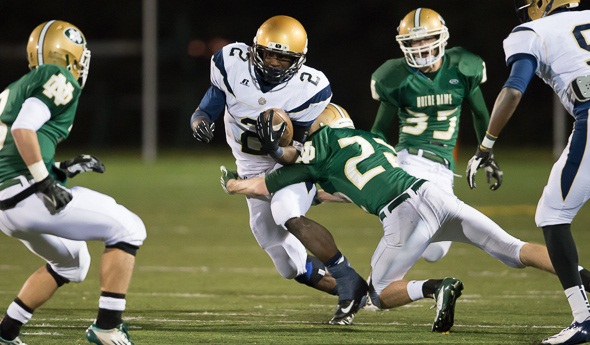
PHOTO: Detroit Country Day senior Trevor Woodland (2) tries to break a tackle by Pontiac Notre Dame senior Mark Juriga during last week’s District Final win for the Yellow Jackets. (Click to see more at Terry McNamara Photography.)