

Talking Practice: Texas, Illinois Revise Policies
December 20, 2013
By Rob Kaminski
MHSAA benchmarks editor
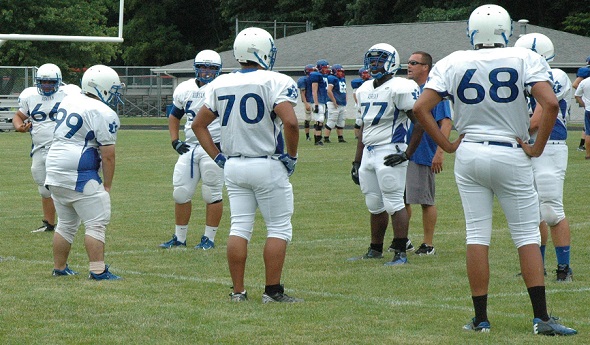
Coaches and players in Texas and Illinois adapted to new football practice limitations this fall, with the Texas policy focusing on contact, and the Illinois regulation emphasizing length of preseason practices.
Following are the main changes those states put in place heading into the 2013-14 season:
The University Interscholastic League, which governs school sports in Texas, put into writing that, “During the regular season and postseason, no football player is allowed to participate in more than ninety (90) minutes of full contact practice per week,” effective with the first day of practice this fall.
The complete policy follows:
For the purposes of the of rule, "full contact" is defined as football drills or live game simulations where "live action" occurs. Live action, as defined by USA Football, is contact at game speed where players execute full tackles at a competitive pace taking players to the ground. A team may continue to dress in full pads for practice, but may only participate in live action drills and game time simulations no more than ninety minutes per athlete per week. It is assumed that when players are in shells (shorts, shoulder pads, and helmets) no live action drills or simulations will occur. This rule is intended to limit live action drills and simulations and not the number of practices a team may participate in full pads. A team may participate in "air," "bags," "wrap," and "thud" drills and simulations at any point. These contact levels are defined below:
• Air - Players should run unopposed without bags or any opposition
• Bags - activity is executed against a bag, shield or pad to allow for a soft-contact surface, with or without the resistance of a teammate or coach standing behind the bag.
• Wrap - Drills run at full speed until contact, which is above the waist with the players remaining on their feet.
• Thud - Same as wrap but tempo is competitive with no pre-determined winner and the players are not tackling to the ground.
 The rule came to the UIL Legislative Council as a recommendation from the UIL Medical Advisory Committee, a permanent advisory committee to the Legislative Council which meets twice each year to discuss and review safety policies for UIL participants. The committee, which is made up of leading medical professionals in various specialties and includes representatives from the Texas High School Coaches Association, the Texas Girls Coaches Association, and the Texas State Athletic Trainer Association, unanimously recommended this limitation in full-contact football practice.
The rule formulates into a formal policy the existing actions of the majority of coaches across Texas, and most coaches have had to make few adjustments, if any. In fact, according to a story on statesman.com, the proposal caused more of an uproar on social media than from coaches.
“It’s not going to affect us in anyway,” Vandegrift HS coach Drew Sanders said in the story. “Most good coaches were way below that 90-minute amount already. Prior to legislation we still monitored it ourselves – the only change is now we have to keep up a log more publicly.”
Illinois put standards in place for its first 14 days of football practices, known as the state’s Preseason Football Acclimatization Practice Period. At the core of the policy is a three-hour practice limit for the first five days, during which teams can also conduct a one-hour walk-through.
 Teams must observe a minimum two hours rest between the practices and walk-throughs. Players may wear helmets only on the first two days, then helmets and shoulder pads for the next three. From days seven through 14 of the acclimatization period, schools may practice for a maximum of five hours per day, as long as that day is followed by a three-hour day, or an off day. During the five-hour days, no session can last more than three hours and must include a two-hour break between practices. Full pads may be worn for the final seven dates leading up to the first contest.
“This policy was the result of a collaborative effort between the IHSA Sports Medicine Advisory Committee and the Football Advisory Committee,” said SMAC committee member and University of Illinois Associate Professor of Orthopedic Surgery Dr. Preston M. Wolin. “The guidelines are based on the most recent scientific evidence, as well as the expertise of the coaches who will help implement them. Both committees believe the guidelines represent a significant positive contribution to the health of our athletes.”
“This new policy undoubtedly changes the way we, as coaches, approach preseason practice,” said Metamora HS coach Pat Ryan, who is a member of the FAC and a past President of the Illinois High School Football Coaches Association. “Coaches have to get more creative with when and how they schedule practices, as well what they do with their time. The proposals were strongly supported by both committees. It is a crucial final step to the process of being able to effectively prepare our teams in a safe manner. Change is always difficult, but the game is changing and we need to adapt to continue to put the safety of our players first.”
The IHSA offered multiple interactive online webinar meetings for high school coaches leading up to the start of practice where questions were answered, along with further clarifications on the policy and the science behind it.
“I think most coaches understood that changes were on the horizon,” said IHSA Executive Director Marty Hickman. “We wanted to be in a position to give our coaches as much information as possible to make sure they are comfortable with the new policy. Their input will be critical moving forward as we develop educational materials, like a best practices presentation. I commend our committees on a policy that is supported by medical experts, football coaches and school administrators.”

Drive for Detroit: District Finals in Review
November 5, 2012
Two down. Two to go.
The postseason portion of this fall's Drive for Detroit is halfway complete. And while a number of contenders have traveled this far many times before, some of the most captivating moments are being created by teams make this leg of the journey for the first time.
For example, River Rouge. The Panthers have one of the strongest basketball traditions in MHSAA history. But before this fall, they'd never won nine football games, much less 11, in one season.
Yet, here they sit, 11-0, with their first District title thanks to a 44-22 win over Almont – an 11-game winner a season ago.
See below for a number of other notable results from this weekend's District Finals, plus a thought on all four 8-player Regional championship games. And click for the rest of last week's scores plus updated schedules as the drive gears up for the third round.
Division 1
Plymouth 20, Livonia Churchill 14
Churchill (10-1) entered the postseason with the highest playoff point average in Division 1, with Plymouth (9-2) tied for 15th. But the Wildcats locked down a Chargers offense that had averaged 44 points per game and extended their sixth-straight playoff run another week. Click to read more from the Detroit Free Press.
Also noted:
Rockford 35, Holland West Ottawa 28 – The Panthers (8-3) gave the Rams a close call for the second time this season, after Rockford (9-2) won by only 10 in their first meeting Sept. 28.
Lake Orion 10, Utica Eisenhower 7 – The Dragons (10-1) scored with just under two minutes to play after trailing Eisenhower (8-3) nearly the entire game.
Division 2
Muskegon 15, Lowell 13
This District Final between two of Michigan's most celebrated powers came down to redemption for what might be the happiest kicker in the state this week. Adrian Briseno missed an extra point and had another blocked, but hit a 27-yard field goal with under two minutes to play to push his Big Reds (10-1) past the Red Arrows (8-3). Click to read more from the Muskegon Chronicle.
Also noted:
Caledonia 23, East Lansing 22 (OT) – After seeing a potential game-winning field blocked late, the Fighting Scots (8-3) outlasted the Trojans (7-4) for their first District title since 2006.
Wyandotte Roosevelt 9, Taylor Truman 0 – The Bears (10-1) lost a three-way tie-breaker to both Brownstown-Woodhaven and Taylor Truman (9-2) for home-field advantage during this District, but beat both Downriver League foes en route to the title.
Division 3
Grand Rapids Christian 68, Zeeland West 44
The Eagles (10-1) have put up massive point totals all season – only once have they failed to score at least 34. But Grand Rapids Christian saved its season-high to offset Zeeland West, which scored at least 38 points in all but one game but couldn’t keep pace this time. Click to read more from the Grand Rapids Press.
Also noted:
DeWitt 45, Linden 44 (6 OT) – The Panthers (9-2) have now used a combined seven overtimes to defeat two of the top four from the Flint Metro Conference, the co-champ Eagles (9-2) and Lapeer West.
Tecumseh 26, Milan 6 – After four straight games decided by three points or fewer, the Indians (9-2) broke one open and ended a perfect season for Milan (10-1).
Division 4
Grosse Ile 70, Dearborn Heights Robichaud 51
One Twitter report had the third quarter of this game lasting nearly an hour. These teams combined for 121 points, good for eighth-most in MHSAA 11-player history for games during which the losing team scored at least 40 (although the record book has not been updated to include all games from this season). At the end, Grosse Ile (10-1) had 10 wins for the second straight season, and Robichaud (9-2) finished its best season since 2007. Click to read more from the Detroit Free Press.
Also noted:
Grand Rapids South Christian 42, Dowagiac 23 – The Sailors (8-3) won their first District title since 2005 by handing the Chieftains (10-1) their first and only loss of the season.
Comstock Park 16, Grand Rapids Catholic Central 7 – This was the third playoff meeting between these two over the last eight seasons, and first win of the three for the Panthers (10-1); the loss was the first and only this fall for GRCC (10-1).
Division 5
Newaygo 30, Reed City 29
What a fall it’s been for the Lions. At 9-2, they’ve tied the school record for wins set in 1994. And they handed Reed City (10-1) its first and only loss to claim their first District title since that season. Click to read more from the Grand Rapids Press.
Also noted:
Grand Rapids West Catholic 13, Muskegon Oakridge 6 – This is only a slightly-lesser upset than the above because although Oakridge entered 10-0, West Catholic (8-3) has made at least the Semifinals the last two seasons.
Flint Powers 34, Frankenmuth 0 – These two both entered 10-0, but reigning champion Powers (11-0) continues to look like a heavy favorite to finish 14-0.
Division 6
Constantine 40, Schoolcraft 27
The Eagles (10-1) had fended off their share of challengers on the way to a 10-0 start, with five wins by 12 points or fewer. The first team to get that close was Constantine all the way back in Week 2. Schoolcraft won that game 42-32, but the reigning runner-up Falcons (9-2) forced the Eagles to play catch-up most of Friday. Click to read more from the Kalamazoo Gazette.
Also noted:
Montrose 33, Millington 28 – The Rams (10-1) keep surviving, with this win over the Cardinals (9-2) their third straight by five points or fewer.
Shelby 26, Maple City Glen Lake 0 – Experience gained from a tough league slate continues to show through for the Tigers (9-2), who ended the best season since 2001 for Glen Lake (9-2).
Division 7
Ishpeming 32, Mancelona 0
Aside from a Week 7 loss to Negaunee, the Hematites (10-1) have thoroughly dominated the rest of their competition this fall. Mancelona, coming in 10-0, looked to be one of the toughest obstacles. But for the second time in three seasons, Ishpeming ended the Ironmen’s season – and in the process won its fourth straight District title. Click to read more from Marquette Mining Journal.
Also noted:
Decatur 34, Lawton 3 – The Raiders (9-2) previously lost to Lawton 38-7 on the first night of Southwestern Athletic Conference South play; Lawton (9-2) went on to split the league title, but Decatur owns the District championship.
Saginaw Nouvel 31, Reese 16 – The reigning champion Panthers (9-2) live on thanks to their best win of a difficult run; Nouvel handed the Rockets (10-1) their lone loss.
Division 8
Mendon 28, Climax-Scotts 6
These two have met in the playoffs four times over the last decade – which makes sense as they are two of the winningest small-school programs in the state during that time. But Mendon has won all four postseason meetings, and with this victory extended its winning streak to 25 including last season’s championship game. Click to read more from the Sturgis Journal.
Also noted:
Harbor Beach 56, New Lothrop 20 – The Pirates (10-1) moved to 21-2 over the last two seasons, while handing New Lothrop its first loss; the Hornets finished 10-1 and are 32-3 over the last three years.
Beal City 28, Mount Pleasant Sacred Heart 21 – They play in different leagues, but these rivals make a point of facing off each season; the Aggies (11-0) also beat the Irish (9-2) on opening night, 38-19, and own four straight over their familiar foes.
8-player (Regionals)
Rapid River 22, Cedarville 14
A lot can change in five weeks. See Rapid River football, 2012. On Sept. 28, Cedarville (10-1) beat the Rockets 72-12 in what eventually became a deciding game for the Bridge Alliance 8-Man Football League title. But the reigning MHSAA runner-up made up plenty of ground to win its second-straight Regional title and improve to 9-2. Click to read more from RRNSports.com.
Also noted:
Bellaire 48, Owendale-Gagetown 0 – After falling in last season’s Regional Final, the Eagles (8-3) left no doubt this time in ending the Bulldogs’ run at 8-3.
Deckerville 50, Kinde-North Huron 0 – The Eagles (10-1) have dominated in this first season in the 8-player division; this was their second win this fall over North Huron (6-5).
Portland St. Patrick 34, Battle Creek St. Philip 28 – The Shamrocks (11-0) beat the Tigers (7-4) for the third time and second straight by seven or fewer points.
PHOTO: Birmingham Brother Rice junior running back Brian Walker surges ahead during the Warriors' 38-6 win over Oxford in Division 2. (Click to see more, plus photos from Detroit Country Day/Pontiac Notre Dame Prep and Plymouth/Churchill at Terry McNamara Photography.)