

Talking Practice: Texas, Illinois Revise Policies
December 20, 2013
By Rob Kaminski
MHSAA benchmarks editor
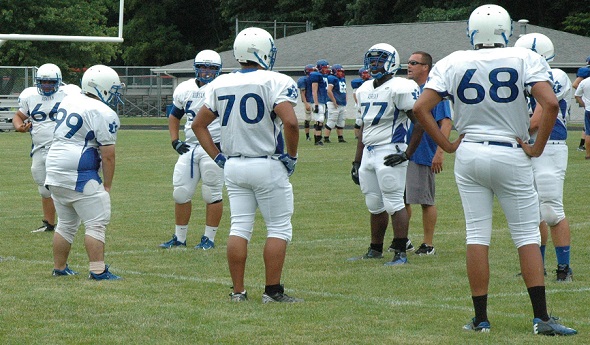
Coaches and players in Texas and Illinois adapted to new football practice limitations this fall, with the Texas policy focusing on contact, and the Illinois regulation emphasizing length of preseason practices.
Following are the main changes those states put in place heading into the 2013-14 season:
The University Interscholastic League, which governs school sports in Texas, put into writing that, “During the regular season and postseason, no football player is allowed to participate in more than ninety (90) minutes of full contact practice per week,” effective with the first day of practice this fall.
The complete policy follows:
For the purposes of the of rule, "full contact" is defined as football drills or live game simulations where "live action" occurs. Live action, as defined by USA Football, is contact at game speed where players execute full tackles at a competitive pace taking players to the ground. A team may continue to dress in full pads for practice, but may only participate in live action drills and game time simulations no more than ninety minutes per athlete per week. It is assumed that when players are in shells (shorts, shoulder pads, and helmets) no live action drills or simulations will occur. This rule is intended to limit live action drills and simulations and not the number of practices a team may participate in full pads. A team may participate in "air," "bags," "wrap," and "thud" drills and simulations at any point. These contact levels are defined below:
• Air - Players should run unopposed without bags or any opposition
• Bags - activity is executed against a bag, shield or pad to allow for a soft-contact surface, with or without the resistance of a teammate or coach standing behind the bag.
• Wrap - Drills run at full speed until contact, which is above the waist with the players remaining on their feet.
• Thud - Same as wrap but tempo is competitive with no pre-determined winner and the players are not tackling to the ground.
 The rule came to the UIL Legislative Council as a recommendation from the UIL Medical Advisory Committee, a permanent advisory committee to the Legislative Council which meets twice each year to discuss and review safety policies for UIL participants. The committee, which is made up of leading medical professionals in various specialties and includes representatives from the Texas High School Coaches Association, the Texas Girls Coaches Association, and the Texas State Athletic Trainer Association, unanimously recommended this limitation in full-contact football practice.
The rule formulates into a formal policy the existing actions of the majority of coaches across Texas, and most coaches have had to make few adjustments, if any. In fact, according to a story on statesman.com, the proposal caused more of an uproar on social media than from coaches.
“It’s not going to affect us in anyway,” Vandegrift HS coach Drew Sanders said in the story. “Most good coaches were way below that 90-minute amount already. Prior to legislation we still monitored it ourselves – the only change is now we have to keep up a log more publicly.”
Illinois put standards in place for its first 14 days of football practices, known as the state’s Preseason Football Acclimatization Practice Period. At the core of the policy is a three-hour practice limit for the first five days, during which teams can also conduct a one-hour walk-through.
 Teams must observe a minimum two hours rest between the practices and walk-throughs. Players may wear helmets only on the first two days, then helmets and shoulder pads for the next three. From days seven through 14 of the acclimatization period, schools may practice for a maximum of five hours per day, as long as that day is followed by a three-hour day, or an off day. During the five-hour days, no session can last more than three hours and must include a two-hour break between practices. Full pads may be worn for the final seven dates leading up to the first contest.
“This policy was the result of a collaborative effort between the IHSA Sports Medicine Advisory Committee and the Football Advisory Committee,” said SMAC committee member and University of Illinois Associate Professor of Orthopedic Surgery Dr. Preston M. Wolin. “The guidelines are based on the most recent scientific evidence, as well as the expertise of the coaches who will help implement them. Both committees believe the guidelines represent a significant positive contribution to the health of our athletes.”
“This new policy undoubtedly changes the way we, as coaches, approach preseason practice,” said Metamora HS coach Pat Ryan, who is a member of the FAC and a past President of the Illinois High School Football Coaches Association. “Coaches have to get more creative with when and how they schedule practices, as well what they do with their time. The proposals were strongly supported by both committees. It is a crucial final step to the process of being able to effectively prepare our teams in a safe manner. Change is always difficult, but the game is changing and we need to adapt to continue to put the safety of our players first.”
The IHSA offered multiple interactive online webinar meetings for high school coaches leading up to the start of practice where questions were answered, along with further clarifications on the policy and the science behind it.
“I think most coaches understood that changes were on the horizon,” said IHSA Executive Director Marty Hickman. “We wanted to be in a position to give our coaches as much information as possible to make sure they are comfortable with the new policy. Their input will be critical moving forward as we develop educational materials, like a best practices presentation. I commend our committees on a policy that is supported by medical experts, football coaches and school administrators.”
Older, Wiser MCC Ranks with Elite Again
By
Tom Kendra
Special for MHSAA.com
October 21, 2020
Max Price is right – Muskegon Catholic Central football is back.
 Not that the Crusaders ever went too far away. But after winning four consecutive Division 8 titles from 2013 to 2016, failing to make it out of Districts the past three seasons felt like a 100-year drought to Price and his teammates.
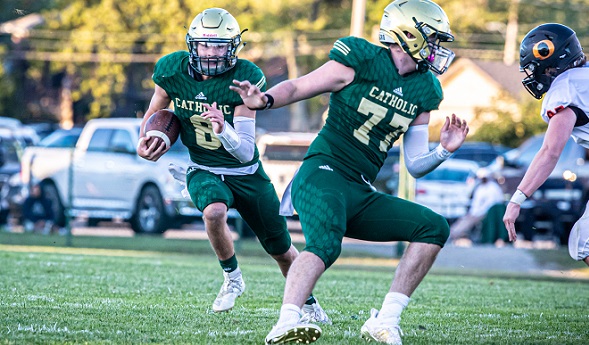
“I feel like this is the way we should be playing here at Muskegon Catholic,” said Price, the three-year starting senior quarterback who has his team at 5-0 and ranked No. 2 in the latest Associated Press Division 6 state poll.
“We were down, no doubt, but now we’re back up and ready for the playoffs.”
MCC has one more hurdle to clear to complete its first unbeaten regular season since 2016 when it hosts Holton at 4 p.m. Friday.
The Crusaders are doing it with defense, allowing a total of 18 points over five games. But even that low number is misleading, as the defense has only allowed one TD from scrimmage (a 79-yard run against Ludington), with the other points coming on an interception return and a kickoff return.
While the defense has been reminiscent of those MCC championship teams, one big change is that the Crusaders are now competing in Division 6 because of a cooperative agreement with nearby Muskegon Western Michigan Christian.
As a result, MCC appears on a collision course to host top-ranked Montague in a Division 6 District championship game next month – which would be a showdown between a pair of three-year starting quarterbacks in Price and Montague’s Drew Collins.
Ironically, MCC’s recent gridiron struggles can be traced back to its first-ever meeting with Montague during the 2017 regular-season finale. The Crusaders came into that game with a 27-game winning streak, but suffered a humbling 34-10 home loss. That game was followed by a lackluster 42-20 win over Decatur in the Pre-District, before a season-ending 26-15 loss at Mendon the following week.
The bad news continued that offseason, when three key sophomores transferred, leaving behind the youngest varsity team in MCC school history.
“We started 10 underclassmen and five freshmen in 2018,” said eighth-year MCC coach Steve Czerwon, whose team finished 3-6 that season. “There’s a lot of JV teams that don’t start five freshmen. I’m as proud of that team as any I’ve coached because of how they hung in there, and now we’re seeing the fruits of that this season.”
Price was thrust into the starting quarterback role as a sophomore and took a pounding behind a small and inexperienced offensive line. He played at less than full strength most of that season and missed the final three games when it was discovered that he had three fractured vertebrae in his spine.
“Looking back, I was scared back there and really didn’t understand the quarterback position,” said Price, who helped MCC flip its record to 6-3 last season. “I was new, and the game was so fast. I am very comfortable now, and that’s a huge thing.”
 Price (5-foot-11, 175 pounds) came out this fall flinging the ball around in the Crusaders’ opening win over Ludington, completing 10-of-13 passes for 212 yards and three touchdowns.
But for those worrying that the quintessential running football team has gone pass-happy, no worries. Since that game, MCC has settled into its running ways, with Price passing for just 235 yards and one touchdown over the past four games.
The Crusaders are back to pounding teams on the ground behind an offensive line that has grown bigger and more experienced under the direction of veteran line coaches Mike Ribecky, Joe Perri and Mike Hornak. Guard AJ Lock (6-1, 220) is still the lone senior starter on the interior line, with the other four being juniors – tackles Jaden Johnson (6-4, 235) and Alex Barnhill (6-0, 260), guard Jack Heminger (5-10, 210) and center Landon Patterson (6-0, 220).
The real secret of this year’s team is a stable of talented and interchangeable backs, led by senior Tommy Kartes and junior Joe Waller. The other backs getting significant touches are all underclassmen – juniors Nick Powell, Dane Rutz and Eliot Riegler.
“We were still in the first quarter last week against Orchard View, and seven different kids had touched the football,” said Czerwon. “I don’t think this team has any superstar on it. Quite frankly, we have a lot of kids of equal ability – we have a lot of good, solid players.”
The first to touch the ball each play is Price, who then distributes the ball around.
Price is thankful to be playing at all, after the COVID lockdown wiped out his junior baseball season this spring and a team that many believed was poised to make a run at an MHSAA Finals championship.
He is also thankful to be healthy. Price likely appreciates his health more than most his age because of the health issues of his father, Paul, who was paralyzed in 2015 after a fall at their home.
“I was in middle school when that happened, and I wondered if I should even play football with all the risks,” said Price. “But I know he wants me to follow my passion and be out there. He is a motivation for me, and I love seeing him on the sidelines at our games.”
 Tom Kendra worked 23 years at The Muskegon Chronicle, including five as assistant sports editor and the final six as sports editor through 2011. E-mail him at [email protected] with story ideas for Muskegon, Oceana, Mason, Lake, Oceola, Mecosta and Newaygo counties.
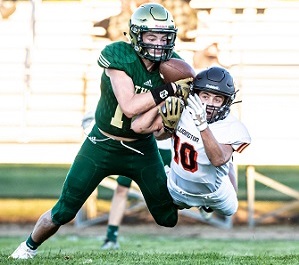
PHOTOS: (Top) Muskegon Catholic Central senior quarterback Max Price runs behind the block of junior tackle Jaden Johnson during the Crusaders' 30-6 season-opening victory over visiting Ludington on Sept. 18. (Middle) MCC senior slot receiver Tommy Kartes hauls in this reception from Price while an Orioles defender works to break it up. (Photos by Tim Reilly.)