


#TBT: Searching for The Hinker Bell
September 28, 2017
By Geoff Kimmerly
Second Half editor
Menominee will host Escanaba on Friday in the 121st meeting between two of the Upper Peninsula’s largest high schools and proudest football programs – but with the trophy celebrating the game still missing after it first disappeared more than half a century ago.
The two teams from 1948-1962 played for the The Hinker Bell, a locomotive bell that hasn’t been seen since 1963.
A decade ago, Escanaba Daily Press sports editor (and now Second Half correspondent) Denny Grall wrote about a newfound search for The Hinker Bell. But the mystery continues, and Grall’s story below tells of many of the twists and turns that to that point that had come in trying to locate it.
ESCANABA — Another search is underway to find the Hinker Bell.
The former locomotive bell went to the winner of the Escanaba-Menominee football game for about 15 years but has been missing for more than 40 years. It came from a locomotive owned by the Bay de Noquet Company and used on the LS&I Railroad that operated in Delta and Menominee counties.
The locomotive was built in 1906 by Baldwin Locomotive Works in Philadelphia and the bell was believed to have been cast in the railroad foundry, according to a 1953 newspaper clipping.
In 1948, one of the locomotive owners presented the bell to his friend, John Hinker of Menominee, an ardent sports fan who donated materials for the press box at Menominee’s Walton Blesch Field.
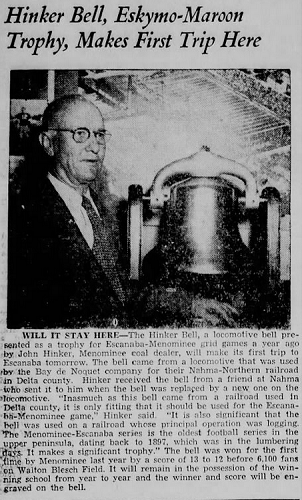 Hinker gave the bell to then Menominee coach Mickey McCormick and indicated proper use for the bell would be as an award for the gridiron rivalry.
Now Hinker’s great great nephew is trying to find the bell, which has not been seen since Escanaba’s current high school opened in 1963.
Tim Waters of Land O’ Lakes, Wis., who has launched the search, became interested by researching his family tree. “It is a big trophy (between 80 and 150 pounds by various estimates) and it is odd that it is missing,” Waters said in a recent telephone chat.
“One theory is that it is in somebody’s hunting camp or a home and they are using it as their own trophy,” said Waters.
“We have a pretty good investigation going on and all help is appreciated. If somebody does have it, we’re not looking to prosecute them. We’re just looking to get the darn thing back. Nobody will be in trouble.”
Waters refuted the old idea the bell was melted down. He has contacted numerous bell collectors, and they said a junk yard would have known it was worth a lot more than melted metal.
“The bell was not destroyed. We’ve come to that conclusion,” he said. “It was not put in a scrap yard.”
Waters contacted Coplan Iron and Metal of Escanaba and learned that bells were not melted or crushed and said the firm never accepted a bell with engravings matching the Hinker Bell.
Waters learned those businesses would sell them for the weight value to people who wanted them for yard ornaments/dinner bells, or to collectors.
“It is a treasure and it needs to be found,” said Waters.
Waters said the last known photo of the bell was with then EHS football coach Al Sigman and Esky players John Fisher and Phil Davidson in 1960. Escanaba beat Menominee from 1959-63 but could not find the bell in 1964 when the Maroons won. No one he has talked to remembers seeing the bell present at the first three games during the tenure of coach Jerry Cvengros.
The current Escanaba High School opened in 1963 and Bay de Noc Community College then occupied the old facility, which has since been demolished.
“Records indicate there was no report (of a missing bell) filed by Escanaba school district to the police department,” Waters said.
“The Hinker Bell is part of U.P. Michigan’s history, as is football and the railroads,” Waters said. “The people of Escanaba and Menominee deserve to have this trophy returned to their high schools.”
Waters, who has never seen an Escanaba or Menominee football game but is planning to rectify that omission this season, is hoping students at the two schools will join in the treasure hunt and talk about it with their parents and grandparents.
He has already contacted EHS athletic director Rob Ryan, who plans to thoroughly search the school basement.
He would like to find a photo of the bell to help collectors in their search. “Each bell was for a special locomotive,” said Waters.
“If they have a good picture we can pass it around and say we are looking for this bell. If they can pinpoint what this bell was on, they can help get the word out.”
He has also extended the search to the website at upfootball.com, which has generated interest but no bell. “If the bell is in the area still today, I don’t think it will take long to surface,” he said.
“If we don’t find this bell, we are going to try to make up a replacement as close as possible if the two schools are interested in that,” he said.
Waters is hoping that real estate agents, postal workers, delivery personnel, construction workers, etc., may have seen the bell during their travels and can help retrieve it.
Molded by Early Losses, Cass Tech Closes Season by Taking Back D1 Title
By
Paul Costanzo
Special for MHSAA.com
November 30, 2024
DETROIT – The players and coaches on the Detroit Cass Tech football team heard the rumblings when they started this season 2-2.
They heard the calls for coach Marvin Rushing’s job. They heard the doubts sprouting up about their ability to compete for a Finals title.
Rather than let the noise break them apart, they used it to rally, and Saturday they put it all to bed with a 42-20 victory against Hudsonville in the Division 1 championship game at Ford Field.
“Everything we did was intentional – we purposely played Rockford to get ready for Dakota – we played those teams knowing we’d have games like this. We went to Ohio intentionally to get ready for all this, and every lesson we seemed to get better from,” Rushing said. “The biggest reason we’re here is our two losses. Those prepared us for today. It’s unfortunate that so many people don’t understand that great things can come sometimes from setbacks.”
The title was the fourth in program history for Cass Tech, and first since 2016, when it completed a remarkable run of three titles – and four Finals appearances – over six seasons.
“The day before check-in day, I chose to stay and play for my team and with my little brother James Johnson,” said senior receiver and defensive back Alex Graham, a Colorado commit who was at IMG Academy in Florida a year ago. “One of my goals my whole season was to win a state championship, and we got the job done. So, I’m real happy to do that.”
 Graham had his usual stat-stuffing performance for the Technicians, who closed the season with 10 straight wins to finish 12-2. He had 54 yards and a touchdown on the ground, 57 yards on four catches through the air, and added six tackles, a forced fumble and an interception on defense.
His fellow wideout, Corey Sadler Jr., meanwhile, had six catches for 47 yards and two TDs.
“I have Batman and Batman,” Rushing said. “Some people say they have Batman and Robin, I have Batman and Batman.”
All those catches and yards came from the hand of freshman quarterback Donald Tabron II, who finished the night 15-of-20 for 176 yards and three TDs.
“It’s a great thing to have around me. It helps me play a balanced game on offense,” Tabron said. “We can run the ball, pass the ball. When you have guys like CJ and Alex, it kind of makes it easy for me as the quarterback. I know that no matter where I put the football, they’re going to make a play.”
Cass Tech dominated the first half, and by the time Hudsonville found its footing, the hole was too deep.
The Technicians scored on their first three possessions, driving 81 yards in nine plays on their first, and taking advantage of short fields on the second two, putting Hudsonville in a tough spot early in the second quarter.
Jaylen Spates scored the first touchdown on a five-yard run, while Sadler scored the next two on passes of 16 and six yards from Tabron. Sadler’s first score followed a short Hudsonville punt, while his second came after a Cass Tech fumble recovery deep in Hudsonville territory.
Tabron added a third TD pass late in the second quarter, hitting Will Sykes for a 19-yard score. That was also a short field, as Graham had intercepted a pass, setting Cass Tech up on the 19.
“We made some mistakes, and Cass Tech’s a really good football team,” Hudsonville coach Brent Sandee said. “They played really well, they’re very athletic. We had to play a clean game, and unfortunately we didn’t. But our kids battled the whole time and represented our school and our community real well. I’m really proud of us and the way we played. They’re great representatives of Hudsonville, and I couldn’t be more proud of them.”
 Cass Tech had a chance to add another score after recovering a fumble in Hudsonville territory with 1:10 to play in the first half, but the Hudsonville defense made a stand to keep the score 27-0.
That didn’t last long, though, as Graham scored on a 54-yard run two plays into the third quarter.
Hudsonville got on the board with a one-yard QB sneak for a touchdown by Griffin Baker. The score was set up by a 22-yard throwback to Baker from Braden VanLaecke.
The Eagles got some extra life when they recovered an onside kick following the score before exchanging turnovers near midfield – an interception for Cass Tech’s Derrick Jackson and a fumble recovery by Hudsonville’s Tyler Strick.
Bryce Fox cashed in for the Eagles, scoring on a 14-yard TD run to pull his team within three scores at 35-13 with 5:07 left in the third.
The Eagles threatened to make it even closer, getting down to the Cass Tech 6-yard line, but the Technicians’ defense held, forcing a turnover on downs.
By the time Hudsonville saw the ball again, it was trailing 42-13 – Cass Tech added a 24-yard TD run by De’Mari Hendrix – and there were fewer than four minutes remaining in the game.
Carson Dykstra ended the scoring with a 15-yard touchdown reception from Baker.
Baker finished 8-of-12 for 112 yards passing for the Eagles (12-2), with Dykstra catching four passes for 74 yards. Owen Haarsma led the Hudsonville ground game with 95 yards on 13 carries.
“I just feel like we have something special with this team, and it’s special for our community, too,” Hudsonville senior Jalen Oosting said. “I just think it’s an awesome story just to hear all the whispers, and all the talk and chatter at school. I just think it’s awesome it’s affected our community. I just loved being here with these guys.”
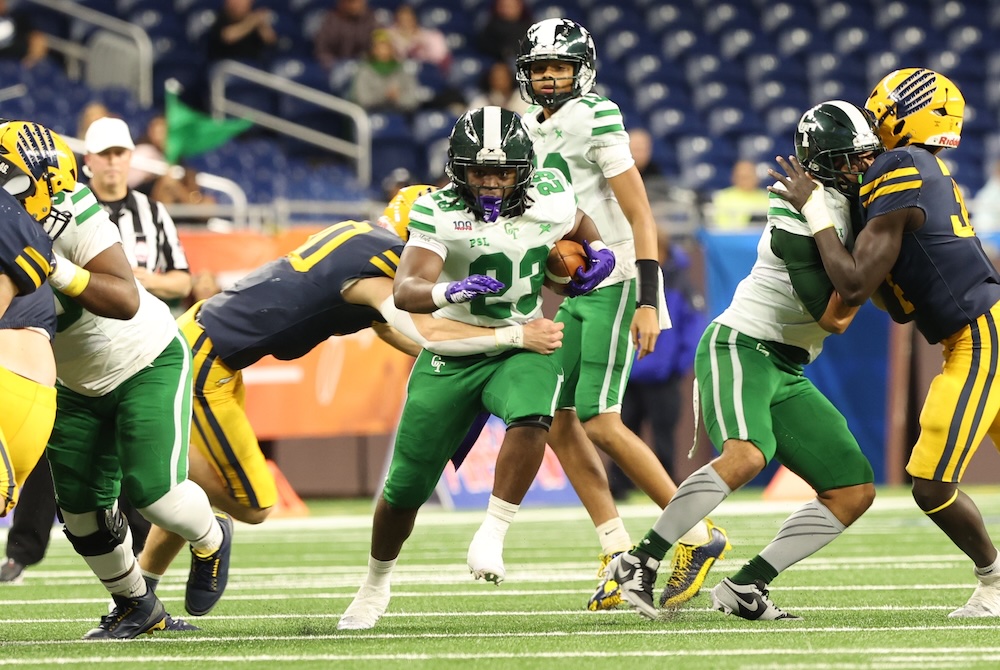
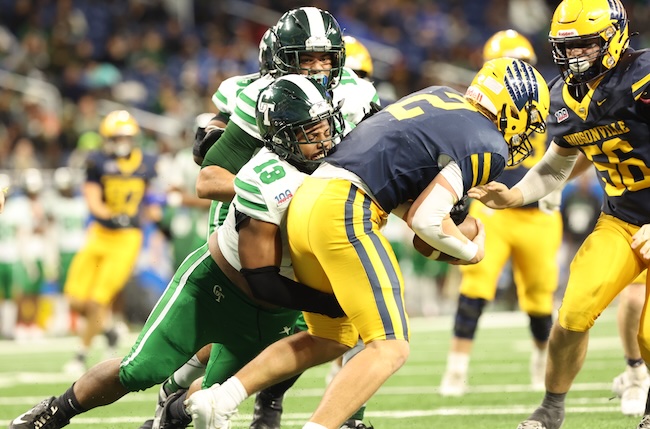
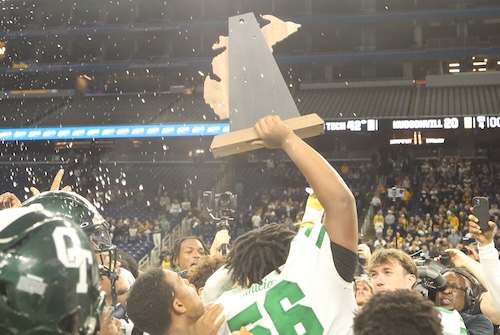
PHOTOS (Top) Detroit Cass Tech’s Julian Taylor (23) works to break a Hudsonville tackle Saturday evening at Ford Field. (Middle) Dylon Pace (13) wraps up Eagles quarterback Griffin Baker. (Below) Cass Tech’s Logan Howell raises the championship trophy in the air as his teammates cheer around him. (Photos by Hockey Weekly Action Photos.)