


#TBT: Searching for The Hinker Bell
September 28, 2017
By Geoff Kimmerly
Second Half editor
Menominee will host Escanaba on Friday in the 121st meeting between two of the Upper Peninsula’s largest high schools and proudest football programs – but with the trophy celebrating the game still missing after it first disappeared more than half a century ago.
The two teams from 1948-1962 played for the The Hinker Bell, a locomotive bell that hasn’t been seen since 1963.
A decade ago, Escanaba Daily Press sports editor (and now Second Half correspondent) Denny Grall wrote about a newfound search for The Hinker Bell. But the mystery continues, and Grall’s story below tells of many of the twists and turns that to that point that had come in trying to locate it.
ESCANABA — Another search is underway to find the Hinker Bell.
The former locomotive bell went to the winner of the Escanaba-Menominee football game for about 15 years but has been missing for more than 40 years. It came from a locomotive owned by the Bay de Noquet Company and used on the LS&I Railroad that operated in Delta and Menominee counties.
The locomotive was built in 1906 by Baldwin Locomotive Works in Philadelphia and the bell was believed to have been cast in the railroad foundry, according to a 1953 newspaper clipping.
In 1948, one of the locomotive owners presented the bell to his friend, John Hinker of Menominee, an ardent sports fan who donated materials for the press box at Menominee’s Walton Blesch Field.
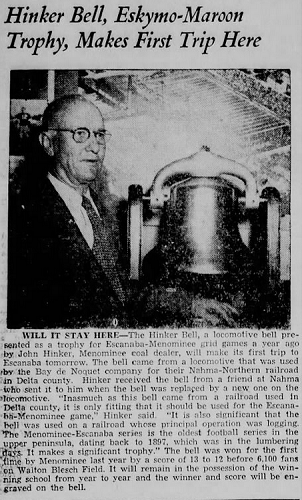 Hinker gave the bell to then Menominee coach Mickey McCormick and indicated proper use for the bell would be as an award for the gridiron rivalry.
Now Hinker’s great great nephew is trying to find the bell, which has not been seen since Escanaba’s current high school opened in 1963.
Tim Waters of Land O’ Lakes, Wis., who has launched the search, became interested by researching his family tree. “It is a big trophy (between 80 and 150 pounds by various estimates) and it is odd that it is missing,” Waters said in a recent telephone chat.
“One theory is that it is in somebody’s hunting camp or a home and they are using it as their own trophy,” said Waters.
“We have a pretty good investigation going on and all help is appreciated. If somebody does have it, we’re not looking to prosecute them. We’re just looking to get the darn thing back. Nobody will be in trouble.”
Waters refuted the old idea the bell was melted down. He has contacted numerous bell collectors, and they said a junk yard would have known it was worth a lot more than melted metal.
“The bell was not destroyed. We’ve come to that conclusion,” he said. “It was not put in a scrap yard.”
Waters contacted Coplan Iron and Metal of Escanaba and learned that bells were not melted or crushed and said the firm never accepted a bell with engravings matching the Hinker Bell.
Waters learned those businesses would sell them for the weight value to people who wanted them for yard ornaments/dinner bells, or to collectors.
“It is a treasure and it needs to be found,” said Waters.
Waters said the last known photo of the bell was with then EHS football coach Al Sigman and Esky players John Fisher and Phil Davidson in 1960. Escanaba beat Menominee from 1959-63 but could not find the bell in 1964 when the Maroons won. No one he has talked to remembers seeing the bell present at the first three games during the tenure of coach Jerry Cvengros.
The current Escanaba High School opened in 1963 and Bay de Noc Community College then occupied the old facility, which has since been demolished.
“Records indicate there was no report (of a missing bell) filed by Escanaba school district to the police department,” Waters said.
“The Hinker Bell is part of U.P. Michigan’s history, as is football and the railroads,” Waters said. “The people of Escanaba and Menominee deserve to have this trophy returned to their high schools.”
Waters, who has never seen an Escanaba or Menominee football game but is planning to rectify that omission this season, is hoping students at the two schools will join in the treasure hunt and talk about it with their parents and grandparents.
He has already contacted EHS athletic director Rob Ryan, who plans to thoroughly search the school basement.
He would like to find a photo of the bell to help collectors in their search. “Each bell was for a special locomotive,” said Waters.
“If they have a good picture we can pass it around and say we are looking for this bell. If they can pinpoint what this bell was on, they can help get the word out.”
He has also extended the search to the website at upfootball.com, which has generated interest but no bell. “If the bell is in the area still today, I don’t think it will take long to surface,” he said.
“If we don’t find this bell, we are going to try to make up a replacement as close as possible if the two schools are interested in that,” he said.
Waters is hoping that real estate agents, postal workers, delivery personnel, construction workers, etc., may have seen the bell during their travels and can help retrieve it.
Century of School Sports: Finals Provide Future Pros Early Ford Field Glory
By
Geoff Kimmerly
MHSAA.com senior editor
November 26, 2024
For hundreds of Michigan high school athletes, this weekend’s 11-Player Football Finals will provide their first and only opportunity to play any sport where the pros play – in this case, Detroit’s Ford Field.
But for a handful, it could instead be the first of several games to come on the Lions’ home turf.
According to data at Pro-Football-Reference.com, Michigan high schools have produced 791 players from 303 schools who have gone on to play in the NFL. They’ve come from all over, predictably from larger population areas like Detroit but also from several now-closed schools like Stambaugh High School in the western Upper Peninsula, which produced a pair of pros during the 1930s before decades later consolidating with Iron River to become West Iron County.
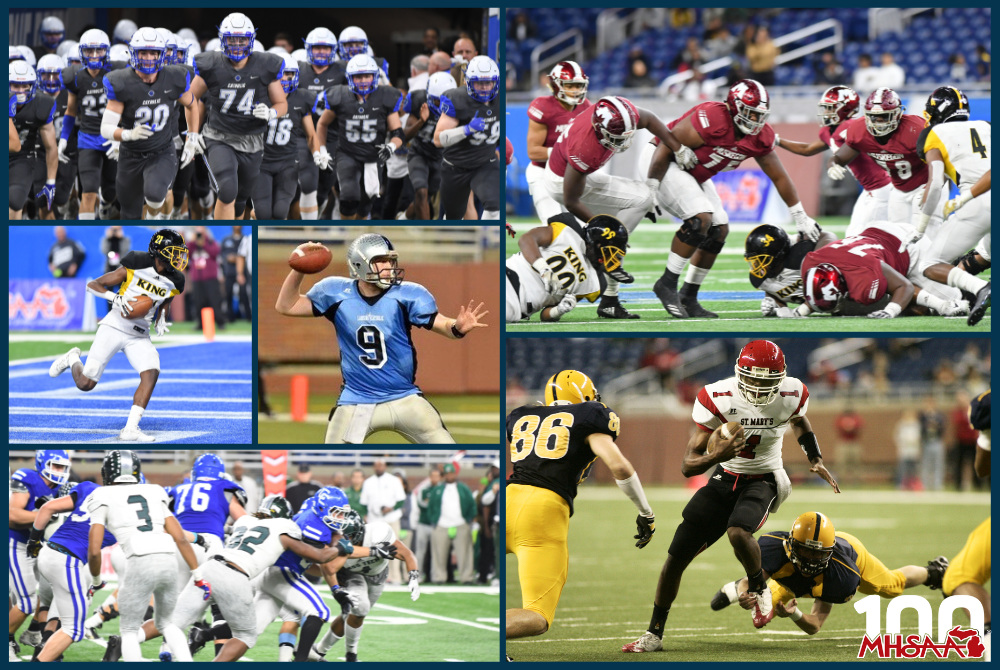
According to that data, 81 players from 61 schools are currently active in the NFL – topped by five from Detroit Cass Tech, including Jourdan Lewis (32) pictured above making a tackle against Detroit Cass Tech during the 2016 Division 1 championship game. Several more current players experienced Ford Field as a high schooler at the MHSAA Finals – perhaps most notably among them Ahmad “Sauce” Gardner, who caught a touchdown pass in Detroit Martin Luther King’s 41-25 win over Muskegon in the 2018 Division 3 championship game, went on to play at University of Cincinnati and has been an All-Pro after both of his first two seasons as a cornerback for the New York Jets.
(Coincidentally, in that win over the Big Reds, Gardner and King played against another future pro – Anthony Bradford, now a starting offensive lineman for the Seattle Seahawks.)
Gardner and Lewis are among those who have formed rich tradition as well of Detroit producing NFL talent. According to Bruce Feldman of The Athletic and FOX Sports, Detroit was tied for the fourth-most players on NFL opening-day rosters this season with 14 – trailing only Miami, Fla.; Las Vegas, Bradenton, Fla; and tied with Atlanta, Ga. During the most recent NFL draft, Michigan high schools saw seven players drafted over the seven rounds, with River Rouge one of 22 high schools nationwide with multiple players selected – Ruke Orhorhoro (Atlanta Falcons, from Clemson) and Kamal Hadden (Kansas City Chiefs, from Tennessee).
Gardner was selected fourth overall in the 2022 NFL Draft, joining a collection of impressive past Michigan high school stars picked at or near the top of the board. Among recent others: 2008 No. 1 Jake Long (Lapeer West/Michigan/Miami Dolphins), 2022 No. 2 Aidan Hutchinson (Dearborn Divine Child/Michigan/Detroit Lions), 2003 No. 2 Charles Rogers (Saginaw/Michigan State/Detroit Lions), 2005 No. 3 Braylon Edwards (Harper Woods Bishop Gallagher/Michigan/Cleveland Browns), 1984 No. 3 Carl Banks (Flint Beecher/Michigan State/New York Giants) and 1991 No. 5 Todd Lyght (Flint Powers Catholic/Notre Dame/Los Angeles Rams).
From this group, Rogers also played in an MHSAA Final catching a 60-yard touchdown pass as Saginaw defeated Bloomfield Hills Brother Rice 14-7 in the 1999 Division 2 championship game at the Pontiac Silverdome.
Previous "Century of School Sports" Spotlights
Nov. 19: Connection at Heart of Coaches Advancement Program - Read
Nov. 12: Good Sports are Winners Then, Now & Always - Read
Nov. 5: MHSAA's Home Sweet Home - Read
Oct. 29: MHSAA Summits Draw Thousands to Promote Sportsmanship - Read
Oct. 23: Cross Country Finals Among MHSAA's Longest Running - Read
Oct. 15: State's Storytellers Share Fall Memories - Read
Oct. 8: Guided by 4 S's of Educational Athletics - Read
Oct. 1: Michigan Sends 10 to National Hall of Fame - Read
Sept. 25: MHSAA Record Books Filled with 1000s of Achievements - Read
Sept. 18: Why Does the MHSAA Have These Rules? - Read
Sept. 10: Special Medals, Patches to Commemorate Special Year - Read
Sept. 4: Fall to Finish with 50th Football Championships - Read
Aug. 28: Let the Celebration Begin - Read
PHOTOS Clockwise from top left: (1) Jalen Mayfield (74) exits the Ford Field tunnel with Grand Rapids Catholic Central in 2017. (2) Muskegon's Anthony Bradford (75) makes a block during the 2018 Division 3 Final. (3) Orchard Lake St. Mary's Allen Robinson eludes an East Grand Rapids defender in 2009. (4) Detroit Cass Tech's Jourdan Lewis (32) makes a tackle in 2016. (5) Detroit Martin Luther King's Ahmad Gardner catches a touchdown pass against Muskegon in 2018. (6) Lansing Catholic's Cooper Rush throws a pass during the 2011 Division 5 Final. All were on NFL rosters at the starting of training camp this summer.