


#TBT: Searching for The Hinker Bell
September 28, 2017
By Geoff Kimmerly
Second Half editor
Menominee will host Escanaba on Friday in the 121st meeting between two of the Upper Peninsula’s largest high schools and proudest football programs – but with the trophy celebrating the game still missing after it first disappeared more than half a century ago.
The two teams from 1948-1962 played for the The Hinker Bell, a locomotive bell that hasn’t been seen since 1963.
A decade ago, Escanaba Daily Press sports editor (and now Second Half correspondent) Denny Grall wrote about a newfound search for The Hinker Bell. But the mystery continues, and Grall’s story below tells of many of the twists and turns that to that point that had come in trying to locate it.
ESCANABA — Another search is underway to find the Hinker Bell.
The former locomotive bell went to the winner of the Escanaba-Menominee football game for about 15 years but has been missing for more than 40 years. It came from a locomotive owned by the Bay de Noquet Company and used on the LS&I Railroad that operated in Delta and Menominee counties.
The locomotive was built in 1906 by Baldwin Locomotive Works in Philadelphia and the bell was believed to have been cast in the railroad foundry, according to a 1953 newspaper clipping.
In 1948, one of the locomotive owners presented the bell to his friend, John Hinker of Menominee, an ardent sports fan who donated materials for the press box at Menominee’s Walton Blesch Field.
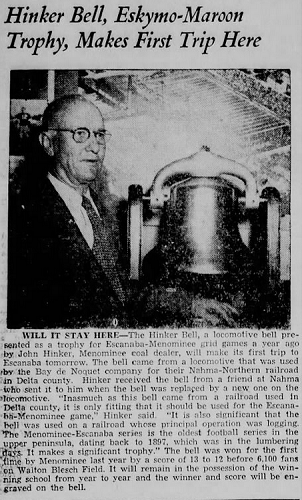 Hinker gave the bell to then Menominee coach Mickey McCormick and indicated proper use for the bell would be as an award for the gridiron rivalry.
Now Hinker’s great great nephew is trying to find the bell, which has not been seen since Escanaba’s current high school opened in 1963.
Tim Waters of Land O’ Lakes, Wis., who has launched the search, became interested by researching his family tree. “It is a big trophy (between 80 and 150 pounds by various estimates) and it is odd that it is missing,” Waters said in a recent telephone chat.
“One theory is that it is in somebody’s hunting camp or a home and they are using it as their own trophy,” said Waters.
“We have a pretty good investigation going on and all help is appreciated. If somebody does have it, we’re not looking to prosecute them. We’re just looking to get the darn thing back. Nobody will be in trouble.”
Waters refuted the old idea the bell was melted down. He has contacted numerous bell collectors, and they said a junk yard would have known it was worth a lot more than melted metal.
“The bell was not destroyed. We’ve come to that conclusion,” he said. “It was not put in a scrap yard.”
Waters contacted Coplan Iron and Metal of Escanaba and learned that bells were not melted or crushed and said the firm never accepted a bell with engravings matching the Hinker Bell.
Waters learned those businesses would sell them for the weight value to people who wanted them for yard ornaments/dinner bells, or to collectors.
“It is a treasure and it needs to be found,” said Waters.
Waters said the last known photo of the bell was with then EHS football coach Al Sigman and Esky players John Fisher and Phil Davidson in 1960. Escanaba beat Menominee from 1959-63 but could not find the bell in 1964 when the Maroons won. No one he has talked to remembers seeing the bell present at the first three games during the tenure of coach Jerry Cvengros.
The current Escanaba High School opened in 1963 and Bay de Noc Community College then occupied the old facility, which has since been demolished.
“Records indicate there was no report (of a missing bell) filed by Escanaba school district to the police department,” Waters said.
“The Hinker Bell is part of U.P. Michigan’s history, as is football and the railroads,” Waters said. “The people of Escanaba and Menominee deserve to have this trophy returned to their high schools.”
Waters, who has never seen an Escanaba or Menominee football game but is planning to rectify that omission this season, is hoping students at the two schools will join in the treasure hunt and talk about it with their parents and grandparents.
He has already contacted EHS athletic director Rob Ryan, who plans to thoroughly search the school basement.
He would like to find a photo of the bell to help collectors in their search. “Each bell was for a special locomotive,” said Waters.
“If they have a good picture we can pass it around and say we are looking for this bell. If they can pinpoint what this bell was on, they can help get the word out.”
He has also extended the search to the website at upfootball.com, which has generated interest but no bell. “If the bell is in the area still today, I don’t think it will take long to surface,” he said.
“If we don’t find this bell, we are going to try to make up a replacement as close as possible if the two schools are interested in that,” he said.
Waters is hoping that real estate agents, postal workers, delivery personnel, construction workers, etc., may have seen the bell during their travels and can help retrieve it.
1st & Goal: Finals in Review
January 28, 2021
By Geoff Kimmerly
Second Half editor
With absolute certainty, we can say this recently-concluded football season was like no other during the nearly 100-year history of the MHSAA.
But after just more than five months, and amid COVID-19, it was played to completion – with 8-Player Finals on Jan. 16 at Brighton’s Legacy Center and 11-Player Finals Jan. 22-23 at Ford Field in Detroit.
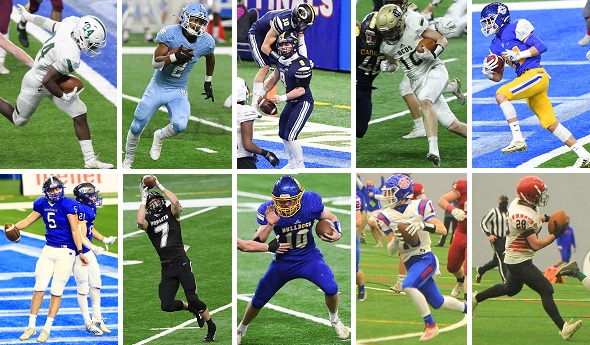
Second Half again covered all 10 championship games, with quick recaps and links (click on the game scores) to those stories below followed by notations of performances entered into the MHSAA Finals record book and a report on some of the biggest and best stories to emerge from the championship weekends. See also below highlights from State Champs Sports Network.
Finals in Review
11-Player Division 1: West Bloomfield 41, Davison 0
Led by Donovan Edwards’ 257 yards and three touchdowns rushing, West Bloomfield won its first Finals championship with a shutout of the 2019 champion Cardinals. Much more on Edwards below, but the Lakers’ effort on the other side of the ball can’t be overlooked – the shutout was the team’s sixth of the season.
11-Player Division 2: Muskegon Mona Shores 25, Warren De La Salle Collegiate 19
After winning its first championship in 2019, Mona Shores earned another in its encore led again by quarterback Brady Rose. Rose had started last season’s Final in place of an injured all-stater, but he was hardly unknown this time – and still ran for 154 yards and two touchdowns, including a 65-yard sprint during the fourth quarter that helped wrap things up for the Sailors.
11-Player Division 3: DeWitt 40, River Rouge 30
DeWitt finished off the longest football season in MHSAA history with its first championship, earning it against a River Rouge team looking to repeat after winning its first title in 2019. Quarterback play was on display in this finale as well, with DeWitt’s Tyler Holtz and Rouge’s Mareyohn Hrabowski putting up big numbers.
11-Player Division 4: Detroit Country Day 13, Cadillac 0
With youngest son Danny a major contributor, Country Day coach Dan MacLean led the Yellowjackets to their first Finals championship since 1999. Country Day kept first-time finalist Cadillac to just 166 total yards, and the shutout was the Yellowjackets’ third straight.
11-Player Division 5: Grand Rapids Catholic Central 48, Frankenmuth 21
The Cougars added their fourth championship in five seasons, this one their first in Division 5 after winning previously in Division 4. GRCC quarterback Joey Silveri accounted for six touchdowns in a Final for the second-straight season as his team built a big early lead against the first-time finalist Eagles.
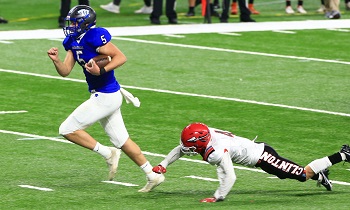 11-Player Division 6: Montague 40, Clinton 14
Strong quarterback play and a father-son connection both came into play in Division 6 as well as senior Drew Collins led dad Pat’s team to its first Finals championship since 2009. What Drew said after told the story of the entire season restart: “Everybody on this football team, coaches, players, trainers – everybody on this football team loves high school football. I love high school football. I love these coaches. I love my friends on the team. I love everybody on the team. I love the community. It’s bittersweet when you win a state championship when you’re a senior because it’s all over.”
11-Player Division 7: New Lothrop 42, Traverse City St. Francis 35
The Hornets’ Julius Garza put up one of the most impressive individual performances of the weekend, scoring three ways for a total of four touchdowns. New Lothrop got up early and then held off a St. Francis comeback to claim its second championship in three seasons.
11-Player Division 8: Centreville 22, Ubly 0
Centreville’s shutdown defense put together one more awe-inspiring performance to help the Bulldogs’ to their first championship. Centreville ran its state-best points-allowed-per-game average to 2.9 with its seventh shutout in 10 games played.
8-Player Division 1: Adrian Lenawee Christian 47, Suttons Bay 0
The Cougars put an exclamation point on a dominating first season of 8-player football with their first Finals championship in the sport, either format. Lenawee Christian not only performed well offensively but held Suttons Bay to 52 yards total. The Norsemen finished Division 1 runners-up for the second-straight season.
8-Player Division 2: Powers North Central 70, Portland St. Patrick 48
The Jets claimed their third championship in what was the highest-scoring 8-player championship game in the decade-long MHSAA Finals history of this format. More on that below, and also on North Central quarterback Luke Gorzinski and St. Patrick quarterback Connor Cross, who were among those to put up giant numbers. The Jets also feature a father/son combo, with Luke the son of head coach Leo Gorzinski.
Records Report
As one might imagine, the highest-scoring game in 8-Player Finals history was filled with record book accomplishments. North Central’s 70 points were the 8-Player Finals record for one team, and the combined 118 points were 19 more than the previous record set in Peck’s 67-32 win over Rapid River in 2013. The teams’ 933 combined total yards ranks third on that 8-Player Finals list, while North Central’s 22 first downs was tied for second and St. Patrick’s 21 first downs ranked fourth. Neither team punted, making for another first in 8-player championship games. The game was not only the highest-scoring 8-Player Final, but the third-highest scoring 8-player game in MHSAA history (including regular season), missing tying that record by only six points.
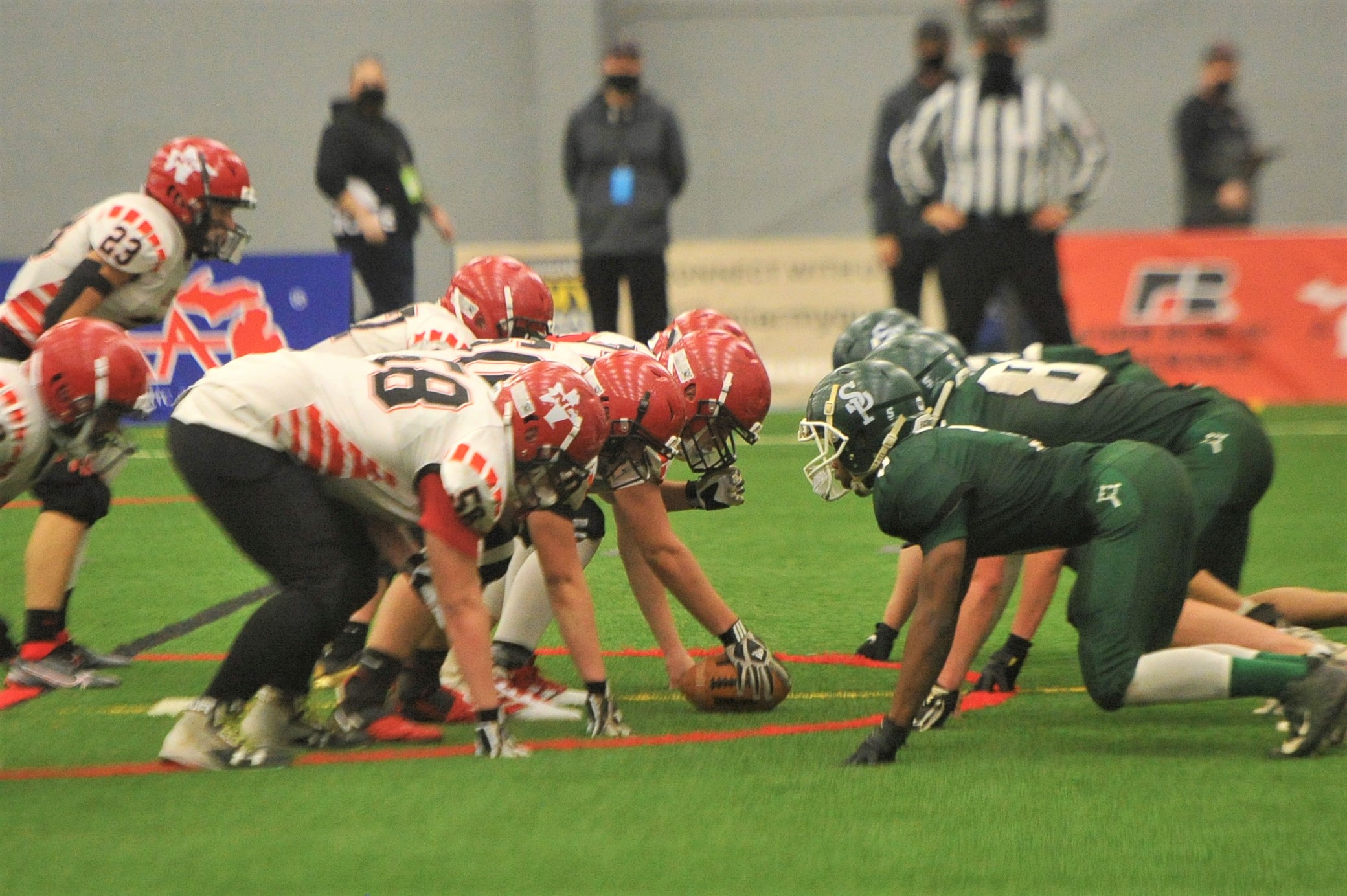 Also as noted above, all-state quarterback play was on display for both 8-player Division 2 finalists. North Central QB Luke Gorzinski totaled the second-most rushing yards, 299, in an 8-Player Final, and with 156 yards passing set the total offense record at 455. St. Patrick QB Connor Cross, with 397 total yards, is fourth on that list. Cross’s 374 passing yards were second-most in an 8-Player Final, as were his six passing touchdowns, and he earned the first listings with 25 completions and 38 pass attempts. Shamrocks receiver Shane Cook, meanwhile, set the record with 13 receptions for the second-most receiving yardage, 179. North Central as a team finished with the third-most rushing yards, 373 on 37 attempts, and third-most rushing touchdowns with six. St. Patrick as a team was second for team passing yards and touchdowns.
Gorzinski wasn’t the only offensive star for the Jets; teammate Wyatt Raab finished with the third-most points scored in an 8-Player Final, 32, on four touchdowns, three two-point conversions and a safety. Gorzinski did finish with the fourth-most points, 28, on four touchdowns and two two-point conversions. Both made the total touchdowns list with four apiece.
The 8-Player Division 1 Final made the record book as well, in two categories. Lenawee Christian as a team defense posted the lowest number of yards allowed, just 52. And Cougars quarterback Landon Gallant also made the total offense list with 326 yards – 59 rushing and 267 passing.
New Lothrop’s Julius Garza was among individual standouts from the 11-Player Finals, tying for fourth with 26 points scored – on four touchdowns and a two-point conversion – and also tying for fourth for touchdowns in a game, in Division 7.
West Bloomfield’s Jake Ward made all three kicking lists for 11-player, tying for third with two field goals in a game, ranking fourth for longest with a 45-yarder, and making the extra points list with five in the Division 1 Final. Grand Rapids Catholic Central’s Jack Barlow tied for fourth on that extra points list with six in the Division 5 game.
The Lakers’ Donovan Edwards was another of the stars of the weekend, with his 257 yards rushing ranking eighth all-time for an 11-Player Final – and while coming on just 14 attempts in Division 1.
Montague’s Drew Collins made the 11-player passing yards list with 244, coming on 15 completions in the Division 6 game. Three of those went for touchdowns to teammate Samuel Smith, who tied the record held by nine others for touchdown catches in an 11-Player Final.
DeWitt quarterback Tyler Holtz tied for fifth on the passing touchdowns list with four in Division 3. Opposing quarterback Mareyohn Hrabowski from River Rouge made the total yardage list with 321 – 94 rushing and 227 passing. New Lothrop’s Cam Orr also made the total yardage list with 344 – 122 rushing and 222 passing.
While quarterbacks starred in many cases, the run game was hardly left behind. In addition to Edwards’ performance for West Bloomfield, Clinton had the fifth-most rushing attempts in 11-player championship game history with 65, for 358 yards. Clinton also tied the record with just one pass attempt, with West Bloomfield tying for fifth on that list with two throws. Those two and Cadillac all tied the 11-Player Finals record by recording zero completions – they brought that all-time list to 21 teams that didn’t complete a pass in an 11-player title game.
Grand Rapids Catholic Central in Division 5 also became the 28th 11-player finalist to go an entire game without punting.
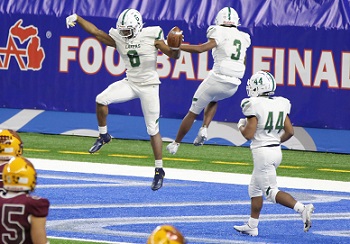 The Division 6 Clinton/Montague matchup also finished as one of the least-penalized in MHSAA 11-Player Finals history. The two teams combined for just 10 penalty yards, coming on one Clinton penalty. Montague was not penalized in the game.
Stories Behind the Scores
The Longest Season: Due to COVID-19, this season started on time, stopped, restarted, stopped again in mid-November, and restarted one more time with rapid testing the final week of December with playoffs ending over two weekends in mid-January. There are many reasons to want to forget the last year, and many much sadder circumstances. But the perseverance of all Fall athletes and families, coaches, administrators and support staff; along with the testing program provided by the Michigan Department of Health and Human Services, made for a memorable story that surely will be recalled for years to come.
First finishing 1st: West Bloomfield in 11-Player Division 1, DeWitt in Division 3 and Centreville in Division 8, and Adrian Lenawee Christian in 8-Player Division 1 all won their first MHSAA Finals in this sport. Cadillac in Division 4 and Frankenmuth in Division 5 made their first championship game appearances.
Edwards’ excellent ending: Edwards was slated to join University of Michigan’s football program as an early enrollee in January. But first, he wanted to finish his high school season, and career, with the Lakers. He led them to their first championship, with one of the top rushing performances in Finals history, and as arguably the biggest headliner from the weekend at Ford Field – likely gaining a few more fans along the way as well.
Many ways to win: As noted above, defense still works – four of 10 Finals were shutouts, and Centreville’s season-long performance was incredible. Also noted above, champions won both running and passing. But a final fun note on offense – seven of 10 champions this season scored 40 or more points in their championship games. That’s compared to two in 2019, five in 2018 and five in 2017.
(Click for more photos from Hockey Weekly Action Photos.)