


#TBT: Searching for The Hinker Bell
September 28, 2017
By Geoff Kimmerly
Second Half editor
Menominee will host Escanaba on Friday in the 121st meeting between two of the Upper Peninsula’s largest high schools and proudest football programs – but with the trophy celebrating the game still missing after it first disappeared more than half a century ago.
The two teams from 1948-1962 played for the The Hinker Bell, a locomotive bell that hasn’t been seen since 1963.
A decade ago, Escanaba Daily Press sports editor (and now Second Half correspondent) Denny Grall wrote about a newfound search for The Hinker Bell. But the mystery continues, and Grall’s story below tells of many of the twists and turns that to that point that had come in trying to locate it.
ESCANABA — Another search is underway to find the Hinker Bell.
The former locomotive bell went to the winner of the Escanaba-Menominee football game for about 15 years but has been missing for more than 40 years. It came from a locomotive owned by the Bay de Noquet Company and used on the LS&I Railroad that operated in Delta and Menominee counties.
The locomotive was built in 1906 by Baldwin Locomotive Works in Philadelphia and the bell was believed to have been cast in the railroad foundry, according to a 1953 newspaper clipping.
In 1948, one of the locomotive owners presented the bell to his friend, John Hinker of Menominee, an ardent sports fan who donated materials for the press box at Menominee’s Walton Blesch Field.
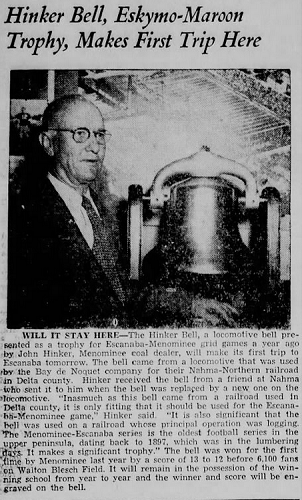 Hinker gave the bell to then Menominee coach Mickey McCormick and indicated proper use for the bell would be as an award for the gridiron rivalry.
Now Hinker’s great great nephew is trying to find the bell, which has not been seen since Escanaba’s current high school opened in 1963.
Tim Waters of Land O’ Lakes, Wis., who has launched the search, became interested by researching his family tree. “It is a big trophy (between 80 and 150 pounds by various estimates) and it is odd that it is missing,” Waters said in a recent telephone chat.
“One theory is that it is in somebody’s hunting camp or a home and they are using it as their own trophy,” said Waters.
“We have a pretty good investigation going on and all help is appreciated. If somebody does have it, we’re not looking to prosecute them. We’re just looking to get the darn thing back. Nobody will be in trouble.”
Waters refuted the old idea the bell was melted down. He has contacted numerous bell collectors, and they said a junk yard would have known it was worth a lot more than melted metal.
“The bell was not destroyed. We’ve come to that conclusion,” he said. “It was not put in a scrap yard.”
Waters contacted Coplan Iron and Metal of Escanaba and learned that bells were not melted or crushed and said the firm never accepted a bell with engravings matching the Hinker Bell.
Waters learned those businesses would sell them for the weight value to people who wanted them for yard ornaments/dinner bells, or to collectors.
“It is a treasure and it needs to be found,” said Waters.
Waters said the last known photo of the bell was with then EHS football coach Al Sigman and Esky players John Fisher and Phil Davidson in 1960. Escanaba beat Menominee from 1959-63 but could not find the bell in 1964 when the Maroons won. No one he has talked to remembers seeing the bell present at the first three games during the tenure of coach Jerry Cvengros.
The current Escanaba High School opened in 1963 and Bay de Noc Community College then occupied the old facility, which has since been demolished.
“Records indicate there was no report (of a missing bell) filed by Escanaba school district to the police department,” Waters said.
“The Hinker Bell is part of U.P. Michigan’s history, as is football and the railroads,” Waters said. “The people of Escanaba and Menominee deserve to have this trophy returned to their high schools.”
Waters, who has never seen an Escanaba or Menominee football game but is planning to rectify that omission this season, is hoping students at the two schools will join in the treasure hunt and talk about it with their parents and grandparents.
He has already contacted EHS athletic director Rob Ryan, who plans to thoroughly search the school basement.
He would like to find a photo of the bell to help collectors in their search. “Each bell was for a special locomotive,” said Waters.
“If they have a good picture we can pass it around and say we are looking for this bell. If they can pinpoint what this bell was on, they can help get the word out.”
He has also extended the search to the website at upfootball.com, which has generated interest but no bell. “If the bell is in the area still today, I don’t think it will take long to surface,” he said.
“If we don’t find this bell, we are going to try to make up a replacement as close as possible if the two schools are interested in that,” he said.
Waters is hoping that real estate agents, postal workers, delivery personnel, construction workers, etc., may have seen the bell during their travels and can help retrieve it.
1st & Goal: Playoff Week 4 Preview
January 8, 2021
By Geoff Kimmerly
Second Half editor
There are a lot of ways to describe what Michigan’s football contenders will restart Saturday, and how it will be talked about for years and perhaps generations to come.
But at the end of it all, it’s pretty simple: It’s great to be talking about the football playoffs again.
Consider this as much a catching-up as a preview of the 8-Player Semifinals and glances at many of the most intriguing 11-Player Regional Finals, all to be played Saturday. Be sure to also take advantage of the opportunity to quickly find your stride this weekend by tuning in, with every game to be streamed live thanks to a variety of sources – Click for the list of broadcasts.
Visit the MHSAA Football Playoff Home for the entire schedule for this weekend, scores as they come in and what’s next as we follow these long-awaited final few weeks of the season.
8-Player
Division 1
Martin (8-1) vs. Adrian Lenawee Christian (9-0) at Adrian College
Two seasons ago the Clippers stormed through a perfect regular season in their first of 8-player, and this season Lenawee Christian followed the same plan. The Cougars are averaging 200 yards rushing per game on more than nine yards per carry, with Jameson Chesser averaging better than 10 yards per carry on the way to 1,055 total. Martin’s only loss was a forfeit, and also led by a 1,000 rusher in Gabe Meyers, who is averaging 11.7 per carry for a team rolling up 300 yards per game on the ground.
NOTE: Suttons Bay will advance with Indian River Inland Lakes forfeit.
Division 2
Marion (8-1) vs. Powers North Central (9-0) at Northern Michigan University’s Superior Dome
North Central is playing to reach the championship game for the first time since claiming back-to-back titles in 2015 and 2016, and the Jets are paced by an excellent defense and multi-threat quarterback Luke Gorzinski – he leads the team in rushing (791 yards, 16 touchdowns) and has thrown for 1,105 yards and 17 scores. Marion’s only loss came in its season opener to Mesick on the way to the program’s first Semifinal since 1992. The Eagles also mix tough defense with dynamic quarterback play, with Mason Salisbury piling up 1,260 yards and 19 TDs rushing and 614 and 10 scores passing.
Kinde North Huron (8-1) vs. Portland St. Patrick (9-0) at Portland High School
Portland St. Patrick has been as close as anyone to winning a championship lately, with this its fourth-straight Semifinal and fifth of the last nine seasons. The Shamrocks defeated reigning Division 1 champion Colon 44-34 to advance to this round this time. This is North Huron’s second Semifinal appearance in four seasons after the Warriors fell to St. Patrick in a 2017 meeting to reach the championship game. North Huron’s only loss this fall was to a Mayville team that fell to Lenawee Christian in the Division 1 Regional Finals.
11-Player
Division 1
Detroit Cass Tech (9-0) at Belleville (9-0)
Five of eight teams remaining in Division 1 are undefeated, and this is one of two matchups of unbeaten teams. The Tigers have won two straight Regional titles, while the Technicians are seeking their first since 2017 but have won eight over the last decade. Yet despite their shared elite success over the last five seasons especially, this will be their first matchup at least in modern history. Belleville will see how its offense, averaging 51 points per game, stacks up against a Cass Tech defense giving up slightly more than seven.
Other Regional Finals: Saline (8-1) at Rockford (7-0), Detroit Catholic Central (9-0) vs. Davison (9-0) at Lapeer, Romeo (5-4) at West Bloomfield (8-1).
Division 2
Muskegon Mona Shores (9-0) at East Lansing (8-0)
The reigning Division 2 champion Sailors must hit the road as they seek their third consecutive Regional championship. They went into the pause with two straight one-score wins and take on a Trojans team that has given up more than one score in a game only once. East Lansing’s wins all have come by double digits, but its offense must play a big role again as Shores will present the impressive defense its toughest challenge this season.
Other Regional Finals: North Farmington (7-2) vs. Traverse City Central (8-1) at Thirlby Field, Oak Park (4-5) at Livonia Churchill (6-2), Warren De La Salle Collegiate (5-4) at Warren Mott (7-1).
Division 3
River Rouge (7-1) at Detroit Martin Luther King (6-3)
These two matched up for one of the most memorable playoff games of 2018, as King won 7-6 in a Division 3 opener on the way to claiming the championship in that division a month later. King moved to Division 2 last season and fell to Mona Shores in the Final, while Rouge claimed the Division 3 title. As they meet again, the Panthers are hoping to find their November momentum; after losing the East Lansing in Week 5 they ran off four straight shutouts at the front end of a dominating run. King may be their toughest challenge again, having lost only to Shores and twice to Cass Tech.
Other Regional Finals: East Grand Rapids (6-3) at Muskegon (8-1), Flint Kearsley (6-3) at Chelsea (9-0). DeWitt will advance with Stevensville Lakeshore forfeit.
Division 4
Grand Rapids South Christian (8-1) at Edwardsburg (8-0)
The only loss between these two this season was South Christian’s one-point defeat versus Division 5 contender Grand Rapids Catholic Central. Otherwise, neither has faced a single-score game – the Eddies are giving up just a single score per game, on average. Before playing in Division 3 last season, Edwardsburg won Division 4 in 2018 and was runner-up in 2017. But the Sailors may be the team remaining in Division 4 best equipped to match the Eddies’ high-powered attack; the last time South Christian was this potent on offense, it won the 2014 Division 4 title.
Other Regional Finals: Ada Forest Hills Eastern (6-3) vs. Cadillac (6-2) at Traverse City's Thirlby Field, Milan (8-1) vs. Williamston (8-1) at Lansing Catholic, Detroit Country Day (6-2) vs. North Branch (9-0) at Lapeer High School.
Division 5
Marine City (8-1) at Frankenmuth (9-0)
The Eagles have been looking to break through with three Regional titles over the last four seasons, and the they outscored their first three playoffs opponents by a combined 139-26. That included a 28-0 District Final win over Almont, last season’s Division 5 runner-up. Marine City opened the postseason similarly, outscoring its first three opponents by a combined 121-28 – and that only loss was a forfeit taken Week 9.
Other Regional Finals: Muskegon Oakridge (7-2) at Grand Rapids Catholic Central (8-0), Grosse Ile (6-3) at Lansing Catholic (7-2). Freeland will advance with Reed City forfeit.
Division 6
Montrose (8-1) at Montague (9-0)
After missing a trip to Ford Field by a one-point loss in last year’s Semifinal, Montague has steamrolled through the majority of this season – only Whitehall in Week 8 (34-31) has given the Wildcats a close game. Montrose’s consistency, meanwhile, deserves more attention – the Rams are picking back up their 11th-straight winning season and hoping for a second Regional title in three seasons. The lone loss this fall was to rival New Lothrop, still rolling in Division 7.
Other Regional Finals: Negaunee (6-3) at Grayling (6-3), Michigan Center (6-1) at Constantine (8-1), Clinton (8-1) vs. Warren Michigan Collegiate (9-0) at Madison Heights Bishop Foley.
Division 7
Cass City (9-0) vs. Ithaca (9-0) at Brighton’s Legacy Center
Ithaca has had to navigate one of the most uneven playoff runs of an uneven season all around, with two of its three wins so far coming by forfeit. But the other was a 41-0 victory over Ravenna, and the Yellowjackets have put up an average of 49 points per game, an improvement of 17 ppg from a year ago. Cass City’s run-up to this game was more eventful, as it eliminated previously-undefeated Sandusky and then Hemlock in successive District games. Doing the same this week to Ithaca would put the Red Hawks in the Semifinals for the second-straight season.
Other Regional Finals: New Lothrop (8-0) vs. Detroit Loyola (8-1) at Madison Heights Bishop Foley, Jackson Lumen Christi (5-4) vs. Schoolcraft (8-1) at Portage Central. Traverse City St. Francis will advance with Oscoda forfeit.
Division 8
Johannesburg-Lewiston (9-0) vs. Iron Mountain (8-1) at Northern Michigan University’s Superior Dome
Viewing from the statewide lens, this might be one of the most intriguing matchups of the weekend. The Cardinals went into the pause with a 28-21 win over 2019 Division 8 runner-up Beal City, their only game closer than 30 points. Because of forfeits, Iron Mountain has played only three games on the field – but two of those three were double-digit District Semifinal and Final wins. The Mountaineers are playing to make the Semifinals for the second-straight season as well.
Other Regional Finals: Carson City-Crystal (6-1) at Ubly (7-2), Sand Creek (8-1) vs. Centreville (8-0) at Portage Central, Petersburg Summerfield (4-5) vs. Clarkston Everest Collegiate (9-0) at Legacy Center.
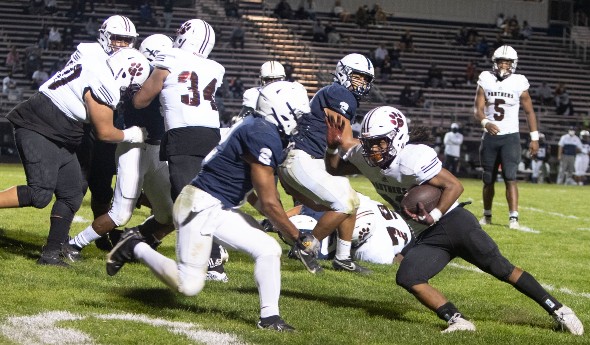
PHOTOS: Championship contenders East Lansing, on defense, and River Rouge met Sept. 25, with the Trojans winning 21-6. (Click to see more from HighSchoolSportsScene.com.)