


#TBT: Searching for The Hinker Bell
September 28, 2017
By Geoff Kimmerly
Second Half editor
Menominee will host Escanaba on Friday in the 121st meeting between two of the Upper Peninsula’s largest high schools and proudest football programs – but with the trophy celebrating the game still missing after it first disappeared more than half a century ago.
The two teams from 1948-1962 played for the The Hinker Bell, a locomotive bell that hasn’t been seen since 1963.
A decade ago, Escanaba Daily Press sports editor (and now Second Half correspondent) Denny Grall wrote about a newfound search for The Hinker Bell. But the mystery continues, and Grall’s story below tells of many of the twists and turns that to that point that had come in trying to locate it.
ESCANABA — Another search is underway to find the Hinker Bell.
The former locomotive bell went to the winner of the Escanaba-Menominee football game for about 15 years but has been missing for more than 40 years. It came from a locomotive owned by the Bay de Noquet Company and used on the LS&I Railroad that operated in Delta and Menominee counties.
The locomotive was built in 1906 by Baldwin Locomotive Works in Philadelphia and the bell was believed to have been cast in the railroad foundry, according to a 1953 newspaper clipping.
In 1948, one of the locomotive owners presented the bell to his friend, John Hinker of Menominee, an ardent sports fan who donated materials for the press box at Menominee’s Walton Blesch Field.
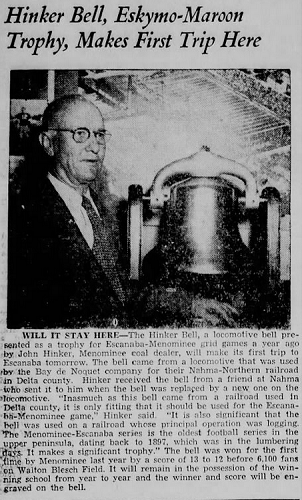 Hinker gave the bell to then Menominee coach Mickey McCormick and indicated proper use for the bell would be as an award for the gridiron rivalry.
Now Hinker’s great great nephew is trying to find the bell, which has not been seen since Escanaba’s current high school opened in 1963.
Tim Waters of Land O’ Lakes, Wis., who has launched the search, became interested by researching his family tree. “It is a big trophy (between 80 and 150 pounds by various estimates) and it is odd that it is missing,” Waters said in a recent telephone chat.
“One theory is that it is in somebody’s hunting camp or a home and they are using it as their own trophy,” said Waters.
“We have a pretty good investigation going on and all help is appreciated. If somebody does have it, we’re not looking to prosecute them. We’re just looking to get the darn thing back. Nobody will be in trouble.”
Waters refuted the old idea the bell was melted down. He has contacted numerous bell collectors, and they said a junk yard would have known it was worth a lot more than melted metal.
“The bell was not destroyed. We’ve come to that conclusion,” he said. “It was not put in a scrap yard.”
Waters contacted Coplan Iron and Metal of Escanaba and learned that bells were not melted or crushed and said the firm never accepted a bell with engravings matching the Hinker Bell.
Waters learned those businesses would sell them for the weight value to people who wanted them for yard ornaments/dinner bells, or to collectors.
“It is a treasure and it needs to be found,” said Waters.
Waters said the last known photo of the bell was with then EHS football coach Al Sigman and Esky players John Fisher and Phil Davidson in 1960. Escanaba beat Menominee from 1959-63 but could not find the bell in 1964 when the Maroons won. No one he has talked to remembers seeing the bell present at the first three games during the tenure of coach Jerry Cvengros.
The current Escanaba High School opened in 1963 and Bay de Noc Community College then occupied the old facility, which has since been demolished.
“Records indicate there was no report (of a missing bell) filed by Escanaba school district to the police department,” Waters said.
“The Hinker Bell is part of U.P. Michigan’s history, as is football and the railroads,” Waters said. “The people of Escanaba and Menominee deserve to have this trophy returned to their high schools.”
Waters, who has never seen an Escanaba or Menominee football game but is planning to rectify that omission this season, is hoping students at the two schools will join in the treasure hunt and talk about it with their parents and grandparents.
He has already contacted EHS athletic director Rob Ryan, who plans to thoroughly search the school basement.
He would like to find a photo of the bell to help collectors in their search. “Each bell was for a special locomotive,” said Waters.
“If they have a good picture we can pass it around and say we are looking for this bell. If they can pinpoint what this bell was on, they can help get the word out.”
He has also extended the search to the website at upfootball.com, which has generated interest but no bell. “If the bell is in the area still today, I don’t think it will take long to surface,” he said.
“If we don’t find this bell, we are going to try to make up a replacement as close as possible if the two schools are interested in that,” he said.
Waters is hoping that real estate agents, postal workers, delivery personnel, construction workers, etc., may have seen the bell during their travels and can help retrieve it.
1st & Goal: 2025 Week 1 Preview
By
Geoff Kimmerly
MHSAA.com senior editor
August 27, 2025
If you’re looking for storylines for this weekend’s Michigan high school football openers, you’ve landed just in time for launch of the 2025 season.
 There will be 305 games played this weekend with at least one Michigan team – 258 tonight, 46 Friday and one Saturday. Several of the most intriguing will play out at traditional Week 1 showcase events – the Amazon Prep Kickoff Classic at Wayne State and Vehicle City Gridiron Classic at Flint’s Atwood Stadium – but those are just the start of the newsy and noteworthy.
This weekend’s slate also includes two matchups of teams that ended last season playing for MHSAA 11-player championships in Detroit, and a third between a reigning Michigan champion (Detroit Cass Tech in Division 1) and an Ohio state runner-up (Toledo Central Catholic). One of the state's longest running rivalries also gets a reboot.
The great majority of varsity games are scheduled to be broadcast this weekend on the NFHS Network. Click the names of the events bolded above for specific broadcast landing pages for those showcases.
Like most, we’re still at the start of learning about this season’s contenders. But every game has a story, and tune in each week for details building up the biggest matchups all over Michigan. All games are tonight unless noted, and follow the MHSAA Scores page all weekend for scores as they’re submitted.
Bay & Thumb
Frankenmuth (13-1) at Goodrich (13-1)
This is one of those matchups of teams that ended last season at Ford Field, as Goodrich is the reigning Division 4 champion and Frankenmuth finished Division 5 runner-up. This will actually be the fifth-straight season they’ll meet in an opener; Frankenmuth has a 3-1 advantage in the recent series coming off a 22-0 win a year ago. Both teams graduated substantial star power from their backfields and lines, likely making this a high-profile debut for several players expected to fill more significant roles at the varsity level this fall.
Keep an eye on these THURSDAY Marysville (8-2) at Almont (9-1), Mount Pleasant (6-5) at Saginaw Heritage (8-4). FRIDAY Marine City (10-3) at Armada (10-2), Cass City (7-4) at Harbor Beach (11-1).
Greater Detroit
Clarkston (7-4) vs. Belleville (10-2) at Wayne State
The post-Bryce Underwood era will begin at Belleville after he quarterbacked the team to Ford Field three of the last four seasons. He and the Tigers defeated Clarkston 35-28 in their opener a year ago at Wayne State, and Belleville’s only other loss of the season came in a Regional Final. Clarkston will attempt to avenge that 2024 defeat keyed in part by an offense that features power up front and a notable passing attack as well.
Keep an eye on these THURSDAY Walled Lake Western (11-1) at Milford (7-3), Davison (7-3) at Roseville (7-3). FRIDAY Warren Michigan Collegiate (9-2) at Clarkston Everest Collegiate (9-2), Detroit Cass Tech (12-2) vs. Toledo Central Catholic (14-2) at Wayne State.
Mid-Michigan
Haslett (8-4) at DeWitt (12-1)
These two combined for 111 points in their opener last season, a 69-42 DeWitt win, and the scoreboard should be ready again as both return playmakers considered among the best in the state – Haslett’s Kory Amachree and DeWitt’s Trav Moore. Both also are coming off nice playoff runs last fall – DeWitt reaching the Division 3 Semifinals and Haslett winning a Division 4 District championship – adding further anticipation to a rivalry renewed despite the Panthers’ dominance in the matchup over the last two decades.
Keep and eye on these THURSDAY Dexter (10-1) at Brighton (8-3), Lansing Catholic (10-4) at Williamston (3-7), Lansing Everett (6-4) at Lansing Sexton (5-5), Detroit Country Day (3-6) at Portland (11-1).
Northern Lower Peninsula
Maple City Glen Lake (9-2) at Traverse City St. Francis (7-4), Friday
These two are facing off for the first time since 2021, with the Lakers coming off their best season since a 2019 run to Ford Field and the Gladiators also looking to build on a District championship game appearance after most recently reaching the MHSAA Finals in 2022. They were both champions in the Northern Michigan Football League last fall – Glen Lake outright in the Legacy and St. Francis sharing the title in the Legends.
Keep an eye on these THURSDAY Howell (11-1) at Traverse City West (6-4), Midland (9-2) at Cadillac (4-6). FRIDAY Sault Ste. Marie (1-8) at Cheboygan (4-5), Edwardsburg (7-4) at McBain (9-2).
Southeast & Border
Fowler (12-1) at Hudson (10-2)
The Eagles won this season-opening matchup 20-6 a year ago and this time head to Hudson after ending last fall with a one-point Division 8 Semifinal loss to eventual champion Beal City. After losing to Fowler in Week 1 last season, Hudson didn’t fall again until its Division 7 Regional Final against Schoolcraft – which capped its longest playoff run since winning the Division 8 title in 2021.
Keep an eye on these THURSDAY Monroe St. Mary Catholic Central (13-1) vs. Clinton (7-4) at Adrian College, Ottawa Lake Whiteford (5-5) at Blissfield (4-6), Flushing (7-3) at Ann Arbor Pioneer (5-5), Jackson (4-6) at Parma Western (6-4).
Southwest Corridor
St. Joseph (9-2) at Niles (12-2), Friday
This is another season-opening rematch, and last year's game was referred to frequently – after St. Joseph's 30-7 win, Niles didn't lose again until falling to Goodrich in the Division 4 championship game. In fact, the Vikings gave up only 27 more points during the regular season. The Bears went on to enjoy a successful fall as well, sharing their league's championship before falling to eventual Division 3 champion Zeeland West in a District Final.
Keep an eye on these THURSDAY Kalamazoo Hackett Catholic Prep (9-3) at Berrien Springs (7-4), East Lansing (9-4) at Portage Central (8-4), Lawton (8-3) at Decatur (11-2), Union City (9-2) at Parchment (7-3).
Upper Peninsula
Marquette (6-3) at Negaunee (6-4)
This matchup of Upper Peninsula neighbors is a rivalry restored, resparking a series that goes back to 1894. These two faced off 141 times – still ranking third-highest for total games played between two Michigan teams – before taking a break after the 2017 meeting with Negaunee leading the series 70-60-11. The Miners have strung together six straight playoff seasons, while the Sentinels just missed the playoffs last year but finished second in the Big North Conference for the second season in a row.
Keep and eye on these THURSDAY Kingsford (9-1) at Escanaba (5-4), East Jordan (8-3) at Manistique (4-6), Houghton (4-5) at Iron Mountain (11-1). FRIDAY Menominee (10-2) at Marinette, Wis. (2-7).
West Michigan
Byron Center (12-2) at Hudsonville (12-2)
This is another matchup of teams that finished their 2024 playoff runs at Ford Field, Hudsonville runner-up in Division 1 and Byron Center in Division 2. Even with both graduating significant star power after last spring and turning to new quarterbacks this fall, this seems the perfect time for this matchup. Hudsonville's double-digit win total last year was its first since 2007, and Byron Center is a combined 22-4 over the last two seasons.
Keep an eye on these THURSDAY Grand Blanc (9-3) at Muskegon Mona Shores (9-2), Pewamo-Westphalia (9-3) at North Muskegon (11-2), Saline (7-4) at Rockford (7-3), Hudsonville Unity Christian (10-1) at Whitehall (8-4).
8-Player
Britton Deerfield (10-2) at Pittsford (8-3)
This was another of the most high-powered openers a year ago, as Britton Deerfield won 68-58 to kick off the program’s best season. The Patriots later advanced to the Semifinals for the first time with a 60-26 rematch win over the Wildcats, who otherwise claimed a league championship and lost just once more over the remainder of their season.
Keep an eye on these THURSDAY Climax-Scotts (8-2) at Gobles (9-1), Bridgman (5-4) at Martin (8-2), Powers North Central (9-2) at Munising (6-4), Mendon (10-2) at Suttons Bay (6-3).
MHSAA.com's weekly “1st & Goal” previews and reviews are powered by MI Student Aid, a division within the Department of Lifelong Education, Advancement, and Potential (MiLEAP). MI Student Aid encourages students to pursue postsecondary education by providing access to student financial resources and information. MI Student Aid administers the state’s scholarship and grant programs that help make college Accessible, Affordable and Attainable for you. Click to connect with MI Student Aid and find more information on Facebook and Twitter @mistudentaid.
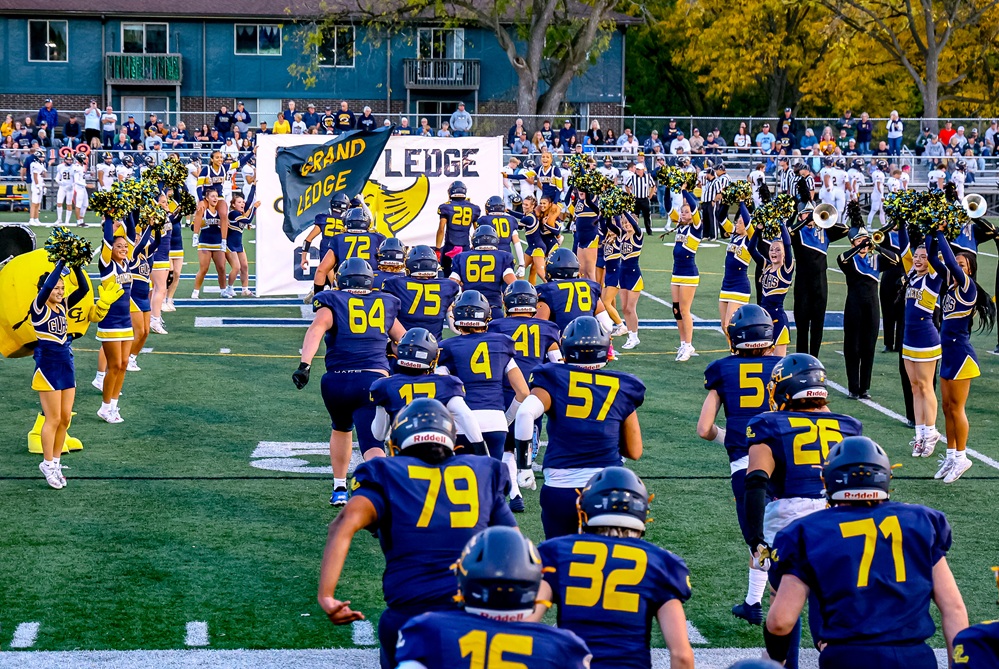
PHOTO Grand Ledge takes the field during a home game last season. (Click for more from High School Sports Scene.)