


#TBT: Searching for The Hinker Bell
September 28, 2017
By Geoff Kimmerly
Second Half editor
Menominee will host Escanaba on Friday in the 121st meeting between two of the Upper Peninsula’s largest high schools and proudest football programs – but with the trophy celebrating the game still missing after it first disappeared more than half a century ago.
The two teams from 1948-1962 played for the The Hinker Bell, a locomotive bell that hasn’t been seen since 1963.
A decade ago, Escanaba Daily Press sports editor (and now Second Half correspondent) Denny Grall wrote about a newfound search for The Hinker Bell. But the mystery continues, and Grall’s story below tells of many of the twists and turns that to that point that had come in trying to locate it.
ESCANABA — Another search is underway to find the Hinker Bell.
The former locomotive bell went to the winner of the Escanaba-Menominee football game for about 15 years but has been missing for more than 40 years. It came from a locomotive owned by the Bay de Noquet Company and used on the LS&I Railroad that operated in Delta and Menominee counties.
The locomotive was built in 1906 by Baldwin Locomotive Works in Philadelphia and the bell was believed to have been cast in the railroad foundry, according to a 1953 newspaper clipping.
In 1948, one of the locomotive owners presented the bell to his friend, John Hinker of Menominee, an ardent sports fan who donated materials for the press box at Menominee’s Walton Blesch Field.
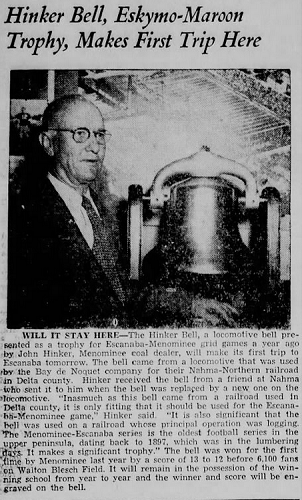 Hinker gave the bell to then Menominee coach Mickey McCormick and indicated proper use for the bell would be as an award for the gridiron rivalry.
Now Hinker’s great great nephew is trying to find the bell, which has not been seen since Escanaba’s current high school opened in 1963.
Tim Waters of Land O’ Lakes, Wis., who has launched the search, became interested by researching his family tree. “It is a big trophy (between 80 and 150 pounds by various estimates) and it is odd that it is missing,” Waters said in a recent telephone chat.
“One theory is that it is in somebody’s hunting camp or a home and they are using it as their own trophy,” said Waters.
“We have a pretty good investigation going on and all help is appreciated. If somebody does have it, we’re not looking to prosecute them. We’re just looking to get the darn thing back. Nobody will be in trouble.”
Waters refuted the old idea the bell was melted down. He has contacted numerous bell collectors, and they said a junk yard would have known it was worth a lot more than melted metal.
“The bell was not destroyed. We’ve come to that conclusion,” he said. “It was not put in a scrap yard.”
Waters contacted Coplan Iron and Metal of Escanaba and learned that bells were not melted or crushed and said the firm never accepted a bell with engravings matching the Hinker Bell.
Waters learned those businesses would sell them for the weight value to people who wanted them for yard ornaments/dinner bells, or to collectors.
“It is a treasure and it needs to be found,” said Waters.
Waters said the last known photo of the bell was with then EHS football coach Al Sigman and Esky players John Fisher and Phil Davidson in 1960. Escanaba beat Menominee from 1959-63 but could not find the bell in 1964 when the Maroons won. No one he has talked to remembers seeing the bell present at the first three games during the tenure of coach Jerry Cvengros.
The current Escanaba High School opened in 1963 and Bay de Noc Community College then occupied the old facility, which has since been demolished.
“Records indicate there was no report (of a missing bell) filed by Escanaba school district to the police department,” Waters said.
“The Hinker Bell is part of U.P. Michigan’s history, as is football and the railroads,” Waters said. “The people of Escanaba and Menominee deserve to have this trophy returned to their high schools.”
Waters, who has never seen an Escanaba or Menominee football game but is planning to rectify that omission this season, is hoping students at the two schools will join in the treasure hunt and talk about it with their parents and grandparents.
He has already contacted EHS athletic director Rob Ryan, who plans to thoroughly search the school basement.
He would like to find a photo of the bell to help collectors in their search. “Each bell was for a special locomotive,” said Waters.
“If they have a good picture we can pass it around and say we are looking for this bell. If they can pinpoint what this bell was on, they can help get the word out.”
He has also extended the search to the website at upfootball.com, which has generated interest but no bell. “If the bell is in the area still today, I don’t think it will take long to surface,” he said.
“If we don’t find this bell, we are going to try to make up a replacement as close as possible if the two schools are interested in that,” he said.
Waters is hoping that real estate agents, postal workers, delivery personnel, construction workers, etc., may have seen the bell during their travels and can help retrieve it.
Marckel Supplies Marketing Magic to Hunter's Heisman-Winning Campaign
By
Doug Donnelly
Special for MHSAA.com
July 29, 2025
When he was hired at the University of Toledo in 2016 as assistant director of creative services, Derek Marckel thought he had found his dream job only a few months after graduating from college.
 Then he became Colorado University’s graphic designer for football in 2019 and thought he had finally landed the job he’s always wanted.
After stops at the Michigan State University to work with former football coach Mel Tucker, and University of Southern California to work with Lincoln Riley, Marckel, 32, is back in Colorado and certain he’s living the dream.
“This was the stuff I thought about doing when I was a kid,” said Marckel, who graduated from Ottawa Lake Whiteford High School in 2011. “I used to sit and draw pictures of all of my favorite University of Toledo football players, and then I’d take them and give them to the players or have them sign them. This is definitely what I’ve dreamed of doing someday.”
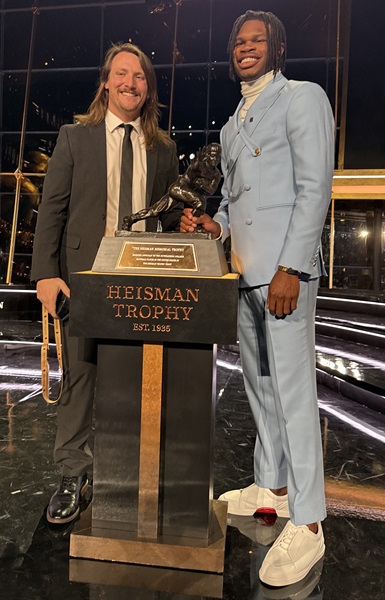
Last winter, Marckel was in New York City when his favorite subject – Colorado football player Travis Hunter – won the Heisman Trophy. It was a surreal moment for Marckel, who led a team of creative content makers who spent months last fall promoting Hunter for the biggest prize in all of college football.
“Going into the season, we knew he was going to have a pretty good chance,” Marckel said. “Once the games started playing out, we knew he had a legitimate shot.”
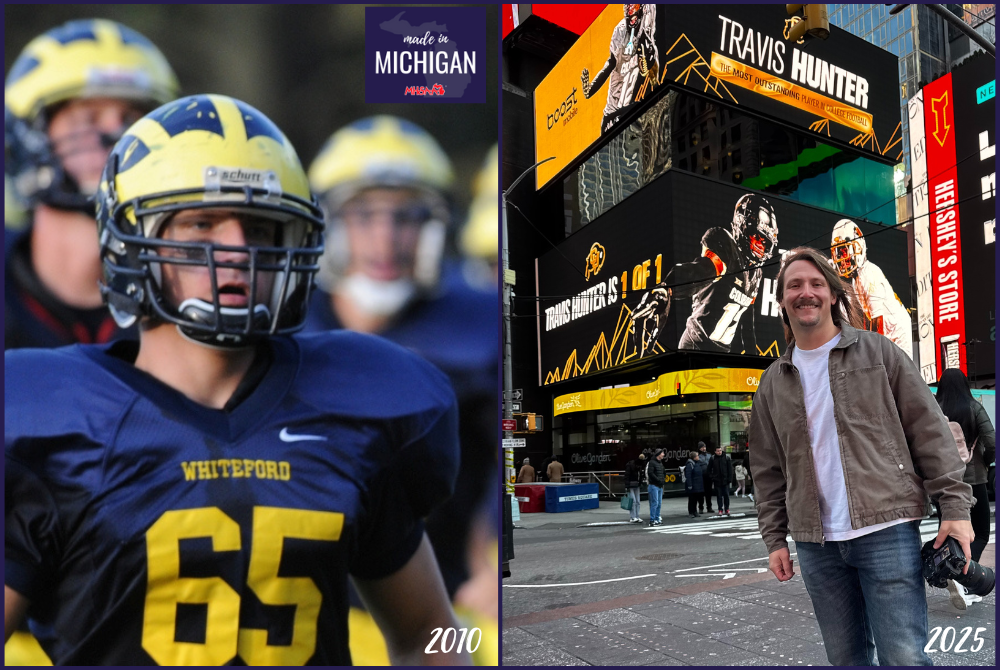
As senior art director at Colorado, Marckel led the Hunter-for-Heisman campaign. He was on the sidelines of every game, home and away, documenting Hunter and the rest of the Buffaloes. He designed billboards that were strategically placed around Denver and one in Times Square in New York City. Marckel’s team met weekly to plan a regular dose of social media posts and content promoting Hunter’s candidacy.
Heisman Trophy candidates emerge based on their on-field performances. But, behind the scenes, winning the trophy has long taken some pushing by colleges and universities.
“There’s a lot that goes into a campaign,” Marckel said. “You have to work with sponsors and donors who helped fund all of that. It’s a lengthy operation.”
As the season drew to a close, Colorado published a packet of information that Marckel designed and sent it to Heisman Trophy voters and the media. ESPN showcased his work.
“Almost everything we were doing was going viral,” Marckel said.
When it became clear Hunter was going to be a finalist for the award, Marckel was called upon to document the entire process. He and a member of his team went to New York City two days ahead of Hunter to be prepared when he landed in the city. Next were Heisman Trophy promotional appearances, photoshoots and the Heisman ceremony itself, and Marckel was there for all of it.
“It was Travis from sun-up to sun-down,” Marckel said. “We’d have little breaks during the day. I designed the billboard for him in Times Square. We had a photo shoot there.”
Helpfully, Hunter was a wonderful participant.
“We put a lot of work into it,” Marckel said. “Obviously it was his award, and he earned it, but it was very rewarding to us, too, to see our hard work pay off. I’ve been around thousands of athletes, and he’s probably my favorite one. He doesn’t necessarily love doing all of the media stuff, but he was comfortable around us.”
 Marckel was born in Toledo but grew up in southeast Michigan. He was football team captain for the Bobcats as a senior and began his interest in design, art and photography during his time at Whiteford.
“I knew from a young age that I wanted to work professionally in sports,” Marckel said. “During my time at Whiteford, I spent a lot of my high school career around the football program. I was lucky to have my first two years of varsity with Coach (Jack) Luettke and my senior year with Coach (Matt) Garno, who had a background in graphic design. This ended up being a great foundation for me to combine my passion for football and graphic design as I was heading into the real world.”
Marckel graduated from Bowling Green State University in 2016 with a bachelor's degree in technology & visual communication technology. He landed an internship with the University of Toledo where he started designing team schedule posters, pocket schedules and souvenir tickets. That’s when social media started revolutionizing the industry, especially college football.
“Social media was kind of secondary to everything else when I started there,” he said. “It started to shift. I got in at the perfect time. Things were really starting to pick up. That’s when I knew sports was going to be what I wanted to do.”
After getting a full-time job at Toledo, his work caught the eye of someone at Colorado, and Marckel went west to become a graphic designer with the Buffaloes. When Tucker left Colorado for Michigan State, Marckel followed him to East Lansing.
At first, he missed Colorado.
“Even on the drive to East Lansing, I was thinking, ‘Why am I leaving Colorado?’” Marckel said.
He stayed two years, then landed the role as director of creative media at USC, working sun-up to sun-down in Los Angeles. When the opportunity came to return to Boulder, he jumped at it, becoming senior art director.
The Buffaloes went 1-11 his first season back at Colorado. The entire football coaching staff was let go.
That’s when Marckel’s world took another big turn.
“The rumors started flying about Coach Prime,” Marckel said, referring to Deion Sanders. “There are always these theoretical situations about who the coach is going to be. We found out about 8 p.m. that it was Coach Prime. We had to be on the tarmac at 1:30 a.m. I don’t get starstruck anymore just because of what I’ve been able to do and who I’ve been able to be around, but as soon as he stepped off the plane, I realized I was getting myself into something huge.”
Pro football hall of famers regularly makes stops at Colorado practices. Warren Sapp joined the Colorado staff. Terrell Owens stops by regularly. A steady wave of Sanders’ former teammates from the Dallas Cowboys attended practices as well.
Marckel documents it all, through his camera – a skill he’s honed along the way.
“When I started at Toledo, I would shoot all of those games, but I wasn’t a great photographer,” he said. “As time has gone on, it’s become such an emphasis. I’ve really had to refine everything I do to become the best at it.”
Initially he had to win the trust of Sanders, who brought some of his own content creators with him to Colorado.
“It took a little while to get us into a groove,” Marckel said. “Now we work side by side every day. It’s a smooth operation now. We bounce ideas off of each other.”
Day to day, Marckel works on social media, marketing, photoshoots of recruits and documents workouts and practices for Colorado social media channels.
He works with the football team exclusively, sometimes long hours during the season.
“You get kind of get burned out by end-of-season, but it's worth it,” Marckel said. “You are on the field every day with Heisman Trophy winners, hall of famers and first-round picks. It’s a cool job when you step back and look at it. This is most fun I’ve had working in college football in 10 years.”
2025 Made In Michigan
July 28: Union City to Omaha: Skirka Takes Murray State Baseball to 1st College World Series - Report
July 22: TC West's Wheelock Still 'Living My Dreams' as CMU Assistant Soccer Coach - Report
July 17: Stevenson's Travels Following Lake Orion Success Include Space Force, Penn, NYC - Report
July 15: 'Who Will Cheer for the Nimrods?' Peterson IV, Watersmeet Found Fans Worldwide - Report
July 10: Feeding 'Drive to Win,' Loy Norrix Grad Morgan Impresses with Strong USBC Showing - Report
July 9: After Blazing Multiple Volleyball Trails, Bastianelli Charting Next Career Path - Report
PHOTOS (Top) At left, Whiteford's Derek Marckel takes the field as a senior in 2010. At right, Marckel poses for a photo this year in front of the Times Square display he designed to promote Colorado's Travis Hunter. (Middle) Marckel stands for a photo with Hunter during the Heisman Trophy ceremony. (Photos courtesy of Derek Marckel.)